
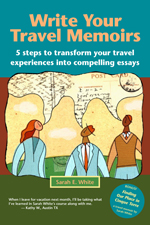
Over the next several months, I am serializing my six-chapter travel memoir about a trip to Italy’s Cinque Terre in 2008* here. In 2010, I self-published Write Your Travel Memoirs: 5 Steps to Transform Your Travel Experiences Into Compelling Essays. It included five how-to chapters and, to provide an example, this memoir. The book is available on Amazon.com.
Meanwhile, I welcome your submissions to True Stories Well Told during my “travel memoir takeover.” Let’s fill that queue for after the series ends. See submission guidelines here.
Chapter 2. Arrival in Cinque Terre: the Challenge of Inserimento

“Questo treno non firma a Vernazza,” the conductor is saying.
This train doesn’t stop at Vernazza? That’s silly! The tickets we bought say Vernazza, and we boarded from the track where we were told to wait. I even asked a young woman on the platform, carefully composing my Italian: “Is this the train for La Spezia?” I used the name of the next major station beyond the five little villages, assuming it was more likely to be recognized. “Si,” she had replied. But when the train stopped, none of the waiting passengers boarded it—only Jim and me.
I should be more careful how I phrase my questions when I’m far from home. Ask exactly what I want to know.
The conductor is urgently trying to get a point across. “Questo treno è espresso, riservo.” Now we know why the other passengers didn’t board; somehow they knew this train, with its reserved seats only, didn’t stop until past the Cinque Terre.
We paid for our mistake. The fine for boarding without reservations plus the additional fare for La Spezia doubled the cost of our tickets, which even so only came to the price of a modest lunch. Trains in Italy are a bargain, subsidized by the state.
The slight young woman in her conductor’s uniform was officious about correcting our mistake, but nothing short of arrest could have upset us. Fueled by cappuccinos and brioche, warmed by sun pouring through the windows of our empty cabin, we could withstand the disappointment of an hour spent waiting for trains to carry us to La Spezia and back.
Pouring rain had greeted us on our arrival in Genoa just thirty-six hours earlier. We’d spent a day sightseeing under gray skies, chill stalking us through the cramped corridors of Genoa’s medieval center. It’s the largest in Europe, according to the guidebooks, but as we explored on foot, the ancient streets kept giving way to dicey harbor alleys or ominous-looking housing blocks. Genoa is a little too real for tourism. We were ready to ditch the place.
I unfolded a newspaper—but scenes outside the train’s windows kept pulling my attention from its pages. The industrial sheds covered with graffiti soon gave way to suburban housing blocks, then glimpses of sea and villas surrounded by palm trees. The station signs flew past. Each sign announced a place name we’d fingered on our maps. Portofino, Santa Margherita—the fancy resorts of the Italian Riviera, too rich for our blood.
Then Sestri Levanti, and then the sign for the first of the Cinque Terre’s villages, Monterosso al Mare. It was gone in a blink. The train entered a tunnel and seconds later, blink—there went Vernazza. Blink—Corniglia. Blink—Manarola. Tunnels swallowed the train between the villages; each occupies a valley and the train is routed through the headlands that separate their narrow ravines. Blink-blink-blink: the light strobed in as the tunnel opened into long galleries, arched windows framing sea views. Blink—Riomaggiore, the last of the five villages. The map had told us the Cinque Terre region is not large; it had taken perhaps 15 minutes for the train to speed past all five towns.
We heard “La Spezia” over the loudspeakers. The train slowed to a stop. We entered the station, purchased new tickets for Vernazza, and resumed waiting. Jim saw a newsstand and disappeared. He reappeared moments later with the first new purchase of Dylan Dogs.
Dylan Dog comic books are our secret vice. These gothic horror/suspense tales feature a young British investigator, a dream detective. He works with Scotland Yard whenever a case involves paranormal phenomena. He is a sex addict and the cases tend to involve beautiful young women.

We first encountered Signore Dog on our first trip to Italy, just after we’d broken free of the Italian Rotary Club. We were sitting at an outdoor café in sunny Spoleto, a just-opened bottle of pino grigio in front of us, and Jim had purchased the comic at a nearby newsstand. We had so much fun then, heads bent together over the illustrated pages, taking turns manning the dictionary to decode the unfamiliar vocabulary. Words like hurlo—scream—incubo—nightmare—fantasme—ghost—you don’t learn those in Conversational Italian class.
We’ve amassed Dylan Dogs on every trip since, buying all we could find, stockpiling for study on the sofa after trip’s end. We were happy now about the unintended detour, fresh Dylan Dogs in hand, lunch in Vernazza dead ahead.
Optimism wrapped me like a sunny cloak, but dread pulled on its hem. Arrivals make me nervous. The problem, when I have planned a trip and finally arrive at the place I’ve been fantasizing about, is inserimento—insertion—making the transition from traveler to temporary resident.
How do you sync up with the place you’ve reached? What is its story, and what is your place in it? When expectations crash into reality, how do you handle the impact? If insertion goes badly, you soon feel like a walking wallet to be harvested of your cash, rewarded at worst with Chinese-made souvenirs or at best a few local products. If insertion goes well, you are living a new life you were always meant for. Either can influence your mood for days. On a short vacation there’s a lot riding on inserimento.
Many people deal with this by careful planning. Me, I prefer the potential in leaving a lot to chance. Jim has too often borne the brunt of my casual attitude, and I’ve learned to prepare for that, too. Reading guidebooks, I skip the sections about lodging and restaurants; I highlight the descriptions of natural wonders. Nerves frayed by disappointment can be re-knit under the influence of flora and fauna. I travel with a list of nature spots like someone else might carry Pepto Bismol.
For this trip I had made only one reservation, for the first night, an exception to my “travel without reservations” rule chosen in hopes of softening the landing after the international flight. I booked us into the Torre Cambiaso, a boutique hotel on Genoa’s outskirts, chosen for online descriptions like “…once the home of a noble family, set in its own private gardens, with a lake, several grottos and a secluded grove where peacocks roam.” If I had known just how far on the outskirts—or that the on-site restaurant would be closed the day we arrived—or that rain would preclude enjoyment of the grottos and groves—well, that’s why I mostly travel without fixed plans.

At midday the train releases us into the main street of Vernazza with four tour groups, mostly school children. We bob down the street, carried along by their tide. Jim and I are the only ones with suitcases—me with a small roller bag, Jim with a grip, our messenger bags and that’s it—we travel light. But even this load is heavy enough that our first thought is lodging. In these crowds, this might be a competition sport.
A small man materializes at Jim’s elbow asking if perhaps we are looking for a room. “What gave us away?” jokes Jim. There’s something instantly likeable about the little man’s smile. The rest of our deal-making is accomplished with relaxed humor, because we all know that we will take whatever he is offering. It turns out to be a little apartment just a few steps away, which he will give us at a good price because he has just repainted the kitchen; it can’t be used. “Good price, but one night only,” he says: day after tomorrow is the festival, and the room is already booked. He is referring to the Festival of Liberation, April 25, a holiday celebrating the end of World War II. (I realized this holiday fell during the dates I’d chosen for our trip, and had decided in advance to accept whatever complications that meant. You try finding out what day the dwarf irises plan to bloom. I went with the botanical guide’s estimated dates and ignored the travel guidebooks’ mentions of holiday crowds.)
The apartment is a stack of rooms one on top of the other, like children’s blocks. The street door opens onto a stairway up to the living room above a shop, with a tiny bedroom off to one side. Above that is the kitchen—this is a regional custom, the kitchen at the top of the house, designed to prevent fires from spreading. (This is why Genoa has the oldest surviving medieval center—it was never destroyed by fire, thanks to the kitchens on top.) One has to think about all the food, all the water, lugged up to those top-floor kitchens—women’s work, heavy labor.
Outside our wet-paint kitchen is a little terrace overlooking the main street. Our haggling with our host amounts only to assuring we may use the terrace, if we promise not to touch anything in the kitchen. “I’m Sergio Calla, if you have any needs, my house is just there, across the street? That little door just to the left of the store is mine.”
© 2024 Sarah White

*I self-published Write Your Travel Memoirs mainly as an experiment to test the print-on-demand workflow before offering it to my clients. I had the content, from workshops I had taught for Story Circle Network’s online classes, and enjoyed adapting it to book form.

 True Stories Well Told