
Over the next several months, I am serializing my six-chapter travel memoir about a trip to Italy’s Cinque Terre in 2008* here. In 2010, I self-published Write Your Travel Memoirs: 5 Steps to Transform Your Travel Experiences Into Compelling Essays. It included five how-to chapters and, to provide an example, this memoir. The book is available on Amazon.com.
Meanwhile, I welcome your submissions to True Stories Well Told during my “travel memoir takeover.” Let’s fill that queue for after the series ends. See submission guidelines here.
Chapter 3. Where Sneaker Meets Rock: The Vernazza-Corniglia Trail

“Today we hike,” I announce to Jim over cappuccinos and sfogliatelle at our new favorite restaurant, the Pirati di Cinque Terre. We discovered this place yesterday while exploring Vernazza. The million marzipan marvels in the Pirates’ pastry case drew us in that afternoon, but on advice of the Sicilian owner we put our euros down for an iced strawberry dessert instead. Velvety layers of cream schmoozed with crystallized berry-blood on my tongue. No wonder we came back for breakfast.
Walking back to our little apartment, I noticed on a wall the red and white slashes marking the CAI trail to Corniglia, four kilometers to the south. This trail is our prime objective today. We are finally where sneaker meets rock; where the entire premise for our Cinque Terre vacation meets reality.
The main attraction of this region is the hiking. People come from all over the world to test themselves against these trails. Are we, at 50-something and coming out of a Wisconsin winter, fit for the task? Rick Steves’ son trotted the full seven miles of trail from Riomaggiore to Montorosso al Mare in 1 hour 31 minutes, the proud father brags in his guide book. But Rick’s boy was one third our age and three times as athletic… at least.
Trepidation trickles through my coffee-and-carbs optimism. I hope we haven’t waited ten years too late to tackle Cinque Terre.
Back at the apartment we pack our bags, leave them at Sergio’s, and set out.
My watch registers 9 a.m. as we start the trail. It’s cool in the sun, but the trail begins with stairs cut into rock, and the exercise quickly warms me. In a few minutes we emerge from the passage between buildings and get our first glimpse back at Vernazza from above. We’ve already gained about 300 feet. I’m puffing but pleased; the view below is a fairytale come true, buildings a jumble of frosting colors, a church dome and a fortified turret jutting above the roofscape. Imposing rock headlands rise above the village in the valley. The lay of the land is finally evident, what could be guessed at but not seen down in Vernazza itself.
As we begin to climb again, a German boy blows past us, veering from our roughly sea-parallel trail onto a steeper path heading inland. He carries nothing; no water, no fuel. He is a goat; we are two plodding mules.
Next, we pass a little sentinel’s booth, but no ticket-taker waits. These trails are managed as a national park, and there is a fee to use them. We have purchased 3-day passes that allow us trail, train, and bus access throughout the five towns and the trails between and above them.
The Cinque Terre is designated a UNESCO World Heritage site. Wikipedia explains why: “Over centuries, man has carefully built terraces on the rugged, steep landscape right up to the cliffs that overlook the sea.” The terraces were built to create a little arable land, so the inhabitants could dine on more than fish. Little plots for vegetables, larger plots for grapevines and olive trees, were the goal. Its achievement is visible everywhere. The landscape we move through is all dry-stone rock wall to our left, vertiginous drops and sea/sky vistas to our right. Turn your head and your eyes take in now close-ups, now panoramic views.
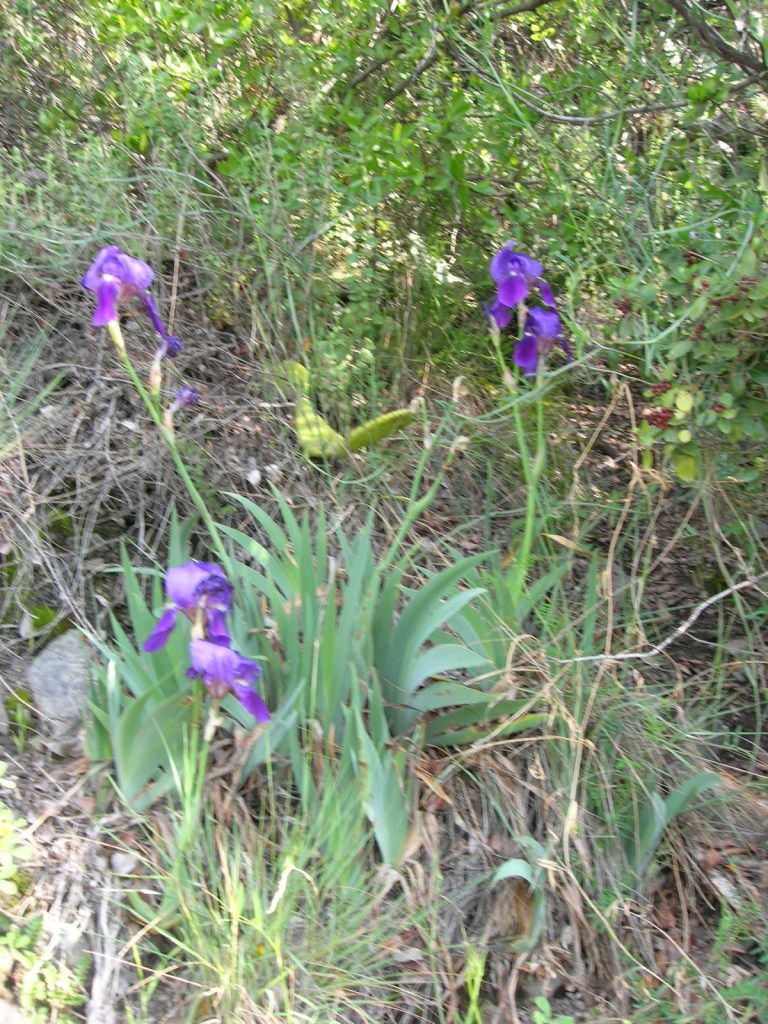

In our planning phase we targeted a near-impossibility: to be in Cinque Terre exactly when the spring flowers bloom. And we did it! Here they are! Irises escaped from domestic gardens are blooming everywhere. And poppies! And valerian, oxalis, bedstraw! So many flowers we stop looking them up in our “300 Pianti e Fiori” book, just photograph them for identification later.
While some of the wildflowers are the woodland spring ephemerals we’d expected, others are less familiar—great prickly pear cactuses, agaves, aloe vera—desert species we have only seen in pots grow as big as boulders. “Maquis,” Jim—a hobby botanist—pronounces. The plant book confirms that this term, macchia in Italian, refers to the dense evergreen shrubbery of high, dry Mediterranean landscapes.
Am I asking Jim about these plants just to pause in our climb?
Sometimes the trail levels off for a few paces, giving me a chance to catch my breath, still the pounding in my ears. But then the trail goes up again. I find myself doing the “Everest Shuffle” inexperienced climbers use to ascend serious mountains. Put one foot just a little ahead of the other, rock your weight forward, step, rock, step, and so ascend in tiny increments.
We sit a moment, leaning back against rocks striated with convoluted twists. Some prehistoric giant crumpled this coast like a ball of paper. Can there be higher still to go? Yes, there can.
We climb on.
Resting again, I ponder the history these slopes have seen. The coves below harbored pirates who preyed on the shipping traffic along Italy’s west coast. The villagers cast their lot sometimes with the pirates, providing supplies; other times they held out, building defensive fortifications on the headlands. One of these towers is visible in the distance—above Corniglia?
Just when I can’t Everest-shuffle another step, the trail finally levels out. Instead of watching my feet I’m again able to look around, take in the nets furled under olive trees for future harvest, the coastal views framed by lush spring foliage. The map says this is 221 meters above our starting point at sea level. That’s 726 feet. It is nearing 10:00a.m. I have never worked a harder hour in my life. I’m fagged but triumphant.
A sign announces “Corniglia, 2km.” It also says “BAR.” I love this about Italy. Every hiking trail should have a bar halfway along it.
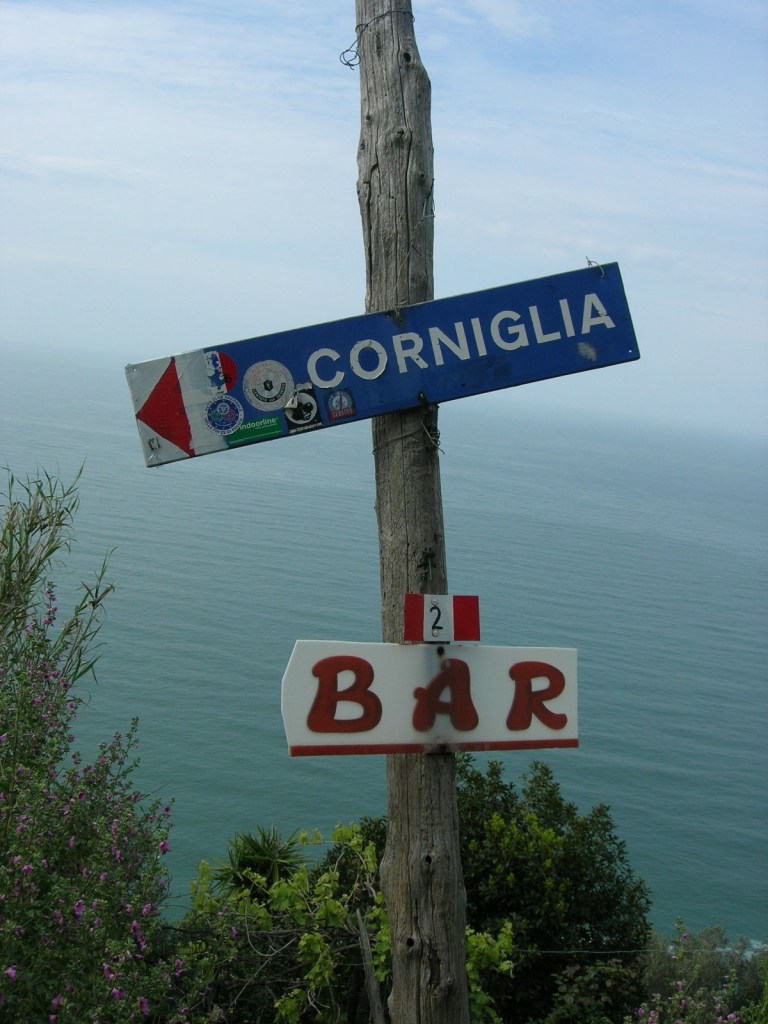
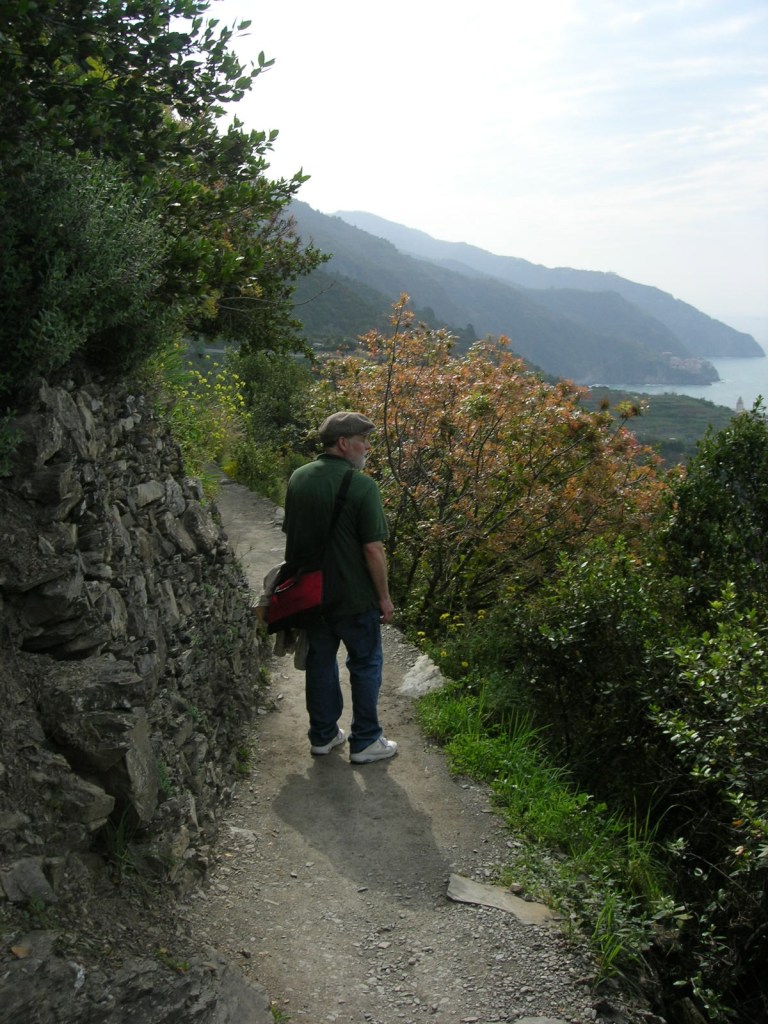
We round a corner and find ourselves entering the micro-hamlet of Prevo. The trail descends stairs to pass directly under someone’s house, where the advertised “bar” turns out to be a room in their basement.
Out the other side the trail finally, blessedly, begins to descend more than it rises. Above us there seems no end to the mountainside. Somewhere the dry-stone terracing must give way to a gentler angle of ascent, but we can’t see it.
The national park area ends at the ridgeline, well over 2,000 feet above sea level. Along the mountain ridge a sacred pilgrimage route emerged in the 1300s. The faithful built shrines and small churches along the route. But connection between the pilgrimage route and the villages below was slow to come. There are few roads, even today. Gaze wherever you like, you’ll hardly see anything a peasant wouldn’t have seen two hundred years ago. Only glimpses of train tracks, where they emerge momentarily from tunnels, speak of the industrial age. The trains rode in on a scheme of national improvement after Italian unification, 1861—the new government hoped railways would tie the new nation together. How those trains must have changed life in the Cinque Terre! (Am I thinking about this to distract myself from my exhaustion?)
Traffic is picking up on the trail now. Each group is coming from Corniglia to the south—no one has passed us coming from Vernazza since that one German boy. We nod hello, exchange just enough greeting to discern nationality. Here come two Norwegians, now a handful of Swedes. Only the Germans sport technical hiking gear. The rest could be out for a stroll. Now nineteen French come, following a tour guide. Now a pair from Belgium. Jim and I begin to joke about the “United Nations of Cinque Terre.”
We come to a little picnic area. A trail splits off down to a cove that our guidebook tells us is a popular nude beach. It is the only place along this coast where the meeting of water and cliff is less than vertical; the rocky little beach was caused by a landslide in the early 20th century.
“Does it get a lot more rugged than this?” The woman who accosts us sounds concerned; her husband is slumped at the picnic table, panting heavily. “I’ve had two knee replacements,” he huffs. They’re dressed in tracksuits and gold bling; they look, and sound, as if they’ve stepped from a shopping mall in Alabama.
Jim and I look at each other. What to tell these people? Turn back, there’s no way you’re equal to this terrain?

© 2024 Sarah White
*I self-published Write Your Travel Memoirs mainly as an experiment to test the print-on-demand workflow before offering it to my clients. I had the content, from workshops I had taught for Story Circle Network’s online classes, and enjoyed adapting it to book form.

 True Stories Well Told