

Over the next several months, I am serializing my six-chapter travel memoir about a trip to Italy’s Cinque Terre in 2008* here. In 2010, I self-published Write Your Travel Memoirs: 5 Steps to Transform Your Travel Experiences Into Compelling Essays. It included five how-to chapters and, to provide an example, this memoir. The book is available on Amazon.com.
Meanwhile, I welcome your submissions to True Stories Well Told during my “travel memoir takeover.” Let’s fill that queue for after the series ends. See submission guidelines here.
Chapter 4: What to Do with Thirty Thousand Guests
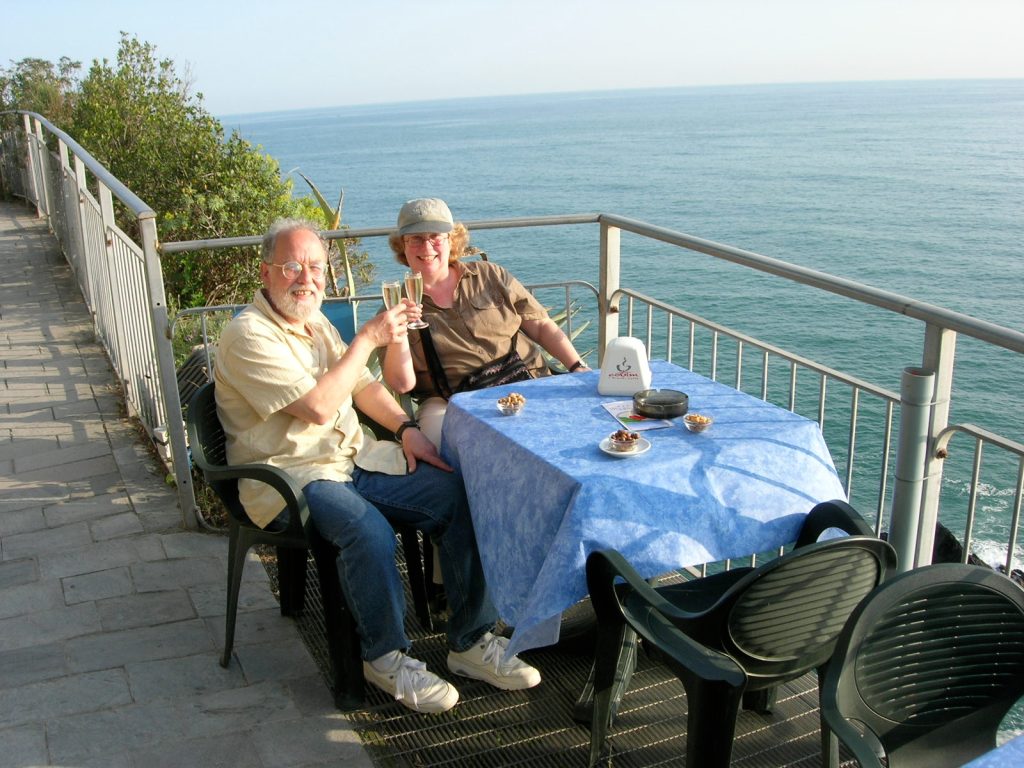
“I propose a plan,” I began. “Let’s alternate a day of hiking with a day of rest. We need recovery time. That means tomorrow, nothing like today’s trail.”
“Agreed,” said Jim, and we clinked glasses. The glasses were filled with pro secco, the light sparkling wine that is so much more drinkable than champagne. It is the custom to serve pro secco with an assortment of finger snacks—here at the Bar del’Amore our glasses came to the table accompanied by tiny olives, salted pistachios, and peanuts. Late afternoon sun slanted through the wine, and water slapped on rock far below our feet, visible through the iron mesh of the balcony on which we were seated. This moment felt like the celebration of an anniversary if ever there was one. The waiter offered to take our picture. We raised our glasses and toasted again. This became the photo we sent to Jim’s generous brothers, the patron saints of our trip.
What to do with tomorrow’s day of rest? Friday brings the Festival of Liberation. The perfect weather promises to continue. No wonder thirty thousand Italians feel compelled to come to our corner of the country, for the day or for the weekend. Where to hide out from them?
When you are in need of rest in Cinque Terre, the problem is not just the incursion of tourists, but the gravity. It’s stronger here. Literally—the slope of everything is constantly pulling at you. Set a pen down on a café table and it rolls toward the sea. Think you’re just going to run out for a bottle of wine, or a piece of fruit? Better warm up your hamstrings. You’ll be climbing or descending from the moment you step out your door. There is an exchange rate for everything, not just in euros but in energy units. If you don’t have infinite physical energy, choosing to do one thing will mean forgoing something else.
We had discovered the Bar Dell’Amore while exploring Manarola the night before, thinking about where to have dinner. Signs led us to the start of the trail to the final Cinque Terre town to the south; Riomaggiore. The trail beckoned so invitingly we ventured around the first bend, to see what lay beyond. The answer was the Bar Dell’Amore. A tiny shed for the bar huddles against the rock wall, while the seating hangs out over the sea, the trail passing between. I love this about Italy, how a bar appears wherever you imagine there should be one.
The guidebook described the trail to Riomaggiore as a delightful 20-minute stroll, mostly level, named “Via Dell’Amore.” Behind its name lies a cute story—true or created for tourists, who knows? For centuries, Cinque Terre villagers only married each other, having no easy way to expand their dating pool. When the train route through the Cinque Terre was constructed, so was a tunnel to store the necessary dynamite, situated equidistant from the villages of Riomaggiore and Manarola. When it was no longer needed to store dynamite it became a walking path and the boys and girls of the two villages could finally meet each other. And soon, amore.
“The guidebook says there’s a botanical garden in Riomaggiore,” I tell Jim. “Picture us just sitting in the garden, studying the plants, watching the people.”
“Maybe we’ll bring a picnic,” Jim replies. And so the plan is set. Tomorrow we will follow the Via Dell’Amore to Riomaggiore to find safe harbor from the sea of day-trippers. While they clog the trails and cafes, we will take our day of rest in some corner of the botanical garden.
With that settled, we return to the main street, pick our restaurant, and happily finish our first day in Manarola over the pleasures of the table.
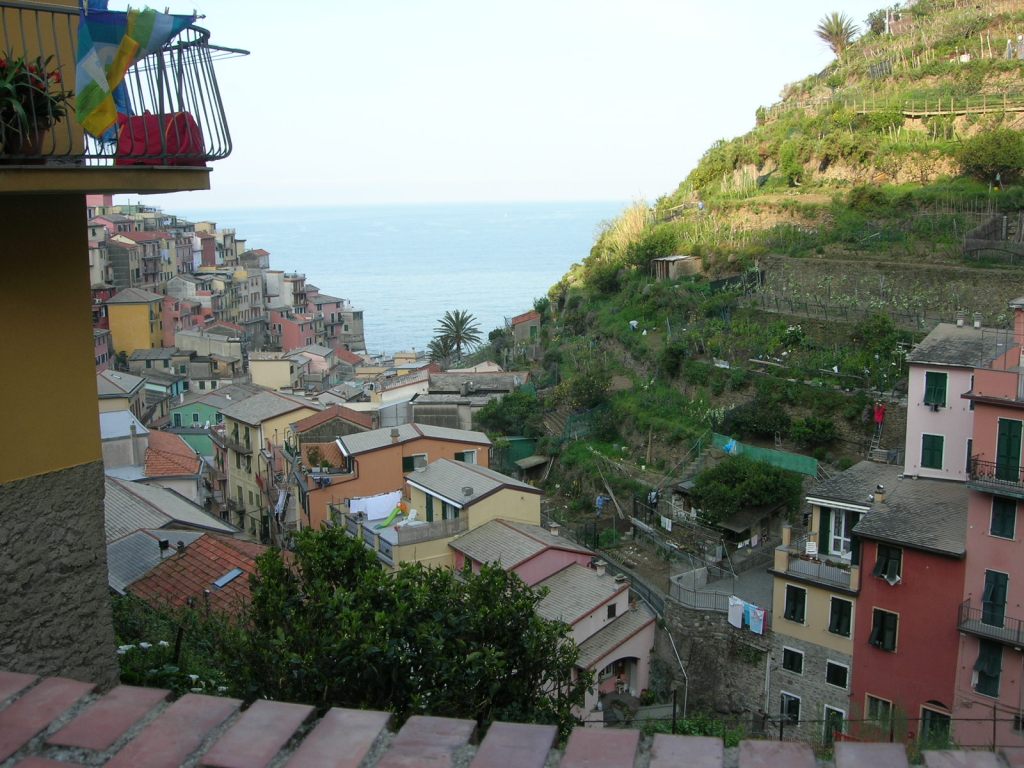
The next morning at breakfast we checked the maps and guides, sitting in the Café Aristide where we had been waiting when the doors opened at 7:00. Early rising is our secret weapon against the crowds.
A pamphlet described the garden as “…a military fortification of the Second World War [that] has been restyled and transformed in the Torre Guardiola Naturalistic Observation Centre. This itinerary is a full immersion in nature, one can study the vegetation, its perfumes, and observe the typical birds with the help of expert naturalistic guides.” Ah, the lovely Italian-canted English of locally-translated tourist guides.
We finished our coffee and returned to the Via Dell’Amore. Beyond the bar we found a section of trail so broad people could walk six-abreast if they cared to; so level, baby-strollers were practical. The galleries that originally stored dynamite were now covered with lovers’ graffiti. Some consider it defacement but we admired its artistry.
The trail delivered us to a lower plaza of Riomaggiore, where a tourist information booth faced large murals on the wall retaining the upper plaza. Panels explained about the “History of men and stones”—the people who had created this landscape by raising walls. The terraces of Cinque Terre contain more stone than the Great Wall of China, a poster said. And these terraces were unlike most other man-made wonders, in one way—they had been erected without coercion. The wall-builders of Cinque Terre had decided to work together for the common good, no local lord or baron subjugating them for his profit. (Historians now question the belief that the worlds’ grant erections could only be accomplished by slave labor; but we won’t let that rain on the locals’ pride in their unique inheritance.)
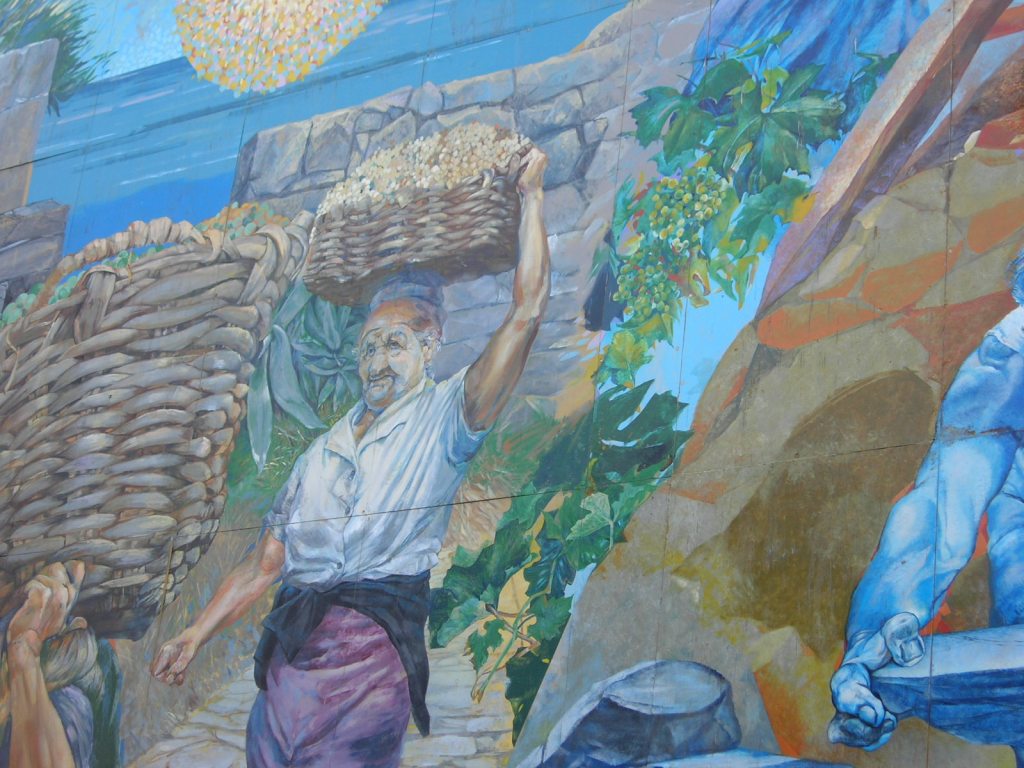
And what did we find, beyond the murals? An elevator to the upper plaza, an unexpected gift on this, our day of rest. On the upper main street (again, a sloping stone pavement covering a river) the shops were opening, the first day-trippers just arriving. And what a lovely town!
But where is the botanical garden? Too bad we hadn’t thought to ask, down at the information booth. We climbed the switchback streets, thinking it’s more likely to be on a promontory than down in the canyon-narrow center. We rounded a corner and were rewarded with a view of the harbor and the Via dell’Amore—but no garden.
“Torre Guardiola? Un orto botanico? No lo so.” A botanical garden named for a guard tower? No, never heard of it. That’s what the locals answered when we stopped several on the street to ask.
We returned to the main street, walked upward still looking for clues—a sign perhaps—until we reached the car-park at the town’s upper terminus. We spotted another tourist information booth guarding the barrier holding back traffic. Inside, we asked again about the botanical garden.
“Oh yes, the entrance is up that road—it’s about fifteen hundred meters. You can walk, or you can take the bus. Watch for the Blue Line, it departs right there.” The distance translates to only a mile but we’ll take the bus, thanks—our Cinque Terre passes make it free, after all, and it’s a mile uphill on this, our day of rest.
The bus winds up a satisfyingly steep incline headed south out of Riomaggiore—aren’t we glad we’re not walking?—and lets us out on a curve where fifteen or so cars are parked along a barricade. We see no evidence of a botanical garden; just the cars and the sea and sky. The bus driver points, “Torre Guardiola, thirty meters from here.”
We walk in the direction he indicated. The land drops precipitously away from the road. A little gate appears and we go through. The trail we take leads along the top of a stone retaining wall. The footpath is barely wider than our sneakers. Each course of stone stands five feet or higher. Depending on the angle of the hillside, between courses there runs a mere footpath, or an arable patch a few feet wide.


Grape vines brush our shoulders, reaching down from the terrace above. An irrigation hose snakes beside our feet. This land is being cultivated. But it doesn’t seem to be a botanical garden—where are the plant-name signs? Pebbles scuffed by our steps rattle as they tumble downward. We could be next to fall. The trail grows even narrower; Jim is grumping, “this cannot be right.” He has never liked heights.
We arrive at a locked gate. In four languages it tells us: “Dangerous path. No entry.” No kidding! We carefully backtrack. As we near the road, we see what we missed before: the real entrance.

© 2024 Sarah White

*I self-published Write Your Travel Memoirs mainly as an experiment to test the print-on-demand workflow before offering it to my clients. I had the content, from workshops I had taught for Story Circle Network’s online classes, and enjoyed adapting it to book form.

 True Stories Well Told