
We are nearing the end of this serializing of my six-chapter travel memoir about a trip to Italy’s Cinque Terre in 2008*. In 2010, I self-published Write Your Travel Memoirs: 5 Steps to Transform Your Travel Experiences Into Compelling Essays. It included five how-to chapters and, to provide an example, this memoir. The book is available on Amazon.com.
It’s time to send your submissions to True Stories Well Told! Let’s fill that queue for after the series ends. See submission guidelines here.
Chapter 5 (continued). The Days Blur, the Faces Don’t

The days run together, but the faces don’t. Standing out in the blur of scenery and snacking are the moments of interaction, not just with the locals, but with the “United Nations of Cinque Terre,” the visitors whose paths cross ours. We came here for the scenery—which has turned out to be more about people-watching than botanizing.
The first interactions were about lodging and food, the basic themes of life. But here, even those are conducted with a note of personal interest; we do not feel like wallets being harvested. Maybe later in the season, when the local people have grown tired of their daily invaders, their hospitality will falter. Today we are greeted as warmly as if we had brought Spring in our luggage.
Late in the afternoon on our first day in Vernazza, we discovered the “Pirati di Cinque Terre,” where we were drawn to the cases displaying tiny marzipan sculptures simulating mussels, tomatoes, hot peppers, even little chicken carcasses. “We haven’t seen pastries like these since Sicily,” Jim says. “And I am Sicilian,” replies the madcap man behind the counter. He turns deciding what to order into a comedy act. I ask his name: “Borat.” I tell him we were admiring the dessert case because Jim is a pastry chef. “You must come to work here,” Borat responds. My mind trips out on the possibilities of that.

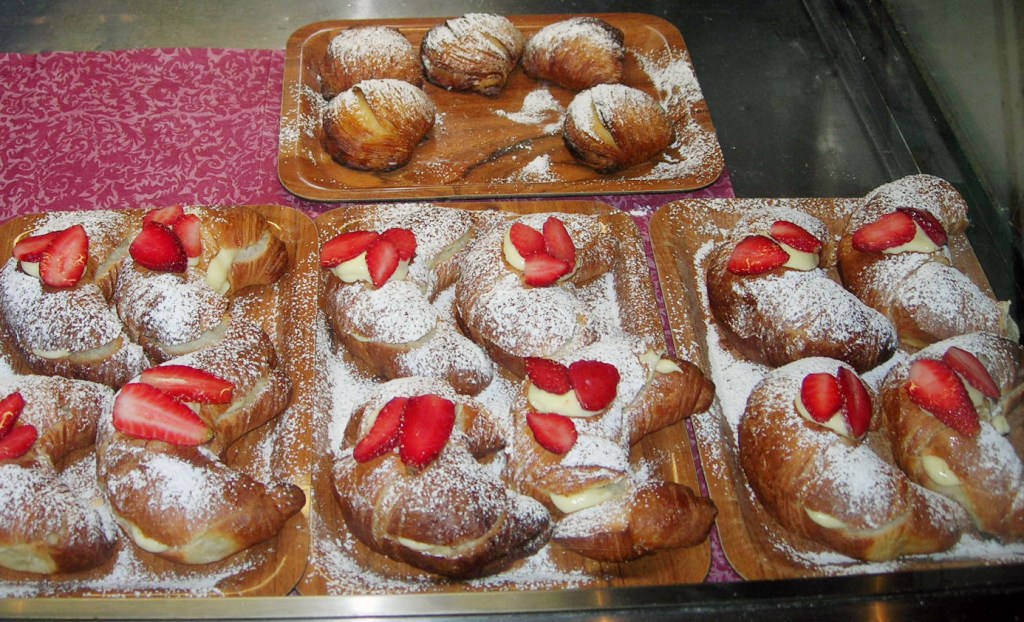
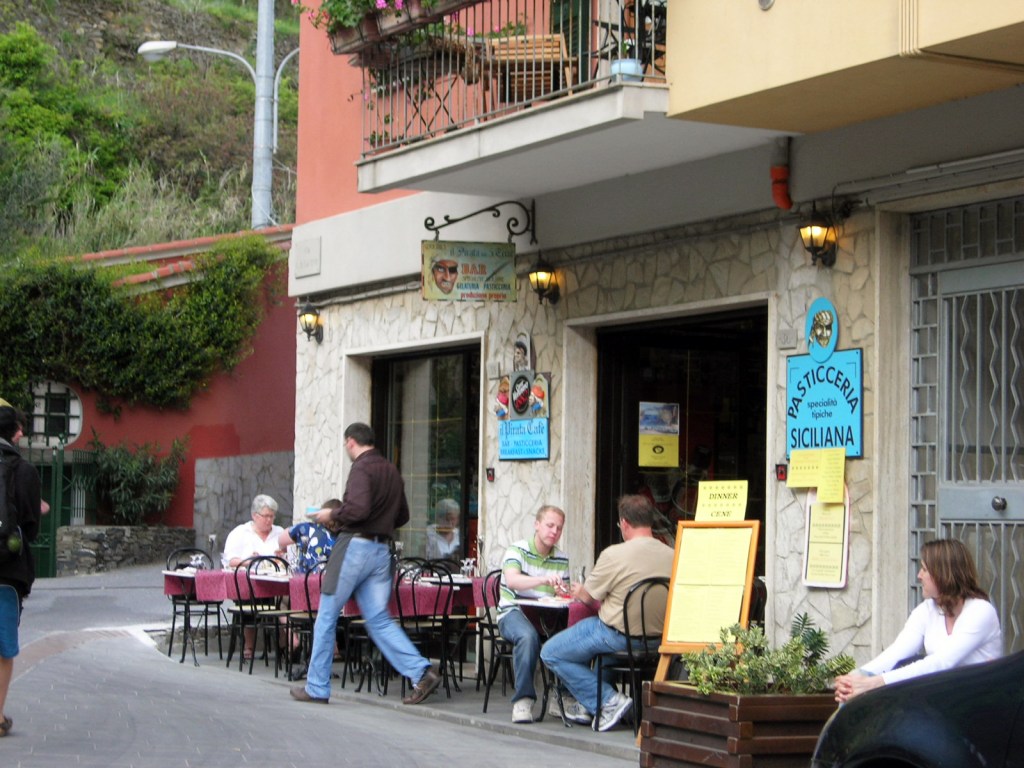
In the morning we go back to the Pirates for breakfast, but now the man behind the counter is dour; could our “Borat” be manic-depressive? No, the laughing Sicilian reappears and introduces us to his twin, Massimo. “He is the serious one. I am the handsome one.” Our affection deepens for these Sicilians who are trying to insert themselves into the business scene of Vernazza. I suspect mistrust of newcomers from outside has denied the Pirates a location nearer the heart of the village. The Sicilians’ restaurant sits at the upper gate holding back the cars (except for deliveries between 8 and 10a.m.) But the pirates’ pastry tricks far surpass the talents of the natives, and their whacky patter pleases the tourists. Rick Steves wrote favorably about them, which is good for business.
When we bring our bags to Sergio’s apartment following breakfast, he introduces us to his wife, already nicely dressed even though it’s early and she can’t have been expecting guests. Their apartment is full of solid midcentury furniture, but few knickknacks. “We rent out this apartment too, all summer, and go live with my uncle in Sestri Levanti,” Sergio tells us. We offer a little thank-you, a cloth shopping bag from our grocery store. They both look surprised, but after protests, accept the little gift.
Little gifts are given to us, too. At the Café Aristedes in Manarola, we indulge in a four course meal—antipasti of prosciutto and melon, followed by gnocchi with pesto, then fried anchovies for me, pork scallopini for Jim. After we order lime sorbet for dessert, the owner sends over little glasses of sauterne and biscotti, with his compliments.
At the ceramics store, Paulo practices his trumpet in the afternoons, when the tourist trade slows and he can stop running credit cards and packing purchases in bubble wrap. From our balcony we appreciate the accompaniment to our late-afternoon sessions with our comic books. Paulo has a songbook of jazz tunes and diligently, he practices. “I’d like to go to America, but Mama…” Did he say this to us, or did I only imagine it, conflating him with the other Italian men I’ve met, his age and like him, the son designated to stay with Mama?
Paulo and his mother have become characters in our Cinque Terre tale, the artist and her son who’d rather be a musician. So have Massimo and Borat (whose name is actually Luca, we find out from his gloomy brother). We want them all to visit us. We want them to invite us back, too. In and around our commercial transactions we feel some common bond; we’re all hanging onto hope, the Pirates with their ambition to insert Sicilian cuisine into this pocket of Liguria, Paulo practicing his trumpet.
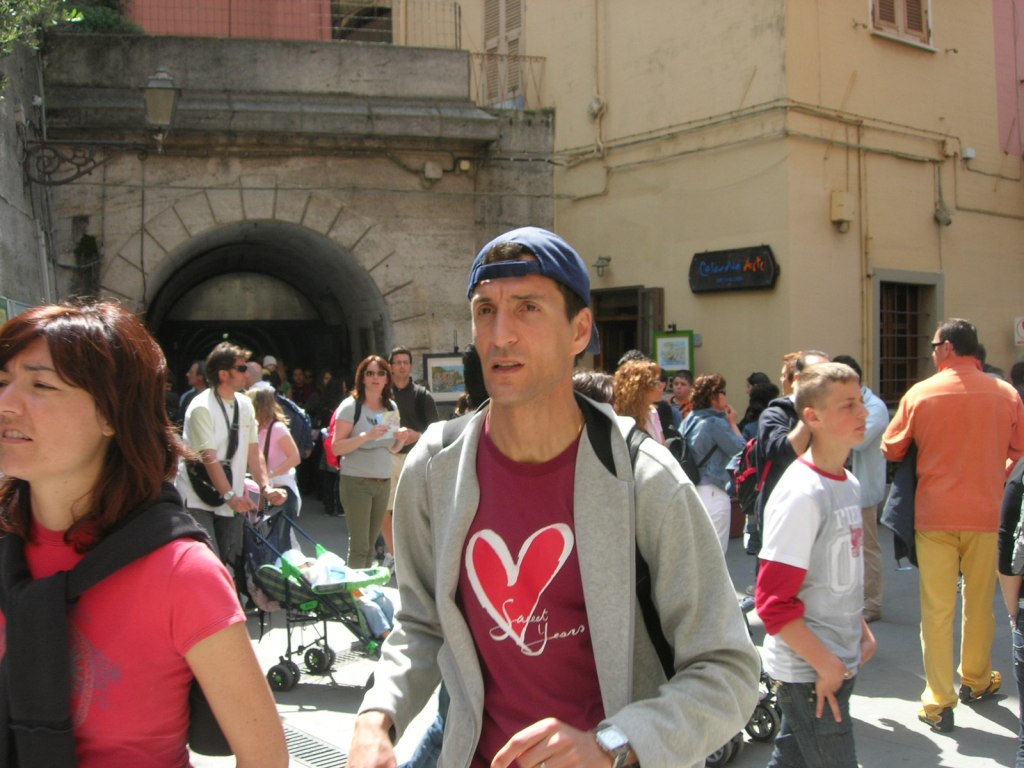
The tourists are one mammoth character, like ants swarming everywhere, thirty thousand of them busy-busy treading the trails, idling outside the many shops waiting to squeeze inside, sunning themselves in the harbor or at the cafés, interchangeable until we have little nodding interactions with them. “Where are you from?”
Packed into the train returning from Monterosso al Mare, someone cries out, “achiughe in olio”—we are anchovies pack in oil. Laughter. The man crammed next to Jim is from New Zealand, on a year-long vacation, with a group of Australians he met somewhere along the way.
The people renting Paulo’s other room are Swedes. They’ve been in Prague for a few weeks, now here for two weeks, then on to the south of France where they share a house with friends every year. Their teenage children will join them. These long vacations for everyone but us!
On our third day in Manarola, Jim and I stop into a bar after dinner for a nightcap; it turns out to be an open-microphone night, and young men are taking turns emoting with guitars. We spot the Swedes at a table in the back. They send over drinks; thimbles of rum next to ground coffee, coarse sugar, and a lime slice on the saucer. They join us to show us how Swedes drink this, dipping the lime in the sugar and coffee powder, sucking it between sips of rum. How could rum be a Swedish custom? They don’t speak enough English to give us a clear answer. We return the favor with glasses of the local schiacchetra, a sweet wine made from grapes left on the vine until they are nearly raisins. We exchange more rounds of drinks as we toast to each other’s countries and well-being. We are getting well-lubricated, a euphemism that derives from the Italian word for “drunk”—ubriaco.
Our “United Nations” experiences continue the next day when some young Dutch women at the train station, doing stretches before beginning the day’s hike, pause to ask us questions. “How is it in America under Bush?” They express concern about our lack of a national health care plan, our crumbling highways. “Do you think Barack Obama will be elected president?” We exchange hopes for a better future.

But how are things in America now? Specifically, how is Fred? This evening we go back to Vernazza, so I can return to the Internet café to check e-mail. Finally there is a message from Elaine and Dave. It delivers a little of the story-line I’ve been hungering for. “We’re having dinner outside on your terrace, and Fred is here, enjoying the sun.” I tell Jim everything’s okay. But I’m still starving for details, for little doggy anecdotes to ease my guilt about day after day of just the kind of fun Fred would have enjoyed if only he were younger—the hiking, the snacking, the people-watching on Paulo’s porch.
To distract ourselves from thoughts of Fred we put ourselves into the hands of the Pirate brothers for wave after wave of their Sicilian specialties. I think they’ll make it here. The locals may never accept them, but the tourists will. Like their comedy routines, the culinary skills of the “Pirati di Cinque Terre” are the stuff of legend.
© 2024 Sarah White

*I self-published Write Your Travel Memoirs mainly as an experiment to test the print-on-demand workflow before offering it to my clients. I had the content, from workshops I had taught for Story Circle Network’s online classes, and enjoyed adapting it to book form.

 True Stories Well Told