
Book review by Sarah White
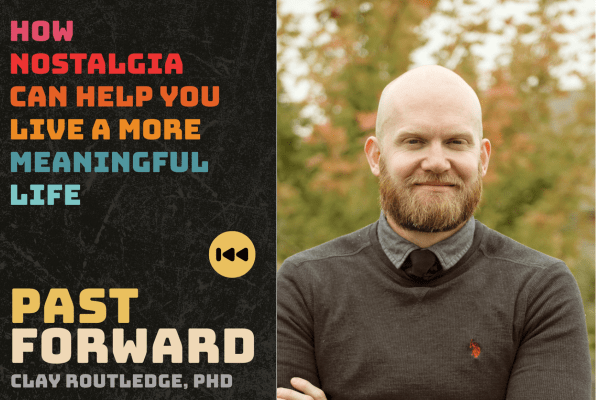
I’ve spent the last twenty-plus years creating the conditions for people to recall, write, and share their life stories, so you can guess my reaction when I heard there was a new book out proclaiming that nostalgia is healthy and useful. Yay!
We are in a worsening epidemic of loneliness; even the U.S. government is concerned about it. “Social connection— the structure, function, and quality of our relationships with others—is a critical and underappreciated contributor to individual and population health …. However, far too many Americans lack social connection in one or more ways, compromising these benefits and leading to poor health and other negative outcomes,” wrote the authors of the U.S. Surgeon General’s advisory paper on the topic.
I believe a highly effective intervention for loneliness is writing and sharing reminiscences in small groups. I respect the Guided Autobiography method as pioneered by Dr. James Birren and developed by “the Birren Disciples” who carry on his work. Chief among those disciples is my colleague Cheryl Svensson, executive director of the Birren Center for Autobiographical Studies. (I serve on its board.)
One of my core beliefs is that looking back over one’s life experiences, drawing insights about what’s worked out and what hasn’t, produces a compass by which one can navigate the future. I also believe that most of us (not all) need purpose and meaning in our lives.
In the reminiscence writing workshops I’ve led since 2004, which are based on Dr. Birren’s method, I see how reminiscence writing in small groups combats social isolation, increases understanding of life experiences, and deepens one’s sense of meaning.
Reading Past Forward would, I hoped, freshen my stock of evidence-based research on the benefits of reminiscence writing—which is nostalgia put to paper. The book did that, indeed.
Evidence for nostalgia’s benefits
Past Forward, 224 pages, consists of thirteen chapters organized into five parts that lead the reader from an introduction to what author Clay Routledge calls “The Nostalgia Revolution” about the scientific background to his research (part 1), followed by sections about how Nostalgia enhances the self (part 2), connects that self to others and increases our prosocial orientation (part 3), makes life meaningful (part 4), and helps us navigate our fast-moving world (part 5).
That’s a good organizational framework and it worked for me; some reviewers on GoodReads have suggested the author should have covered nostalgia and trauma in the subjects he considered.
My “you had me at hello” moment came when, in Chapter 2, Routledge wrote “…a deeper inspection reveals that this trip to the past is really about packing a bag for a journey into the future. The past isn’t the true destination: it’s just where we go to grab supplies for the trip” [page 21*]. Yes! He’s talking about the compass I mentioned earlier!
But oh, how I wish Past Forward had been a more compelling read.
What did NOT work for me was the way Routledge introduced each topic with the details of how he conducted the research that produced the data from which he drew his conclusions. While he states the book is “based on hundreds of studies conducted over the last two decades,” the research he described consisted mostly of having groups (I suspect drawn from his students) write either neutral memories or nostalgic memories prompted with various qualifiers. A major omission IMHO is any clear definition of how the difference between these types of “writing about a memory” was explained to the study participants, or who they were, precisely. It felt a bit like junk science, but I found no criticism of Routledge’s methodology when I searched for it, so maybe it’s just me?
I admit I quickly began skimming the “how we know this” sections that preceded each nugget of insight.
Nostalgia: a changing view
Nostalgia was originally considered a disease when the term was coined in 1688, and until recently was seen as a form of depression. It was only in the 1970s—about the time Dr. Birren was doing his pioneering work in gerontology with the use of guided autobiographical writing—that the view of nostalgia as a mental illness started to crumble. The history is quite interesting, and Routledge writes about it well.
I’ll share a few other insights I noted and encourage you to read the book if this interests you.
How Nostalgia Enhances the Self: It helps us make connections among our life experiences that leads to self-continuity, “the feeling that we have a stable self across time, that the person we were years ago is connected to the person we are now and the person we will be in the future” [page 51]. Dr. Birren made similar observations in his work on self-concept.
How Nostalgia Connects You to Others: “Loneliness is problematic, in part, because it’s self-reinforcing. …the lonelier people feel, …the more likely they are to withdraw from others.” Routledge found that nostalgia eliminated that effect, by helping “people find the confidence … to take steps to build or restore relationships” [page 101-2].
How Nostalgia Makes Life Meaningful: “People are more empathetic, generous, and motivated to connect with others when they feel meaningful. … people who lack meaning tend to be passive and lethargic, whereas people who have meaning are active and engaged” [page 150]. Routledge proclaims that nostalgia restores and increases meaning, and inspires people to more positively impact the world, for example by reaching out to others.
Resource: NOSTALGIA IN AMERICA:
by Clay Routledge, Vice President of Research & Director of the Human Flourishing Lab, Archbridge Institute
THE POWER OF LOOKING BACK TO MOVE FORWARD
Routledge closes his argument with observations about nostalgia’s ability to help us adapt to change, maintain an optimistic attitude, and problem-solve more effectively. “…With our nostalgic memories, we’re reminded that life is full of experiences that make it meaningful and that make the world worth improving and humanity worth fighting for,” he concludes [page 192].
There you have it—if you accept the assumption that batteries of individuals prompted to write nostalgically produce solid quantitative and qualitative data—that nostalgia is beneficial, with the implication that it could address the epidemic of loneliness.
And here I sit, feeling like we—the Guided Autobiography instructor community and others who lead small groups who write reminiscences, share, and receive feedback from each other—have the cure.
If I could wave my magic wand to bring the “vaccine” of nostalgia to the lonely millions, I would create a national—or why not worldwide?—network of teaching opportunities for my colleagues, perhaps based in healthcare facilities, especially in rural and isolated areas, because just about everyone, even those so lonely and lethargic they can’t take the next step on their own, see their healthcare provider.
In the meantime, go ahead—indulge in nostalgia. It’s good for you!
© 2024 Sarah White
*Page numbers refer to the paperback edition.

 True Stories Well Told