
Today I offer Renee Lajcak’s essay, read by the author. Why? Because Renee writes sometimes to be read, and sometimes to read aloud, because she enjoys performing her pieces. “There’s a difference in how I write for spoken word,” says Renee. “I use shorter sentences, more repetition. On the page, you can be more abstract. For listeners, I keep it visual, ‘in your face’.” She enjoys having some control, through her stress and intonation, over how her audience (readers transformed to listeners) takes in her stories.
By Renee Lajcak
After class in Indonesia, I asked one of my English language students why his teeth were so beautifully white. He said that in his village, they would polish their teeth with “crushed brick”. I don’t know how that worked, but it sure did. I was surprised by the teeth of most Indonesians seeing that they ate a lot of white rice, fruit and sweets. In fact, when you bought something at a shop and got change, instead of small coins, they often gave you candy.
My dental experience in Japan was a different story. There, it was very common to see teeth out of kilter or crooked. I assume part of this was due to the lack of good dentists in those days. In fact, one Japanese man, very relieved after a dental appointment in the States told me, “I think Japanese dentists like to cause pain.”
Those crooked teeth were so common that they eventually became a sign of beauty. Today, a woman or anime character with slightly crooked, fang-like canines is seen as “kawaii” or cute by many Japanese. The cattywampus teeth remind them of a cat or a bunny. Advertising would call this clever technique “brand image enhancement through repackaging”.
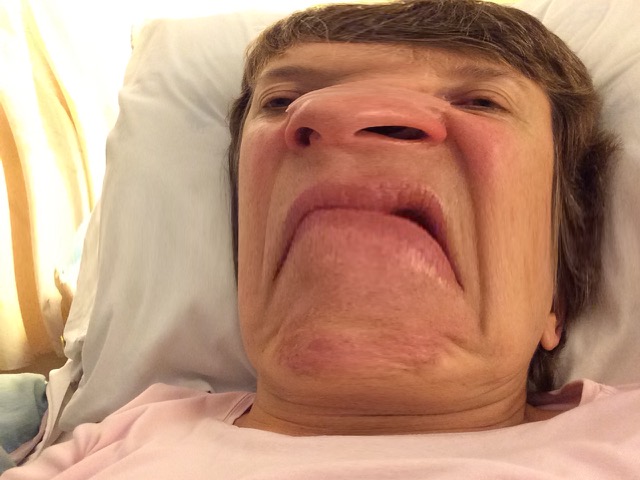
Culture clearly determines beauty. The first time I encountered this idea was with one of my very first students, a Laotian refugee. She told me, “Your big nose and white skin. Very beautiful in Laos!” I was taken aback that my oversized schnoz and my pasty winter skin could seen as signs of beauty. Sometimes Japanese women would admire my “high” nose and sigh disappointedly over their own small noses. This was a shock because I had always hated my nose growing up and secretly planned to get plastic surgery as soon as I was an adult. Finding out that it could be seen as something beautiful turned my self-perception on its head, or should I say nose?

Self-perception is a powerful thing. I once worked with an American teacher in the US who was very heavy, but she exuded strong self assuredness, sometimes lacking in American women of a certain weight. She said that confidence was due to living in Africa, where the males of the region adored her larger size and treated her like a sex goddess. Every woman should feel like a sex goddess at least once in their life. It is something that can carry you through the plain days.
Sexual attractiveness is definitely tied up with beauty. Marilyn Monroe and Cindy Crawford each had a beauty mark on their face that was seen as sexy. But moles are things that Americans often have removed, especially if they are on the face, large, dark or all three. However, this is not a universal idea. On one of my visits to Japan, I spent a lovely afternoon with a group of women eating Japanese delicacies and learning about the koto, their 6-foot long traditional stringed instrument. As we chatted, they started discussing the numerous facial beauty marks and moles on a very beautiful young woman. She was considering having them taken off, something that is less common in Japan, partly due to the fact that the national health insurance won’t pay for it. But there was another less practical reason. There’s a whole branch of fortunetelling that uses the placement of moles to determine good and bad fortune. The women were discussing which moles could be taken off and which should be left to insure future good luck. Beautiful? Ugly? Fortuitous? It’s all in the eye of the beholder.
What is beautiful will always be subjective and cultural, and can change through time. In the US beauty standards are expanding, allowing space for those with a variety of body shapes and skin. It’s a joy to see fashion models with birthmarks or with larger bodies or even of a certain age, like me. I hope that there may be less self-shame and more confidence as a result. As for me, even at this certain age, I’m still working on fully appreciating my big nose.
©2025 Renee Lajcak
Renee is a newly retired English language teacher who has taught in several Asian countries but now enjoys her woodsy backyard the best. She loves the connections made through storytelling and teaching conversational English, but writing about memories allows her to go inward to contemplate the good, the bad and the ugly. But mostly the good.

 True Stories Well Told