
This is the first post in a short series. We begin with a review of the book Family Trouble. Next week, I’ll post a personal essay about an experience with “the hazards and rewards” of writing about loved ones.
As a personal historian, my work is all about helping people write their lives. I do it in a variety of ways—as a coach, ghostwriter, and reminiscence writing teacher—but regardless of the approach, one constant remains—family stories are going to be told. And when family stories are told, somebody’s going to have a different view.
I tell my writing students, “Write like no one’s looking over your shoulder. There will be plenty of time to pull your punches later, if it looks like something you wrote is going to get published. Don’t censor yourself before you have to!” But that advice will only get you so far, I discovered as soon as I began seeing a few of my own stories published. I’ll get back to that story. But first, on with the book review.
So I was delighted when Josh Feyen brought the book Family Trouble: Memoirists on the Hazards and Rewards of Revealing Family to my attention.
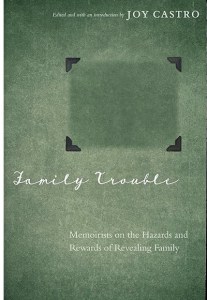
From the back jacket copy:
This volume navigates the emotional and literary minefields that any writer of family stories or secrets must travel when depicting private lives for public consumption.
Essays by twenty-five memoirists… explore the fraught territory of family history told from one perspective, which, from another angle in the family drama, might appear quite different indeed. In her introduction to this book, Joy Castro, herself a memoirist, explores the ethical dilemmas of writing about family and offers practical strategies for this tricky but necessary subject.
The book is structured in four thematic parts, each signaling a different stage or aspect of navigating ethical and emotional challenges in memoir writing.
Drawing Lines explores the boundaries memoirists must draw—between truth and privacy, between storytelling and betrayal. Where do you draw the line between artistic expression and familial loyalty?
In The Right to Speak, contributors consider the moral and philosophical right to tell their stories, especially when those stories intersect with others’. Themes include power dynamics, voice, and permission—who owns a story, and who has the right to tell it?
Filling the Silence centers on the silence surrounding family histories—whether due to trauma, taboo, or generational gaps—and the memoirist’s role in breaking that silence. These essays reveal how memoir can serve as a form of recovery, resistance, or reconciliation.
Conversations of Hope offers reflections on what happens after disclosure. These essays grapple with the aftermath—how families respond, how relationships evolve, and whether healing is possible.
Together, these sections map a journey: from the internal debates about what to reveal, to asserting one’s narrative agency, to confronting silence, and finally, to seeking connection or resolution through truth-telling.
I loved sampling different memoirists’ views on writing about family. I kept popping over to my library’s app to put a hold request in for another author’s book. What is more satisfying than a book that serves as a guide to many more good reads?
I have had personal experiences with that one! Here’s just one:
Decades ago, one of the first personal essays I published was about Winona Lake, the religious resort community where three generations of my family lived or summered, where my cousins and siblings and I spent many summer weekends in our childhood. The essay got published on a website for Hoosier authors of autobiographical narrative. One of my cousins found it through Google; she emailed it to my extended family. It offended my aunt, who said, “It’s disrespectful,” and pretty much never spoke to me again.
Which was fine, because in fact, I had always disliked her. But I tell this tale when I teach, “Don’t censor yourself before you have to.” Remember, there’s a thing called the Internet, and anything you publish can and likely will be read by people who know you. That can have consequences.
When it goes poorly—well, let’s hope the relationships you lose are with the family members you dislike. When it goes well, may you find out more about your family and your history—as has happened for me, and more often than the adverse outcomes.
Stay tuned for next week’s adventures in personal history.
© 2025 Sarah White

 True Stories Well Told