
This post concludes our short series that began with a review of the book Family Trouble: Memoirists on the Hazards and Rewards of Revealing Family. In the second, I recounted my own difficulties in Friend Trouble. In this final post, Josh Feyen contemplates sharing his memoir with family members.
By Josh Feyen
I introduce my memoir with this story:
In my junior year of college, I worked as a housefellow at the UW-Milwaukee Sandburg dorm. One January night in early 1992, my freshman roommate Scott invited me to his new apartment on Downer Avenue. We became good friends but lost touch when he moved off campus, so I was eager to reconnect.
Scott introduced me to a small group and then went on to welcome others. The small talk fizzled and I stood on my own, drinking beers and feeling out of place. I compared myself to the crowd—this guy was handsome, that couple looked out of People Magazine. My self-esteem fell to the sticky floor.
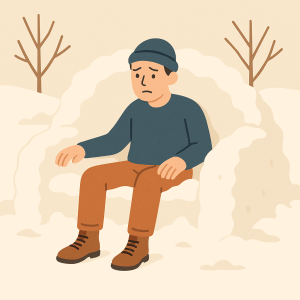
I said goodbye to Scott long before the party ended. It had been snowing and continued as I walked back to my dorm. I strolled past the athletic center and noticed a fresh snowbank that looked like an overstuffed chair. I dropped into it and closed my eyes. I was tired, dizzy and feeling sorry for myself. I sat alone despite having just been with people, and my dislike of winter compounded my sadness. The snow chair was comfortable, and in the front of my mind, I considered taking a quick nap. In the back of my mind, I knew that if I sat there long enough, I’d never get up. Somewhere between the front and back of my mind, I was OK with that.
And then a story my mom shared with me emerged. During her college years at UW-Milwaukee, after a few drinks at a winter party, she’d spotted an inviting snowbank and sat down, feeling depressed. She was lonely, and social and world affairs of the mid 1960s weighed on her mind. Then she started thinking to herself that there had to be a reason she existed, and while it frustrated her that she didn’t know why, she accepted the ambiguity. She opened her eyes, pushed herself out of the snowbank, and went home.
When I read this introduction to my husband, he said, “You’ve never told me that story.” This is precisely the problem. We’re not telling one another the important stories of our lives. My mom’s story, and its inspiration to push me away from that snowbank, is why I’m able to write this story today.

When I picked up Family Trouble by Joy Castro, I was searching for kindred spirits who understood the complexity of telling others our stories. The book’s 25 memoirists wrote about the challenges they faced as they shared, and censored, their stories.
My own memoir started during the pandemic isolation of 2020—passing time going through old journals and photos. As I approached my birthday in 2021, I challenged myself to write one story a week, aiming for at least 50 to mark my 50th year. These two projects resulted in thousands of words illustrated with hundreds of photos. But they had no audience except my patient husband.
Looking for readers, I wrote, designed and printed one 450-page memoir titled Out With It, The Things We Don’t Talk About—a gift for my first niece’s high school graduation. I expected it would either travel with her to college, or collect dust on a bookshelf, either way, it would have a reader of one or none. I got a little braver, and expanded the idea to print personalized editions for each of my other three nieces, my nephew, and my godson as they graduated high school.
I wrote for an audience of six young adults who I hoped to help and guide with stories and lessons I had learned. Topics include personal experiences sex, death and money, but also religion, growing up poor on a farm, and many of the isms, including sexism, racism and classism. As I revised and prepared new editions, I began to recognize that they weren’t just personal anecdotes but explorations of universal human struggles. The journalist in me yearned to find a wider audience because sharing what we’ve learned is how we connect our differences. My mom shared her story, and I think it saved my life. If my experiences could push one person out of their personal snowbank, wouldn’t that be worth the risk of sharing?
But it’s one thing to share personal stories with six young adults who know and love me; it’s another thing to imagine anyone else reading them. I wrote about subjects few people talk about, or if so, in hushed voices with trusted friends—because sharing them widely might cause trouble. Family trouble.
As I read through the Family Trouble essays, I realized there was only one person I was worried about reading my stories: my dad. Would Dad feel shame learning that I think we were raised poor? How would he react to my conclusion that his beloved Catholic Church was more confusing than nurturing to my childhood? What about the argument with my parents over my gay marriage that led to years of strained communication? If he were to read Out With It, he would learn about these, and everything I’ve kept from him in the chapter, The Things I Never Told My Parents.
But maybe there’s little to worry about. Dad and I have gotten a lot closer in the last five years. Together he and I navigated Mom’s dementia, planned her earlier-than-expected funeral and are navigating his new life as a widower. Since she died, we’ve continued to spend a lot of time with one another, talking late into nights, and for me, our relationship is far stronger than any in the past. Perhaps it’s strong enough for me to bravely share my memoir, and for him to hear my perspective of our shared life. I’m inching toward sharing a copy with Dad, with a suggestion that maybe he skip the Sex chapter. Or maybe I’ll share some of the “easy” chapters first, and drop the more challenging ones as he gets used to the idea.
I know that when my mother’s story got me out of a snowbank, I glimpsed how stories can save us. Now, as I contemplate sharing my memoir, I’m increasingly embracing the possibility that sharing our unsaid truths doesn’t have to push people apart. With genuine courage—from both the writer revealing and the reader receiving—these stories can actually pull us closer together.
© 2025 Josh Feyen
Josh Feyen was raised on a farm in southwest Wisconsin, went to college in Milwaukee, lived abroad for four years on three continents, and now finds himself with stories to tell. In the middle of 2021, Josh set about writing 50 short memoir stories in his 50th year. Today, the main focus of Josh’s 50 in 50 writing journey is to share what he’s learned with his four teenage nieces and nephew. Josh lives in Madison, Wisconsin. Find his other blog posts for True Stories Well Told here.

 True Stories Well Told