
By Violet Suta Moran
This essay is an excerpt from Violet’s latest book, Sweetgrass: Growing Up in Montana.
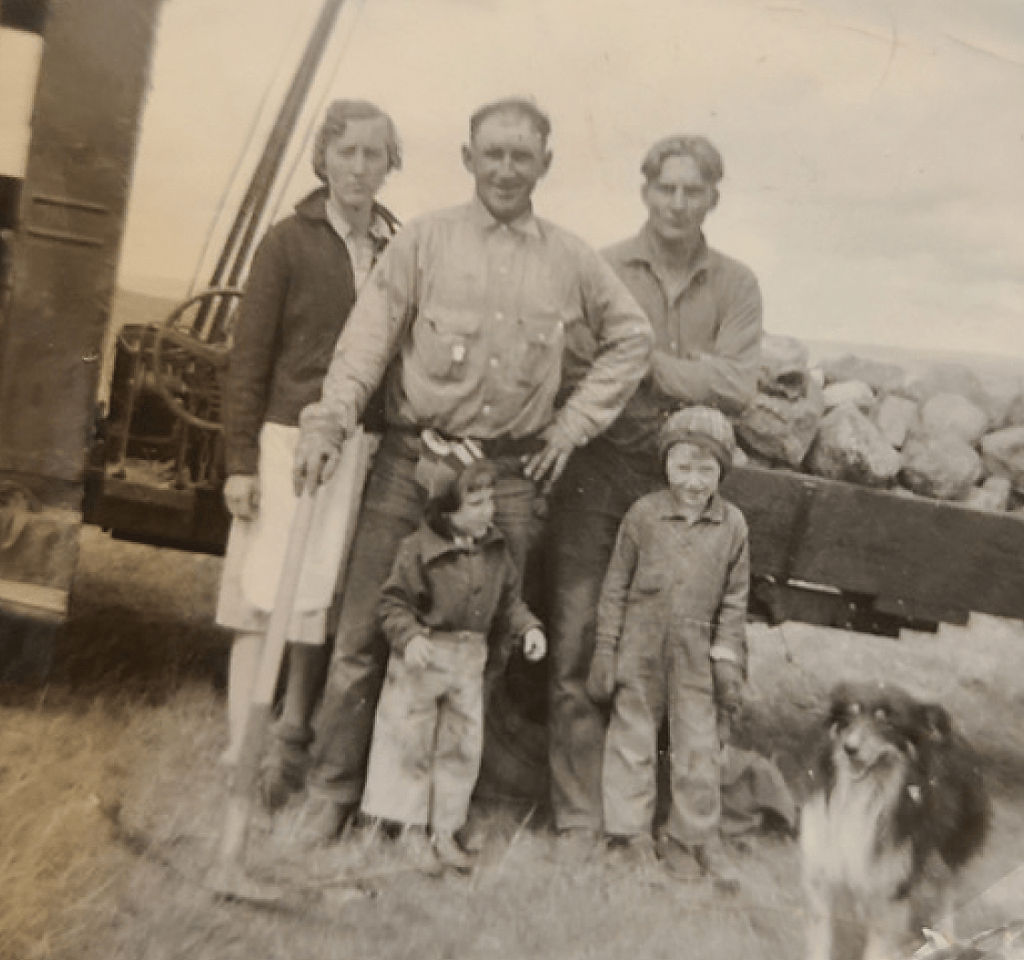
One summer, my three sons and their families came to the mountains of Montana for a reunion with the Suta family. After a few days in the mountains, we all felt the need to go to the prairie and visit where my siblings and I had lived, the farm we playfully named “The Suta Rock Farm.” We children thought that name was appropriate because rocks seemed to be the most prolific crop on our wheat farm.
We went into the quonset hut, a large metal storage building, housing our beloved Hildegard, a 1932 International truck. I was talking about Hildegard to my granddaughters Hannah and Becca, who were maybe five and three years old. I explained that this truck was used when we were picking rocks and pointed out that there were some rocks in the truck bed. I showed them the pulley Pop had installed to be able to crank up the front of the truck box so the rocks would slide off the back. I said, “We were really happy to have this pulley so that we no longer had to unload the rocks by hand.” Hannah looked up and said, “Okay, Grandma, I understand that. But why would anybody want to pick rocks?”
Such a good question, but it was hilarious to the adults. We doubled over laughing. None of us ever “wanted” to pick rocks, but they could damage expensive farm machinery if left in the fields. We didn’t have a choice.
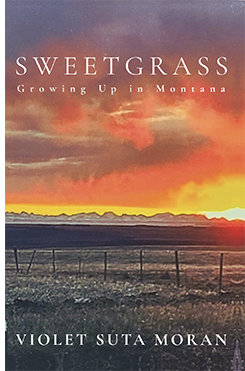
Sweetgrass: Growing Up in Montana
By Violet Suta Moran, available in the Lulu.com bookstore.
Violet Suta Moran grew up on a farm twelve miles from Sweetgrass, Montana, which in the 1930s and 1940s was a thriving little town with everything a farm family needed. In the 1950s, Sweetgrass went into decline and now is not even a ghost town.
Sweetgrass was written because Violet’s three sons and five grandchildren wanted to know what it was like to grow up on the Suta Rock Farm without any modern conveniences. These stories tell that the families on a developing farm worked hard and did not have much time to play. But the siblings worked together with camaraderie, respect, and geneality.
Picking rocks
Mom often said, “No rocks, no crops,” as if the rocks added to the land’s fertility. She was trying to encourage us—and herself– to go out and work. Our idea of “quality family time” was to all go out and pick rocks together.
Mom gave me a small bucket, like a beach toy, so that I could pick rocks with the family. I was about one year old when we moved onto the farm, so I can honestly say that I started picking rocks as soon as I could walk!! My little bucket filled quickly, and I kept bothering Mom to empty it onto the truck. Mom was smart and convinced me that I should pick tiny rocks because nobody else was doing that. Then she didn’t have to empty my bucket so often.
Picking rocks is hard physical labor
You have to bend over, grasp a heavy rock with both hands, stand up, carry the rock to the truck, and lift it up as high or higher than your shoulders to stack it onto the truck bed. Then you walk back to where you picked that rock in order to pick another. The ground is uneven, and your body has to constantly re- balance as you walk back and forth. Repeat, repeat, and repeat.
We never counted the number of rocks it took to make a truckload, but I can tell you that it is enough to make your muscles sore and your back ache.
When we had picked enough rocks to fill the truck bed of Hildegard, we dumped the load of rocks onto the dam that had been made between a couple of hills to create a reservoir. The reservoir collected water from rain and melted snow to provide a source of water for our cattle. The reservoir was necessary because there was no lake or other source of water on several thousand acres of land.
Large boulders that none of us were able to lift had to be put onto the stoneboat to be hauled away. The stoneboat was a flat piece of heavy wood about six feet square and low to the ground, with no sides. Pop used the grader attachment on the tractor to push the boulder onto the stoneboat. If a boulder was partly buried in the ground, we had to dig the soil all around it to wrap chains under it and lift it with the tractor.
Favorite rocks
Even though my family didn’t like picking rocks, each of us sometimes selected a rock they thought was special and piled it against our house. The rock somehow “spoke” to that person. None of us ever questioned why a rock was special to a person. No explanation was needed.
My favorite rock was a huge boulder located down the steep hill from our house. The top of the rock was fairly flat and at least four feet in diameter. As a child, I thought I could hide behind that rock when I didn’t want Mom to see me. I named that boulder my “Picnic Rock” because I often took dolls and cookies along for a party. Sometimes I just lay down on the ground behind the rock, enjoying my privacy and watching the white clouds change shape.
Everybody needs a rock
Everybody ought to have a special rock of their own. Your rock will silently communicate with you as you speak to it, touch it, and think about something. Some people carry a small smooth rock that they can rub with their thumb to help them relax.
I have a special rock that fits perfectly into the palm of my hand, and I keep it nearby to help me think when I am stressed or stumped over a problem, writing, or planning something.
I think everyone would benefit from having a personal rock.
© 2025 Violet Suta Moran

Violet Suta Moran developed a notable reputation as a nurse prior to retirement and writing. Among her accomplishments was creation of the first Intensive Care Unit in Madison, Wisconsin, in May 1963, one of the first in the nation. Her activities in the nursing profession included publications, holding elective offices, and providing continuing education. She also was a leaderin the specialty of teaching staff to care for children who have profound developmental disabilities. Although her heart remains in Montana, she enjoys living in the beautiful city of Madison, Wisconsin.

 True Stories Well Told