On Turning 65

By Sarah White

The first clue that this might not be purely a joy-ride was the weather. The temperature hovered at the cold edge of comfortable, wearing the jacket I had brought to Italy. The scowling clouds looked like they could easily unleash rain. This was not auspicious for a ride on a rented Vespa through the back roads of Chianti. But dammit, it was my birthday, and this rural spa–medieval hamlet–hotel rented scooters. It was now or never.

To prepare, I spent the morning watching Vespa how-to videos on YouTube: how to start the engine, how to get the scooter on and off the kickstand, riding skills refreshers. It had been 13 years since I parted ways with my beautiful little vintage 150cc Vespa Primavera on the byways outside Madison. But scootering is like riding a bike—the body remembers. Right?

The second clue that this might not be purely a joy-ride came when I realized that the map in my hand bore little resemblance to the landscape around me. The place names at the first fork in the road were not those on the map. But no worries, I had my iPhone with Google Maps as my copilot. I took the right fork, didn’t like the looks of the broad agricultural plains ahead, and made my first cautious U-turn back toward the cozier-looking hills to the left. Scooters are definitely more stable at higher speeds. It has something to do with the gyroscopics of those tiny wheels.

The third clue came when, thoroughly chilled but smiling from head to toe, I pulled into a little parking lot in the village of Gaiole in Chianti. I carefully turned the scooter around so its nose faced the road and killed the engine. Then, I could not for the life of me get the Vespa to “hop on its kickstand” as the YouTube videos had suggested would happen so easily.

The concierge and I had rehearsed this in the parking lot of the hotel. “Well, you can always get a man to help you,” she suggested as she waved me on. Now, I spied my helpers–three men at an outdoor table at a café across the road. “Scusa?!” I called. “Scusa? Aiutami?” Finally, after several shouts, one detached himself and crossed the street to help me hoist the scooter onto its stand. To break the silence, I asked him if I could park in this lot. For thirty minutes, he told me.

My difficulty was not a matter of lack of strength, or body weight—it’s just that I am barely 5’3”, and a 200cc scooter is built for an average-height man to ride. My center of gravity isn’t situated where it needs to be for the scooter to respond to my leans. It behaves instead like a recalcitrant horse. Or more accurately, dead weight precariously balanced on two small wheels.
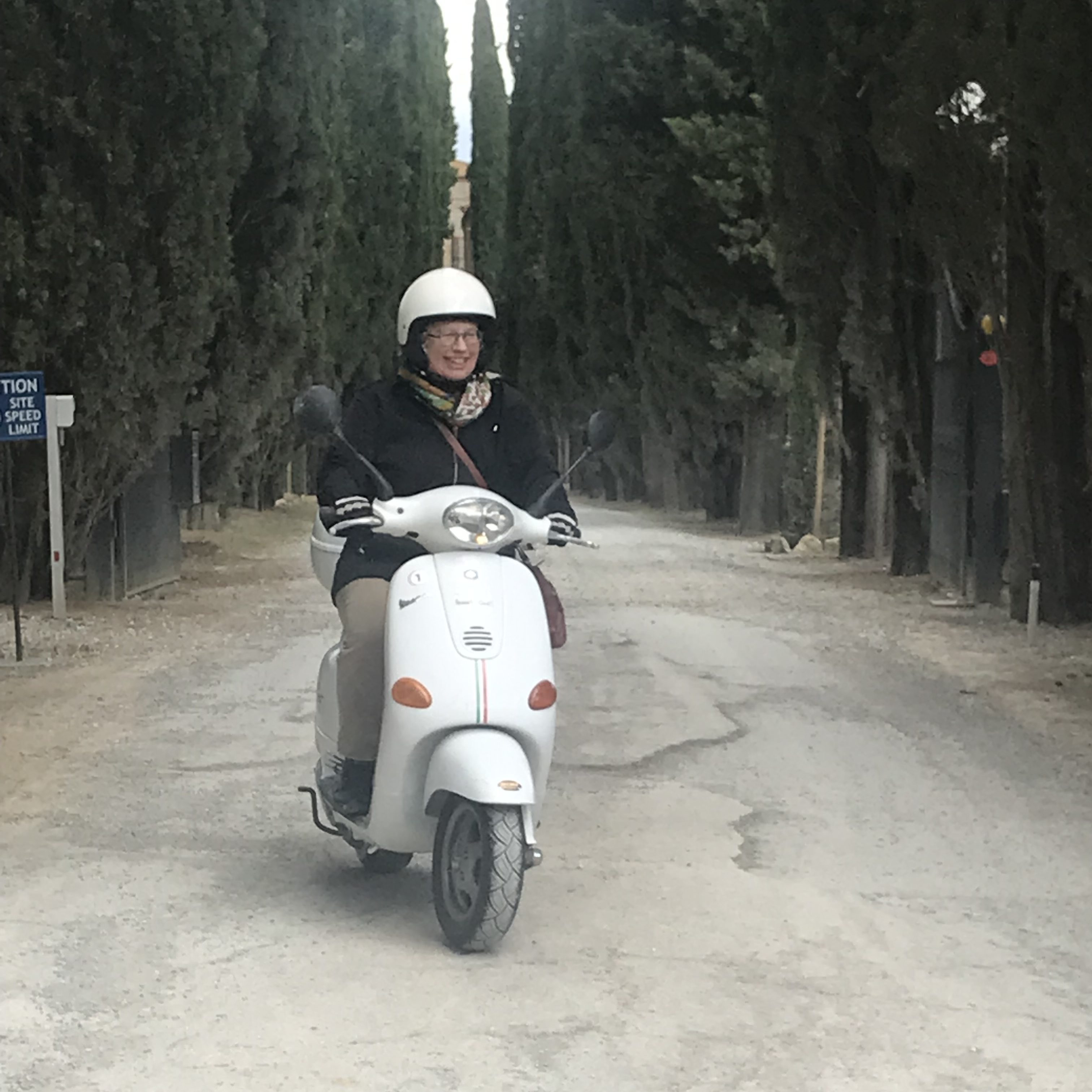
The scene was repeated in reverse when I finished my pizza lunch. I spied a man unloading bread from a van nearby and again, “Scusa” and”Aiutami” got me what I needed. But now I knew the truth—this wasn’t going to be an afternoon of point-to-point touring through Chianti villages to meditate on turning 65. I’d be lucky to get the beast and me back to our hotel without losing control on a turn or dropping it sideways in some awkward blind spot, at the mercy of Italy’s overly casual drivers.

And so day went down to dusk on my 65th birthday. I motored past vineyards and olive groves into hills of dense forest, spotlit in green and gold by shafts of sunlight that randomly broke through the clouds and just as randomly disappeared. I navigated hairpin turns at angles of ascent and descent that brought back the long-ago lessons of  motorcycle driving class, where I learned to slow the beast on approach, plan a through-line, and accelerate gently along it while fixing my eyes on an exit point beyond the curve.

At days’ end I was finally back in my warm resort, drinking red wine and meditating on turning 65. On this day I had by turns been thrilled, terrified, disappointed, satisfied, and perplexed. And multiple times, I had been forced to ask for help. As far as being a harbinger of things to come—if as goes the day, so goes the life—then this is what turning 65 means. Study up, courageously attempt, don’t hesitate to ask for help. Oh, and—avoid falling. Above all, do NOT drop the beast.

© 2021 Sarah White

p.s. FYI, this adventure took place on a “Best of Italy” trip with Viaggi di Gusto, my friend Cathy Fleming’s travel company, which I highly recommend.
Posted in Sarah's memoir | Tagged | 2 Comments

Hair

By Paige Srickland

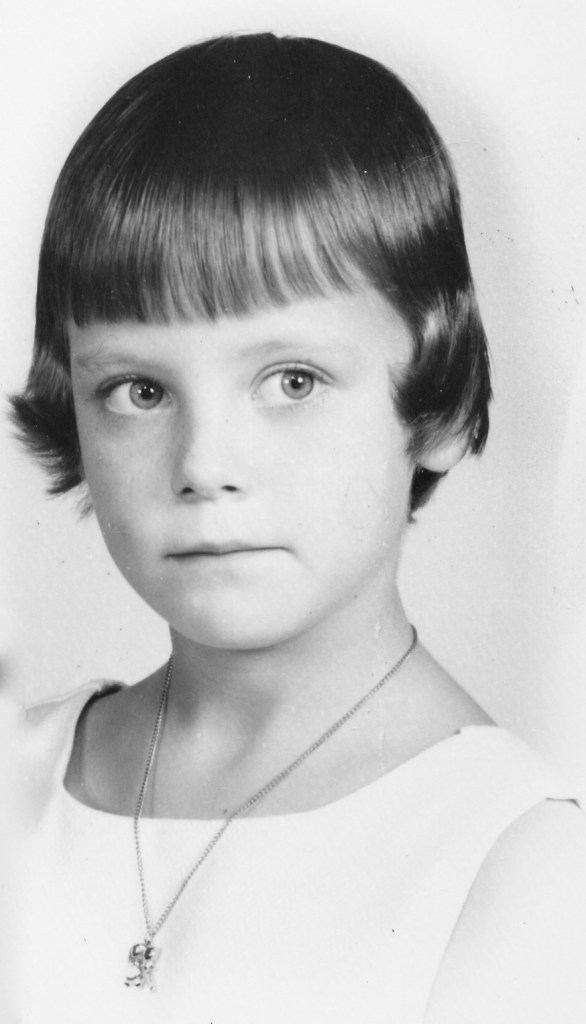
“Me, age 8 or 9”

I’m not sure why, but I have always been partial to long(er) hair. Today, when I see a friend or colleague who had lengthy or “big” hair suddenly appear with a short bob I often feel a sense of loss because my mental image of them has been marred. I grieve for the likeness that once was. It’s partly disliking having to acclimate to another change, and it’s partly because I genuinely prefer seeing more hair than not on people.

When I was small, my (adoptive) parents were big believers in short hair. In fact, I didn’t have a single adoptive family member with long tresses. Perhaps for the men it was the norm of the day plus the influence of having been in the military.  For the women, I think they were just into keeping low maintenance and simple. I felt differently. 

I wanted my hair like Cher’s. At the very least I wanted pigtail braids or a long ponytail past my shoulders like Laura Ingalls Wilder or Dorothy in The Wizard of Oz. I never had that experience. Instead, as soon as my hair began to cover my ears, my mother would either schedule a trip to her hairdresser or take me out to the backyard and snip away. It was never just a little trim.  

I learned to distrust beauticians anywhere when it came to scissors, lest they attempt to also coif me in what they believed to be their preferred image, and not what I wanted for myself.  There were far too many times in my life when I was mistaken for being a boy because of my short ‘do. I remember once very clearly being with my brother at a Reds’ baseball game. We were leaning up against a fence getting a closer up view of the players. (Johnny Bench was my celebrity crush back in the day.) An attendant, (an older man), approached us and said, “Hey fellas, you have to move away from there!” “I’m a girl!” I yelled back at him before stomping off. I was more irate about being called a “fella” than I was about having to go back to my real seat. Identity was and is a powerful thing.

I was too small in the 1960s and most of the ’70s to tell my parents that not just trimming but cutting OFF my hair made me feel worthless and unaccepted. It made my body feel invaded and violated. I felt naked, scalped and cold. Forced hair chops did not help me feel secure and cared for because there was no negotiating. The whole experience created unfair communication practices. It was a control measure for the convenience of adults. 

Instead of taking the time to help with styling or teaching me what I could do with my fine, fly-away hair and fragile self image, my parents would have it all cropped short and simple. It was for them; not for my benefit. Hair-chops caused me to detest my appearance and created a negative body image. In my child-mind it convinced me that something must be undesirable about me because the important people in my life couldn’t accept me for the way I was. Maybe hair cutting was a way to make me look more like my adoptive family and less like the real me.

I wanted to see the Real Me. I needed to see the Real Me.

© 2021 Paige Strickland

Paige Adams Strickland is an adopted person who grew up in the closed or “Baby-Scoop” era. Today she is the author of two memoir books: Akin to the Truth and After the Truth, which are about life as an adopted child and adult respectively. She is married with two daughters and two grandchildren, a teacher, pet mom, Zumba Fitness ™ instructor and in reunion with her biological family.

Posted in Guest writer | 10 Comments

A Place That Felt Like Home

By Katherine Becklin-Johnson

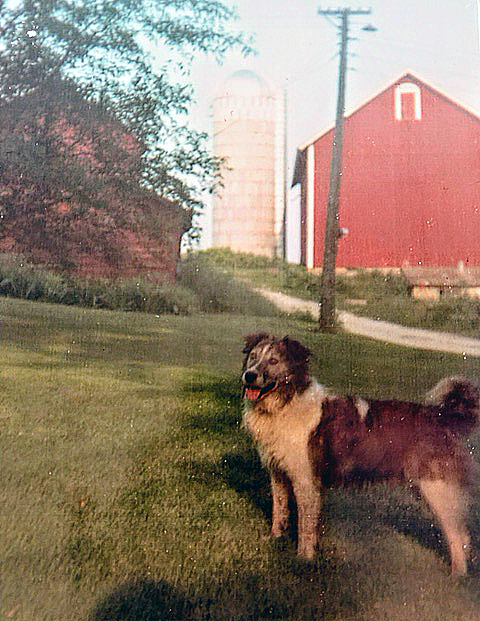
It rose up like a beacon on the 200 acre dairy farmstead, set in a valley near the wild Pecatonica River in the lush green unglaciated hills of Southwest Wisconsin. This simple wooden and stone structure bore a steep pitched roof. It was painted a distinctive red, mimicking the barns of my farming ancestors next to the Hadeland Fjord in Norway. The barn’s trim was white, a simple accent to a simple honest way of life. Some might say it was homely but to me it was home—the heartbeat of my daily existence.

It had a countenance of sorts—expressing a humble yet proud attitude that conveyed: “important work is done here”. A silo stood at attention next to the barn filled with precious silage to feed the herd that sustained our way of life. Our trusty herding dog Patches was an invaluable helpmate–waiting to be summoned to do his job bringing the cows in from the pasture to the barn at milking time.

The foundation of the barn was made of stone and its buff color accented the red barnwood perfectly; there was a symbiotic harmony to the blend of colors. A small stone milk house was attached on the East end of the barn where the liquid gold was carefully poured into 10 gallon cans and placed in a 4 foot by 8 foot concrete cistern filled with ultra-cold water from our well until the cheese factory collected the cans.

The upper section of the barn, the haymow, a large and cavernous space, provided a dry space to store the newly mown hay—and smelled of alfalfa, sun, sweat, and toil. This hay provided winter nourishment for the cows below when they couldn’t graze on green summer pastures. A large oats bin filled a small square section of the haymow.

Inside the main level of the barn behind the cross-hatched Dutch doors, our herd of dairy cows each had their own stanchion and a soft straw bed on the concrete floor where they could lie down and rest. In the winter, the cows helped warm the unheated space—our breath rose up in the still cold air. The stanchions kept them in place so we could safely milk them and provided a water trough and hay and silage to munch on. Twice a day these bossie beauties had to be milked; we were their servants.

The walls of the barn were whitewashed for cleanliness—this was a place of food production, after all. Our gigantic yet regal Percheron workhorses, Jerry and Ben, took their places in a wide stable just as one entered the barn. Behind them was the stray cat feeding station—multiple large bowls Dad filled with milk so the feral cats would have nourishment to be the mousers the barn required. These felines knew my father had a kind heart but he also recognized their role in keeping the barn free of vermin.

The barn was the nerve center of the farm. All life revolved around the cows. Ours were Holsteins, the black and white spotted variety. We rarely gave them names—Dad was too afraid we’d get attached. Farm life quickly teaches a child the arc of life and death. The cows’ milk provided our income, our livelihood. Their well being was our well being; we were inextricably linked. We didn’t raise cash crops. Instead the crops we grew on the fertile soil nourished the cows: corn for silage, hay, and oats. The cows’ needs dictated our every action: a cow struggling to give birth, a cow with mastitis, a cow with a sudden decrease in milk production. They could be cruel masters—we only took one family vacation when I grew up because we couldn’t get away from the rigors of milking cows morning and night.

From the time I was a young child I remember going to the barn with Dad. At first I stayed out of the way. There is a distinct rhythm to milking time and it must be respected. Then I was allowed to do small chores—putting milk into the cats’ bowls. As I grew, I got to feed the calves or give the horses hay. Then came carrying pails of milk to the milk house forty feet away and pouring it into the strainer-topped milk cans. Butterfat content mattered. But sanitary practices were essential–bacteria counts were carefully monitored by the cheese factory.

Of course the farmhouse was important—it is where we sat around the kitchen table, ate bountiful meals lovingly prepared by my mother, fed the threshing crew, entertained, and where we slept. But there was something magical about our barn. It was as if becoming a part of its purpose and essence made you a real contributing member of the family. The barn was the place I discussed the important issues of the day with my father. I was, after all, the quasi “hired man” until my brother was old enough to help. Dad gave me a percentage of the milk check when I was 11. We set up a checking account at the local bank for my portion. Dad said, “Now you have a stake in our livelihood—when the farm does well, you will do well”. We tuned into Milwaukee Braves World Series’ games, discussed politics and world affairs, and Dad listened to me recite my high school forensics speeches.

The bonds created by father and daughter, animals and child, were strong and unbreakable. Very much home.

© 2021 Katherine Johnson-Becklin

Katherine holds a B.S. in Education and an M.S. in Business-Marketing from the University of Wisconsin-Madison and has National Association of Gifted Children best practice coursework as well as a CSAC designation.  Katherine enjoyed a multifaceted career in business and education. She has served on numerous boards in service of education. A proud life-long Lutheran, Katherine is writing her memoir from which this excerpt is taken. The dairy farm she grew up on was less than a mile as the crow flies from the Lutheran church her Norwegian great grandfather helped found. Her farm bordered the one room country school she attended. She is passionate about the rural experiences that helped shape her.

Posted in Guest writer | Leave a comment

Branding Day

By Violet Suta Moran

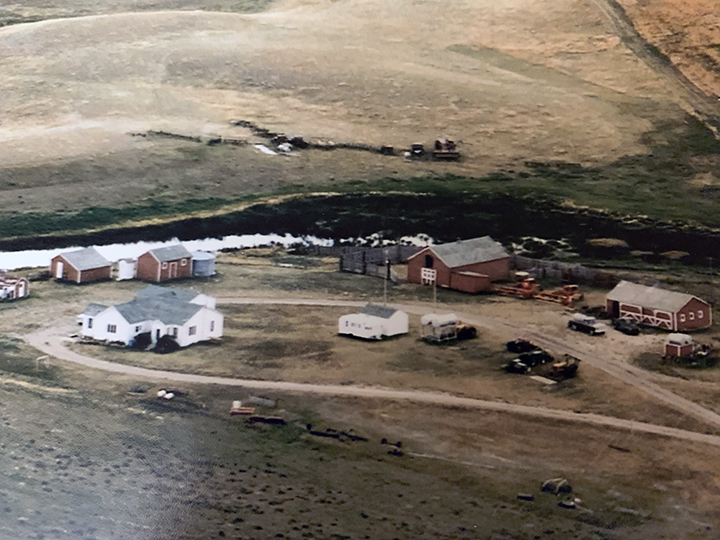
Aerial view showing the main buildings of the Suta ranch.

Branding was not a happy time for those on the receiving end but I remember it as an exciting day when I was a child expecting visitors and lots of action on our Montana ranch.

First thing to do was to herd 30 or 40 calves from the pasture into a corral. separating them from their mothers, and they weren’t willing to leave her side. Pop chased the cattle in his pickup truck refusing to use a horse because long ago he and a horse had an accident.. All the rest of us were on foot, running and shouting and waving our arms with a couple of dogs barking, the cattle mooing and Pop blowing his horn. This was noisy and dusty work in our dry-land country,

I would climb up and perch on the top of the corral to watch. My three older brothers would all run after one calf trying to trap it into a corner so they could get a rope around its neck. I thought it was funny when the calf kept escaping from their grasp and they had to continue running around the corral. Pop would get impatient and yell at the boys, “Get that goddamn calf over here,” as if they weren’t trying to do that. My brothers were glad when Uncle Gilbert relieved them. He was a real cowboy who could lasso the calves instead of chasing them around the corral.

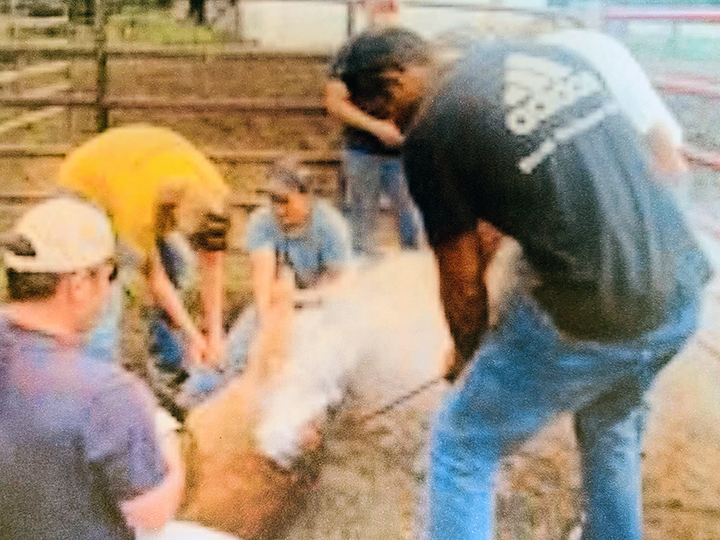
Once a calf was caught, it was thrown down onto its side. It was held in place with one person leaning back on the rope around its neck and another person sitting down at the rear to control the back legs. The man at the rear got kicked and shit upon. This was one time I was glad to be different than my brothers because my job was to help in the house instead!

A calf being held down, one person giving a vaccination, and smoke coming from the hide as the calf is being branded.

Henry remembers me bringing morning break out to the men, only to be scared and chased by the mama cows who were mad as hell at everybody for hurting their babies.

Pop always did the branding himself, knowing the brand would be visible to anybody and wanting it to look good. The hot branding iron had to be held in place just the right amount of time to scorch the brand permanently onto the leather hide. If the iron wasn’t held flat for a long enough time, hair would grow back on the hide and obliterate the brand. Making a perfect brand wasn’t easy with the calf bucking and moving despite being held.

The temperature of the branding iron was a big factor in making a good brand. If the iron was too hot it would burn too deeply into the skin and could start a fire that might disfigure the brand, When the iron was not hot enough it had to be held in place a longer time, making the brand messy as the calf didn’t lay still for this.

Heating the irons was a special skill taken very seriously by Grandpa Lozing. He had to tend the fire carefully to have hot coals without too much flame and he had to move the irons around to get them heated just right.

The noise of the day continued until everything was done. The calves were bawling for their mothers who were bellowing back. Pop was shouting and cussing about everything and at everybody. Those not holding down a calf were busy trying to catch the next, chasing around the corral and yelling. Corral gates were being quickly banged open and closed. The pungent smell of fresh manure was mingled with the acrid smell of the burning hair and hide.

Our brand was registered by Pop as “lazy T H bar” honoring his first two sons, Ted and Henry. As my brother Ben said, “The cattle are lucky we weren’t all six children born yet.”

© 2021 Violet Suta Moran

Violet grew up on a farm in Montana just 8 miles from the Canadian border and about 70 miles east of Glacier Park. After getting a degree in nursing at Montana State University in Bozeman, she literally picked Madison, Wisconsin off the map as the first place she was going “on my trip around the world.” Delayed by marriage, 3 children and administrative positions in facilities including University of Wisconsin Hospital and Clinics, trips to many different countries came later. For the last 20 years before retiring, Violet ran her own nurse consulting business. In retirement she enjoys travel, dance, and jazz, often in combination.

Posted in Guest writer | Leave a comment

Beavers’ Tale

By Faith Ellestad

One theory of eternity, my current favorite, involves the ability to return to earth as a different entity.  Given a choice, I think I might like to return as Castor canadensis, a good old North American beaver. “What?” you say. Well, there is a lot to be admired about beavers. They are industrious, family centric, clever, and adaptable, all qualities I strive for.  And I just find them endearing.  Although probably not true for everyone, all my somewhat sporadic beaver-related connections have been happy. Nope, never had a bad day that involved beavers.

But what drew my attention to beavers in the first place, as opposed to, say, lemurs or gorillas?  My interest probably dates back to the early 1950’s when the Bristol Meyers company introduced Bucky Beaver as the spokes-rodent for their new Ipana toothpaste.  “Brusha  Brusha  Brusha, here’s the new Ipana, with the brand-new flavor, it’s dandy for your teeth,” sang Bucky, while enthusiastically demonstrating just how fun brushing really was.  As a Colgate family, protected by its trademark Gardol Shield, we never actually used Ipana, but still, Bucky Beaver with his gleaming white incisors captured my heart.  Soon after the introduction of Bucky, the iconic “Leave It To Beaver” series premiered, featuring the toothy Jerry Mathers, (who ostensibly resembled a beaver, but in reality looked more like a chipmunk, if you want to be picky). Still, I was a devoted fan of The Beav.  As I got older, and more discerning, I read natural science books exploring the lifestyle of actual dam-building beavers, watched “life of the beaver” nature specials, and eventually, on a family camping vacation, saw chewed tree stumps and an actual beaver dam.  For some time, I was hooked on beavers. 

Then puberty intervened, bringing new, more immediate interests, such as social life, education, marriage, kids and work.  I put away the things of a child, passed the baton of wildlife studies on to my offspring, and reluctantly assumed the mantle of under-employed adult.

One of my early jobs with the State of Wisconsin was file clerking in the UW Hospital Xray file department. It was a physically taxing, exasperating and monotonous slog made bearable only by good benefits and my amusing, quirky fellow clerks, most notably Tim.  Tim was unusually good-natured about the job, which I attributed to his being strong, tall, young, and just marking time until his musical career took wing.  Nothing seemed to bother him, whereas I would drag in, perpetually late, frazzled, hungry and often make-up-free after struggling to get my kids ready for school.  Occasionally, staff had to work weekends and one memorable autumn Saturday, Tim and I were assigned to cover an early morning shift. When I arrived at the ungodly hour of 7AM, Tim was already there and in bubblingly good cheer.

“Hey, welcome!” he practically yelled as I walked into the file room past the barred security window.

“What’s up with you?” I asked, puzzled that anyone would be in a such a chipper mood at that hour on a Saturday.

“Oh, this is so great! I couldn’t wait for you to get here!” he boomed.  Tim had a deep base voice that could carry to all corners of a room effortlessly.

I flinched a little. I loved Tim, but this morning the volume was a bit much.  “What’s so great?” I repeated.  “Tell me.”

“It was so cool. You won’t even believe it.”

“Yes I will.  I promise. What?”

“OK. “Well when I got here this morning, there were these two guys standing at the window.  I asked what they wanted and they said they were waiting for an Xray to be brought over from the radiology department. Of course, I needed to see some ID.  It turns out one guy was a deputy sheriff and the other one was-get this-a forensic pathologist. So we talked until the Xray copy arrived and I logged it in and had them sign for it.”

“OK, so what was their story?”  This was definitely unusual, and I was curious.

“Well, I looked at the Xray naturally, and it was just the lower part of a detached arm. Just the arm. Nothing else. I don’t think we ever had something like that before, so I said ‘what IS this!’

And the deputy said, ‘It’s an arm.  Someone found it in the woods and we’re investigating. We don’t have the rest of the body. We need the Xray as evidence’.”

Recounting his story, Tim, in his excitement, had flushed a vibrant and rather alarming shade of puce.  He continued.

“So I asked the deputy, ‘what do you think happened? How did it get there?’

And the forensics guy said,”

Here Tim allowed a dramatic pause before assuming the conspiratorial tone of the pathologist,

“’Hmm. We think beavers.’”

“Beavers!” he repeated gleefully. “Beavers.  Can you believe it?  We think beavers!”

This might be the most perfect story I’ve ever heard. And I will love Tim forever for sharing it with me.  It became a personal meme for me in the 1980’s, before “meme” was even a thing, and still serves me well.

A few years ago, as I became my mother’s caregiver, I was compelled to develop new, unwanted skills, among them, hair cutting.  As a person severely lacking in the digital coordination department, my attempts to manipulate comb, mirror and scissors in unison were clumsy and laughable at best.  Although I persevered and eventually got the front looking presentable, between my lack of dexterity and Mom’s constant fidgeting, the back was dreadful, different lengths, slanted from left to right and shorter than I had intended. 

“How does it look?” she asked me.

Well, actually,” I was forced to admit, “The front looks ok, but the back kind of looks like it was chewed by a beaver.”  She was delighted.

“That’s ok,” she said.  “No one looks at the back, anyway.” 

So I able to practice my special style numerous times.  As long as she couldn’t see the back, I was willing to keep gnawing at it.  

After Mom died, I thought I could retire from the styling business, but then Covid arrived, and with it, the closing of all the chop shops, salons and barbers. I decided to just grow my hair, but after about 6 months, my husband really needed a trim. 

“Would you mind giving me a haircut?” he asked? Seeing my reluctant expression, he said, he thought encouragingly, “You cut your mom’s and it always turned out fine.”

 I guess she was correct, no one had looked at the back. So I agreed to give it a try.

Armed with scissors, comb and a spray bottle, I set to work, dropping the comb every time I positioned the scissors and misplacing the scissors every time I reached for the spray bottle, but after an agonizing learning curve,  a you-tube tutorial, a lot of laughter between us and  really, very little blood, I finished the job.  Much like my mother’s stylings, the front was definitely improved.  The back?  Ehh.  

“Well, how does it look?” my spouse queried faux-casually, in an attempt to mask his anxiety. I handed him the mirror so he could view all angles, and offered a thoughtful critique.

“Hmmmm,” I said, “We think beavers!”

© 2021 Faith Ellestad

Faith has been writing to amuse her family since she was old enough to print letters to her grandparents. Now retired, she has the opportunity (and with Covid restrictions, the time) to share some personal stories, and in the process, discover more about herself. Faith and her husband live with two elderly cats in Madison, Wisconsin. They are the parents of two great sons and a loving daughter-in-law.

.

Posted in Guest writer | 1 Comment

Governor’s Island Magic

By Ellen Magee

If the number and size of the Mendota Mental Health grounds’ effigy mounds are any indication, Governor’s Island and the Mendota lakeshore surrounding it for miles was sacred ground to the early inhabitants of the area. I have my own reasons for considering this land to be sacred or magical.

Governor’s Island is not an island any more. The first white man taking ownership of the island was Governor Farwell. In 1858, Governor Farwell gave it and miles of lakeshore land to the State of Wisconsin for the first state hospital for “the insane”. In the 1860s a land bridge was built to connected the island to the grounds of Mendota State Hospital.

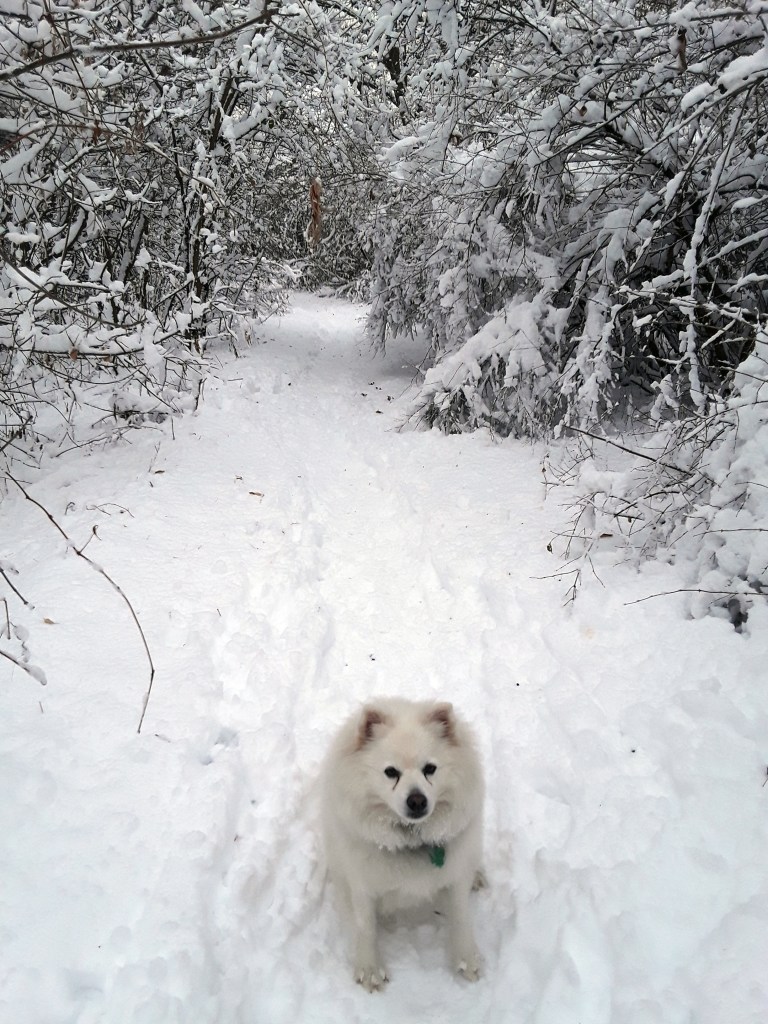
In this time of COVID, I often drive to Governor’s Island with our dog, Snowball, in the hatchback. We cross busy Northport Drive onto Troy Drive until we turn left at the Mendota Mental Health grounds. Cinder Lane is the second left, just past the speed bump. I always slow down after that turn and look closely to see if there are any deer loitering in the woods. A sighting is rare in the summer, but during the winter several can usually be seen lying in the snow in the woods or, if it’s dusk, moving across the road in a small herd. Sometimes Snowball stands on his hind legs to watch them, but never makes a sound as they walk by.

The parking lot is straight ahead, not far, and the road turns into a dirt lane before you get there. On weekends in summer the small lot is full of cars and in winter, large trucks hauling trailers or fishing shanties. Snowball and I prefer weekdays. Then we usually have the place to ourselves. In summer there might be one car, often someone else with a dog. In winter there are sometimes a couple of trucks with trailers for hauling 4×4 vehicles. It is a popular ice fishing area and you can see the fishing shanties spread out over the huge area of the frozen North end of Lake Mendota. Each afternoon, about the time we arrive, the fisherpeople load up their equipment on sleds and head back to their trucks on their 4x4s.

 If it’s icy I will have attached my ice gripper spikes. In winter I just wrap my scarf around my face for warmth, rather than wearing a COVID mask. Besides, we hardly see anyone walking after mid January.

Snowball blasts out of the car like he doesn’t know I will grab his leash before he gets far. If there is nobody in sight, I let him run off-leash. He trots around with his nose to the ground and leads the way to the trail. The trail is less than a mile long, but Snowball’s forays into the woods make his run about double. Snowball is an American Eskimo, and in the winter he is in his element. Once he gets on the trail, he starts out running full speed for five or ten seconds, then he flips onto his back and wiggles around in the snow for a few seconds, turns over, takes a bite of snow, and takes off again. These antics never get old; for him or for the entertainment value. Recently, someone built a snow figure near the start of the path and each time we walk, it’s more yellow. If Snowball smells a particularly fresh patch of yellow snow, he will roll in it, making a doggie angel. Soon after arriving he does his business.

At the beginning of the path one day, before the ground was snow covered, Snowball came running out of the woods with a big white bone with some red stuff still on it and dropped it at my feet. I ungratefully threw it back into the brush and to my surprise, Snowball never went looking for it again.

There is one place where the path forks to the right down to a narrow peninsula and Snowball barrels down the hill full speed. In the summer there is a little cove on the shore side where the water is perfect for Snowball’s dip. He runs into the water until it’s up to his chin and then sits down to cool off. He doesn’t like the big waves, although he has gradually gotten braver. He has a very thick set of two coats that insulate him winter and summer. When he’s done with his dip, he prances out and shakes, looking like a skinny chihuahua. If you know where to look in the hollow of one of the trees, there is a fairy bed of lashed sticks, a milkweed pod pillow and pretty abalone shells. There are duck blinds down at the end of this little peninsula in the fall. In the winter the wind chill can be pretty intense and I often skip that path, but not Snowball!.

As we progress back up along the main path, Lake Mendota is more visible. The path winds along the top of a bluff with the lake below on the right and dense thickets on the left of the path. In the summer there are often people sitting at the foot of the bluffs or in boats fishing. The city skyline is visible across the lake. As we walk around the island, the city-scape of course changes, which I find a bit disorienting. Walking back around the other side of the island, when the lake is open, I look for eagles up in the trees. When there are more people in the summer, we often get a tip, “There were eagles back there”, (pointing). Although I have only seen an eagle once, I always look, when I get to that area.

In the winter I try to spot the woodpecker we can hear, and once in a while I glimpse a cardinal or nuthatch. Winter is fun when we can see animal tracks and scat in the snow: usually deer and rabbits. Snowball typically appears quite anxious if he can’t see me. But on Governor’s Island he sometimes disappears into the brush until he hears me call his name–the magic of Governor’s Island.

I had an interesting experience this year around New Year’s. The lake was still open except for about six yards of ice out from the shore. There were a lot of geese, swans, and ducks congregating as they bulked up for migration. It was pandemonium near the parking lot. As the bird calls lessened on my walk, I heard a distinct whistle and thought, hum I’ve heard of whistling swans, it must be the swans. I could also detect a faint tinkling sound. I heard the calls again as I returned to the parking lot.

I came back several days later and the parking lot area was silent. The majority of the birds were gone, except some stragglers far out into the lake. After our walk, on our way back to the parking lot, I heard the whistling and tinkling sounds again, very nearby on the right. Not a bird in sight. I walked closer to the water to make sure I hadn’t missed a bird behind the bushes, and that’s when I realized the ice itself was making the sounds. Pure magic!

© 2021 Ellen Magee

Ellen lives in Madison with her husband and animals too numerous to mention.  She is a retired social worker.  Her family includes her son, two step-sons and their assorted kids.  She keeps busy by writing racial justice-themed letters to decision makers and editors, mentoring people in substance abuse recovery, dancing, kayaking and e-biking.  Her goal in retirement is to cultivate her friendships.

Posted in Guest writer | Leave a comment

Me and Marching Bands

By Sarah White

Forward Marching Band at the Orton Park Festival, August 2021, Madison Wisconsin

In the 1960s, a high school stood behind our house in Carmel, Indiana, separated from our yard by a chain link fence. Beyond the fence was the high school parking lot, and beyond that a building that was constantly being expanded to hold the bulging Baby Boom. Its paved surfaces waited for me like open roads. I learned to roller skate, bicycle, skate-board, and eventually drive there.

Up and down that parking lot flowed life. Crowds came to football games on October nights. Families came to pageants at Christmas. Early spring snow locked the fans in the stadium many a time during the boys’ basketball tourney. But the most intrusive element of the school’s life on ours was the marching band.

Every year in early summer, the Carmel High School Marching Greyhound Band started practicing for the Indiana State Fair Band Day competition held in August. Thirty or forty teens drilled in that parking lot. Each year, the band would learn a three-minute show piece and marching routine designed to win the competition. They would practice every morning, going over the piece of music while marching the show routine, the sound dopplering back and forth. When they added two-a-day rehearsals by midsummer, the approaching and retreating music accompanied our supper as we ate on our screened back porch.

Shouts echoed across our back fence from the band director, Mr. Loveall, through his ever-present megaphone: “Come on, don’t be a Mickey Mouse band! March 8 to 5!  Guide down your lines!  Take it from Letter B!”  Band music is the only type of live music performance where the players don’t have to worry about being too loud.  This barrage of sound was maybe 20 yards from our back door. 

After dinner I’d join my friends, a pack of half a dozen little girls from Audubon Drive. In summer 1962 I was the most recent one to master riding a bicycle—I would have been about five years old. We’d pedal around to the high school parking lot where the band was practicing. That summer, we had a mission.

Back then, majorettes—ours were known as the Carmel Coquettes—carried pompons made of tissue paper streamers. These shed strips as the girls practiced their synchronized gestures. With the perfect faith of children, we believed we could make our own pompons if we just collected enough of the fallen tissue strips. To catch them, we would circle on our bikes at one end of the parking lot and wait for the band to pass. Then, like birds after crumbs, we would dart in to pick up tissue fragments, leaning around the handlebars of our bicycles until the band reversed and approached again.

One day I failed to notice the band returning. Abandoned by the other little girls, I was suddenly engulfed, swallowed by a pattern without a space in it for me. Trombones jutted, trumpets blared, drums banged, and the sousaphones’ huge toothless mouths gaped at me. I howled with fear and embarrassment. There was my little blue bike and me, drowning in a scary noisy sea.

First the Coquettes and then the rows of instruments passed. The way I remember it, they actually went through me as if my bike and I were made of air, not steel and flesh. Not an eye turned left or right; not a hand reached down to steady me; somehow their marching feet varied from the designated pattern the minimum necessary to return to formation as soon they passed the obstacle that was me.

Why not stop and comfort a crying child? Because theirs was a serious business. In the middle of the 20th century, a high school marching band was the most visible manifestation of school spirit and carried the burden of the whole town’s pride. They had their eyes on the prize and that was winning the State Fair competition.

Had the drum major who led the band even noticed me? If he had, what could he have done? A band doesn’t turn on a dime. On the other hand, what kind of person doesn’t notice a marching band coming? I only know I haven’t changed. If one thing holds my attention nothing else can break through.

I have recently discovered the activist marching band movement, where former marchers piratically riff on the regimentation of traditional marching bands. They tend to be community-based and collectively-organized. They turn out for protests and street fairs. They dress in thrift-shop uniform bits and pieces. They make music, and out of music make a community, and out of that, bring a measure of joy to the angry business of protest. Their brassy volume demands our attention–just like the high school bands do, but for a very different goal.

When Portland, Oregon’s March Fourth Marching Band played a local summer music festival, they had me at first squeal. Dancing to their raucous brass sound, my early childhood trauma of being run over by a marching band was finally healed.

Our Madison, Wisconsin version, the Forward Marching Band, formed in 2011 in response to the epic protests surrounding our newly-elected governor’s regressive agenda. I seek them out and the spectacle never fails to delight me.  If I knew how to play a band instrument, by golly I think I’d join them.

(©  2021  Sarah White

Posted in Uncategorized | 2 Comments

 Only One Shoe

By Patricia LaPointe

You awaken to see the alarm clock with its bright red numbers. It’s 2:00 AM. You walk the halls  and check each of your daughters’ rooms to be sure they’ve all returned home. One daughter is missing. You begin to worry, but remember she said she might be at Brian’s apartment.

As you return to your bed, the phone rings.

“Mom, an accident. Brian’s hurt. I only found his shoe…At the hospital…they won’t let me see him” your daughter, gasping for breath as she speaks.

You tell her to sit in the waiting room. You’ll be there soon.

As you drive to the hospital you wonder if your child was also hurt. You’re angry with yourself for not asking.

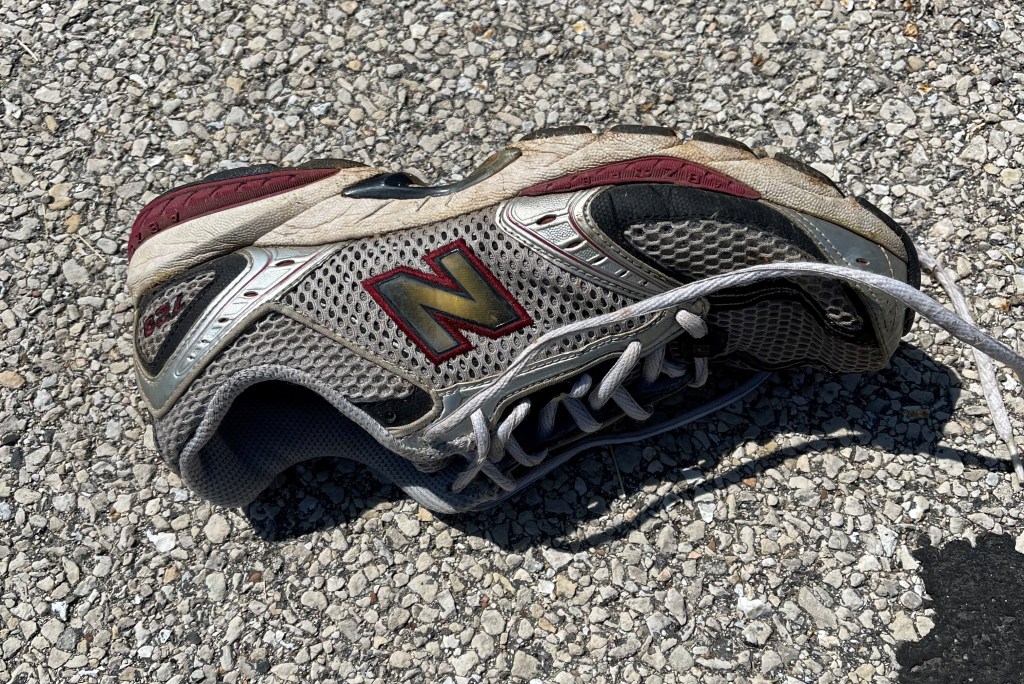
At the hospital, your daughter rushes to you. “Mom, we had a fight. He ran away. Hit by a car. I only found his shoe. They won’t let me see him.” She is hugging his shoe. You’re grateful that she doesn’t seem harmed.

A nurse takes you to his room. There are no sounds coming from the monitors still attached to his body. You look closer. It appears his neck is broken. Someone enters the room with a large black bag.

Your daughter runs to you when you return to the waiting room.

“Where is he? Is he OK? Did you talk to him? I have to go to him. I need to tell him I’m sorry.”

Before you can answer, you see out of the corner of your eye, a large black bag being wheeled down the hall. You grab your daughter and try to move her away from looking in that direction. No eighteen-year-old girl needs to see that.

It’s too late. She turns just as the black bag is passing by.

“Mom, that’s not him. It can’t be him. I have to tell him I’m sorry.”

Someone brings a bag with Brian’s belongings: a leather jacket and one shoe.

 She is trying to run into the hall. You hold her back. She collapses, sobbing, on to the floor.

These are the last sounds she makes for the next three days as she lies in bed wearing Brian’s jacket and holding onto his shoe, much as she held her stuffed animals when she was younger.

At the wake, Brian’s parents angrily demand your daughter tell them how it happened. What were you arguing about? Why didn’t you stop him from running away?

You hear their questions and move to stand beside her. She tries to speak but is sobbing and shaking.

You understand their need to know these details, perhaps to have closure. So, you answer their questions, knowing that for your daughter, closure may never come.

©  2021 Patricia LaPointe

Pat LaPointe, editor of Changes in Life, a monthly online women’s newsletter, is contributing editor of the anthology, The Woman I’ve Become: 37 Women Share Their Journeys from Toxic Relationships to Self-Empowerment. In addition, she conducts writing workshops for women — both online and onsite. Pat’s essays and short stories have been published widely. Currently, Pat is completing her first novel, forthcoming late 2021.

Posted in Guest writer | 2 Comments

Wednesdays

By Mona Jean Harley

Wednesday, March 17, 2021. I am feeling such nostalgia and wonder today as I reflect on the significance of Wednesday connections today and throughout the years. I’m working from home today, the one day per week I still work remotely during this COVID-19 pandemic. It is reminiscent of every day that I worked from home starting almost exactly one year ago, through the end of last school year. It was quite a different experience last spring to do school social work from my grown daughter’s bedroom! Years ago on Wednesdays I would play with my then young daughter in that same bedroom, and later my son would join us, when I worked part time and was home on Wednesdays. When my daughter began Kindergarten I started to volunteer in her classroom on Wednesdays, and then 4 years later I started volunteering in my son’s classroom on Wednesdays, too. During my part-time years I took a yoga class from a neighborhood yogi on Wednesdays and also an exercise class at the Y. As the kids exited elementary school and I had more quiet time on Wednesdays, I tried taking time to journal or read by the fire on chilly days, and on the breezy porch in milder weather.

I’m reminded today of another Wednesday ritual I experienced years ago, in the late ’80s. My husband and I had just moved to Madison, Wisconsin to attend graduate school, leaving our families in Indiana where we had both grown up. I remember our first apartment off of Fish Hatchery Road. On Wednesdays I had one class in the morning, then I would take the bus home. In nice weather I would get off the bus on the north side of the Beltline, walk along Fish Hatchery Road over the Beltline to our apartment, rather than spending an extra tweny minutes on the Madison Metro winding around endless frontage roads! On one of my parents’ first visits to Madison I recall my dad exclaiming that he had never seen so many roads that led to nowhere!

Upon arriving at our apartment either by foot or by bus, I would eagerly get the mail, and like clockwork, there would be a letter from Alan’s mom. She would write about the weather, church activities, her siblings who lived close by, and her second grade students. I would read the letter a second time before I picked out just the right stationery, sat down at the table, and would write a reply.

Writing letters has always been a joy of mine, the action of writing, the feel and the beauty of the perfect card or paper. When I was young one of my Christmas gifts every year from my grandma was a box of stationery. I recall Betsy Clark & Holly Hobbie notecards, and round paper stationery covered in little woodland creatures with words in a spiral stating, “We all plan to write when we get around to it, now I can do it, I’ve got a round tuit!” And in the very center of the paper was a little brown wooden coin that had the letters “t-u-i-t.” I thought that was so clever! I enjoyed writing my letter on the plain side of that stationery, in a dizzying spiral pattern. I would always save the last beautiful notecard or piece of stationery as a way to treasure the special gifts from Grandma.

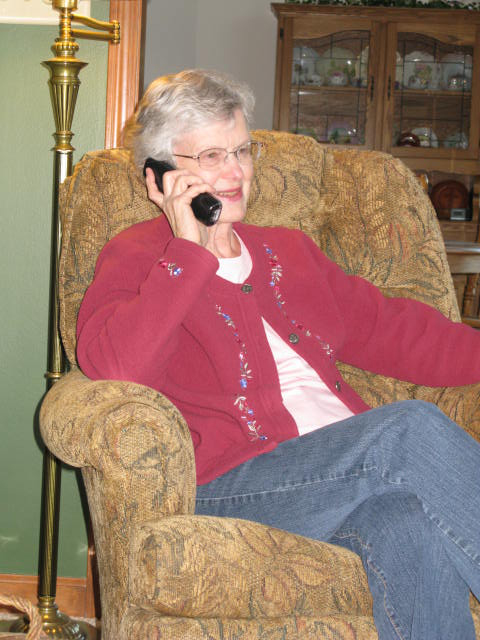
My mother-in-law Dorothy talking with me on a Wednesday

Those Wednesday letters from my mother-in-law in the late 1980s transformed years later into Wednesday phone calls from her, my friend. She would still tell me about the weather, church activities, her siblings who lived close by, and sometimes stories about her former second grade students. But now she also wanted to hear stories about her two grandchildren, and she would delight in their antics.

She and I would enjoy sharing the simple life pleasures we were experiencing, with our common sensibilities growing through the years. I knew the kinds of things that would delight her…the first crocus peeking out from melting snow, an evening stroll in the light of the full moon, making her mother’s delicious bran muffins, receiving a letter or card from me.

Just today on this Wednesday, I sat down to play the piano. I opened a book of Bach music and was sight reading many compositions. I started playing a Musette, quickly realizing that I had memorized this as a teenager. The notes were rolling off of my fingers much more smoothly and fluidly than with any of the other pieces I was playing. I felt a sense of excitement and wonder that I still knew so many measures by heart, after all of these years. A sudden urge to text Dorothy, my dear second mom, leaped into my mind. In an instant I could imagine her excitement when she heard the ping from the text message, then her warm smile growing across her face as she read my text about the music that I still knew by heart, after all of these years.

In the next moment I remembered the reality that she had passed away two years ago next Wednesday, yet I knew by heart the love that we would always feel for each other.

© 2021 Mona Jean Harley

Mona Jean Harley was delighted to stumble across the “First Monday First Person” writing group in Madison Wisconsin in the fall of 2018, which has been a perfect space to become more fully inspired in writing and in paying attention to life.” Noticing connections as she experiences life is expressed in her living and writing.

Posted in Guest writer | Leave a comment

Braided Essay: Silverwood Park Responds to Dane County Parks Hours, Rules, & Information

By Sarah White

In my writing, I’ve begun to play around with patterns; one is the Braided Essay, a form that invites the weaving of a personal narrative with outside information that takes on more resonance as the essay unfolds. The following is an attempt written for a recent class I took with CreativeNonfiction.org titled “I to Eye: Integrating Research Into the Personal Essay.” In that class, I focused on writing about Silverwood Park, one of the most recent in the Dane County, Wisconsin parks system, where I have been volunteering since last July.

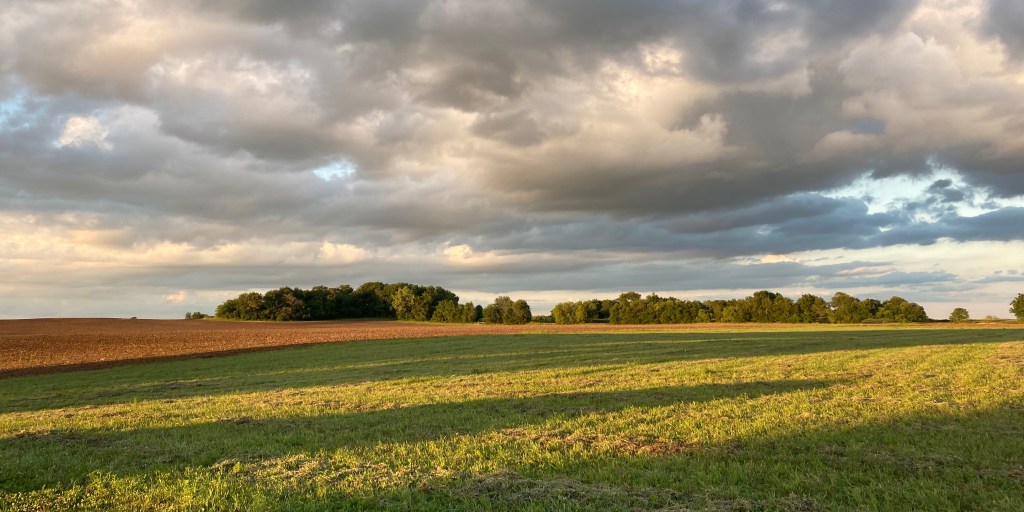
This is my land, my Silver Wood. If your heart is hurting, if your soul is troubled, I offer my comfort. If you are bored, I’ll divert you. If you have been too sedentary, let me put you in motion. Recreation is what I’m here for. Plus education and agriculture—aspects you won’t find in many of the 26 parks in the Dane County system. I have over 200 acres of farmland and 100 acres of woods, bordering a small lake.

Most of my forest has been restored to native-only plants and trees, thanks to the volunteers who groom me. I am shapely, thanks to the glaciers that passed this way, full of slopes and glades. Because I drape myself over a high ridge, I am breezy and cool, even on the hottest days. You can see for miles from my brow. Join me here and experience my welcome.

Dane County Parks Hours, Rules & Information

Report an Incident or Emergency

To contact the police, call 911 (Emergency) or (608) 255-2345 (Madison Police non-emergency dispatch). You can also report park related issues or incidents to the Dane County Parks Office (608) 224-3730.

If you should injure yourself or come upon an emergency, by all means follow those instructions. But if your visit to me coincides with an emergency of an existential nature, please contact a licensed therapist. Or, for that matter, any sort of healer, especially if you experience nature as spiritual. I hope you find assistance well-matched to the nature and severity of your incident or emergency.

Park Admission

Visiting and hiking in Dane County Parks is free. Some activities require a reservation or a permit.

Have you ever really thought about the words, admission, permission, reservation? Admission is the word for when you check into a hospital, admitting that you cannot for the moment care for yourself, and must give permission to others to intervene.  Reservation means a limiting condition. But it can also mean, a doubt, a hesitancy. Not all who come here seek healing, and not all activities here are benign.  I admit I am sometimes hesitant to grant permission to some park visitors.

Personal Conduct

All controlled substances and paraphernalia, identified in Chapter 161, WI State Statutes, shall be prohibited from use or possession.

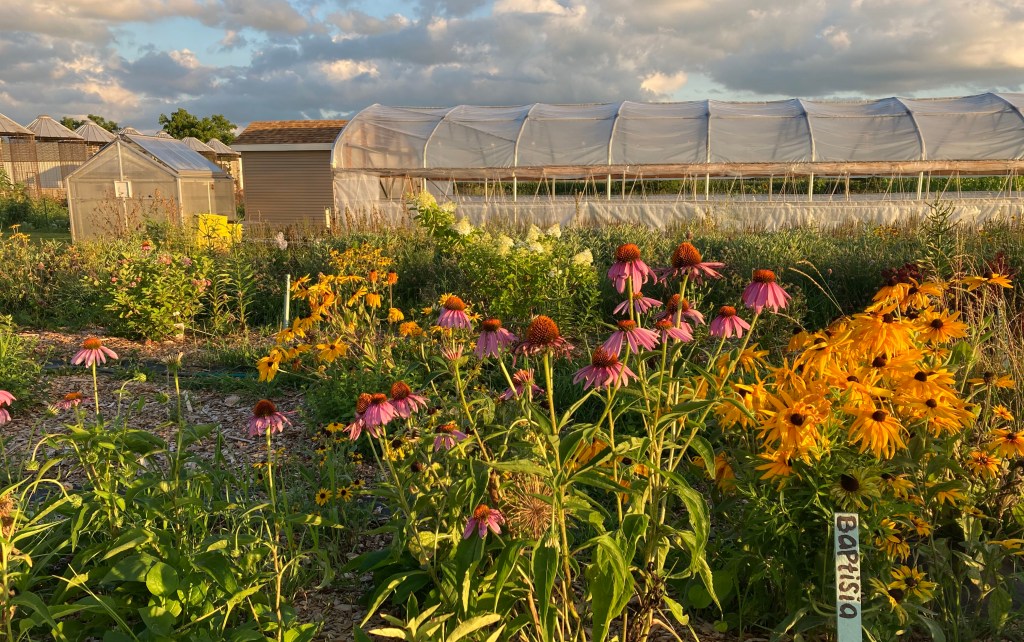
I know my parking lot has been a site for opioid sales and use. I want you to know that there’s Narcan in the first aid kit located in the North Shed. It’s a good thing Farmer John is a retired emergency room nurse; most days, he’s at the park working on the perennial beds and pollinator prairies. He’ll be happy to show you how to administer the Narcan.

But really, I’d rather you keep your personal conduct from making work for others or harming the land. I’m sorry if you are so sad you turn to drugs. Have you considered getting out of your truck and letting my forest bathe you?

Refuse

No commercial or household waste is allowed. All litter, debris, and trailer refuse must be removed or placed in areas or containers provided.

Please don’t refuse to manage your refuse; your household trash doesn’t belong here. However, I am quite willing to accept your emotional baggage. Please feel free to leave behind the concerns, grief, fear, or anger that you carried in.

I have thrived for millennia without “Parks Hours, Rules & Information.” I was home to woolly mammoths and mastodon 7,000 years ago. Paleo Indians gave way to Mound builders on my watch. Ho Chunk would still be returning to harvest rice from my marshes if Norwegian and Yankee settlers hadn’t come along. When George Silverwood bought me in 1849, I was uncultivated prairie and savanna. He thought he owned me and could give me his name. But ever since I was donated to the Dane County Parks system in 2001, I have belonged to you.

How might I be of service?

© 2021 Sarah White

I teach about the Braided Essay, among other ways to “play with patterns,” in my class in Creative Writing occasionally offered through Madison College. Find upcoming classes on my Upcoming Workshops page, here.

Posted in Sarah's memoir, Uncategorized, Writing prompt | Leave a comment