Despite Covid19

By Kurt Baumann

According to Webster’s Dictionary, the word “serendipity” means “the faculty or phenomenon of finding valuable or agreeable things not sought.” My old fifth-grade teacher explained it as “looking for something and accidentally find something else.” That describes my day, on Thursday, December 3rd, when I found something that I hadn’t had for a while.

My original goal was to work on a paper for my writer’s group, First Monday, First Person, and read it at our next meeting. On her way to do an errand in Sun Prairie, for some work on her car, Joan, a nice lady from my church, agreed to drive me to the Columbus Library, then take me back home at 3:30.

Before that, I had some errands to do. Since it was the third of the month, my Social Security benefits were directly deposited to my checking account. Since I use this day to pay my monthly expenses, as well other bills, and do grocery shopping, it’s a busy day for me. After phoning for a taxi, I was driven to my bank, where I did my transactions.

Since March 2020, COVID19 has made its presence known. Wearing a mask when riding in a taxi, because of possible airborne virus transfer contact with the driver, was a rule of the taxi company. American National Bank’s branches, in Beaver Dam, passed the same rule, and closed its lobbies, for the same reason. Drivers had to steer through the bank’s drive-thru while customers talked to the tellers through the drive-thru intercom. This is how I withdrew my money, and made money orders to pay my bills.

After my errand at the bank, the taxi dropped me off at the post office where I mailed my bills and Christmas cards. COVID19 rules were in effect there, too. People wore masks and did social distancing while waiting in line. From there, I walked to Recheck’s Food Pride, where masks and social distancing were required, did my grocery shopping, and phoned for a taxi which took me home.

 Despite COVID19.

 Joan arrived at my place at noon, drove me to the Columbus Library, and we arrived at 12:30. Sadly, I had forgotten that a person had to make an appointment to use the personal computers. Making matters worse, the library would be closed from 1:00pm-3:00pm. Before getting out of Joan’s car, I used my Trace-Phone to call the Library and make an appointment, managing to secure time on a P.C for half an hour. At 3:30, Joan would be back for me.

 COVID19 had thwarted me again.

 For half an hour, I printed various articles I had wrote and submitted. Two of them I sent to the leader of my writer’s group. She had been nice enough to put it on her blog, “True Stories, Well Told.” I enclosed them with my Christmas cards and sent them to my various relatives. These were as close to Christmas gifts my budget could afford–and I wasn’t above bragging. Since I couldn’t finish my article in time for my writer’s group meeting, I also printed up some old “Letters to the Editor” submissions I had made to the Beaver Dam Daily Citizen, over the years, to read when we virtually got together.

Kurt researching on COVID19

When the Library closed at 1:00, I left, having two and a half hours to kill. Looking for a place to eat, I saw a tavern that was open. Though I don’t usually visit them, I decided to make an exception. Once inside, I ordered a Diet Pepsi and was disappointed when I found out they didn’t serve any food. Despite that, I prepared Christmas cards to my relatives and enclosed my articles into each of them. The bartender, a heavy-set, thirty-something lady, with dirty-blonde hair was since enough to give me some Scotch tape so I could seal the flaps of each envelope.

After that, I relaxed, drank some sodas and played a couple of songs on the digital jukebox. Before I left. I was told that there was another tavern around the block that served food. On my way there, I stopped at the Columbus Post Office and mailed my Christmas cards. The new tavern was a basic bar and grill on the outside, but on the inside had an Old California decor. It had a warm atmosphere of heat from the kitchen and spicy odors of Mexican food

I ordered a salad along with a Diet Pepsi and had a late lunch. It could have been COVID19 or mid-afternoon when people were at work, but I was the only customer there. I can’t recall how long I stayed there, but I enjoyed the meal, thanked the owners, and left to return to wait at the Library. Joan came by a little earlier that I expected, but I didn’t mind. She drove me back home, to Beaver Dam, and dropped me off at Park Avenue Sports Café, where I relaxed and had some coffee before going home.

I was a little disappointed that I couldn’t finish my article, but it occurred to me that I actually had a good time that day. COVID19 may have closed a bank lobby, instituted a mask mandate and social distancing in post offices and grocery stores, even limited the hours at the library—but it didn’t stop me from enjoying the day, despite having to change my schedule. 

Thanks to serendipity, I sat in a Columbus tavern, drank soda, prepared my Christmas cards, listened to songs on a digital juke box, mailed my Christmas cards, had a Mexican meal in another tavern, drank more soda, and had a good time doing it—and COVID19 didn’t stop me from doing it.

Can anyone believe I did all that? That Thursday, December 3rd, part of me remembered how to appreciate life.

Despite COVID19.

©  2021 Kurt Baumann

Since 1983, Kurt Baumann has lived in Beaver Dam involved in his community theater, church, and contributer to his local newspaper. After working a variety of jobs for most of his life, he has retired to do some writing. He has written one book: The Written Works of Kurt Baumann.

Posted in Guest writer | Tagged | Leave a comment

Salama Who?

By Marlene Samuels

Almost everyone in my family had some kind of crazy weird foreign accent, as did almost everyone in our immigrant Montreal neighborhood. Jake, my brother, and I had a saying between us: “If you’ve got an accent and we can’t understand what you’re saying, then you’ve got some big troubles!”

My Polish-Russian father spoke English quite well — at least most of the time except when he got all riled up. At those times, he began to sound exactly like Boris Badanoff from the old Rocky and Bullwinkle hour. My Romanian mother was a dead-ringer either for Zsa Zsa or Eva Gabor. For anyone old enough to remember the Green Acres television show, my mom easily could have been an audio substitute in the event that Zsa Zsa ever developed a serious case of laryngitis.

Then there was our Aunt Esther’s husband, Uncle Sigmund —Ziggy for short. He was a German-Jewish Holocaust survivor utterly incapable of pronouncing the letter “W”. Consequently, “V” and “W” were indistinguishable from one another and to uninitiated listeners, they also sounded like “B”.  The most challenging times were when Uncle Ziggy asked for more “vater” at one of our family dinners. He stood a very good chance of being served more butter or vice-versa. Once Jake and I moved out of Ziggy’s earshot, we’d amuse ourselves by impersonating our views of Nazi guards, muttering to each another, “Achh, vee half vayz of making you Chews talk!” Our performance always was followed by our outbursts of hysterical laughter.

Aunt Esther, our mother’s sister, had her own unique linguistic problems. Other than the fact that she, too, sounded like one of the Gabor sisters, Esther was totally incapable of comprehending any difference between “kitchen” and “chicken.” To my aunt, those two words were both interchangeable and indistinguishable from one another. We were accustomed to her asking whether we’d like another piece of kitchen or if we could bring her another towel from the chicken.

Jake and I were particularly amused when our father, with the greatest seriousness, attempted to correct our mother’s pronunciation of English words. During our summer holidays in the Laurentian Mountains, our father cautioned us daily, “Better you should be careful! You need always to look inside from the flowers if you’re going to pick them. Remember, sometimes beans are hiding inside them.” Jake and I couldn’t fathom why our dad thought beans were inside the flowers.

“Do you think someone puts beans in them or maybe where Dad grew up in Poland, beans grew inside flowers?” I asked my know-it-all older brother.

The greatest mystery of all however, continued to be the meaning of that single expression our father invoked during a wide range of events. It was his catchall single phrase — applicable to a multitude of emotions and circumstances: anger, frustration, disappointment, and on a few very rare occasions, surprise or delight. My father modulated his voice when using the phrase so that it suited whatever situation was at hand. We’d been listening to the expression during the entirety of our young lives yet remained baffled about what it actually meant especially because Dad applied it to so many situations.

“Salama witch!” Shouted our father if he dropped his sewing-needle on the speckled linoleum floor of his tailoring shop. “Salama witch, that’s wonderful!” He’d announce when hearing good news. “Salaaama witch!” Screamed my father after he’d spilled hot coffee on his crotch and another time after he’d knocked a glass of water off the table.

At long last, our remarkable day arrived, the day on which Jake and I unwittingly learned the true meaning of Salama Witch.

One beautiful, warm Sunday morning our entire family gathered at our house to have brunch together. Uncle Ziggy and our father had just come out of the house to make a quick run to the grocery store. Jake and I sat on the front steps playing “Fish” with our cousins. The two men approached our father’s massive green Ford and it was at that moment we heard Dad suddenly scream at ear-piercing volume, over and over again, “Salama witch, salama witch! You bastard, you goniff (thief)! Salama witch! What in the hell is going on here?”

He and Uncle Ziggy had come upon our neighbor who was busy syphoning gas out of our father’s car. Where upon Ziggy immediately chimed in, also screaming at full volume, “Son of a bitch is right!  Verfluchtener Gauner! (God damned thief),” he screamed in German. “Son-of-a- bitch for sure, you bastard!”

©  2021 Marlene B. Samuels

Marlene Samuels earned her Ph.D., from University of Chicago where she serves on the Advisory Council to the Graduate School, Social Sciences Division. A research sociologist and instructor, Marlene is conducting research, with partner Pat LaPointe, for their anthology about female-to-female relational aggression. Marlene edited and coauthored The Seamstress: A Memoir of Survival, is author of When Digital Isn’t Real: Fact Finding Off-Line for Serious Writers, and is completing her book, Ask Mr. Hitler: A Memoir Told In Short Story. Marlene’s essays and stories have been published widely including in Lilith Magazine, Our Echo, Story Circle Network Anthologies, Iowa Summer Writers’ Anthology and others. Marlene divides her time between Chicago and Sun Valley, Idaho with her amazing, emotionally supportive Rhodesian Ridgebacks, Ted and George. Visit her website, marlenesamuels.com.

Posted in Guest writer | 1 Comment

Grandpa

By Patricia LaPointe

My Grandpa Pasquale was my best friend when I was four-years-old. He had to be. I was given the American female version of his name. He understood more English than he could speak so I needed to learn some basic Italian.

He lived with my Aunt Jo, upstairs from us and it was my job to go get him for meals. I would race down the stairs ahead of him and he’d call out “Patty, aspat- wait. I’d sit and talk to him for hours, never considering he might not understand everything I was saying. When he was overloaded by my words, he’d say Patty, you cyuck ya don- a chatterbox. He’d always be smiling or giggling when he said this, often pulling me on to his lap.

One day, shortly before my fifth birthday, I was going up to get him for breakfast, when Aunt Jo stopped me at the door. “ Grandpa isn’t feeling good. He’s going to stay up here.”

“Can’t I go see him?”

“Not today, Patty.”

As I turned to leave, there was an ambulance parking in front of the house. The EMTs were coming up the stairs with a stretcher. I tried to follow them up the stairs, but they wouldn’t let me.

I was waiting at the bottom of the stairs when they came down with Grandpa; Aunt Jo following close behind.

Grandpa called me over. “Pasquala, I’m sick and they are taking me to get better.”

“Will you be back for my party?”

“Of course. I’ll be there”

Several days went by. A week before my birthday, Mom told me Grandpa wouldn’t be coming home.

“Yes he will. He said so.”

Every day I’d say “Grandpa is coming home today.” I would run to the front of the house, knowing he’d be home at any time.

Finally, I was told that Grandpa went to heaven.

“But I know he’ll be back for my party.” I’d respond.

Taking me to the funeral home didn’t convince me. I was not allowed to into the room where he laid. But, I could get up on my toes and see Grandpa’s head.

“He’s in there sleeping. Can I wake him up?” I asked Mom.

She simply replied, “No.”

“OK, I’ll see him at my party.”

I spent most of my party staring at the door. Of course, he didn’t come.

Near the end of the party, Aunt Jo gave me one more present. She said Grandpa had bought it before he “left.” It was a tiny doll that looked like the Gerber baby. I broke down in tears, I finally believed he wasn’t coming back. That doll, now 65-years-old, remains in my dresser drawer ’til today.

©  2021 Patricia LaPointe

Pat LaPointe, editor of Changes in Life, a monthly online women’s newsletter, is contributing editor of the anthology, The Woman I’ve Become: 37 Women Share Their Journeys from Toxic Relationships to Self-Empowerment. In addition, she conducts writing workshops for women — both online and onsite. Pat’s essays and short stories have been published widely. Currently, Pat is completing her first novel, forthcoming late 2021.

Posted in Guest writer | 1 Comment

Bring a little light to your winter with a writing workshop

If I’d known earlier how much joy teaching brings into my life, my career trajectory might have been something quite different. But I didn’t want to be the apple that falls not far from the tree–many of my mother’s people were teachers–so I never gave it a thought. My apple fell under the tree of my father instead, a freelance writer.

But here I am, those two sides reunited in the classroom. “He who teaches learns twice,” they say, and that is part of the joy of teaching. But, especially in this COVID19 winter of our discontents, joy comes from simply being in conversation with other minds, hearing the brave, funny, deep writing we produce, week by week.

I have a number of different options for writers lined up for Winter-Spring 2021, listed below. Besides my core interest in memoir writing, you’ll see creative writing and some offerings in creative nonfiction, drawing on what I learned in my MFA program.

For descriptions of the workshops, please visit my website’s Upcoming Events page or follow the links below to go directly to the sponsoring organizations’ descriptions on their websites. All workshops meet online, using Zoom. The “Remember to Write” Memoir Workshop is free; all others involve a registration fee.

Research and Write Your Family History, offered through Story Circle Online. Four weekly meetings starting January 13th, on Wednesday mornings 10-noon. More info here.

Introduction to Creative Nonfiction, presented by Arts+Literature Laboratory. One meeting, Saturday January 16th, 2-4pm. More info here.

Getting Started in Creative Nonfiction, presented by Arts+Literature Laboratory. One meeting, Saturday January 23rd, 2-4pm. More info here.

“Remember to Write” Memoir Workshop, offered through Monona Senior Center and Monona Public Library. Six weekly meetings starting February 16, on Tuesday afternoons 3-5pm. For description to to my Upcoming Events page. To register, email Diane Mikelbank, dmikelbank@ci.monona.wi.us.

Creative Writing, offered through Madison College. Eight weekly meetings starting February 18th, Thursday evenings 6-8pm. More info here.

Dive Into Creative Nonfiction, presented by Arts+Literature Laboratory. Four weekly meetings starting April 6th, Tuesday evenings 6-8pm. More info here.

Proceeds from all  workshops presented by Arts+Literature Laboratory will help fund  their Capital Campaign.

For a description–and testimonial video–about my memoir workshops, please visit this page on True Stories Well Told.

I hope to see you in my “Zoom Classroom” in the coming months!

  • Sarah White
Posted in writing workshop | Leave a comment

Unspoken Questions

By Patricia LaPointe

Nick

Nick hears her in the kitchen. He worries she’ll not come to him by seven o’clock. He’ll ask her about the time. He never stays in bed after seven. As he waits, he wonders who is that woman in the picture, next to his bed, the first thing he sees every morning, wearing a wedding dress, standing with him. She is pretty.

He worries that his “private” parts will show when she helps him don his pants. He worries about falling as he grabs his walker and stands for the first time that day. He worries about having to leave his walker outside the bathroom and take the few steps to the toilet unprotected. He worries what people would think of a man who must sit like a woman rather than stand like a man. He worries about losing his balance as he attempts to sit.

He wonders why she’s standing there, a needle in her hand. He wonders why she pushes that needle into his arm.

He wonders what happened to that woman who used to give him coffee and breakfast. Was she the woman from downstairs who fell and went to the hospital? The woman who loved to shop? Who brought groceries in? Could she be the woman standing next to him now?

He wonders if she knows he eats oatmeal every morning-just a tiny bit of milk. And that he takes a lot of milk, not cream in his coffee, and always has a slice of buttered toast.

He worries that she is only having coffee and toast. Does she want some of his oatmeal?

He worries she won’t pull his chair out enough or put his walker close enough for him to walk to his favorite chair. He wonders if she’ll remember to push the lever down so his feet are up. Or that he needs his special blanket to keep him warm.

He worries when she says she has to leave. He wonders if she’s going shopping. He worries that she won’t be back to make lunch. He wonders why she is going to the hospital. Is she going to see that woman who fell? He wonders if he should go with her.

He wonders why she kisses him goodbye. He worries about being left alone.

He wonders who this other woman is who comes to stay with him. Wasn’t she the woman that fell? Did she ever make him coffee?

He worries about how long the woman who made his breakfast will be gone. He needs her to wake him, feed him and get him to bed.

He worries about her taking him to the car. He worries they won’t be home for dinner. He always eats at six.

He wonders what this place is. It’s not a house. He wonders why the lights are dim; why are there rows of chairs. Why is there a strong scent of flowers? He wonders why so many people are coming to him–sometimes holding his hand, sometimes kissing his cheek. Why are they all saying they are sorry? What is that at the front of the room? Why is she taking him there? Is that the lady from downstairs who fell, lying in that metal bed? Why does he want to touch her hand? Is she the lady who made his coffee and breakfast?

“She’s pretty. She always loved blue,” he whispers.

©  2020 Patricia LaPointe

Pat LaPointe, editor of Changes in Life, a monthly online women’s newsletter, is contributing editor of the anthology, The Woman I’ve Become: 37 Women Share Their Journeys from Toxic Relationships to Self-Empowerment. In addition, she conducts writing workshops for women — both online and onsite. Pat’s essays and short stories have been published widely. Currently, Pat is completing her first novel, forthcoming late 2021.

Posted in Guest writer | Leave a comment

“Over the River and Through the Woods…”

By Suzy Beal

Grandma and Grandpa’s house

We headed for Grandma and Grandpa’s house in Forest Grove. As a kid stuffed in the family station wagon with six other siblings and my parents, it was a long, boring ride. It took three hours to get there from Newport. As we approached Grand Round, at the half-way point, we designated one of us to holler out “I need to go pee.” The Ground Round restaurant had the best pies in the world, but not better than Mom’s. They put three inches of meringue on the lemon and banana cream and a huge scoop of ice cream on the cherry and berry pies. We kids knew if we convinced Dad to stop for a pee, we might get to have a piece of pie.

It worked! And in we went. Mom loved to stop here too. I think she liked to eat a piece of pie she hadn’t baked. The lemon pie with meringue floated on my tongue. It slid around waiting to be swallowed. I put off the swallowing as long as possible. The soft, sweet cloud of meringue filled my mouth to the roof nearly, blocking off my throat. It was like having my mouth full of warm marshmallows. Great, Mom ordered coffee with her pie; this meant we didn’t have to rush. Before going back to the car, we paraded to the bathroom.

Full of pie and with our sweet tooth satisfied, we headed for Grandma’s house. Somewhere between Grand Round and Forest Grove boredom set in, but someone shouted, “Burma Shave on the right.”


“A Monkey took

One look at Jim

And threw the peanuts

Back at him

He needed

Burma Shave”


Our interest piqued, we waited for the next slogan to pass. We remembered there were several along this stretch of the highway. Mom said, “I wish they displayed what crops were growing along the highway by putting up signs like these.” We weren’t interested in the crops; we were ready for the next Burma Shave posting.


“Slow down, Pa

Sakes alive

Ma missed signs

Four

And Five

Burma Shave”


“To change that

Shaving job

To joy

You gotta use

The real McCoy

Burma Shave”


The best part of arriving at Grandma’s house was the cookie drawer. She baked cookies for us and put them in the bottom drawer of a kitchen cabinet where we could reach them. We charged into the kitchen and raided her drawer while Mom shouted, “Only two apiece until after dinner and be sure to thank Grandma.” 

“Thank you, Grandma,” we mumbled with our mouths full.

Next, we headed for the huge box of blocks Grandpa always had hidden in the hall closet. It took three of us to haul it out and dump it on the living room floor. We built castles, villages, and skyscrapers until someone’s building fell on someone else’s project. Then pandemonium broke out. Grandpa put a stop to the noise and sent us outside to play.

Grandma and Grandpa

As we approached Grand Round on the way home, my siblings volunteered me.

“Dad, I have to go pee.”

2© 020 Suzy Beal

Writer and budding poet Suzy Beal spent twenty-five years helping seniors put their stories to paper and this year just finished her own memoir. Suzy’s work has appeared on truestorieswelltold.com, including a serialized portion of her travel memoir. She writes personal essays and is currently studying poetry.  Her work has appeared on Story Circle Network, 101words, Central Oregon Writer’s Guild, and recently an essay in  Placed: An Encyclopedia of Central Oregon. She lives and writes from Bend, Oregon.

Posted in Guest writer | 4 Comments

Old Tom Turkey

By Faith Ellestad

Every year, I look forward to the Thanksgiving holiday, because it heralds the emergence of Old Tom Turkey. And I don’t refer here to meat.

You know that thing you wanted so much as a child but never got, usually because it was too frivolous or too expensive, or maybe you just never expressed your desperate desire properly to your family? You were left yearning but less hopeful with each emphatic “no.” The longing for your unfulfilled desire waxed huge for a time, then maybe waned, until some event brought it back into full focus. For me, that event was a chance encounter with a particularly enchanting Thanksgiving decoration. 

I’m not exactly sure where I realized my childhood dream, maybe at a Ben Franklin, or a book store on the Capitol Square, but I do remember when. It was shortly before Thanksgiving, 1976, and we had just moved into our first home with our one-and-a-half-year-old son. I was out doing errands when I laid eyes on Tom, and it was love at first sight. All the yearning from my childhood rushed back. Something I wanted desperately then, was now available to me, and for less than 5 dollars! 

Maybe I couldn’t have had this as a child, I realized, but my kids would not be denied such pleasure. Whether or not they would even care didn’t enter my mind at the time.  I hurried home with my prize, a foot-tall cardboard turkey stored flat in a large colorful Thanksgiving-themed envelope.

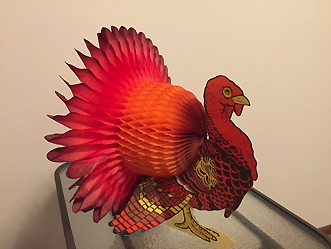
Why, you might wonder, would such a mundane decoration cause me palpitations?  Because. When he emerges and you unfurl and fan out his crinkly crepe paper tail feathers, he become a full-fledged three-dimensional multicolored centerpiece. The Turkey of my dreams. The fold-out decorations I wanted more than anything when I was little.  

Old Tom Turkey in all his glory

Old Tom truly is the essence of fulfillment to me.  Something I was able to give my family, a tradition that was all ours, even if it was mostly mine to begin with. But every year I can’t wait until Halloween is over, Thanksgiving is upon us, and I can retrieve and set up Tom Turkey to preside over out festivities.  That’s my favorite part of my favorite holiday.

During a move several years ago, Tom Turkey went missing.  He was AWOL for three years, and I searched for him repeatedly.  Eventually, in despair, I made an attempt to replace him with two little 4-inch turkeys sporting similar fanned-out crepe paper tails.  They are cute, but they couldn’t replace Tom. 

Miraculously, on the fourth anniversary of his disappearance, he reappeared.  Someone had carefully packed him between two large art books to prevent bending, and when we finally got around to unpacking those boxes, there he was, regal as ever, just in time to join us for dinner.

 Of course, we always celebrate with the quintessential feast: a golden savory bird, stuffing, mashed potatoes and gravy, cranberry sauce, jellied, because the consensus among my family members is no texture in the red stuff. And pumpkin pie. With squirt whip.  I consider this meal an homage to my mother, at whose knee I learned that fiber was for other families, but we could enjoy roughage-free meals, secure in the knowledge we did not have to worry about encountering any texture in our feasts.  Now, occasionally as a rebellious adult, I may insert fresh beans or, perhaps a relish plate just to prove my independence, but overall, the Thanksgiving feast remains traditional and smooth. And family approved, year after year.

This year, there were just three family members and Tom in our COVID-bubble festivity, but the food was exactly as anticipated. I was so glad the meal was acceptable, because it re-appeared the next day in exactly the same form, except the beans were frozen this time.

The third reprise, the following evening, was met with somewhat less enthusiasm.  I had prepared a hash (a la James Beard) with turkey, stuffing, and some veggies, and although it was wholesome, the flavor was basically unchanged from the previous two meals, which had become a mite tiresome.  My husband politely served himself slightly more than a “no thank-you” helping and polished it off gamely, but I, being an astute observer of meal enthusiasm, discerned that turkey had lost its luster and needed to retire to the freezer for another time. Once our turkey dinner overload is just a memory, there will be turkey soup and eventually turkey pot pie.

Still, because I waited too long to get groceries, and by the time I shopped, the smallest turkey I could find was 15 pounds, there remains after three iterations, at least half a turkey and its attendant carcass, relegated to several one-gallon plastic Ziploc bags, in the freezer.

Unfortunately, the packaging of the turkey leftovers heralds the packing up of Old Tom.  He can’t keep us company for as long as we’d like these days, because he is becoming increasingly fragile. He’s been around 44 years now and I would like him to last as long as I do.  I should probably bequeath him to one of my sons.  I can just hear their responses when I bring this up to them.

“When I’m gone, would you be willing to take care of Tom Turkey?”

“Who?”

“Sure. Whatever.”

Oh well, as long as Old Tom Turkey’s around, Thanksgiving will be my happy place.

© 2020 Faith Ellestad

Faith has been writing to amuse her family since she was old enough to print letters to her grandparents. Now retired, she has the opportunity (and with Covid restrictions, the time) to share some personal stories, and in the process, discover more about herself. Faith and her husband live with two elderly cats in Madison, Wisconsin. They are the parents of two great sons and a loving daughter-in-law.

Posted in Guest writer | 1 Comment

November 2020: My COVID19 Flu-cation

By Sarah White

In the last week of October, I was exposed to COVID19 through my visits to my mother in a congregate living facility. She tested positive just before she passed from this life, but what took her down will go on record as respiratory failure of unspecified origin. I, on the other hand, will be counted in the great roll call of COVID statistics–happily, not among the dead. At least not yet.

My symptoms came on about two weeks after that known exposure. Because of the exposure, I had already gotten tested two times, five days apart—both tests came back negative. The first clue I was sick was a spell of unstoppable shaking as I ended a Zoom class I was teaching. I put it down to nerves about teaching a new curriculum. The next day, headache and body aches followed. I put that down to a new yoga routine and a longer walk than usual. But by Friday, I had a fever over 100, had lost my appetite, I hurt all over, and everything tasted different. I went to the clinic for another COVID test, cleared my calendar, and prepared for the unknown.

Saturday that third test came back negative but a new symptom appeared—a steady stream of post-nasal drip that upset both my lungs and my stomach. Soon my dry cough turned into a wet, sleep-disrupting mess. On Monday I tele-visited with my doctor who prescribed antibiotics. By Thursday, I was back at the clinic, suspecting pneumonia, which a chest x-ray confirmed. The next day—25 days after my last known exposure to the virus—I finally tested positive. This is quite unusual for COVID. Even 14 days would be considered a long time for enough viral load to develop for a positive test result.

And so began my COVID Flu-cation. I’ve been self-employed for most of the last 20+ years; I don’t take a lot of time off. To permit myself two weeks off in a row, I generally have to leave the country. Doing nothing for weeks on end in my own home was a brand new lifestyle. To be released from striving felt rare and wonderful.

Sleep was my only interest—my hobby, my passion. I couldn’t stand to wear anything but stretchy pajamas, knowing that at any moment an irresistible urge to hop back in bed might overtake me. I would wake hungry, at odd times, but no food sounded good and I found it difficult to finish even an egg or a slice of toast.

Oddly, while I couldn’t summon the brainpower to even think of doing any work, I found I could read and listen for pleasure. I pulled random children’s books off the shelf and re-read old favorites. I listened to podcasts. I simply slept, entertained myself, and tried to eat and drink water, as advised.

I was tremblingly weak, and yet my COVID lifestyle was strangely enjoyable. My spirit floated somewhere above my suffering body, experiencing the days like shards of light piercing the dark. Hot baths became long moments of beauty as sun fractured on the surface of the bathwater and steam soothed my lungs. And to crawl back between the flannel sheets afterward, and descend into another sleep, was purely a gift. There were other gifts—people brought us groceries, sent chocolate, emailed links to silly YouTube videos. My flu-cation was marked by generosity and compassion.

My daytime sleep was merely loss of consciousness. Nights were a different world. I descend into fevers, sweats, long hours awake as my lungs crackled and wheezed. And when I did sleep, I entered a vivid place, peopled with streets full of performers in costumes, sometimes jugglers, sometimes marching bands, with an atmosphere like Carnevale. Night after night I found myself returning to the same geography—an alternate version of the near east side of Madison along Williamson Street. I had a definite sense that these crowds of people were other dreamers in their COVID nights, and messages were trying to reach us. We were enmeshed in some kind of wisdom school.

After about two weeks in this dark fun-house dreamland, an  episode came that felt like the culmination. I had become a motivational speaker aboard a cruise ship. The message I preached, received from COVID, was complex and beautiful and the rest of my life would be devoted to sharing it.

On waking, that complex beauty slipped through my brain cells like water through fingers. All I could capture of it were two phrases:  Be kind to each other, and elevate your daughters. Not bad messages, but nothing compared to the spiritual beauty I felt lurking just beyond my ken.

Virginia Woolf wrote, in an essay titled “On Being Ill,”

Considering how common illness is, how tremendous the spiritual change that it brings, how astonishing, when the lights of health go down, the undiscovered countries that are then disclosed… it becomes strange indeed that illness has not taken its place with love and battle and jealousy among the prime themes of literature.

Because my COVID flu-cation came 80 years after the widespread use of antibiotics, it was over much quicker than illnesses in Virginia Woolf’s time. Even so, it was an ellipsis, an omission from regular time. From the beginning of quarantine after my mother’s positive test to the day the Public Health Department ascertained I was free to leave the house, 34 days had passed. When I went under, the world outside was still in Fall, days sunny and improbably warm. When I was reborn into the world, it was December and the world was dusted with frost crystals glinting in the sun.

Thirty-four days is enough time for a physical, emotional, and mental reset. I have that disoriented feeling that comes when one returns from a long vacation: What is this place? And what is my role in it?

© 2020 Sarah White

Posted in Sarah's memoir | Tagged | 6 Comments

“Freckled” by Toby Wilson Neal

I asked Jeremiah to review this book, realizing that since he grew up in Hawaii, he would offer a more informed perspective than I could. I enjoyed the book and highly recommend it. As an entrant in the “awful childhood memoir” category, it joins the greats. – Sarah White

Review by Jeremiah Cahill


Author Toby Wilson Neal subtitled her book Freckled as A Memoir of Growing Up Wild in Hawaii, and I thought she might be exaggerating. Not so! I was born and raised in the Islands, and reading Neal’s work made me realize, by contrast, that I grew up…well, civilized. Oh, I endured similar stresses in a sometimes contentious racial environment, but not at such a young age and to the degree she did. I also had many stabilizing influences, while Neal had precious few.

To begin, the astute Foreword by John Wehrheim describes the social context on the island of Kaua’i, which the Wilson family stepped into as haole (non-native, white) outsiders. Wehrheim has also chronicled nearby Taylor Camp, and provides a link to graphic photos and a film looking back at the “hippie” compound.


To see photos and videos of Taylor Camp, visit John Wehrheim’s website


Neal’s parents’ compulsions center on surfing, and the island of Kaua’i provides great waves and uncrowded conditions. The price the family pays for surfing bliss includes homelessness, poverty, social isolation, substandard schooling, and various physical and psychological risks. Energetic and outgoing, eldest daughter Toby bears the brunt of her parents’ struggles.

Amid the chaos, this plucky, resilient child manages to survive successive troubles and emerge grappling for a better life. Not all her peers were so fortunate.

Initially I questioned the pace the book might set, based on Neal’s first happy recollection of being at the beach with her mom. That ends abruptly as Toby is yanked—literally by her hair—into the dysfunctional world of her parent’s anger, neglect, and substance abuse.

Facing conditions she’s often not old enough to understand, Toby channels much of her energy in directions that help her survive. Getaway destinations—real and imaginary—give her respite, as do frequent trips to local libraries. Early on, she develops a passion for reading. Books are her escape, whether holed up in a soggy rainforest tent or under the porch at Grandma’s place in California. Reading well beyond grade level becomes a main strength, helping her catch up following lapses in formal schooling and priming her for a career as a writer.

She’s also aided by her family’s unconventional but frequent spiritual explorations. At 11 years old, during a potential health crisis, she has an extraordinary experience that sets her on a path of guidance and comfort.

Neal needs all the comfort she can find, as her parents’ love is on again, off again. Toby whipsaws between occasional trust, in that “I know how loved I am,” and the desperation of “Mom doesn’t care how we feel.” Her dad’s anger and depression complicate her attempts to appreciate him as a father. The result—years of conflicted emotions.

The onset of puberty only deepens her conflicts as she struggles with self-image. She wears hand-me-down clothes and ugly “welfare” glasses, feels chubby and plain, eats free school lunch, and could never bring friends home to the hovels her parents call home.

During her teen years, Neal develops a fighting streak that she intuits will take her away from poverty and a dysfunctional lifestyle. “Normal is my rebellion” comes to define her efforts.

At age 13 she gains a breakthrough insight, stating “Now I know I’m good at school.”  She’s able to nail down A’s wherever she goes, once she has a chance to catch up. Keeping a journal and learning to get regular exercise also contribute stabilizing effects.

Neal’s later teen years see her rapidly developing life goals that include not having to worry about “…being homeless, getting washed away in a flood, or wondering where the next meal is coming from.”

At age 17, in eleventh grade, Neal is still stuck on Kaua’i, still subject to her parents’ denial and destitution. Taking her fate into her own hands, she exercises deep-seated determination, and makes a phone call that will change her trajectory.

Despite dreading separation from her younger sisters, Neal is soon pondering college choices that will be “…exciting, glamorous, different…and furthest from Hawai’i.” Her motto? “No way out but forward.

Neal went on to become a prolific author of mystery and romance fiction, now having published over 30 books. She’s also a Licensed Clinical Social Worker and has had a counseling and coaching practice—no surprise, as her early years gave her lots of material to work with!

Years later, Neal herself experiences an occasion of grace and reconciliation as one of her childhood tormentors appears in her clinic with his family seeking counseling. It’s an unexpected and touching encounter.

For anyone who’s ever been bullied, threatened, beaten or otherwise harassed, Neal’s life is an inspiring example of what it means to grow, to move on, and to heal.

In a brief Afterword, Neal gives a sneak peek toward her next book, Open Road: A Memoir of Travel through the National Parks. As someone who became a chronic overachiever, her “marathon of overwork and stress” eventually depletes her health and sends her on a midlife journey.

No release date given yet for Open Road, but I’ll watch for it. Reading Freckled left me wanting more of TW Neal.

© 2020 Jeremiah Cahill

Jeremiah Cahill resides in Madison, Wisconsin and counts his many blessings every day. Oddly, he’s thankful for the extra time granted to reading and writing during pandemic isolation. His fantasies include dropping everything to chase well-formed waves on some distant seacoast. 

Posted in Book review, Guest writer | Leave a comment

Home

By Ellen Magee

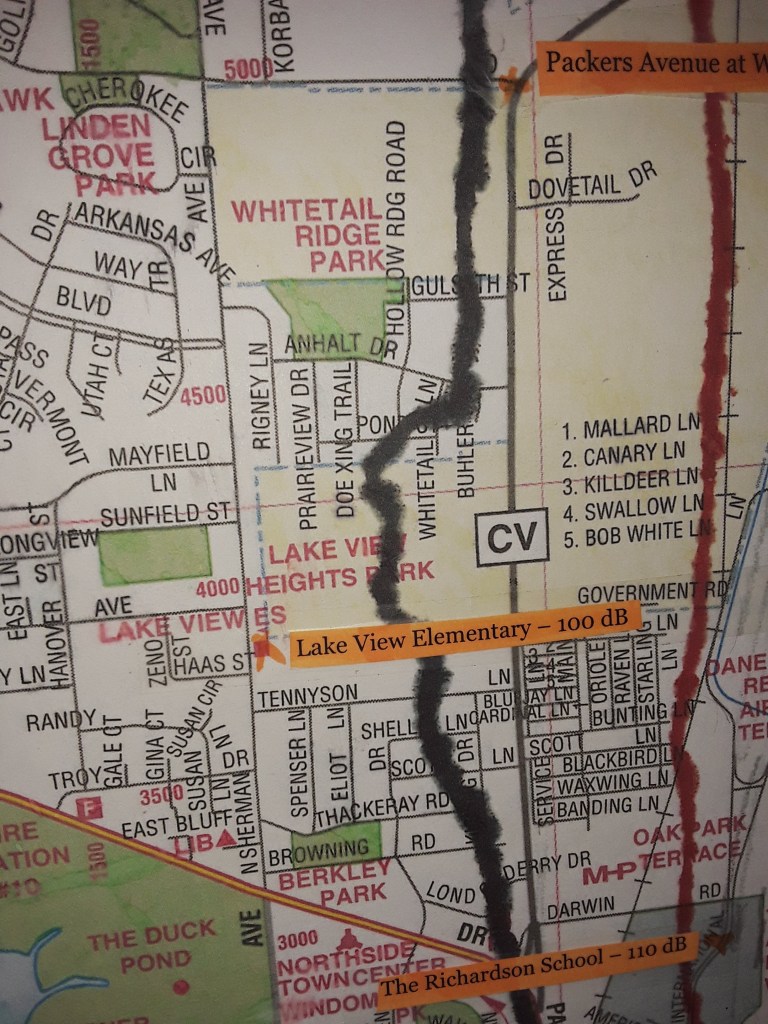
In September 2019, we first heard about F-35 military jets coming to the Air National Guard at the Dane County Airport, a half mile from our Northside home.  There had been a gathering, sponsored by the Air National Guard at The Alliant Energy Center, which we heard about after the fact, where the new jets were introduced as well as the recently completed draft of the environmental impact statement.  It was reported that the audience of this presentation was made up of people not directly affected and outside of our neighborhood.  The National Guard noted in the draft environmental impact statement that those most directly affected would be children, low income and people of color.  An actual map was drawn encircling the airport and the inner circle would “not be consistent with residential use”; in other words, the “sacrifice zone”.

Subsequent North-east-side meetings and speak-outs, sponsored by local activists and elected officials from the area have been well-attended.  At the first of these I attended, we heard from a city council member from Burlington, VT as to the process they used to fight the F-35’s scheduled to come to their Air National Guard.  They have been organizing and fighting for almost a decade, including a lawsuit.  We heard that:

  • The National Guard Bureau took seriously the citizen’s objections,
  • The VT congressional delegation, (including Bernie Sanders), demanded the F-35’s come, so they are now coming starting the last week in October,
  • Neighborhoods were nearly destroyed by the government buy-outs, and the bulldozing of homes in the “sacrifice zone”,
  • Burlington citizens continue to fight to get rid of the F-35’s,
  • Different town units are dealing with dramatic reductions of property tax revenues from the sacrifice zone,
  • Uncertainty about how the increased flights and greater noise levels will affect the families who refused to sell to the government and what, if anything, their homes will now be worth, and finally,
  • Sound remediation previously offered for homes nearby has not, and will not be forthcoming.

We and many of our neighbors have been vocal in writing to express our feelings to local and state elected officials since realizing how close we are to the sacrifice zone.  We are seeing how much power the “military-industrial complex wields.  One of our darlings in WI’s congressional delegation, turns out to be beholden to Lockheed Martin.  WI’s national elected officials are willing to sacrifice a couple of Madison’s most racially and economically diverse neighborhoods to keep federal dollars flowing into the state. 

The sacrifice zone near Ellen’s home

My husband and I have very few assets other than our home.  We are just outside the area deemed “inconsistent with residential use” in the environmental impact statement.  This means we will not be bought out by the government.  We don’t know if we can live with the increased noise levels and flights.  We could move, but wonder how much our home would sell for under the circumstances. 

We are equally concerned about our neighbors in the trailer park at the end of the street and in the many subsidized apartments in the sacrifice zone, who are unlikely to find subsidized units to move to (due to years-long wait lists).  Many will likely become homeless.  Several schools will close.

Meanwhile, we are continuing to maintain our older home, painting the exterior, (a happy blue).  As I am processing this uncertain situation, and prepare for a possible move, I wrote this farewell letter:

Dear Home,

Thank you for the comfort and security you have provided to Guy and me since 1999.  Your bones, including a dry basement, have brought security and joy to us.  You are spacious enough for each of us to have our own spaces as well as plenty of comfortable common space.  We love our wood-burning fireplace. The lovely wooded lot, including a big fenced backyard, has been enjoyed by our pets:  Sibby, Misty, Snowball and Groucho. 

Our neighbors for the most part, have been peaceful and Dennis has greatly helped us with winter snow removal and summer mowing.  The neighborhood has offered serenity to Guy as he sunbathed in the front yard and to me and my women friends gathered for fire ceremony in the privacy of the backyard.  Children have enjoyed the play structure and birds and squirrels love our yard for its mature trees, brush pile and weeds.

Our future with you is uncertain at the moment because of the possible expansion of the Air Guard and new deafening jets.  We are hurting at the thought of leaving you to escape the unhealthy sound levels.  We fear that you will not be kept up or be appreciated as a peaceful refuge. 

On the other hand, if property values plummet, you may fall into the hands of a poor family who never dreamed they could afford such a great home.

“We leave behind a bit of ourselves wherever we have been.” 

– Edmond Haraucourt

© 2020 Ellen Magee

Ellen lives in Madison with her husband and animals too numerous to mention.  She is a retired social worker.  Her family includes her son, two step-sons and their assorted kids.  She keeps busy during COVID by writing racial justice-themed letters to decision makers and editors, mentoring people in substance abuse recovery, dancing, kayaking and e-biking.  Her goal in retirement is to cultivate her friendships.

Posted in Guest writer | 1 Comment