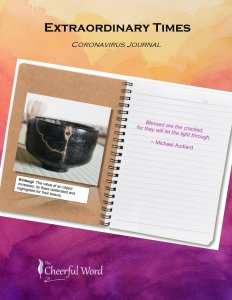
“Extraordinary Times: Coronavirus Journal” from Sam Uhl

I’ve found a partial solution to how to blog while experiencing a COVID19 pandemic-related form of writers’ block: I’m sharing resources offered by friends/colleagues who are finding their own ways to help “ordinary” people cope in such an extraordinary time.

Sam Uhl of The Cheerful World is a personal historian and custom publisher I met through the Association of Personal Historians. Her recent newsletter brought us back in contact. I invited her to share news of her free new offering, a downloadable collection of writing prompts titled Extraordinary Times: Coronavirus Journal.

“From birth, I was destined for a path of listening to and preserving stories,” Sam describes herself on her website, going on to tell about parents and family elders who introduced her to the power of elder’s stories, and how she now partners with people–as Mike Oke and I do–to bring their stories into the world in published books and more. Sam is located in Hendersonville, North Carolina, but as we’re all learning–through the power of virtual collaboration, personal historians can work with anyone, anywhere.

I asked Sam to chat with me about why and how she created her journaling aid. My opening question: When the pandemic bullied its way into our lives, how did you respond in your business?

Sam: “It showed up, and much to my surprise–business did not slow down. People wanted a way to write.” Sam and her husband are active in their tourist/retiree-heavy little mountain town. “When this hit, I got trickles of emails and calls saying ‘I just miss stopping by your studio and chatting. I don’t have a way of expressing how I feel about this whole Corona-virus thing.’ Most of them are at least story-tellers if not writers.” She decided to put together a tool to help them express themselves. “Through a variety of prompts, they can be thinking about something besides the virus, the politics, the jobs lost,” she explained. “This is a historic moment. People will point back to this moment like we look at the 1918 Influenza Epidemic.”

Sam, who is trained in the Guided Autobiography method of writing short reminiscences stimulated by questions, started creating her list of prompts. “People can choose what they want to address on any given day.” She came up with 100 prompts, which should get us through the shut-down. If people write on a few of them, Sam will feel she has helped. “I need to not feel hobbled by this pandemic. I want to be an active participant in helping people feel better.” She hopes we will all record our thoughts and experiences in this strange time–“including all of the wonderful things that are happening”–and reframe the experience in our own thoughts and conversations toward something more positive.

Sam envisions our journals finding their way to community collections, at libraries and historical societies. She wouldn’t mind if it caused a few people who are writing and discovering they have something to say to reach out for her writing coaching services. “But really, I created the journal just to help–I haven’t thought too far beyond that.”

To download a free copy of Sam Uhl’s writing prompts, simply click Extraordinary Times: Coronavirus Journal.  Thanks, Sam, for helping us all find our way forward!


What is the story of your resilient moment? How are you facing this challenge and coming through?

See submission guidelines here–then send me your true RESILIENT story well told. Or hey, just a link to any resource that helps you refill and recharge.

  • Sarah White


Posted in Call for action, Writing prompt | Tagged | 2 Comments

“Write your Family Story” online course with Mike Oke–free! (for now)

I’ve found a partial solution to how to blog while experiencing a COVID19 pandemic-related form of writers’ block: I’m sharing resources offered by friends/colleagues who are finding their own ways to help “ordinary” people cope in such an extraordinary time.

Mike Oke (rhymes with bloke) is a Briton who started Bound Biographies in 1991. We met in 2006 as fellow members in the Association of Personal Historians. We keep in touch.

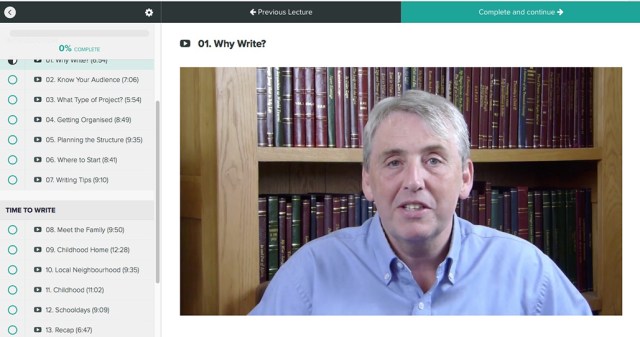
He recently let me know about his new online course, Write Your Family Story.” In response to the current pandemic lock-in, he has reduced the price (ordinarily $199) to FREE. I checked it out–it’s just like having a chat with Mike in his office.

Check out the course here!

This is what the course looks like: Screenshot from Mike Oke’s online course, “Write Your Family Story”

Mike has developed an effective methodology he shares with his clients as he coaches them to write their autobiographies. He published an interesting guide-cum-anthology with examples drawn from his clients’ stories, Write Your Life Story, (4th edition published in 2010). It’s a fun read, since all the references are “teddibly British.”

Recently, Mike adapted that methodology to an online course format. He chunked it into 22 short lectures–about 10 to 15 minutes each. Every lecture ends with tips to get you going on applying what you’ve learned. Helping him was his friend and client, audio engineer Imran Ahmad.

Imran encouraged Mike to adapt his coaching process to the online course format. Since Mike had already written a book, he had a sense of how he would organize the course. He includes in the online course a downloadable resource based on the book.

“I’m happy to offer it for free,” Mike told me, “because good things will develop through it. I suppose it’s our small tribute to the people living alone and finding these times a real struggle. If this can help them through, then that’s fantastic.”

Mike and I hope you’ll take a look!


What is the story of your resilient moment? How are you facing this challenge and coming through?

See submission guidelines here–then send me your true RESILIENT story well told. Or hey, just a link to any resource that helps you refill and recharge.

  • Sarah White
Posted in Call for action, writing workshop | Tagged | 2 Comments

COVID-19 Musings, April 15 edition (or: How to Blog through Writers’ Block)

On this morning, April 15, 2020, I sit looking out at an unnaturally quiet street, feeling like a stranger in a strange land.

How, in this new place, will I use True Stories Well Told? How will I blog while not feeling particularly wise or witty about anything? There’s nothing in my mind that’s fit to print. I haven’t found the time to reach out to some of you for guest posts. I will, but for now, I’m gathering links to articles that feel helpful to me. Call it my ‘COVID Resilience Collection.’

I’m continuing to journal almost every day. Just a few jottings but I’m hopeful, like a traveler, that what I’m capturing will bring back greater recall–and deeper understanding–when this trip has shifted from present to past tense.

Today’s link is an article in the Canadian magazine Maclean’s by Ayelet Tsabari. Ayelet is a mentor with the U-King’s-Halifax MFA-Creative Nonfiction program. She joined the program in my second year and I had the opportunity to attend a few classes she taught. I was charmed. She has a poet’s heart. Her memoir The Art of Leaving (link to review) won the Canadian Jewish Literary Award for Memoir. She knows a thing or two about resilience.

What the Gulf War taught me about coronavirus

What the Gulf War taught me about coronavirus

“The futility of planning.” Yes, that puts a pin in it–what I’ve been feeling for the last month.

Just one example: After my mom realized she absolutely had to use oxygen all the time, she was virtually a prisoner in her room because she couldn’t manage without assistance the transition from room oxygenator to portable tanks. I spent a week on phone calls and websites trying to find the best deal on a portable oxygen concentrator that would give her more independence. (Turns out that’s a whole shady  underbelly to the medical equipment supply industry.) The day her concentrator arrived, her assisted living facility went on full shut-down–residents not allowed out of their rooms. The futility of planning.

“Life in crisis doesn’t leave time for pondering,” wrote Ayelet. I won’t ponder, but I will try to capture what I’m living through. “…the only way to cope with the uncertainty is to accept it, to root ourselves firmly in the present, to live small…I hold on to the now like my life depends on it.” Thanks Ayelet, me too.


What is the story of your resilient moment? How are you facing this challenge and coming through?

See submission guidelines here–then send me your true RESILIENT story well told. Or hey, just a link to any resource that helps you refill and recharge.

  • Sarah White
Posted in Commentary | Tagged | Leave a comment

Finding our Resilience in this Spring of COVID19

Our memories are too important to let a global pandemic get in the way of preserving and sharing them.

I find I’m not doing a lot of reminiscence writing these days–just a little journaling, trying to capture the weird day-to-day of this COVID19 thing, one day focusing on sounds, another on sights, and so on. I want to remember how neighbors suddenly exchanged cheery greetings, the thwack of staple guns from the construction site down the street (are those workers safe?)… The sight of near-empty streets, the blue tape Xs on the floors of the retail stores I still enter (pharmacy, grocery). The smell of Spring, humidity returning to my Wisconsin landscape as April unfolds.

How will I use this blog during this strange time? Please help me.

Let’s mine our memories for stories of resilience. Queen Elizabeth showed us the way when she spoke about her first radio broadcast as a young princess in 1940, reassuring children who were being evacuated from London to the countryside for their safety. She called on a memory of past resilience and used it to encourage us all.


What is the story of your resilient moment, when you faced a challenge and came through?

Maybe it was a lesson learned from mentors and teachers, the “Yoda” who expanded your skills and understanding in ways so profound it was like handing you a light saber. Maybe it was something you learned on your own, the Hero on your Journey crossing the threshold, meeting the challenge, grasping the boon and bringing it back to your people. Maybe it’s not your story but that of an ancestor whose example inspires you.

See submission guidelines here–then send me your true RESILIENT story well told. Let’s help each other through.

  • Sarah White


Posted in Call for action, Writing prompt | Tagged | Leave a comment

Down the Rabbit Hole with COVID19

The rabbit-hole went straight on like a tunnel for some way, and then dipped suddenly down, so suddenly that Alice had not a moment to think about stopping herself before she found herself falling down what seemed to be a very deep well.

Either the well was very deep, or she fell very slowly, for she had plenty of time as she went down to look about her, and to wonder what was going to happen next. First, she tried to look down and make out what she was coming to, but it was too dark to see anything; then she looked at the sides of the well, and noticed that they were filled with cupboards and bookshelves; here and there she saw maps and pictures hung upon pegs. She took down a jar from one of the shelves as she passed; it was labelled “ORANGE MARMALADE,” but to her great disappointment, it was empty: she did not like to drop the jar for fear of killing somebody underneath, so managed to put it into one of the cupboards as she fell past it.

“Well!” thought Alice to herself, “after such a fall as this, I shall think nothing of tumbling down stairs! How brave they’ll all think me at home! Why, I wouldn’t say anything about it, even if I fell off top of the house!” (Which was very likely true.)

–Alice’s Adventures in Wonderland, Lewis Carroll

This passage / image has been playing on repeat in my mind since the start of the COVID19 “Shelter in Place” which, for me at least, began on Friday, March 13th, 2020. Coping with my mother on hospice in a nearby assisted living facility, everyday objects passed by as we plummeted into this strange place.

Every day we try to solve last week’s — yesterday’s — last hour’s problems, only to find them irrelevant in the new now.

“Down, down, down. There was nothing else to do, so Alice began talking again…. when suddenly, thump! thump! down she came upon a heap of sticks and dry leaves, and the fall was over.”

Stay well, friends, and stay grounded.

© 2020 Sarah White and Lewis Carroll, public domain.

Posted in Commentary | Tagged | Leave a comment

Reflections on 19 episodes, 1.5 years, and a true story, well told

Starting August 2018, Suzy Beal’s family adventure has been unfolding here, one chapter each month through February 2020–19 episodes in all. And what an adventure! In 1961, teenage Suzy’s family moved to Europe, built a sailboat, and took up life on the high seas. The memoir takes readers from “Heading East” via Volkswagen van from Newport, Oregon to cross the country and the ocean, destination Barcelona and Mallorca to live while building the boat. True Stories Well Told leaves the family, a bit shaken by their shake-down cruise “Living Aboard” the newly launched sailboat, as they “shelter in place” for winter in Toulon, France, before attempting life aboard again next spring. As the series concludes, I asked Suzy to describe what it was like to have her writing featured in this way.

Circe in Sete Harbor

The experience of having one chapter a month from my memoir published on Sarah White’s blog True Stories Well Told has been terrifying, exciting and valuable.

Terrifying because it’s the first time I’ve put myself out there in the publishing world. I’m not sure if I feared rejection or felt insecure in my writing skill, but I made it a New Year’s resolution to submit one piece a month. Once I decided to submit, I quit worrying about the rejection slips.  I found truestorieswelltold.com where I submitted an essay and Sarah accepted it.  She suggested we try a once a month serial from my memoir and I was hooked.

 Exciting because, I’ve never thought I cared about being in print and guess what, I do. Once my work was accepted in several publications, I realized I was on track and heading in the right direction.  This gave me the courage to continue. I still receive rejection slips, but some of my work is accepted and the thrill of receiving the email saying “Suzy, we want to publish your piece,” outweighs the disappointment of rejection.

The valuable part comes from looking at my work with a more critical eye and making the necessary changes. During the last year and a half I’ve been on Sarah’s blog, I’ve learned to take my writing more seriously.  Realizing there are others reading my pieces has given me a new perspective.  Until now, I’ve thought more about what Iwanted to say rather than what I wanted my readers to read.  I’ve developed a better sense of what it is to have a connection with my readers. I still have a lot to learn, but I’m committed. Being responsible for a chapter each month on truestorieswelltold has been an incredible opportunity and has helped shape my writing experience.   Thank you, Sarah.

I have really enjoyed this experiment as well. I didn’t ask Suzy to share the series with me ahead of time. Just like my readers, I had no idea from month to month what adventures teenage Suzy would encounter next. The coming-of-age story embedded in the family-adventure story has me charmed.

What happened next for the 9-member family (plus Rusty the dog and Anitra the cat) living aboard a  32-foot sailboat is not so comfortably shared with a public audience, and so we close the series here. Thank you, Suzy!

Readers, did you enjoy the series? Leave your comments on this post.

© 2020 Suzy Beal and Sarah White

Suzy Beal, an occasional contributor to True Stories Well Told, has been writing her life story and personal essays for years. In 2016 Suzy began studying with Sheila Bender at writingitreal.com

Posted in Guest writer | 2 Comments

Let’s add some reading and writing (forget the Arithmetic)

These are troubling times. I’m self-isolating (as if my lifestyle weren’t already pretty self-isolated, as a home-based freelance writer). I’m trying to meet the world as if I were the one carrying contagion, protecting those around me with social distance, as opposed to the all-too-easy stance of fear of others carrying contagion to me.

Talk about isolated, let’s talk about my mother, locked down in an assisted living facility where all activities have been cancelled (even Bingo!) and meals are brought to the rooms. I hope she’s watching old movies, not the 24/7 freak show on cable news!

How are we going to cope with weeks or months of this? Well, one thing you can do is read more. ‘Tis the season to unplug from your social streams (after you’ve gotten a good boost of connectedness, and resisted click-bait fear links) and open a book. How high is your bedside pile? What about the pile by your armchair, your sofa, your dinner plate? Let’s make a dent in those piles, people!

Another thing you can do is write. Get a few more musings down for that memoir of yours. Journal. Pull out a diary from a distant year and add some new thoughts from the you-now about the you-then. This is a perfectly great moment for time-travel and memory is the safest seat on the bus.

Here’s the call to action that blends my recommendations to read and write  — send me a book review!

Any book, as long as it’s a “True Story, Well Told.” Memoirs, creative nonfiction, history, biography, bring it on. Click here to read some of my reviews on this blog, if you’d like an example.

You could write a review of a genre-crossing book like this memoir in graphic novel form.

Book reviews are formulaic. To save you googling it, here’s my cheat sheet:

  1. Describe what is on the page. Summarize major sections in the book, to convey how it is structured. No spoilers, please.
  2. Identify the genre (memoir, biography, etc.) and assess how it fits in the genre. Dead center or peripheral? A genre-bender, like a memoir in graphic novel form? (Think Persepolis.)
  3. Share your opinion of the author’s writing style. Does it suit the intended audience?
  4. For bonus points, consider literary devices. What did the author use and why? ( Here’s a quick quiz if you’d like to refresh your memory of what I mean by “literary devices.”)
  5. Wrap it up with a bow. Do you feel satisfied at the book’s end?

I’m eager for new essays to publish here on True Stories Well Told. I hope I’ve inspired you to read, write, and review while we all hunker down!

© 2020 Sarah White

Posted in Book review, Call for action, Writing prompt | Leave a comment

The School of Hard Knocks

By Melodee Leven Currier


I loved school and did well – until the third grade — when I was traumatized by my teacher.   As she walked around the classroom she would stop at my desk and plink my head hard with her thumb and index finger.  My hair was in braids, so it really hurt my scalp.  After she did this a few times, I told my mother and she and my step-father, who was a teacher, had a talk with her.

The next day, the teacher announced to the class they could all go to recess except me.  She then told me to follow her and she took me to the principal’s office.  No one else was around when she showed me a large wooden paddle with eight holes and two rows of wire across the top.  Then she screamed at me “If you go home and tell tales out of school again, I’ll beat the tar out of you!”  I was completely terrified and couldn’t wait to get home and tell my mother, but this time she didn’t do anything about it.  That was a turning point for me — I was no longer the fun loving, extroverted child entertaining the class with a song, a hula dance or memorizing poems.  Trust in teachers and adults dissolved and my attitude and grades forever plummeted.

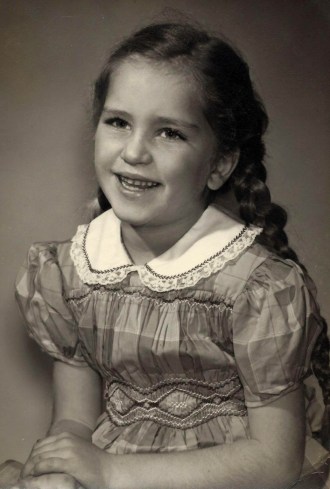
Melodee in grade school

The next year in the fourth grade during “milk break,” a nickel was collected from each student who wanted to order white or chocolate milk.  I was the only one who didn’t want milk, so my teacher made an announcement to the class “When Melodee grows up her bones are going to break because she doesn’t drink milk.”  I was 23 years old when I got my first cavity.  I wonder how many “milk drinkers” can say that.  That same teacher scared the class by saying that when we grow up there won’t be any vacant land left.  Some things you never forget.

In the seventh grade, out of the blue, my teacher announced to the class “Melodee is spoiled!”  I don’t know what prompted her to say that.  She had no idea what I was dealing with at home with a mother who didn’t want any children and a step-father who violently beat me with his belt every chance he got.  I certainly was not spoiled.  Some teachers don’t know the difference between a problem child and a child with a problem.

The only teacher I ever had that I really liked was my sixth grade teacher.  She was so kind and gentle with everyone.  When I was in my twenties, I saw her at the grocery and told her that she was my favorite teacher.  I don’t believe she remembered me then, but it felt good to let her know.

When my son was in grade school, he had some mean-spirited teachers too.  When I had him repeat the second grade, the first day of class his teacher asked if anyone wanted to get the flower vase for her.  Then she said “John, you were here last year, you know where we keep the vase, would you get it?”  That was embarrassing to him and decades later he still remembers how humiliated he felt when she said that.

I was a young single mother then, lacking the courage to speak up for my son when he told me just as my mother hadn’t spoken up for me when I was his age.  We have a responsibility to our children to say or do something when they aren’t being treated respectfully.  If we are not being heard, we need to go to the next level – or higher up if necessary.  The School of Hard Knocks has taught me many lessons over the years.  Speaking up for myself — and sometimes others — is one of them.

While it’s not possible to change history, the future is a clean slate.  Make it one that years from now you can look back and be happy to have history repeat itself!

© Melodee Currier

Melodee Currier left corporate America in 2008 where she was an intellectual
property paralegal.  Since then she has devoted her time to writing and has
had three eBooks (www.amazon.com/author/melodeecurrier) and numerous articles published on a wide variety of topics.   Her articles can be read on her website www.melodeecurrier.com.  Mel is an occasional contributor to True Stories Well Told.


Posted in Guest writer | 4 Comments

Snap Judgment

By Sarah White

When we meet a person, we make an assessment based on a few signals—the coat they’re wearing, the car they’re driving, the state of their hair. But can we ever trust the accuracy of that snap judgment? And conversely, what can we ever know about the judgments others make about us? We’re mostly ships passing, completely at sea in our attempts to see and respond to each other.


My mother had been hospitalized the week before and it had snowed the day before. Cars all over town were white with road salt. With a worried head, I stopped to fill the tank and purchase a car wash. My thoughts ran along the lines of, “Whatever reasonable preparations I can think to make, I’ll always do something unnecessary and leave undone something crucial. But I can be fairly certain I’ll need gas, and since my mother bought the car for me, I should take care of it.” At the pump across from me was the cleanest vehicle I’d ever seen. It was a shiny black GMC step van. Painted on the side was, “Madison Custom Polishing and Plating Service.

To distract myself from my worries, I started a conversation with the rough-looking fellow who was gassing it up.

Sorry, I have nothing to illustrate this story with.

“In a business like yours, you must have to keep that thing really shiny,” I said. He replied, “Would you believe it’s got over 400,000 miles on it?” Then he said, “I do custom plating. Want to see an example?” He reached into his pocket, then extended his closed hand toward me. I bent to look as he opened his fist.

In his palm was a shiny silver object. Slowly I recognized the shape as two elephants making the beast with two backs. There was excellent detail picked out in the conjoined shapes, and yet they were as smooth as a silver-plated buckeye.

“Nice!” I said.

“Did you see what it was?” He must have been used to more of a negative reaction.

“Elephants fucking,” I replied. “Nice work.”

Encouraged, he reached into his other pocket and again presented me with a closed hand. In his palm: Two hogs in coitus, plated gold.

One time is funny, two times a little creepy. “You’re naughty!” I said, wagging my finger. “Madison isn’t safe with you on the streets!”

He laughed, finally satisfied with the reaction he got.

I turned back to my gas pump and shut off the flow, climbed in and drove off to the carwash, leaving the plate-metal pocket pornographer behind.


How long will I be wondering about why he picked me to reveal his pocket treasures to, and how far off from truth am I in my perceptions of him?


© 2020 Sarah White

Posted in Sarah's memoir | Tagged | 2 Comments

Living Aboard

This is the 19th and final episode of a travel memoir that is unfolding, one chapter each month, here on True Stories Well Told, about teenage Suzy’s family move to Europe to build a sailboat and takes up life on the high seas circa 1961. Click here to read the earlier episodes.
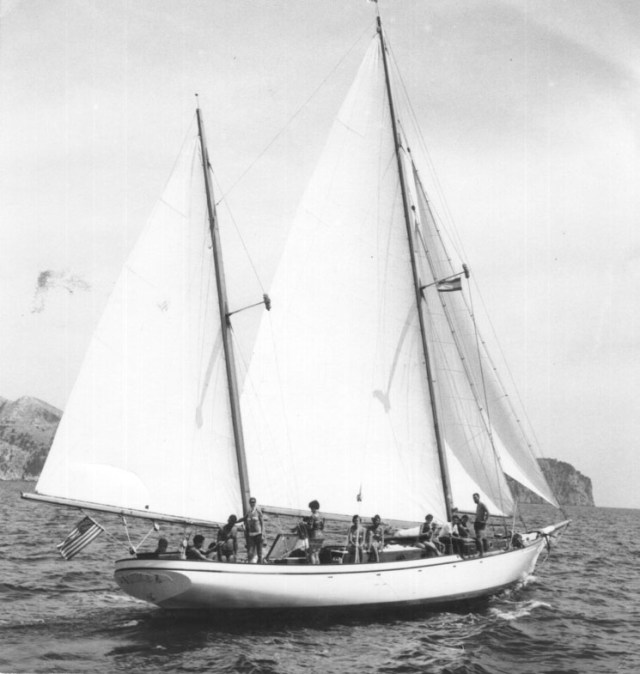
Circe under sail

Our first “shakedown” cruise took us around the Island of Mallorca and over to Ibiza, then back to Puerto before leaving for France.  I got seasick as soon as we hit the open sea.   My brothers had made several trips with Dad, but this was the first time for the rest of us including our dog Rusty and cat Anitra.

We thought we’d lost Anitra not long after we headed out, but we found her hidden in the towels in the “head.”   Whenever Rusty needed to relieve herself, she would go to the stern of the boat and bark. The boys would pull the dingy we towed up alongside, Rusty would jump in and do her duty, and then one of the boys would reach down and pull her back on board, while under full sail.  When we came into a harbor for the night, the boys took turns taking the dingy ashore to clean it out.

We soon realized we would need to make a harness for Anitra.  She would sneak off the boat as soon as we put into dock.  We trained Rusty to go look for her and more often than not she would be on another boat.  She hated her harness, but it was the only way to keep her from running away.  The boys tied the harness to the mainmast, so she could be on deck and see what was going on.
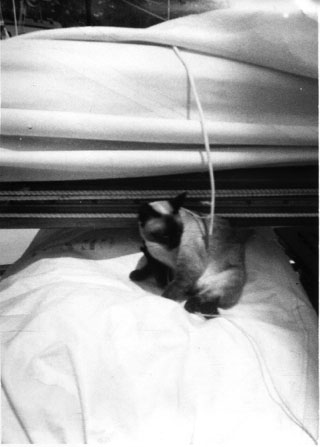
Anitra in harness

From my diary

August 27 – We sailed to France to the Bay of Roses.  Some of us were so sea sick we couldn’t even stand.  Mom, Jan and I stayed in our bunks.  Conrad and Frank, too, seemed to be sick.  I carried a bucket around for us to throw up in. The dog threw up in my bunk!  Dad, Tom, Hank and Carl were on deck most of the time.  The sea was so rough Dad tied the boys on ropes to the main mast.  I just wanted the motion to stop and tried to imagine myself gimbaled like the light fixtures.  The boat heeled over on its side so far, I thought we were all going to drown.

August 28, 29 – Port Vendres, France

August 30 – Sete, France –  We didn’t drown but the memory of that feeling didn’t go away soon.  We sailed into the French port of Sete.  Dad had given us directions on how to behave when the Port Official came aboard.  They searched for contraband or items we needed to declare such as liquor.  Dad had placed several bottles of wine in the wine cabinet and one bottle of Spanish Fundador Cognac.  These bottles, he would declare.  We all knew that he had dozens of bottles under the floorboards in the bilge, which he didn’t plan to show the police.  When the official came aboard he visited with Dad, asked questions, and wanted a tour around the boat.  When they came back into the salon Dad gave him a drink of cognac and with a twinkle in his eye handed the Port Captain a bottle of cognac for himself. I worried he might find the bottles hidden in the bilge, but he didn’t.

August 31 – We arrived in Marseille harbor late at night, in a storm.  The boys on deck had to find the harbor entrance in the dark with rain pouring down.  With the sails down, we motored into the harbor looking for a safe berth for the night.  The fumes from the diesel engine made me sick, but I climbed off my bunk and Jan and I made some soup because we knew Dad and the boys would be hungry.  Mom was too sick to get up.  Finally, they found a berth, and we dropped anchor and motored in stern to the dock.

The next morning, Anitra woke us with her crying and trying to get out on deck.  When we opened the companion way door, we found ourselves in the middle of the morning fish market.  Fishermen had their boats tied up on both sides of Circe.  They had their fish out on display for sale.  One of them started feeding Anitra tiny eels.  She ate them as fast as she could.  We created quite a scene in the middle of the fish market with our boat full of children and laundry hung on the lines to dry out.
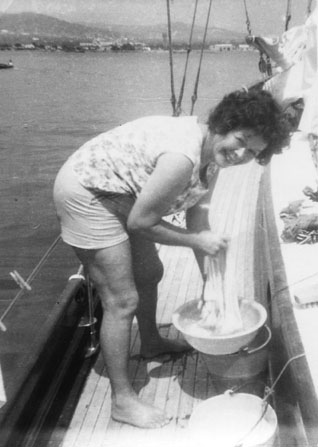
Mom doing laundry

Many French people came up to the boat to ask questions about where we were from and where we were going.  Everyone seemed friendly, and they appeared to admire family of nine with cat and dog on a boat.  Our lack of knowledge in French became immediately apparent.

Circe in Sete Harbor

The port authority let us stay there until the afternoon, when we had to move the boat to the Yacht Harbor we hadn’t been able find the night before, in the dark.  We stayed two nights in Marseille and then headed east for Bandol.

September 2 – Bandol – Another little French town on the coast. Tom and Hank learned Bridgett Bardot lived here and went searching for her.  We were catching on to how this would work.  During the day we would set sail the head out to sea going east along the French Riviera.  By late afternoon Dad picked a harbor for us to spend the night in.  After the Marseille experience, he gave up nighttime arrivals.  We pulled into the harbor, dropped anchor and settled in for the evening.  Mom, Jan and I did the meal preparation and cleanup, while Tom, Hank and Carl did the deck work.  Conrad and Frank had pet chore with the help of Carl.
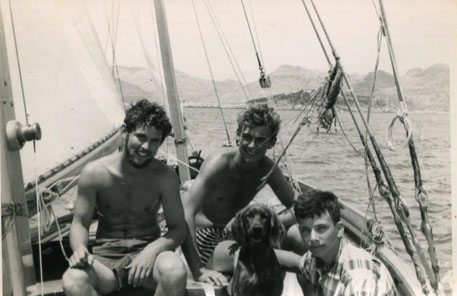
Tommy, Hank, Rusty, and Carl

September 7 thru 29 – Cannes –  As we came back to the Yacht Port in Cannes from doing our shopping, we heard her screaming.  We knew it was Anitra –  there was no doubt.  We thought maybe a dog had found her tied to the mainmast in her harness; my brothers took off running for the boat. We found her over the side with her “tail end” just in the water.  She had tried to jump to the boat next to us, but her harness rope wasn’t long enough.  The boys pulled her back up on deck and Jan took her below to dry her off.  After this episode, Mom decided to have Anitra “fixed”.  Pequeñas Cosas!  Carl, Jan and I went with Mom to the vet.  Mom didn’t speak much French, but she made herself understood by making a scissor sign with her fingers.  We left her overnight, which was difficult.  It took Anitra several days to recover, but after that she was easier to handle and she quit trying to leave the boat.

September 28 – San Tropez – Heading west once again, back to Toulon. Where to spend the winter? Mom and dad had a plan for spring which was to go along the coast of France and Italy to Greece, where we would spend the summer.  But, first we had to get through the winter, which would be cold and damp in this maritime zone.  They decided on Toulon, so we left Cannes and headed back west along the French Coast at the end of September.

As soon as we found a slip for CIRCE, I moved ashore and lived with a French family to learn French and take care of their four children. Once again I found myself in the difficult situation of trying to learn a new language and make myself understood, I knew how to do it this time, but I missed my friends and didn’t want to make new ones.  I wondered how many more new experiences were in my future before I turned eighteen.  My friends back in Oregon were preparing to graduate from high school and go to college. Where would I be when they graduated?
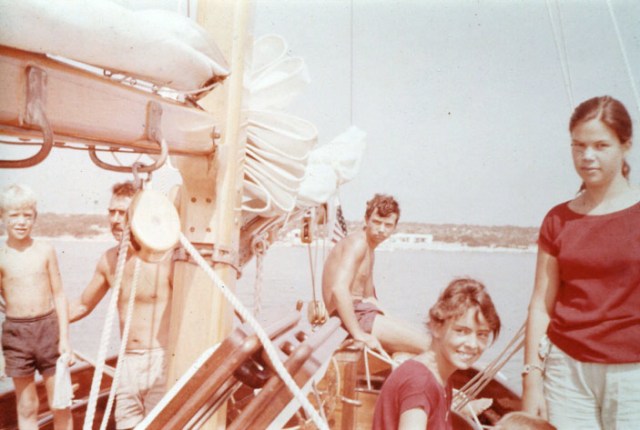
Frank, Dad, Carl, Suzy and Jan

© 2019 Suzy Beal

Suzy Beal, an occasional contributor to True Stories Well Told, has been writing her life story and personal essays for years. In 2016 Suzy began studying with Sheila Bender at writingitreal.com.  Please leave comments for Suzy on this post.


Posted in Guest writer | Tagged | Leave a comment