It’s that time again: “Throw me somethin’, Mister!”

Mardi Gras was yesterday and it’s time to “Throw me somethin’, Mister,” in the parlance of the crowds to the krewes. Today the call is going out from True Stories Well Told  and it’s not plastic trinket “throws” I seek, but your stories, true and well told.

That’s a writing technique called “borrowed interest” and I’m not ashamed to stoop to it to fill the digital pages of this blog. I publish writing prompts, book reviews, and stories from my own life, but my favorite content is YOUR stories.

Here are the guidelines. Now throw me somethin’, Mr.,  Ms., whoever you are! Send your stories to sarah.white@firstpersonprod.com.

Posted in Call for action | Leave a comment

Dazed and Out of Place

By Suzy Beal

This is the seventh episode of a memoir that is unfolding, one chapter each month, here on True Stories Well Told. Stay tuned for more of the adventure as teenage Suzy’s family moves to Europe, builds a sailboat, and takes up life on the high seas circa 1961. Click here to read the earlier episodes.


I met a young German boy, Joachim, who came to the Quay every day to work on his suntan and swim.  He spoke Italian and German so we had no way to communicate except smiling and gesturing.  Although he was older than I, he seemed interested in knowing me.  If I was the first to arrive, he always put his towel next to mine.  He smiled and I, ready to move on to a new relationship, smiled back.

One evening, a group of us including Hank and Carl walked to town to see a movie.  In the center of the town’s plaza, benches lined the square.  They faced a wall, and I realized the wall was the screen.   Joachim and I sat next to each other.  I noticed Hank had seated himself next to a girl with whom I’d been visiting on the Quay.  The smell of roasted pipas coming from the vendor’s stands filled the warm night air.  The vendors roasted these sunflower seeds on small hot burners in their carts. They put them in a paper cone and salted them before handing them to the buyer.  Everyone popped them into their mouths eating the seed and spitting out the shells that fell everywhere.  The projector started with a rattle, a whirring sound, and the wall came to life.  Here in Spain in an outdoor theater set up helter-skelter, we sat on hard wooden benches, the actors on a stucco wall saying things I can’t understand.  Sitting next to a German boy with whom I couldn’t speak, I felt dazed and out of place, but I still enjoyed the differences.

After the movie we walked to the café for cokes, then walked home in the darkness. Upon arrival at our villa, Joachim maneuvered us to a secluded spot to say goodnight.  The next thing I knew his tongue was in my mouth!  What was this guy doing?  John kissed me twice, but both times it was only a peck on the lips. This was something entirely different. At first, I didn’t like it.  How long would this go on? How could I make it stop?  This must be what everyone back home talked about — French kissing!  It wasn’t all bad, but just as I was getting the hang of it, he pulled away.  He gave me a hug and set off into the darkness.  I never saw him again, but he left me with an experience I thought might come in handy later.  I wouldn’t be so clumsy if the opportunity arose again.  He wrote once, but in German.  I kept it, hoping to find someone to translate it for me.

Notes to Harbor Light

(The editor of our high school newspaper had asked me to write to him about our travel experiences.)

This island reminds me of Harry Bellefonte’s song “Island in the sun where people have toiled since time begun.”  This song is about Jamaica, but it is Mallorca, too. Time seems to stand still here.  Everyone who has a car is driving a Model T or Model A from the ’30s and ’40s.  No one has television.  There are no phones, washing machines, or dryers in the homes.  Our maid washes the laundry by hand for our entire family of nine including our bed sheets.   Everyone seems happy, though, and they have fiestas for almost no reason at all. Fireworks flash from across the bay in the night sky.  We watch them from our terrace wondering what they are celebrating.


The family settled in to our daily routine.  Mom, Jan, and I purchased our food in the local markets.  We learned hard lessons discovering the difference between pounds and kilos, having to eat green beans for days because we purchased too many.  Mom tackled the gas stove and took over cooking the evening meals.   We shopped at the carniceria (butchers) to buy our meat.  The meat hung on hooks.  Half a cow, lamb, or goat just hanging there frightened me, but Mom hardened herself to order by pointing to the animal part she wanted, leg of lamb or breast of chicken.  She soon learned to say carne picada (hamburger).  The first night she made hamburgers, my little brothers screamed with delight.

There were difficult times adjusting.  Tommy and Hank quarreled, having to share a room, and soon the quarrels broke out into real fist fights.   Dad spent most of his time in Puerto Pollensa and Mom found it hard dealing with these fighting boys and keeping them apart.  My parents sent Tommy to Palma for a course with the Berlitz language school.  He lived in a pension in Palma for six weeks and spent his days learning Spanish.  Mom and Dad wanted someone in the family to speak enough Spanish be able to communicate. At the shipyard where Dad was planning to build our sailing boat, they only spoke Spanish.  He needed someone to translate.

Carl on the “sailfish” – photo by Jan

Dad came home from Palma one day with a “Sailfish” for us to use in the bay.  It was a sailing boat without sides so if we made a mistake sailing, we slid off into the water.  It had one big sail and a rudder and centerboard.  Dad wanted us to learn the basic elements of sailing from this little boat.  At thirteen feet long and three feet wide, it only held two people.  If we tipped over, we had to hold on to the side, standing on the centerboard.  We needed to slowly, ever so slowly, let the water drain out of the sail.  Then we tipped it upright.  If we rushed it, the weight of the water in the sail might break the mast.

It didn’t take us long to learn how to keep it upright.  Carl was the first one to become an expert at handling the little boat. He spent his days on the sailfish while the rest of us sunbathed and swam from the Quay.  One day I noticed Carl wasn’t sailing alone, but had a young girl with him.  She was French and only spoke a few words in English and Carl no French at all.  Her name was Martine.  Each one of us found ways to make friends and sweethearts.

Jan came with Hank and me to the Quay occasionally, but usually stayed near the villa or trekked into the hills with Conrad searching for adventure, which he found one afternoon at home.

“Help, Mommy,” he ran out on the terrace where we were sitting with his hand dripping blood and an awl sticking out of the middle of his palm. He’d been drilling a piece of wood, making a model boat, when the awl slipped.  Dad jumped up and carefully pulled the awl from his hand.  “We need to take him to the doctor to see if he needs stitches,” Mom stammered. “I won’t be able to understand the doctor, but I guess if we take the awl, we can make him understand what happened.”  Conrad got a tetanus shot and came home with a bandaged hand, the hero for the day.

 On the afternoons when Dad was home, he met the local men at the café on the waterfront.   He had a way about him that made others eager to know him.  It didn’t hurt that he was always happy and willing to buy the drinks.  He didn’t speak much Spanish, but Dad adapted well to making himself understood.  He occasionally drove the van filled with these men to Palma for a day of eating and attending the bullfights.  I realized, for the first time, how much of a man’s world my dad lived in and how he enjoyed it.  Mom stayed at the villa on these afternoons keeping an eye on the younger ones and watching the world go by from the terrace with her binoculars.

One day, Dad announced that these local men wanted to take our whole family out to the Island of Dragonera, near Puerto Andraitx.  They wanted to make paella on the beach for us.


© 2019 Suzy Beal

Suzy Beal, an occasional contributor to True Stories Well Told, has been writing her life story and personal essays for years. In 2016 Suzy began studying with Sheila Bender at writingitreal.com.  Watch for new chapters of her travel memoir to be posted! Please leave comments for Suzy on this post.

Posted in Guest writer | Tagged | 2 Comments

Sarah’s Big MFA Adventure: Home Stretch!

This morning I’m staring down a deadline for Chapter 9 of my book, working title The Soulful History of Glory Foods. This is the last chapter I’ll write under the guidance of a mentor in my Big MFA Adventure through the University of King’s College in Halifax. Next month I’ll do a rewrite of my book proposal, and then–I’m hatched into the world, a fledgling Serious Author of Creative Nonfiction!

But there’s one more step in the Big Adventure: graduation! Or, what they call Encaenia at this 230-year-old school. I am planning to return to Halifax to accept my diploma in person (for the first time in my checkered educational career. It’s now or never.)

Sadly, the tradition of parading with a bagpiper before the ceremony has been discontinued this year. My bad luck!

And…

I am going to share this experience with a small group of friends/writers on a

Nova Scotia Writing Retreat!

I may have one or two spots open, so read on and see if this writing (or not) retreat sounds like the adventure for you.

May 20-25

For May 20-23 we’ll be based at Windhorse Farm, a bit more than an hour south of Halifax, just down the road from the world-famous Peggy’s Cove. Read more about Nova Scotia south shore tourism here.

May 23-25 we’ll move to University of King’s College, our base for exploring Halifax.

Of course, you’re welcome to watch me don a robe and get my diploma, but no pressure–if I were in Halifax for a couple of days I wouldn’t want to waste an afternoon in an auditorium.

What about the Writing part?

Some of us want solo writing time, some want to workshop a piece of memoir or family history, and some just want to relax and be tourists. I’ll orchestrate the experience you’re looking for. Personally, I think it’s an excellent opportunity to practice travel writing, opening your senses to the contrasts between our country stay and bustling Halifax.

The details:

  • $700 for lodging and transportation. Price includes most meals while at Windhorse Retreat, breakfasts while in Halifax.
  • Deposit $350 due March 15, balance due May 15.
  • You’ll make your own travel arrangements to Halifax. Please arrive in Halifax in time for noon departure for Windhorse Retreat on May 20. (For those of us in the midwest, that likely means arriving on the 19th.)

Confirm your reservation with me now! 608-347-7329 or sarah.white@firstpersonprod.com

To get you dreaming….

The Wentzell Farmhouse where we’ll stay while at the Windhorse Retreat:

View from the porch:

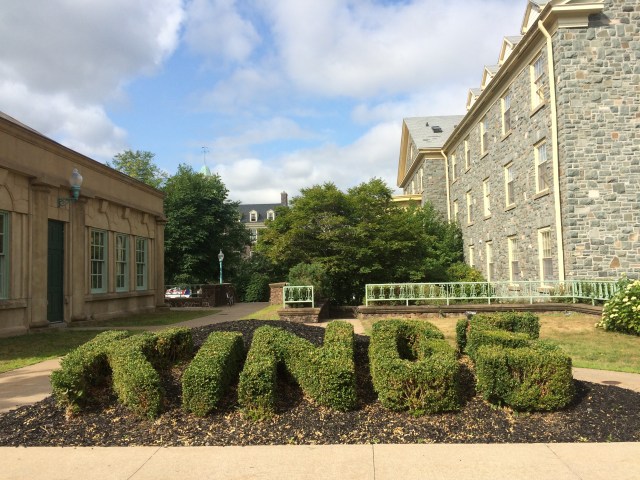
University of King’s College, our base for exploring Halifax:

I love that the shrubbery includes an apostrophe.

Posted in Call for action, writing workshop | 3 Comments

Flash Memoir: Finishing Your Work

Three months ago I began a series of “writing workshop” posts here on Flash Memoir. Today that series comes to an end with my thoughts on the revision that gives your essay its final form.

If you’ve followed this post series, I hope you’ve been producing new writing, rough drafts that now await your red editor’s pen. If so, I hope these suggestions help you find where to prune and shape these pieces so that, like topiary, they take on a pleasing form while remaining small, true to the Flash genre.

In your first revision pass, pay specific attention to your beginnings and endings.

A great beginning will have something about it that hooks your readers. It will surprise, puzzle, or shock in some way that creates tension. It will compel readers to root for you through the rest of the story. In a Flash Memoir, you have to accomplish that in just a sentence or two.

A great ending will resolve the tension introduced in the opening for a nice mini-version of the “bookends” technique that connects the ending back to the beginning. It will maintain the pace of the story’s beginning and middle. It will leave the reader wanting more.

Something in your first few sentences will make a promise that is delivered on in at the end. Think about how, in “Balloons Are for Kids,” a sentence that begins the second paragraph is mirrored at the end.

“I boarded my city bus for home, thinking about the balloon’s fate….”

“I don’t know how long the balloon lasted. I never saw the girl again, but I’ve thought of her often….”

Really think about the moment where your story begins and ends. Every fairy tale starts with “Once upon a time.” Somehow that story has settled on where it begins. Not two weeks before, not a half hour before. Sometimes it takes a lot of revising to find the right place to start a story from. Flash Memoir will always have a real sense of starting just as the action of the story gets going, and ending as soon as the action ends.

First drafts often begin unintentionally with “throat-clearing,” a warm-up of your writing mind. How much of what is in your first paragraph is essential to the reader’s understanding of the action? If you delete it, is the story stronger?

Likewise, many essays can be improved by removing musing at the end, trusting the reader to do that musing instead. Does your story end still grounded in object writing? Try lopping off anything you’ve written after the final concrete and observable action. Internal action, as in “Balloons Are for Kids” where Kay wonders if the child remembers her, is acceptable as action in this sense.

For more thoughts on revising your work, see this post: “More on revising your work: Jean Krieg and Sarah White talk writing craft.”

And that concludes the “Flash Memoir” series. Post your comments here, and review the four posts any time you’d like to work on writing short, powerful, reminiscence essays!

Posted in writing workshop | Tagged | Leave a comment

Mr. Peck

“When an old person dies, it’s a library burning.”

By Doug Elwell

I hadn’t seen Mr. Peck in many years. He seemed an old man then because in the eyes of the young all grownups are old. When I was a child, he lived two doors west and when I passed his house on my tricycle and he was in his yard, he would wave and call out a hello. I mostly picture him with a hoe scratching weeds from the cracks in his sidewalk. He was a tall, thin man who was missing his right arm at the shoulder and I was not afraid of him. As far as I could tell from the seat of my tricycle he seemed to get along quite well without it. The weeds were always cut short. I hadn’t given Mr. Peck much thought in at least thirty years after I left Pinhook. For the young, old people often simply disappear with little or no notice. One day they’re there and the next they’re gone.

The day after I graduated high school I left town. My last stop was the post office where I mailed a letter to Addie, a girl I loved and of whom I was afraid. I met Mr. Peck on his way out. I held the door for him. We talked in the morning sun. I was about to say goodbye when he tapped my shoulder and asked if he could buy me a cup of coffee. One for the road he said. I begged off. I told him I would catch him the next time I was in town. He smiled in the bright sun. A puff of air caught wisps of silvery hair and they danced a step or two in the light.

Be sure to do that Mick. I’ll be here.

He patted me on the shoulder again with the letters in his hand and our eyes met. You’ll find your way son, I know it—might take a while, but I know you’ll find what you’re looking for.

After I left Pinhook I didn’t really think of Mr. Peck or of the old folks I had known as a boy. I lost touch with people who once stood large in my life. It was thirty some years later Mom told me Mr. Peck lay dying in a nursing home. I remembered him as a good and gentle man because he took time to talk to me when I was a child. Adults who give time to children are not forgotten. The last time I saw him was on the sidewalk in front of the post office. His smile, blue eyes bright in the morning sun and glistening wisps of silvery hair. I was moved to go back to see him. It was a way to tie up a loose childhood end. I didn’t know why I was so moved except to follow up on a long ago promised cup of coffee. It was important I see him.

At the nursing home, he told me to stop by his house and pick up a trunk from is attic. There were journals in it he wanted me to have. I took them home and began to read through them. His stories and letters were written with a keen eye and ear to the world in which he lived. In each story I was hooked in the first few lines. Each an impressionist painting. They captured moments in his daily life from the turn of the century to the mid-sixties. His words and phrases were short, quick brushstrokes. His subjects ranged from the nearby woods to fields of shocked wheat shimmering in summer sun and daily life in the village. His prose was poetic in places. In one story he called Morning Walk, he described a spring walk through the village:

Aunt Mertie’s tidy house and side garden were drenched in golden sun.Before the heat of the day, wrens warbled their bubbling exuberance across the village while cardinals called ‘wha-cheer-cheer-cheer’ from telephone lines overhead. As I passed, I heard her broom scratch softly across the red bricks of her back walk, then the tired creak of a screen door as it thumped softly leaving her calico cat basking in the sun on the wooden porch floor. The tip of his tail twitching. At Barnett’s across the street, his old brown and red rooster crowed from atop his coop. A car, somewhere in the distance, backfired.

When I felt the late sun burning the back of my neck, I realized I had spent the day immersed in his stories. Words began to blur on the page. It was time to quit. One more thin binder of stories to read would keep until tomorrow. I put everything in the trunk and sat back in my chair. Bright new leaves were emerging on the sycamore tree above me. Lilac wafted from the parsonage next door. The images Mr. Peck created in his stories flowed smooth through my mind no doubt aided by the effect of a couple slowly sipped glasses of bourbon. I had traveled almost a century back in time—his stories were that vivid. And through them I got to know the tall, kindly thin man with one arm who took time to talk to a little boy on a tricycle those years ago.

A day immersed in his stories stirred something in me that had lain dormant for years. In my long ago flight from Pinhook I left everything behind. Over the years, when I thought of my childhood and youth at all, it was like looking at random black and white images lit by the flashing of a strobe. A surreal quality to them. Mr. Peck—my sister—school—the town square—brick streets—tractors pulling wagons of corn to the elevator—Addie who I loved and feared. For years shattered images like those flashed through my mind only rarely. They always left me wanting more. There was something, some vague thing missing in me and I mostly ignored it until I heard of Mr. Peck—spent and dying in a nursing home. His memory surfaced and wouldn’t let me loose. I felt like a salmon swimming upstream to a remembered place. I believe it was the memory of him; the man who showed kindness to the little boy on the tricycle. He had time for me and when I heard he was near death in a nursing home I made time for him. It was a small payback I was privileged to make.

Children often lose their ability to plumb the souls of people when they grow up. But when I saw Mr. Peck I became a child again for those minutes we were together and for a while I could look at the soul of that kind and gentle man through the eyes of a child once again.

© 2019 Doug Elwell

Doug Elwell grew up on the prairie of rural east central Illinois. His stories feature the characters, lore, and culture of that region. He explores the depth and richness of the inner lives of its people and communities. He is an occasional contributor to The Australia Times. His work has also appeared in The Oakland Independent, Ignite Your Passion: Kindle Your Inner Spark, True Stories Well Told, Every Writer’s Resource, Writers Grapevine, Ruminate and Midwestern Gothic literary journal. He has a Kindle novel, Charlie, available from the War Writer’s Campaign at www.warwriterscampaign.org. Proceeds from purchases go directly to the campaign, a non-profit that helps re-integrate veterans into society following their deployments. Doug can be contacted via email at: djelwell@mchsi.com.

Posted in Guest writer | 1 Comment

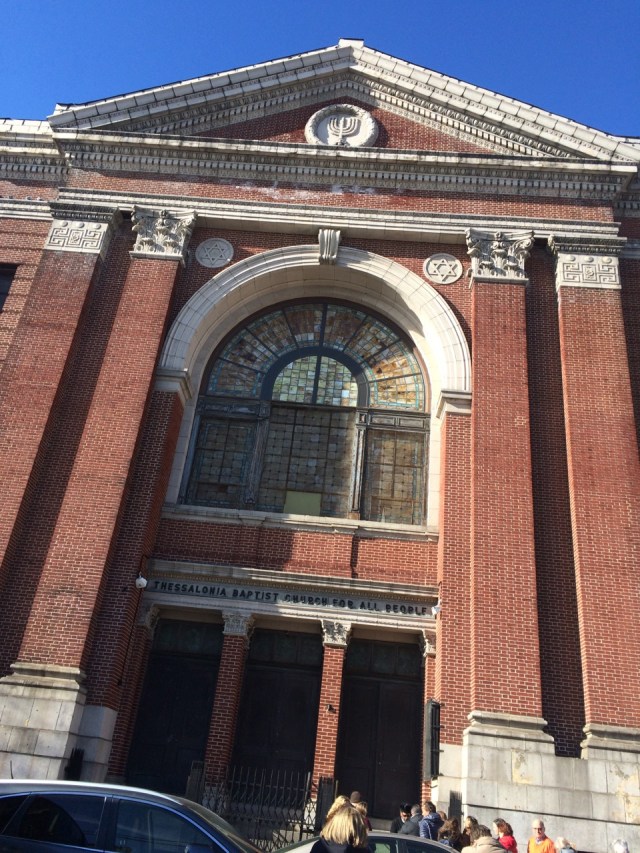
Soul Searching at the Thessalonia Baptist Church

“America has always had a problem with racism,” said the guide for the benefit of the foreign tourists, which was everybody on the bus but me that January Sunday morning as we left Times Square on the Harlem Gospel Spirituality Tour. During the 40-minute drive north to Harlem he gave us a quick history of the reasons Harlem came to be, and how, as a result of the Great Migration of blacks out of the south,  developed its distinctive African Americans culture that has drawn curious whites ever since.

“You might want to leave your coats on the bus,” he said as we pulled up in front of the Thessalonia Baptist Worship Center. “It will be warm in there.” Then he briefed us on the protocol: Photos permitted but not videos. There would be a collection, but giving was optional—he carried a check for the church. Be ready for his signal: “We won’t stay for the whole service, just about an hour.”

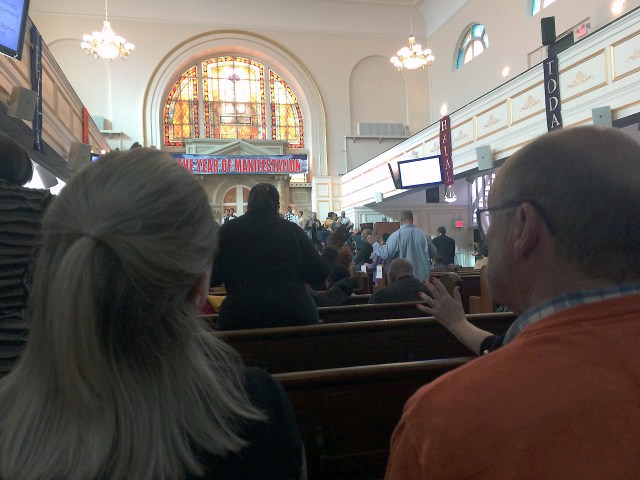
Inside, Black men and women milled, beautiful in their Sunday clothes, as the early service gave way to the late one. Greeters showed us to the rear pews. Young women in white dresses and young men in dark suits with white boutonnières passed out programs along the aisles. It was warm in the church beyond physical heat—it glowed with the warm spark of souls connecting.

Choir singers took their places on a raised dais behind the pulpit and lecterns. The congregants settled, listening as a keyboard player and drummer laid down a quiet groove. Their music stopped at the deacon’s signal. The choir lifted their throats and began to sing. Hymn verses appeared on TV monitors above us and the congregation joined in. The patterns of an ordinary church service unfolded: A lesson read, parish announcements, another lesson, alternating with hymns. The young ushers passed collection plates. I was already so moved, I placed the last $20 in my wallet in the plate. (I would regret that later when the guide said it was customary to tip the bus driver.)

Next up, according to the program, was the “Worship Experience.” It began like a hymn, but slowly grew into something more. Voices rose and the sound grew, like the church was a belly and this was something quickening inside it. Two phrases—of music and of words—interwove in a free-flowing call and response. It was tuneful but couldn’t be termed a melody. The paired phrases on the monitor started out with something like “Oh Lord come down” and “Fill us with your glory,” but morphed every few minutes into some other pair of phrases. The music had a harmonious life of its own. It would seem bound for a concluding crescendo—but not conclude. Instead it calmed itself, collected its energy for another run at Glory, and began to swell again. The congregation swayed and sang in the pews. The sound itself seemed to fill the space until it pushed the walls like a fetus nearing term.

Some worshippers stood and raised their arms in a kind of introspective solo wave. Babies were passed among relatives to free more arms for raising. Those babies! So mesmerized by the music, there was no crying, no babbling, no wriggling, just solemn-eyed gazing or slumbering in the embrace of warm flesh and amniotic sound.

Silent tears leaked down my face, a silent witness—not singing, not praising, just feeling their soul, my soul, all God’s children’s got soul.

The driver’s signal came and we tourists crowded through the narrow foyer and down the steep steps like newborns spilling into the world. Back on our bus, the guide said, “They’re nowhere near done. There will be a sermon, another collection—then more singing like that. A good Sunday service takes three or four hours.”

I had found my soul, and it was singing still.

Posted in Sarah's memoir | Tagged | Leave a comment

Where Do I Fit In?


By Suzy Beal

This is the sixth episode of a memoir that is unfolding, one chapter each month, here on True Stories Well Told. Stay tuned for more of the adventure as teenage Suzy’s family moves to Europe, builds a sailboat, and takes up life on the high seas circa 1961. Click here to read the earlier episodes.


Each morning my brothers, sister and I walk the dusty road to the Quay with our swimsuits on and our beach towels over our shoulders. The Quay is a huge rock jetty built out into the bay to protect the harbor with a walkway to the lighthouse on the end. We spread out our towels next to the other tourists from France, Germany, Italy, England, Sweden, and Norway. Everyone lying along the Quay has his or her own version of suntan lotion. I smell sweet lotions made with honey and olive oil mixed with lemon juice. We are baking ourselves to perfection, rotating at intervals to keep the tan uniform. When we get too hot, we dive into the blue Mediterranean. I begin to recognize the young people arriving each day. I’d taken French with Mr. Blivens in the sixth and seventh grades, but I‘m not prepared for this “rapid fire” French. The differences between French and Italian or Spanish are difficult for me to grasp. I make a game of guessing which country someone is from before we introduce ourselves. Gesturing with our hands is our only form of communication.

Daily we walk the other direction to Puerto, full of hope, for the correo (mail.) Sweat soaks the back of my shirt as we walk the mile and a half to Puerto in the afternoon sun. My white espadrillas (canvas loafers) are dirty and filling with dust as we walk along the gravel road. My brother Hank comes along with me because Mom won’t let me walk to town alone. Sometimes, Dad drives us if he has any errands to do in Puerto, but today he is on the other side of the Island working out the details for building our sailing boat. When summer is over, we will have to move to Puerto Pollensa. None of this matters now; I just want a letter from home.

Puerto Andraitx from our terrace – by Jan Chamberlin

As Hank and I walk along, I can sense Mom watching us with her binoculars from the terrace of our house. She likes to sit on the veranda and watch the world go by. Heading to Puerto Andraitx, the bay is on our right and the rental homes and pensions for the foreign vacationers on our left. Suzie Wong, the movie star lives, just ahead. I remember Mom saying that Miss Wong’s latest movie was way too risqué for us kids, so I try to look in to figure out what makes her risqué. Then we pass the road to Bobby Summerset’s house. He is a world-famous sailor from England and a new friend of Dad’s. Mr. Summerset will soon sail back to England and my brother Hank will go with him. Hank is excited and Dad thinks it will be helpful if one of my brothers has sailing experience before we move onto our boat.

The post mistress brings the mail to the café each day and sets up on a table. As we approach town the ka chunk, ka chunk of the old man working on paving the main street in town reaches our ears. His bones stick out he is so skinny. He must be in his sixties or seventies. On his head he wears an old straw hat he takes off, slapping the side of his leg with it. The dust cloud it creates makes him almost disappear. He moves along the pile breaking the stones with his sledge hammer ka chunk, ka chunk, he stops for a drink, and then he returns to his work. We have grown accustomed to hearing this steady, rhythmic sound while we wait for the mail. Today, it reminds me of just how foreign my new life has become.

The post mistress arrives with the day’s mail in a bag. She doesn’t smile or greet us as she lays out the mail on a table. Forbidden to approach the table, we wait until she calls out our names. The extranjeros (foreigners) including us, sit at other tables waiting for her to sort the mail. Today we order Cokes while we wait, and I hope. She calls out the names on the envelopes. “Familia Chamberlin.” I race to pick up our mail, but she hands me only letters for my parents, another day of disappointment and tears. Why won’t just one of them write? Then the post mistress says something, “Hay un paqete para ustedes.” What? What does she mean? She sees my confusion and points to the back of the table. A package for ME catches my eyes! I see my name printed on it. It is from my girlfriend Pat. I’m overjoyed and excited, but I want to savor the moment and open it in private.

Mom asked us to pick up bread at the bakery, so we head for the panaderiaand ask for two loaves, “dos panes por favor.” The baker takes our basket over to the counter. He puts paper in the basket’s bottom then puts in the two loaves with more paper over them. We pay with the Pesetas we are learning to use.

Sweaty and dusty, on our way home, my mind is on my package. Back home at Villa Coleta, Mom takes out the bread and reaches under the paper in the bottom. I can’t believe my eyes as she pulls out a carton of American cigarettes. We carried contraband cigarettes all the way home! This is another custom I’m trying to adjust to, purchasing contraband items scares me. The Spanish government taxes any products not made in Spain, but some locals deal in contraband to please the tourists by selling products from other countries without taxing them, such as American cigarettes. We see the Guardia Civil (civil guard) everywhere. There are two who patrol around Puerto with their pistols in holsters. I’m terrified of them since Pat told us they can shoot to kill without questioning.

I race downstairs to my bedroom tearing open my package as I go. My high school annual! I can see my friends in the photos of dances and football games. My friend Pat took the book around and my friends signed it. “Sue, Have fun in Spain, but not too much. Bob L.” “Sue, to a real sweet girl, I have enjoyed knowing very much and hope you have loads of fun over there in Spain. Steve E.” “Sue, Hope you’ve met that dream-boat you were counting on. Miss you terribly in Latin. Lots of love, Linda.” The photos and notes from everyone fill a hole I’ve been carrying around since we arrived in Spain two months ago. On page 33 is a message from John. “Sue, to a real nice kid who I have liked and always will. We have had fun together and if you come back, I hope we will still be friends and maybe we can start where we left off. P.S. Watch out for the Spanish boys. Love John.”

“Maybe we can we can start where we left off? We left off with you dating Sandy at the same time you were dating me!” I scream into my pillow. With tears running down my face I hit my pillow in anger and disappointment. I pick up my annual and finish reading the notes from other friends. “Sue, Have lots of fun with the European boys and if you stay as you are, you will. Ray.” “Sue, I wish you could come back here, cause everyone misses you something fierce. Cindy.” I smile through the tears knowing I do have friends who care about me.

The betrayal by John gives way before a growing urgency to move forward, turning on the radio I discover I recognize a song I’d heard for the past several days, even though it is in Spanish. I promise myself, I will learn to speak and understand this new language and I will accept the customs of this country. I will make new friends. Perhaps living in a house with a name might help me become a part of this new place. When anyone asks where I live I answer “Villa Coleta” with pride.

Suzy (me) on the porch at Villa Coleta – photo Jan Chamberlin


© 2019 Suzy Beal

Suzy Beal, an occasional contributor to True Stories Well Told, has been writing her life story and personal essays for years. In 2016 Suzy began studying with Sheila Bender at writingitreal.com.  Watch for new chapters of her travel memoir to be posted! Please leave comments for Suzy on this post.

Posted in Guest writer | Tagged | Leave a comment

Flash memoir: Characters and their desires

Two months ago I began a series of “writing workshop” posts here on Flash Memoir. Today that series continues with a look at Characters and their desires.

How will you bring the diverse cast of characters in your stories to life on the page? First, consider which roles they play.

  • Protagonists–in memoir, that’s usually you, writing in the first person voice, becoming both “I” and “eye” through which readers perceive the dramatic action of the story;
  • Allies and supporting characters–the people who have your back and help you achieve your goals and desires; and
  • Antagonists and adversaries–the people who bring conflict into the story, by thwarting your goals and desires, for good or ill.

And then, there’s that fourth, complicated, category–the Beloved Adversary.

Tristine Rainer, author of Your Life as Story, gave this name to the characters who love us and wish us well, but have a different desire line than we do. Parents are perhaps the most pervasive of these character types. Note the interplay of adversarial parent/child relationships in this example by Seth Kahan:

Got thoughts on bringing out characters and their desires in our writing? Post to the comments section! And stay tuned for Part 4 of this four-part series on Flash Memoir.

© Sarah White 2018

Posted in Uncategorized | Leave a comment

How I found Jesus

January 6th in the Episcopal liturgical calendary is the feast day Epiphany–important  for me as a young Episcopalian in Carmel, Indiana in the 1960s, because our parish celebrated with “The Burning of the Greens.” It put the final bookend to the season of festivity that started with Advent. We’d all gather in the church parking lot around a pyre made of the greenery removed from the sanctuary, augmented by Christmas trees brought from our homes. The sparks flew into the night sky carrying our prayers for the year ahead. Faith submitted another kind of Epiphany memory for your reading pleasure.


By Faith Ellestad

I was the third of four children born into a seriously Catholic family, and like most Catholic families, we had our special traditions to accompany various feast days, holy days and holidays.  Our favorites, of course, revolved around Christmas. We especially loved the day we decorated our tree and set up our Nativity tableau, always on a high shelf, hopefully out of reach of our dog.  Curly was a very limber dog, a spaniel-terrier mix with a remarkable talent for scoping out and sneaking off with forbidden objects. His go-to burial plot was next to the garage, but occasionally he would chew through his rope, and permit himself a nice dig in our neighbors’ garden. We were friends with the Van Daams, but they were not dog lovers. Mr. V would periodically weary of Curly’s transgressions and appear at our door angrily waving whatever half-eaten dirt covered object or tangled string of Christmas lights he had discovered in his yard. He always forgave us, though.

Christmastime was especially hazardous for poor Curly, owing to the availability of tree decorations, lights, figurines, and unusual foods, all so tempting to a curious canine.  He so enjoyed surreptitiously munching on the occasional fallen ornament, or forbidden hors d’oeuvre or strand of tinsel, and had required at least one festive holiday visit to the vet for a tinselectomy. He was particularly alert for any opportunity to raid the Nativity scene.

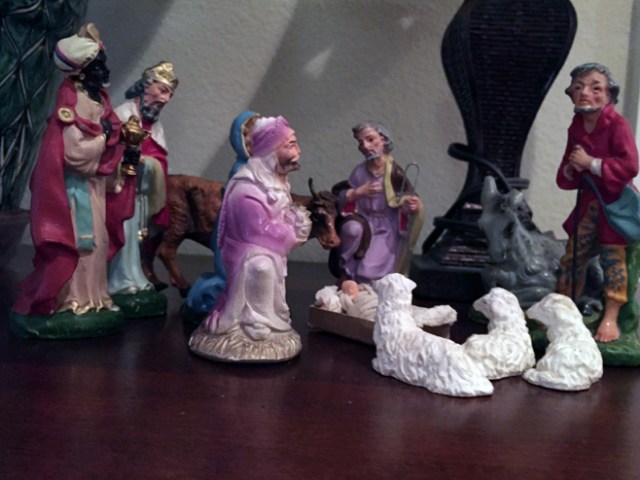
What made our creche unique among the doubtless millions of crèches displayed worldwide during the Christmas season was the eclectic collection of mostly papier mache figures. We had, of course, the Holy Parents: Mary, dressed in a blue veil and pink gown, and Joseph in a brown tunic, grasping a straightened paper clip, someone’s solution for a replacement of his lost staff. They were flanked by a devout shepherd, a donkey, and an ox who was absent one horn. Because of his deformity the ox always faced left to highlight his good side.

According to the Bible, the Three Wise Men did not arrive in Bethlehem until January 6th, the feast of the Epiphany, so we placed them on the shelf a short distance from the Family group, and moved them a little closer each day. Balthazar and Melchior were made of papier mache and stood upright; Casper, puzzlingly, was plaster of paris and was molded in a semi-kneeling position, creating the impression that he may have crab-walked all the way from Egypt to the stable. In the middle of one Christmas season the original Baby Jesus, manger, and shepherd’s flock had gone missing–courtesy, we assumed, of Curly. This was not a situation we could leave unaddressed.

To repair the damage and save Curly from a harsh reprimand, our artistically talented and bossy big sister, Ann, took charge. She painstakingly constructed a manger out of a tiny matchbox with toothpicks for legs, and a mattress of evergreen needles. My brothers and I were dispatched to Cherry’s Dime Store to see if we could come up with a replacement baby Jesus and other accessories for the crèche.  My older brother dug through the farm animal display and discovered a 4 pack of little plaster sheep, perfect for the flockless shepherd back home, while I searched the girl toy section for a Jesus doll small enough to fit in a little matchbox manger and not overpower its 3 inch parents.  Eventually, I found the perfect thing- a thin plastic rod holding five tiny pink naked baby dolls attached to it by plastic tabs.  It was like a tree branch of babies.  You could snap one doll off, and have four in reserve.  Our little brother, not showing any religious inclination at all, selected a miniature metal airplane and we hurried home with our finds. Ann snapped one of the babies off the rod, wrapped it in a minute strip of cloth from someone’s old undershirt, the best we could do for swaddling clothes, placed it in the matchbox manger and arranged the sheep at the feet of the shepherd. Finally, the manger scene was once again complete.  We were delighted to the point of smugness with our innovative additions.

This mismatched group of figures served as the family crèche for years. Eventually, as we grew up and started our own traditions, our parents acquired a very elegant Lennox nativity set and the old one was packed away. But I had always had great affection for the shabby old set, and some years later, when my first child was a baby, I retrieved it from my parents’ basement in the hope that it was still usable. As I unpacked the box, I discovered that each figure had been carefully wrapped in numerous Kleenexes that over time, had become quite friable and disintegrated at my touch, covering the figures and me with a fine patina of years-old dust.  Once I ceased coughing and cleaned off the debris, I could see the set was intact; even the matchbox manger had survived. Baby Jesus was extremely grimy, and tooth marks suggested that he had been rescued from Curly at some point, but still recognizable in his yellowed swaddling clothes. As I washed him tenderly, I thought about the branch of baby Jesuses and wondered what had ever become of them.

I queried the family, but way too much time had passed and no one could remember. Likely the dog had buried them or chewed them to pieces, or they were lost during some move or another.  Well, the original was clean, if a bit dented.  I could have gone on a replacement mission, but by then I was busy with my own real baby.

Some years later, after my dad died, Mom wanted to distribute a few of his favorite belongings to us kids.  I already had the old Nativity set which I loved, but only I considered that a prize. These antiques were special to him. There was a beautiful set of cranberry colored cut glass vases with covers, a ceramic Mettlach stein, a little pewter dachshund with a hollowed out back for holding a pipe, and a silver plate tea service.  As we examined these artifacts, we shared stories about them.  We reminisced about the day our house was moved from one lot to another.  All the breakables had been packed, but no one had noticed the cranberry glasses still sitting on the mantle. Amazingly, they had survived the move intact. Mom gave them to my sister, who had coveted them since early childhood. I got the tea set which I had admired for its delicate etched flower pattern when I hosted tea parties for my dolls, My younger brother, who smoked a pipe took the dachshund with its comforting, smooth concave back, and my older brother received Great Grandfather’s mug with the pewter lid that we all remembered flipping up and down as kids, just to hear the satisfying thunk it made when it closed, even though we were forbidden to touch it. I wanted to give it a last flip for old times sake before it went to live with my brother, so I placed my thumb on the little flange, flicked up the lid, and glanced inside. Unbelievable! There, in the bottom of the stein, were the four missing baby Jesuses! Wordlessly, I handed the mug to my sister. “Oh, wow!” she exclaimed, looking in, “so that’s where babies come from!”

And that’s how I found Jesus – in a beer stein.
 

(c) Faith Ellestad

Faith describes herself as a serial under-achiever, now retired after many years as a hospital scheduling specialist.  When her plan to cultivate a gardening hobby resulted only in hives, she decided to get real and explore her long-time interest in creative writing. She’s so happy she did. Faith and her husband live in Madison, WI . They have two grown sons of whom they are very proud, and a wonderful daughter-in-law.


This story is dedicated to the memory of Ivy, our beloved Belgian Tervuren who died in November. Although not particularly a dog story, it reminds me of how pets insert themselves into every aspect of our lives and why we let them.

Posted in Guest writer | Tagged | 1 Comment

Jello Girls

By Sarah White

When I saw Jell-O Girls: A Family History on a “new nonfiction” list recently, it caught my eye, since I’m researching and writing about another 20th century company with the intent to produce a social history/memoir. I can always use more examples of how others approach this hybrid, rather niche genre.

This book weaves together several stories: an intergenerational memoir about motherhood and loss is the dominant thread, which features grandmother Midge, mother Mary, and Allie, author of this memoir. Other threads include the social history of Jell-O as a cultural object and an investigation into the mysterious LeRoy Girls, a connection I’ll explain in a moment.

As heirs to the Jell-O fortune, the three generations of women grew up with wealth the author barely mentions, and which the family achieved through a shrewd business deal rather than old-fashioned values like innovation and hard work. Orator Francis Woodward (owner of Genesee Pure Food Company and great-uncle-in-law to Midge) acquired the brand from its inventor, a cough syrup manufacturer, in 1899.

Author Allie Rowbottom has written a decent feminist take-down of Jell-O and the femininity it enshrined. Women and girls in Jell-O advertisements are just like the gelatinous dessert they shill—dainty, sweet, malleable, and transparent. “So easy even a child can do it” was the product’s first claim to fame, and its first advertisements featured a Kewpie-like girl-child preparing her dish to please adults. That girl became the role model for generations of women in the Woodward family, and the silent servitude expected of women is a recurring motif in the book. Like the cheerful women smoothly managing their households in the Jell-O ad campaigns who don’t hunger for a role outside that household, this book speaks to the sweet smothering of female ambition and desire that was endemic in 20th-century America.

It can be troubling to read the woes of the rich—a certain “poor me” note wafts up from some pages—but the fact is, rich or poor, women live in a man’s world and patriarchy can spell trouble in every income bracket. Generations of Woodward women tried to conform to the “Jell-O mold.” Grandmother Midge loses her sense of self in motherhood she finds unrewarding. Mother Mary strives for a more creative life, but becomes increasingly obsessive about researching what she believes to be the “Jell-O curse.” Both die while their daughters are young—Midge when Mary is 14, Mary when Allie is still in her 20s.

I really enjoyed the corporate history threaded through the book, as the brand tried to keep up with women’s changing roles through second- and third-wave feminism—its reinvention as a child’s treat promoted by Bill Cosby is one memorable example.

Meanwhile, Rowbottom explores her mother’s obsession with “the Jell-O curse,” a family legend that was said to affect men, but which Mary began to believe was actually afflicted on the family’s women, and which she fought by turning to Seventies ideas of women’s power, embodied by witchcraft and goddesses. As Mary became progressively more ill with cancer, her art gave way to writing a memoir and researching the possible toxicity of being raised in a Jell-O town. Mary’s research and writing became source materials for Rowbottom’s own memoir.

Rowbottom writes about the entrapping conservative nature of Le Roy, New York–the small town where Jell-O was made—where trucks arrived with remnants from animal processing to be transformed into colorful boxes of flavored powder and a rainbow in the river, the color determined by each day’s factory production.

The Le Roy Girls storyline is the most perplexing in the book. The author became fascinated with a twitching condition that beset a group of high school girls in Le Roy in early 2012. Some likened it to the Salem witch trials; others linked their affliction to environmental toxins, still others to group psychosis, probably conversion disorder. Rowbottom tried to investigate the story, but was unable to make contact with any of the girls or their family. Her curiosity (obsession?) lies stillborn on the page.

Allie Rowbottom received an MFA from California Institute of the Arts and a PhD in literature and creative writing from the University of Houston. It’s my guess that she set out to write about the Le Roy girls for her MFA project, but it didn’t pan out, and advisors encouraged her to write her family story instead. I just made that up, but doesn’t it sound believable?

I found this book a compelling read, in spite of some flaws that are well-noted on GoodReads and Amazon reviews. As I got to the final chapters, the creepy closeness between Allie and her mother began to bother me, as the mother’s cancer worsened and surgeries led to wound care that frankly, if I had the Jell-O fortune behind me, I’d hire a nurse to manage.

If you want to study how an earnest wordsmith with a talent for the well-turned phrase takes so many divergent parts and weaves a book, get yourself a copy of Jell-O Girls.

© 2018 Sarah White


Posted in Book review | Leave a comment