Skating through Life!

By Gina Chirichella

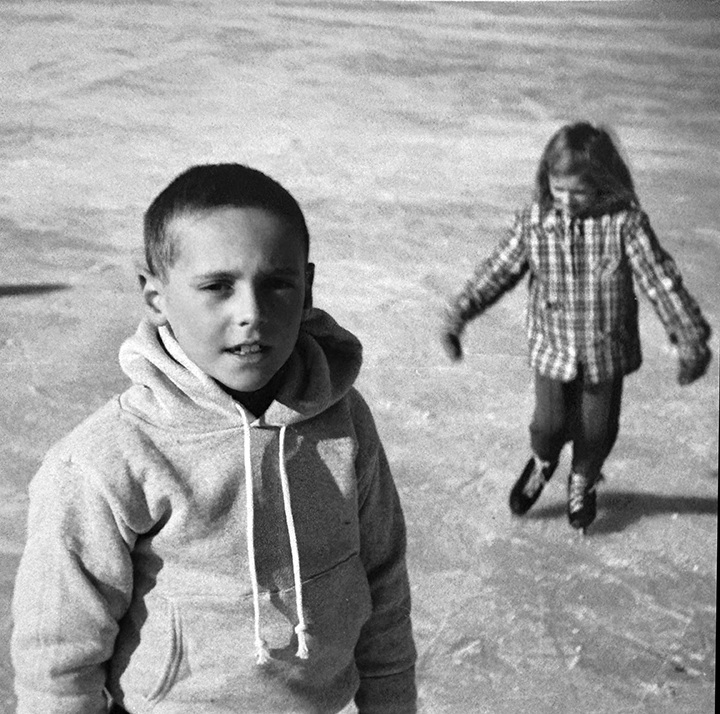
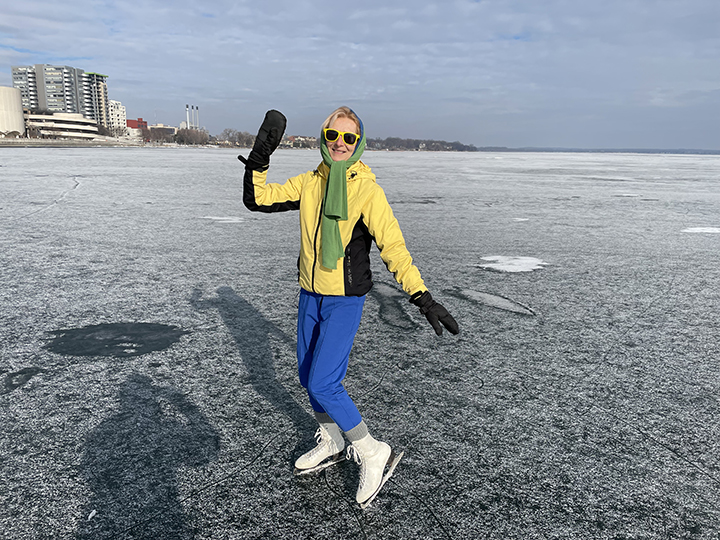
Gina skating on Lake Monona

 My favorite winter activity has always been ice skating. Actually, at this stage of my life, it’s one of the few outdoor winter activities that I still partake in. Now that the kids are grown, I no longer make snow creatures or stand around freezing at the sledding hills. 

For many years, I enjoyed the rush of downhill skiing, but once I hit my late 20s, I realized that since I never mastered the snowplow or any reasonable method of slowing down, it was foolhardy to boldly race down the hill and hope for the best. It certainly was nothing short of exhilarating, though!  Looking back, I probably should have taken some much-needed lessons with an instructor. 

Luckily, I did not make the same mistake when it came to skating ( more on that later)

Growing up in downtown Madison, my brother and I and our neighborhood friends would shovel the snow off an area of Lake Monona at the end of our backyard and have our own private skating rink. We’d spend hours playing tag and red rover and crack the whip.  On weekends, our dad would sometimes take us to Tenney Park rink, which had the added benefits of gliding along underneath the bridges over the lagoons and sipping cocoa near the fire in the warming hut.

We moved to a house across the street from Brittingham Beach on Monona Bay by the time I entered junior high at Madison West. Cool teenagers that we were, our makeshift rinks were utilized mostly at night, adding an air of excitement and danger.

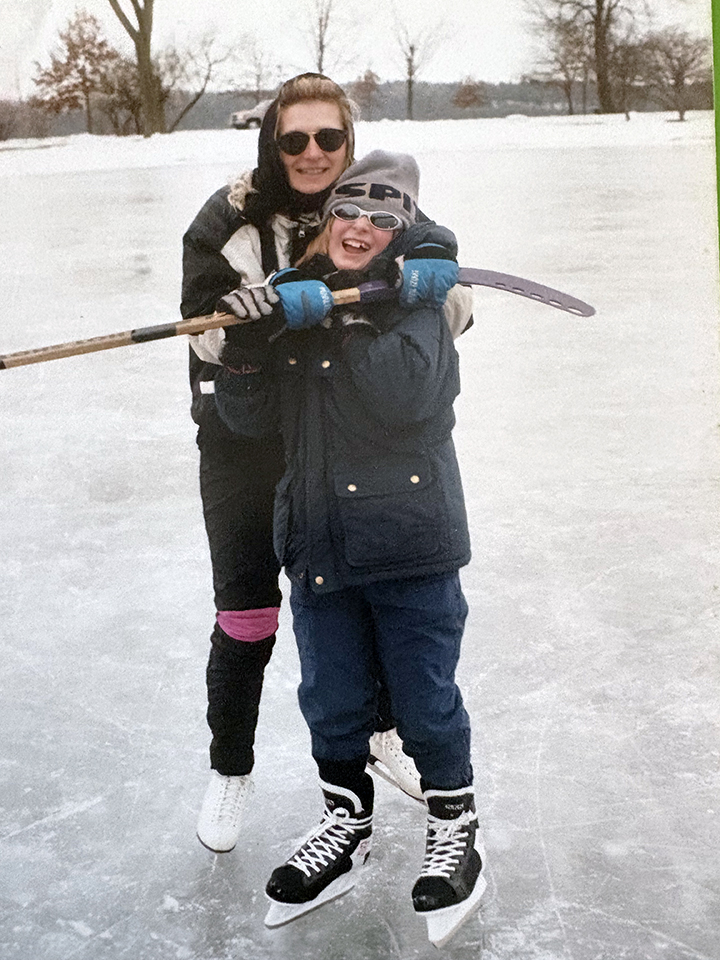
Alas, there is no disputing that the heart of our social scene was the Vilas Park rink, where I’d have to say, my friends and I spent inordinate amounts of time gossiping, goofing around, and trying to impress the boys, but didn’t exactly concern ourselves with perfecting our skating technique. What were we thinking? Obviously, not very clearly, because employing some fancy footwork would surely have drawn attention.

This brings me to my wise decision to finally, whilst attending the UW, enroll in Figure Skating 1. The instructor, Jim, was funny and inspiring. He had the class executing forward and backward crossovers, waltz jumps, turns and stops and ice dancing in no time. He would often state, “Bend your knees, please, if I got a nickel for each time I have to remind you, I could retire early a rich man.” Or “Protect your knees with knee pads–you won’t get a new pair when you turn 40”.  His stand-up comic style delivery always made us laugh, but this was sound advice that I take seriously, ( now).

 I continue to practice many of the moves that I was lucky to learn from Jim, and I still skate at Vilas and other rinks around town. 

Though what I always hope for, as it isn’t possible every season, is to find that window when the lakes freeze yet there is no snow and one can literally sail on skates across the whole lake on beautiful smooth ice. This must be done with a buddy, of course. Each year, I have fewer friends who are still physically able to even stand on skates. I miss the camaraderie and games and silliness, but I love feeling the sun on my face and marveling at the distant clouds and reminding myself that a bit of winter is not so bad.

© 2025 Gina Chirichella

Gina attended the UW, majoring in Theatre, and performs in local theatre and film. She enjoys writing thanks to Sarah’s classes and encouragement. She has had her haikus published in the Isthmus and bus lines poetry. She loves swimming, skating, singing and dancing, music ( especially punk and indie), playing ukulele, reading, and liberal politics.
Posted in Guest writer | Leave a comment

Pigs Can Swim (And I Almost Drowned Trying to Save Them)

By Iryna Mroz

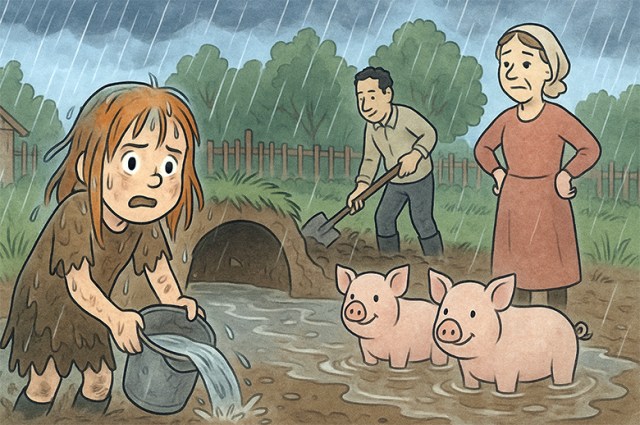
Image by ChatGPT from prompts

When I was about nine years old, I made a shocking discovery: pigs can swim. Not that anyone had bothered to tell me this crucial piece of information before I risked my life for them.

We lived in a small village in eastern Ukraine. Life in the Soviet Union had improved a little, but if you wanted meat, you had two choices: buy it on the black market (and risk your life) or raise it yourself (and risk your sanity). My parents chose the second option and brought home two adorable piglets. My father even built them a fancy underground pigsty, a zemlyanka—which is basically a pig mansion, Soviet-style.

Everything was fine until one fateful spring day. My parents had gone to the city to shop, leaving me home alone, which was their first mistake. Suddenly, the sky turned dark, thunder rumbled, and rain came pouring down like the heavens had a personal vendetta against our village.

I ran outside to check on the pigs, and what I saw nearly stopped my heart. Their underground house was flooding! Water was gushing in like a mini-Titanic disaster. The pigs looked up at me, completely unfazed, probably thinking, Well, this is new.

Panic set in. I had to save them! I sprinted back to the house, grabbed two buckets, and began bailing water as fast as my little arms could go. I worked like a hero in a disaster movie—except instead of saving people, I was trying to rescue two ungrateful pigs who didn’t seem the least bit concerned.

An hour later, I was soaked, covered in mud, and exhausted. Just when I thought I had won the battle, my parents returned. Finally, I thought, reinforcements!

Did they rush to help? Nope. My father casually grabbed a shovel and started digging a trench, redirecting the water away like it was just another Tuesday. My mother stood there watching me, hands on her hips, shaking her head like I was the biggest fool in the village.

Then she dropped the bombshell:

“Pigs can swim.”

I froze. My eyes twitched. My exhausted brain replayed the last hour—me, battling the flood, working like a crazed lunatic, while the pigs just sat there, waiting for their next meal.

Not a single “Good job, Ira!” Not even a “Wow, you really gave it your all!” Just, “Pigs can swim.”

I stood there, drenched, betrayed, and questioning my life choices. The pigs? They snorted, splashed in the water, and went right back to doing pig things.

That was the day I learned three important lessons:

  1. Pigs can swim.
  2. Parents don’t always appreciate your heroic efforts.
  3. Next time, let the pigs fend for themselves.

© 2025 Iryna Mroz

Iryna Mroz was born in Ukraine to Darya and Terentiy Shaleyko and raised with strong values of resilience, education, and family. She built a career as an engineer and later a manager at the Zaporizhzhya Nuclear Power Station. Together with her first husband, Leonid Marchenko, she raised twin daughters while navigating the challenges of Soviet life, including the Chernobyl disaster. After immigrating to the United States in 2007 she embraced a new chapter. She is now a U.S. citizen, happily remarried to Jeff Mroz. Her journey has been shaped by hardship and healing, love and loss, but above all, by the strength of family and the hope for future generations.

Posted in Guest writer | Leave a comment

Notes from the Fourth Lake Writing Weekend

Why would someone like me—a writing teacher, MFA holder in Creative Nonfiction, and professional writer of more than 25 years—sign up for a weekend writing workshop?

Because sometimes, even the most practiced hands need to put the client work down, leave the house, and write something personal. To be the student, not the editor. To get a little lost, on purpose.

That’s what the Fourth Lake Writing Weekend offered. Hosted by Madison Writers’ Studio, the event brought about 40 writers together for two days of workshops, discussion, and literary camaraderie just a few miles from my home. And still, I booked a room at the Concourse Hotel.

The weekend included four workshops, an open mic at Lake City Books, and a final Q&A panel. But for me, the value lay not just in what was on the schedule, but in the shift in mindset that happens when you choose to step outside your daily life and treat your writing as worthy of that space.

Surprise on the Page

Michelle Wildgen’s opening workshop, “Embracing the Mess,” was just the jolt I needed. We wrote from prompts, then shared to find what she called “hot spots”—lines where you feeel a sizzle of energy. Her prompt was simple: Write about a smell. I rolled my eyes. Then I wrote. And out came something that led me to a fresh take on an old experience, one I thought I’d gnawed all the meat off of decades ago.

That’s the thing about generative workshops. I often doubt the value of what I draft in them. The writing is raw, half-formed. But it’s also where surprise lives. Every once in a while, the results aren’t drivel. A door cracks open and in strolls inspiration.

Susanna Daniel’s “Building Creative Resilience” prompted us to examine the beliefs, habits, and myths that hold us back. What struck me most was the shared honesty in the room. Sometimes it helps just to be reminded that you’re not alone.

Because you’re not. We all need community. I met new writing buddies this weekend, exchanged contact info. There’s comfort in gathering with people who understand the peculiar hope and frustration of the blank page.

Workshops come in different flavors. Generative ones ask you to write; craft or discussion-based ones ask you to think and respond. Deshawn McKinney’s session, “Who Am I Writing For?”, landed somewhere in between. It was my favorite of the weekend—a thoughtful look at how audience shapes writing. Although we ran short on time, I left with questions that I’ll return to as I revise my current work.

Christopher Chambers’ session on fragmented and mosaic writing was more discussion than generative. I like playing with patterns in essays, and this introduced me to yet more ways to build a story.

Staying Onsite, Even in My Own Town

Living in Madison, I could easily have come and gone each day. Instead, I checked into the Concourse and treated the weekend like a true retreat. Just me, my writing tools, and a delightfully air-conditioned respite while the Heat Dome assaulted Madison. The fact I got upgraded to the Governor’s Club didn’t hurt a bit. But even if I’d been in the humblest of rooms, I would still have stayed. Sometimes you need to physically step away from your routine to see your work differently. Even a three-mile separation can feel like a flight away if you give it the right context.

It was, in the end, a kind of MFA cosplay. But it reminded me why I teach, and why I need to grow in my own creative writing, stretching to try new forms. When you see a writing retreat, workshop, or conference that intrigues you–listen to that voice. I predict you’ll be glad you did!

© 2025 Sarah White

Posted in Sarah's memoir, writing workshop | 3 Comments

Mood Swings (Facing the Mew-sic)

By Faith Ellestad

In years past, far past, my husband used to refer to me, I assume affectionately, as Pollyanna. I was always in search of ways to make things better, or at least more cheerful.  Yes, I looked on the bright side of life.  If I could get a laugh or solve a problem, I had won the Oscar.  I was relentless in my sunny outlook.  God, I must have been insufferable. 

The antidote for my joie de vivre was, predictably, adulthood.  Kids, jobs, family crises. Sickness and health, poverty and sustainable income, better and worse, Good times and less excellent ones.  As we drove our Volkswagen down the highway of life, Pollyanna was relegated to the back seat.

Then came Covid, long Covid, the deaths of my mother, brother, and dear friend, my dog and cats, and with the emotional struggles of those around me in addition to my own, I thought I had hit bottom.  Yes, there were occasional visits with friends, and thankfully, “Spring Baking Championship” on HGTV, but my hold on sanity was tenuous, and pretty much dependent on Trump losing the election. (I understand not everyone feels the same, but this is a personal essay.). In any case, that obviously didn’t happen, and since then I have been staunchly glued to the news on TV and online, basically force-feeding my saddest, angriest, and most depressive instincts.

What might happen?  Will Social Security go away? Will health insurance be curtailed? Will Medicare not cover the services we need? Will democracy survive? I’ll spare you every last droplet of my brain-ringing, but since many of you are in similar situations, or know someone who is, you get the idea.

Nights of lying awake spinning, days turning off the TV just to turn it on again a half-hour later. Trying not to talk constantly about politics, but everyone else is anyway, so get-togethers seem more like support group meetings.

After a particularly bleak couple of weeks, I decided I had to at least try to shake things up.  What options might there be for improving one’s outlook? Exercise would have been a good choice, but I was recovering from spine surgery and emphatically curtailed from most physical activity including, unfortunately, exercising and fortunately, cleaning.  I had no dog to walk and no snow to shovel (forbidden anyway).  I didn’t have enough laundry to keep me occupied, even loading the washing machine one garment at a time, and the limply drooping houseplants were a testament to the dangers of boredom-induced over-watering.

I wasn’t just drowning my plants, I was underwater, too. There had to be something uplifting, somewhere.  What, what, what?  I racked my brain, and I probed my family’s brains.  We all came up empty and the news only got worse.  I stopped reading the paper except for the advice columns and Hints from Heloise because even in my horrible funk, I understood the importance of learning new ways to reuse paper napkins. (Apparently, if you refold them inside-out, no one will notice the stains, though I haven’t actually tried this myself yet.)  

One day while perusing said newspaper, I happened on a “Pets for Sale “column directly below “Hints from Heloise,” and fell in love with a photo of an adorable black puppy destined to become an adorable huge dog.  No matter. I desperately wanted him.  I planned to name him Bernie, after Bernie Sanders and pictured happy, yes, actual Happy! jaunts through the neighborhood.  Then reality set in.  I was still too debilitated to tussle with a strong, frisky puppy, and didn’t have the time or money to get our yard fenced. Yet another non-starter.  Back to deep sighs and moist Kleenex.

Dismal weather and more bad news exacerbated my depression. When we attended a Trivia gathering and I couldn’t come up with a single correct answer, my self-esteem, tenuous at best, plummeted.  The time had come to invite Pollyanna back into my life.

“Look”, I told myself, “it’s only Trivia.  You doubtless have so much useful information stored up, you just don’t have room for trivial stuff.” Hey, good for me, a baby step away from despair.

Maybe I could figure out something to lighten the household mood.  I worked at cooking some tastier meals.  I ordered new spices from Penzy’s. I changed the living room decor and redecorated the mantle.  I even went out to see some music with my husband and discovered the song “Shut Up and Dance With Me” by Walk the Moon could provide a brief interval of upbeat-ness, which was encouraging, but I couldn’t listen to it 24 hours a day. My mood was moment-to-moment, certainly not joie de vivre, more a range between depression and Meh-de vivre.  There was definitely more needed to change the dynamic.

I sensed an idea struggling to bubble up through the primordial ooze that had become my brain. When it finally burst through fully formed, I hosed it down and realized I might have found a solution. Perhaps not the most prudent or smartest plan, but maybe that wouldn’t’ matter.  I’d broach it anyway.  I was desperate.

“Hey, I just had this awesome idea!      Kittens!”

 I’m not clear on whether the stunned silence that met my announcement was due to its content or the fact that I was actually sounding cheerful.

 “What about kittens?“

“Maybe we should get some kittens. You know, something to take our minds off everything else. We liked having cats before.”

“True, but those were legacy cats, not kittens.  And after Maisie died, I distinctly remember you saying ‘no more pets.’”

“I know, but I was grieving.  I changed my mind.  I think we need something besides the news to focus on.”

“Ok,” my bemused husband nodded. “You make a good point. Kittens could keep us busy.” 

And that is why we are now happily owned by two eight-month-old felines. Thistle and Bramble. I thought about naming one of them Pollyanna, but really, I didn’t want to burden a happy young cat with maudlin reminiscences of my distant past.

Honestly, they have exceeded our expectations. My mood has lightened, I feel needed, and when one bounces over for a quick pat, I am validated. My husband thinks they’re charming.

 Kittens.  Probably not the solution for everyone.  Therapy might be less of a commitment and possibly cheaper in the long run. 

But if you just need to see eager little faces or hear happy purring to raise your endorphins, it’s kittens all the way.

© 2025 Faith Ellestad

Faith has been writing to amuse her family since she was old enough to print letters to her grandparents.  Now retired, she has taken the opportunity to sort through family memorabilia, discovering a wellspring of tales begging to be told, which she hopes to expand upon in written form (where appropriate, of course!).   She and her husband live in Madison, Wisconsin. They are the parents of two great sons and a loving daughter-in-law, and recently expanded their family to include Thistle and Bramble, two irrepressible young felines.

Posted in Guest writer | 1 Comment

Magic in the Moment

By Janet Manders

The day started like most others. Recently retired, I had learned to enjoy sliding into and savoring mornings. A huge difference from what I had experienced in prior years as a working mom.

For the bulk of my adult life, a screeching alarm pushed me, and my loud moans and groans, out of bed. My rituals to start the day were not activities I looked forward to. And truth be told, no one in my family found anything to appreciate about me, as they watched me stumble around with a frown on my face. But, after gulping down a cup of energy-boosting coffee, I was always ready to tackle the day with my left-sided brain. Mental, as well as hand-written, checklists dominated and directed my life. I thrived on being organized and well prepared to complete the many tasks that awaited me, both at home and at work.

Finally, at the age of 66, gentler and quieter routines became my new normal. Instead of waking up to a number on the clock, I rolled out of bed when I felt ready. A cup of strong coffee was still key to jump-starting my day, but my life had evolved to sipping that java, on the couch, with my phone in hand. I looked forward to time spent scrolling through my online sources that provided current news as well as spiritual messages. Successfully playing the online word games from the New York Times always had me mentally pumping my fists in the air. And a sense of connection to those I loved was found through shared texts and social media posts.

Letting go of those mental to-do lists was a little trickier however, so my second cup of coffee was always followed by opening my electronic calendar to see what was scheduled for the day. Perhaps lunch with a friend. Or volunteer work. Or meeting with my writing group. Hopefully not the dreaded dentist!

It was the Spring of 2024, and I had now enjoyed the satisfaction of nine months of developing and nurturing my new morning practices. The pleasant fragrance of hazelnut, from my steaming mug of coffee, accompanied me as I settled into the soft cushions of our worn, brown couch. I eagerly opened my phone to the sense of fulfillment that I knew would come next. Sure enough, an inspirational quote about gratitude, completing Wordle in only three attempts, and a text from my bestie all had me grinning widely. 

When I flipped to the calendar, I realized it was March 11. Three years since Dad died. The pain from his loss had recently settled into a dull ache. I closed my eyes to consider how I could honor his memory. Before I could plan anything though, I needed to know if there were any obligations to consider.  Was today a day where I’d be providing childcare for one of the grandchildren? Were there left-overs in the refrigerator or was today one for meal prep? Was the laundry basket overflowing? The questions mounted as I moved to the kitchen to rinse out my empty coffee cup. What task on the to-do list was a priority to start the day? Did I need actual pen and paper to organize and get it all done? I could feel the muscles in my neck tightening ever so slightly, now that my brain had switched to that familiar mode of list making.

September 2011. Enjoying time with Dad

Out of the corner of my eye, I caught a glimpse of color and movement. I turned towards the window and saw a cardinal perched on the sill outside. The commonly held belief that cardinals are a sign that a departed loved one was visiting, stopped me in my tracks. I placed a hand over my heart and heard myself whisper, “Well, hello Dad. How are you doing?” Gentle warmth spread in my chest as the bird cocked his head towards me. “I sure miss you. So does Mom. Judy, Mary, Tom, and I are taking good care of her. She’s doing okay.”

The cardinal bobbed his head once and then flew off. I followed his red streak through the air, past the white, fuzzy buds on our magnolia bush. He paused near the vibrant green leaves poking through the ground. Tulips would soon be blooming. 

 My shoulders relaxed as I went in search of my baseball cap. Who cares about the dishes in the sink or a to-do list, I told myself. It’s time to head outside. To find more of the magic in the moment.

© 2025 Janet Manders

Janet is a newly retired Occupational Therapist who enjoyed a career working with Public School Teachers to support students to be successful academically, socially, and emotionally. She has always enjoyed books and is currently working on a memoir along with picture books for children.

Posted in Guest writer | Leave a comment

The Last Concert

By Loriann Knapton

We all have gifts. Natural talents that make each one of us unique.  For example, some folks are athletic, setting records that put them on top of podiums, while others can solve complicated math equations. Some work magic with their hands, creating beautiful crafts with knitting needles, crochet hooks, pottery wheels or paintbrushes, and still others can turn a box of Ritz crackers, a can of Cheeze Whiz and a pound of dry salami into an unrecognizable yet delicious appetizer.  The point is we all have something, a skill or ability that comes to us easily and naturally. Special gifts, formed at conception when sperm meets egg and nurtured throughout one’s lifetime.  We all have them. The challenge is in recognizing exactly what they are.  

My mother and dad had grand ambitions for me as their only child. They weren’t interested in having me become a CEO, Nobel prize winner, or Astronaut. Mostly, their dreams for me were more modest. Grow up, get married to a nice man, have babies and because they both loved to dance, maybe, just maybe, I could make a few extra bucks playing a musical instrument in a polka band. But there was one small issue with this plan. Namely, the fact that musical talent was most definitely not one of my natural gifts. Sunday school choir had proved that I couldn’t carry a tune in a bucket, and my one year of piano lessons amounted to me being able to plunk out Mary had a Little Lamb with one finger.  Despite this knowledge, my parents still held high hopes for me, and when the accordion band came to town offering to sign up the neighborhood children for lessons, they promptly put me on the list. Now as a child of the late 60s and teen of the early 1970s the accordion was the last musical instrument that any of my peers would consider “cool” and as a pre-teen “cool” was what I desperately wanted to be so admittedly I wasn’t as enthusiastic as my mom and dad were for me to learn to play an instrument mostly associated with polka bands and the Scottish jig.

No matter, because the illusion that I would become the female version of Lawrence Welk went on for the next seven years with weekly lessons and the purchase of a $1500 Santini accordion with money I received when my grandmother passed away.  Soon there were frequent requests from my mother whenever anyone visited for me to  “Play for us Loriann” at which time I would ceremoniously drag my accordion out and play the only tune I knew from memory, the  “She’s Too Fat for Me” polka for my beaming mother and her less than impressed friends.  On occasion, I would include a bit more fanfare and Oompa my way through a piece from my current lesson, which included many more stops than starts. After several years, when it became apparent that the Lawrence Welk show wouldn’t be contacting me anytime soon to audition, my mother finally relented and let me stop taking accordion lessons when I was fourteen. The great accordion experiment was over, but the Santini remained.

After I grew up and moved out of the house, I begrudgingly dragged the accordion with me to each new dwelling and stored it in an out-of-the-way closet. Very occasionally during these years, I might be persuaded to drag it out and play the one song I remembered, the trusty “She’s too fat for me polka” if anyone asked, but mostly that grand Santini stayed in the closet taking up space. Once, about eight years ago, after moving it again from one closet to make room in another, I suggested out loud that I might sell it–an announcement that made my grown-up daughter exclaim. “Mom NO! Not your accordion! You can’t sell it. I want it and I’ll take it as soon as I have room.” Which meant it wasn’t going anywhere soon, and so in the closet it stayed, collecting dust, until this past October when I resurrected it in preparation for the last concert.

I’m not sure where the idea came from, but I suddenly had this great thought that the perfect Christmas gift for my 93-year-old mother might just be an accordion concert. God knows she didn’t need more bath powder, and my giving up the accordion those many years ago had been a disappointment.  And so, with great hope that the gift of music had somehow found me in the years between my childhood lessons and receiving my Medicare card, I started practicing.  Several times each week leading up to Christmas when no one was about, I dragged out the accordion, propped up my old music books, and practiced my very rusty repertoire of songs.  I found that my arthritic fingers were no longer nimble on the right side keyboard, my left hand struggled to feel my way around the chord buttons and the continuous action of pulling my left arm to move the bellows was no longer an easy movement, one that ultimately required a trip to the massage therapist to repair what I ruefully called “bellow arm”. But I persisted for several determined weeks until I was finally able to play several pieces well enough to not embarrass myself during our family’s Christmas celebration.

That snowy night in late December, as our entire family settled around the tree to exchange gifts, I pulled the accordion from its case to my lap and announced, “Mom, your gift is first,” and  I began to play. I started with the trusty “She’s Too Fat” polka, the one piece I was semi-confident I could get through without error, and continued with a few of mom’s favorite Hank Williams songs including “Your Cheating Heart,” “Jambalaya” and “Hey, Hey Good Lookin’,” before finishing up with “Silver Bells” and “Silent Night.” For 20 minutes, my family listened to the music. There were stops and restarts, several missed notes, a grandson stepping in at one point to substitute for a music stand, and at least one “I played that so much better yesterday!” comment from me before I snapped the bellows shut. 

My mom just sat silently throughout, softly clapping her hands, tapping her toes, and beaming at me, until I played the last song, her favorite Christmas carol, “Silent Night,” at which point she sang along in her wobbly soprano with tears in her eyes. After I had put the accordion back in its case and closed the lid, she looked at me, glowing with pride at the cleverness of her only child, and with sparkling eyes and a huge smile, she said. “Loriann– That is the best Christmas present I have ever received”.  

We all get natural gifts, unique to each of us, determined at conception when sperm meets egg.  Until the last concert, I did not realize that making music was one of mine.       

© 2025 Loriann Knapton

Loriann Knapton has been writing since childhood.  Having crafted countless rhymes, short stories, and personal essays over her sixty-odd years she has a keen interest in ensuring her family memories are recorded for the next generations. Her writing reflects the humorous and poignant experiences of growing up in 1960’s small-town America with her mom and disabled dad.

Posted in Guest writer | 3 Comments

A Snippet of Many: It’s Not So Easy

By Marlene Samuels

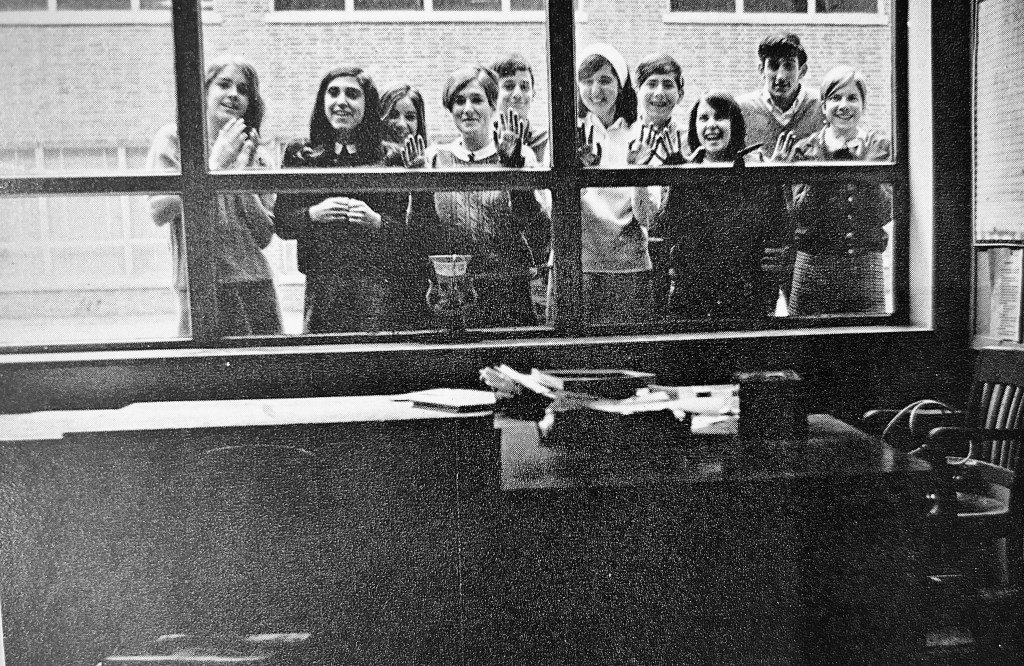
Image source: Echoes Yearbook 1968, New Trier High School, Winnetka, Illinois.

High school in our new American community was, for me, a stress-filled experience that fueled my debilitating sense of dread every school-day morning. I was the proverbial “duck out of water”,  the girl who did not fit in—last one chosen for gym class teams, who sat alone during lunch-hall, to whom no one spoke—an outsider among the teenagers who’d known one another since nursery school and whose parents were long-time friends, many of whom had attended the same elite colleges.

My parents had moved our family to the affluent Chicago suburb from our poor Montreal neighborhood populated almost entirely by Holocaust survivors. They were people who’d been unable to secure U.S. immigration visas after being liberated from the camps. My parents were foreigners, but not because they were from Canada—the country on the pull-down school map most students and their parents regarded as the United States of America’s northern extension.

Mom and Dad were bona fide foreigners. They spoke seriously accented English and always attracted sideways glances at village restaurants when they lapsed into Yiddish conversation. They’d grown up in eastern Europe, but particularly difficult: they were Jewish immigrants in an elite Protestant community where the few Jews who did live there were highly assimilated and boasted American roots dating back to the early 1800s. Besides their religious identities and pronounced accents, my parents were Holocaust survivors as well. They’d each been in concentration camps.

Each weekday morning, I awoke sick to my stomach, apprehensive about the taunts and isolation the school day might bring. I refused to raise my hand in classes and cringed in terror that I might be called upon. I avoided interacting with any other student. Dad’s admonishments created a continuous loop in my head, lessons he’d taught me beginning in my earliest years.

“Always, you must be quiet in a group. Never you should talk in front of strangers, but if yes, then only to answer a question what they are asking you! Farshteyst mir (understand me)?” He repeated this one lesson almost daily.

“Sure I do, Dad, but what I don’t understand is why!” 

“Why?” He snapped, indignantly. “Why is because never you should call attention to yourself, never! Best it is to be something like the invisible person. This I know because if you’re not careful and god forbid, you become visible, they will notice you. They’ll look closely on you and then poof! Then just like that they can decide to finish mit you!”

By second semester of my senior year in high school, and because I’d completed every mandatory history class, I was permitted to select one from a group of electives. I chose to register for an unconventional one, Oriental History: Japan and Her People. Thus far, my high school performance had been deplorable so chance to study something unusual, excited me.

Two weeks into the semester, Mr. Gould, my history teacher, made his announcement:

“Each of you will select a topic from our readings for an in-depth review. Write one sentence stating your topic on a three-by-five card and submit it to me by the end of Friday’s class. I’m giving you one week to prepare, and you’ll present your report to the class. Make sure to practice your presentations and make certain they don’t exceed fifteen minutes. I’ll start calling you randomly on Monday!”

I was dumbstruck by my teacher’s announcement. Was it possible I’d have to present in front of the whole class, before the students who mocked me and to whom I’d never spoken? The week dragged on. Each day, my dread increased exponentially. By Saturday evening, although I’d completed my report days earlier, I was so overwhelmed with dread, I was awake all night. By Sunday, my stomach was in knots, and by dinner-time, my appetite was obliterated.

I’d always been a healthy eater with a hearty appetite fueled by Mom’s gourmet cooking skills. But at dinner that evening, I stared, unblinking, at the plate before me. Several fork-pokes later, and still I’d not eaten one bite. I was plagued by thoughts about what the coming week might hold for me.  I fought nausea.

My mother was impressively observant, a woman who noticed every change and detail from the seemingly most insignificant to the largest, in people and in her surroundings. Everything registered in her brain, an aptitude I’d always suspected was one that had proven  invaluable to her surviving Dachau.

“What’s the matter with you tonight? Are you sick?” She asked, staring at my face and  the untouched food on my plate.

“I’m not sick, but my stomach is a mess.”

“Could you be overly hungry?” She suggested. “If you eat something, you might feel better.”

“Mom, I’m sure I’ll throw up if I eat!”

“So what’s this business tonight with you? Are you going to tell me?”

With that, I began to sob uncontrollably, blurting out the source of my indescribable distress. “Mr. Gould, my history teacher, said he’ll start calling on us tomorrow to present our reports in front of class.”

“And so for you, it’s a problem? You told me you finished the assignment already, yes?”

“I did finish. And yeah, it’s a huge problem! Mom, I can’t talk in front of the whole class—in front of those kids who make fun of me and are mean to me all the time—because I’ll throw up for sure. If Mr. Gould calls on me to present tomorrow, I’m going to die!”

My mother stared at me long and hard, expressionless. She shook her head back and forth. Then, in her soft voice, barely above a whisper, she said, “Trust me, Marlene, you definitely are not going to die. One thing I know for sure, it’s not so easy to die!”

© 2025 Marlene Samuels

Marlene holds a Ph.D., from University of Chicago. A research sociologist by training, she writes creative non-fiction by preference. Currently, she is completing her book entitled, Ask Mr. Hitler: A Memoir Told In Short Story.  She is coauthor of The Seamstress: A Memoir of Survival, and author of When Digital Isn’t Real: Fact-Finding Off-Line for Serious Writers. Her essays and stories have been published widely in anthologies, journals, and online.  (www.marlenesamuels.com)

Posted in Guest writer | Leave a comment

What the German Knew

by Donald A. Ranard

The author riding into town to witness the Pathet Lao takeover
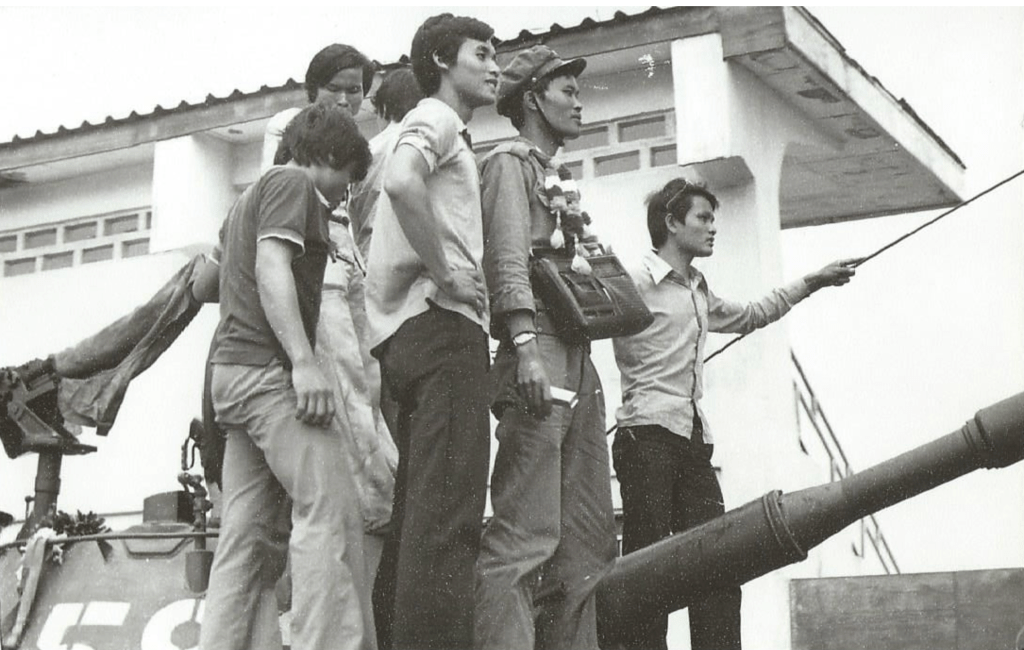
Student supporters of the Pathet Lao riding into town on a tank
Left: Pathet Lao commander on the lead tank. Right: foreign journalists interviewing Pathet Lao soldiers

Photos by Ray Oram, a British volunteer who taught English with the author at the lycée.

I met the German at the night market in Chiang Mai. The northern Thai city was a small town then, and in the evening, people would gather in the open-air night market, strung with white lights, to drink Thai beer and eat khao soi noodles. I spent my days in my small rented room writing and my nights at the night market drinking beer and watching people. There was a waiter who became a waitress over a two-week period, each day adding a little more make-up and sashay, and there was an old blind man, led by a young boy, who went from table to table, blowing loud, random notes on a harmonica. You didn’t pay him to play; you paid him to stop and go away.

It was December 1975. In May, six months before, I’d been evacuated to Thailand, from Savannakhet, a small riverside town in central Laos, after the Pathet Lao communist takeover. The U.S. had spent billions over two decades in Laos, funding a corrupt government that had collapsed without resistance after the fall of Saigon in April. U.S. officials in Laos had maintained a demeanor of unflappable optimism that toward the end seemed delusional. To men who’d had their formative professional experience in World War II, defeating two of the world’s greatest military powers, the thought that the U.S. might meet its match in a poor, tiny backwater, population 3 million, had seemed inconceivable.

But reality could not be ignored forever. As local officials fled to Thailand, the town was taken over by pro-Pathet Lao students—some of them, my students from the French-medium lycée where I taught English as a Fulbright grantee. Along with other Americans, I was placed under house arrest. But it was house arrest Lao style, which is to say it was loose, unclear, and negotiable, and when the PL finally rolled into town in a convoy of jeeps, trucks, and an old Soviet tank, no one seemed to care that I was among the curious lining both sides of the street. The commander sat in the head vehicle, an old jeep with a flat back tire, giving the people their first look at life under the new regime: ka-plunk, ka-plunk, ka-plunk. After the jeep, came canvas-covered trucks full of soldiers in green khaki and floppy Mao-style hats. They were young—younger than my students, many of them—and behind the impassive expressions I sensed the wariness of villagers on their first trip to town. Students jumped up on the trucks and joined the soldiers, posing for friends who ran alongside taking pictures, and when I saw them, the smiling sons of the elite, in their bell-bottom trousers and Lacoste polo shirts, next to the grim soldiers in their threadbare uniforms, I felt a twinge of fear for my students. This was not the beginning of a beautiful friendship.

 The next day, the small community of American aid workers and English teachers gathered at the landing strip that served as the airport. “Bon chance,” said the director of the French cultural center, an old Indochina hand, who had come to say goodbye. He seemed sincere in his sympathy, but as I shook his hand, I wondered how he really felt. Not so many years ago, the Americans had watched the French lose the First Indochina War. We had arrived on the scene confident we would succeed where the French had failed. We didn’t lose wars—we were Americans! Now we were leaving, and the French were staying.

An hour later, we stepped down from the cargo plane onto the tarmac in Udorn, Thailand, to a small scrum of waiting reporters. “End of an era,” said Sandy Stone, Savannakhet’s USAID director. “Or should I say, error?”

Stone, a retired colonel who’d served in World War II in Europe with OSS, the forerunner of the CIA, was in his late 50s then and young enough for one more overseas assignment: Afghanistan.

#

The German and his young American friend were sitting at the table next to me, and I fell into a conversation with them the way you do with fellow foreigners abroad. The German was an affable old Thai hand in his late forties. His young American companion was a freelance photographer, quiet and intense, new to journalism and the region.

They’d returned a few days before from Ban Vinai, a makeshift camp in northeastern Thailand, near the Laotian border, built in great haste to accommodate Hmong refugees pouring into Thailand. After the easy-going lowland Lao had proven to be unenthusiastic fighters, the CIA had recruited the Hmong hilltribe people to fight in what the agency touted as a “low-cost” war—low cost, that is, in American lives. For the hill tribe people, the cost had been grievous; the war had killed, injured, or displaced nearly half of the Hmong in Laos. In the end, boys as young as ten were pressed into military service. There was an informal rule, a CIA operative would later recall: A boy had to be as tall as an M-1 rifle to become a soldier.

The Hmong had been promised they’d be taken care of if things ended badly. When things did end badly—and more quickly than anyone had anticipated—only the leaders and their families were evacuated to Thailand. Now thousands of men, women, and children were making the long dangerous journey on foot from the mountains of Laos and across the heavily patrolled Mekong River to Thailand, many dying along the along the way. Soon Ban Vinai refugee camp would become the largest Hmong community in the world.

#

“Well, there’s one good thing about all this,” the American photographer said. “The U.S. will think twice the next time their government tries to drag us into a war.”

The German regarded his young friend with a small smile. “You’d be surprised what people will allow their government to do when they’re angry and afraid,” he said quietly.

A few days later I left Thailand on a backpacking trip through India and Nepal, and I never saw them again. But a little more than a quarter-century later, in a feverish run-up to another ill-conceived war with disastrous consequences, I remembered the German and what he said in the night market in Chiang Mai. 

© 2025 Donald A. Ranard

A somewhat different version of this essay first appeared in So It Goes, a literary magazine published by the Kurt Vonnegut Museum and Library.

After his evacuation from Laos, Donald A. Ranard worked in refugee assistance programs in Southeast Asia and the U.S. His writing has appeared in The Atlantic, The Washington Post, The Boston Globe, The Los Angeles Times, New World Writing Quarterly, The Best Travel Writing, and elsewhere. In 2022, his flash fiction story “5/25/22” was longlisted by Wigleaf as one of the year’s top 50 Very Short Fictions, and his play, ELBOW. APPLE. CARPET. SADDLE. BUBBLE., about a wounded Iraq war veteran, placed second in a national playwriting contest.

Posted in Guest writer | 2 Comments

Share YOUR “Family Troubles”

For three weeks, my posts have focused on “Family Troubles”–the difficulties we encounter when we put our life stories out in the world, where people whose lives overlap ours can read them. Now I want to hear from you–have you published a memoir? How was it received by family and friends?

Write about it. Send my way–see Submission Guidelines here.

The posts in this series so far:

  • My tale of my difficulties on publishing a slim travel meoir in Friend Trouble.

Your true stories, well told, are welcome here!

  • Sarah White

Posted in Commentary, Uncategorized, Writing prompt | Leave a comment

Family Trouble and the Things We Don’t Talk About

This post concludes our short series that began with a review of the book Family Trouble: Memoirists on the Hazards and Rewards of Revealing Family. In the second, I recounted my own difficulties in Friend Trouble. In this final post, Josh Feyen contemplates sharing his memoir with family members.

By Josh Feyen

I introduce my memoir with this story:

In my junior year of college, I worked as a housefellow at the UW-Milwaukee Sandburg dorm. One January night in early 1992, my freshman roommate Scott invited me to his new apartment on Downer Avenue. We became good friends but lost touch when he moved off campus, so I was eager to reconnect.

Scott introduced me to a small group and then went on to welcome others. The small talk fizzled and I stood on my own, drinking beers and feeling out of place. I compared myself to the crowd—this guy was handsome, that couple looked out of People Magazine. My self-esteem fell to the sticky floor.

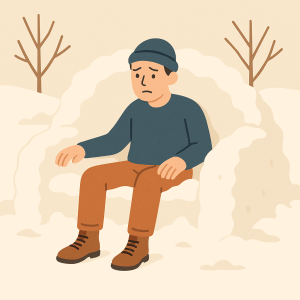
I said goodbye to Scott long before the party ended. It had been snowing and continued as I walked back to my dorm. I strolled past the athletic center and noticed a fresh snowbank that looked like an overstuffed chair. I dropped into it and closed my eyes. I was tired, dizzy and feeling sorry for myself. I sat alone despite having just been with people, and my dislike of winter compounded my sadness. The snow chair was comfortable, and in the front of my mind, I considered taking a quick nap. In the back of my mind, I knew that if I sat there long enough, I’d never get up. Somewhere between the front and back of my mind, I was OK with that.

And then a story my mom shared with me emerged. During her college years at UW-Milwaukee, after a few drinks at a winter party, she’d spotted an inviting snowbank and sat down, feeling depressed. She was lonely, and social and world affairs of the mid 1960s weighed on her mind. Then she started thinking to herself that there had to be a reason she existed, and while it frustrated her that she didn’t know why, she accepted the ambiguity. She opened her eyes, pushed herself out of the snowbank, and went home.

When I read this introduction to my husband, he said, “You’ve never told me that story.” This is precisely the problem. We’re not telling one another the important stories of our lives. My mom’s story, and its inspiration to push me away from that snowbank, is why I’m able to write this story today.

When I picked up Family Trouble by Joy Castro, I was searching for kindred spirits who understood the complexity of telling others our stories. The book’s 25 memoirists wrote about the challenges they faced as they shared, and censored, their stories.

My own memoir started during the pandemic isolation of 2020—passing time going through old journals and photos. As I approached my birthday in 2021, I challenged myself to write one story a week, aiming for at least 50 to mark my 50th year. These two projects resulted in thousands of words illustrated with hundreds of photos. But they had no audience except my patient husband.

Looking for readers, I wrote, designed and printed one 450-page memoir titled Out With It, The Things We Don’t Talk About—a gift for my first niece’s high school graduation. I expected it would either travel with her to college, or collect dust on a bookshelf, either way, it would have a reader of one or none. I got a little braver, and expanded the idea to print personalized editions for each of my other three nieces, my nephew, and my godson as they graduated high school.

I wrote for an audience of six young adults who I hoped to help and guide with stories and lessons I had learned. Topics include personal experiences sex, death and money, but also religion, growing up poor on a farm, and many of the isms, including sexism, racism and classism. As I revised and prepared new editions, I began to recognize that they weren’t just personal anecdotes but explorations of universal human struggles. The journalist in me yearned to find a wider audience because sharing what we’ve learned is how we connect our differences. My mom shared her story, and I think it saved my life. If my experiences could push one person out of their personal snowbank, wouldn’t that be worth the risk of sharing?

But it’s one thing to share personal stories with six young adults who know and love me; it’s another thing to imagine anyone else reading them. I wrote about subjects few people talk about, or if so, in hushed voices with trusted friends—because sharing them widely might cause trouble. Family trouble.

As I read through the Family Trouble essays, I realized there was only one person I was worried about reading my stories: my dad. Would Dad feel shame learning that I think we were raised poor? How would he react to my conclusion that his beloved Catholic Church was more confusing than nurturing to my childhood? What about the argument with my parents over my gay marriage that led to years of strained communication? If he were to read Out With It, he would learn about these, and everything I’ve kept from him in the chapter, The Things I Never Told My Parents.

But maybe there’s little to worry about. Dad and I have gotten a lot closer in the last five years. Together he and I navigated Mom’s dementia, planned her earlier-than-expected funeral and are navigating his new life as a widower. Since she died, we’ve continued to spend a lot of time with one another, talking late into nights, and for me, our relationship is far stronger than any in the past. Perhaps it’s strong enough for me to bravely share my memoir, and for him to hear my perspective of our shared life. I’m inching toward sharing a copy with Dad, with a suggestion that maybe he skip the Sex chapter. Or maybe I’ll share some of the “easy” chapters first, and drop the more challenging ones as he gets used to the idea.


I know that when my mother’s story got me out of a snowbank, I glimpsed how stories can save us. Now, as I contemplate sharing my memoir, I’m increasingly embracing the possibility that sharing our unsaid truths doesn’t have to push people apart. With genuine courage—from both the writer revealing and the reader receiving—these stories can actually pull us closer together.

© 2025 Josh Feyen

Josh Feyen was raised on a farm in southwest Wisconsin, went to college in Milwaukee, lived abroad for four years on three continents, and now finds himself with stories to tell. In the middle of 2021, Josh set about writing 50 short memoir stories in his 50th year. Today, the main focus of Josh’s 50 in 50 writing journey is to share what he’s learned with his four teenage nieces and nephew. Josh lives in Madison, Wisconsin. Find his other blog posts for True Stories Well Told here.

Posted in Guest writer | Leave a comment