Boxes and Bags

By Janet Manders

I was a shy and quiet person throughout my youth. My personality often kept me in the background. And unnoticed. I enjoyed a small circle of gal pals, but I was never the one to lead that group in any direction. Instead, I gladly followed my friends’  lead for what to wear and do. At times, I even observed and conformed to their thoughts and belief systems. I definitely didn’t see myself as attractive or appealing to the opposite sex. I had my share of crushes but always kept my infatuations private. Being asked to a school dance never happened for me. I was also the ultimate rule follower and did everything I could to avoid getting in trouble with my parents or teachers. I was content with my life. But looking back, I’d have to describe myself as conventional. And boring.

Things started to change when I started my college experience in the fall of 1975 in Madison, Wisconsin. The campus was huge and vibrant. I quickly found a small circle of friends from the dorm I lived in. Late-night discussions with that group opened my eyes to new ideas and possibilities. I found myself beginning the wonderful process of exploring who I was. And who I wanted to be. My new group included both females and males. One of the males, Bob, was tall with soulful eyes and long silky black hair. He loved music more than studying. I quickly fell in love with him and the alternative lifestyle he embodied. So different from my traditional youth. As I grew more confident in myself, his interest in me grew. Life was suddenly exciting.

Halloween on campus was the perfect opportunity to express my emerging sense of self. The yearly celebration occurred on the edge of the sprawling campus on State Street. Creatively costumed characters pushed traffic off the street to party all night long around bonfires. Bob was the creator of our costume freshman year. A white pillowcase, with a face drawn on it, covered our raised arms, head and shoulders. A sweatshirt with the sleeves hanging limply at our sides along with knee-high socks, boots and a pair of shorts pulled low over our hips gave the illusion that we had huge heads and a squat torso.  Our group of pillow people paraded around State Street, gathering attention and laughs everywhere we went. No one knew it was me underneath that pillow but I definitely wasn’t in the background anymore.

During my sophomore year, Bob took his guitar and dropped out of school. He also dropped me. I was devastated. My self-esteem took a serious hit. But, life goes on and Halloween season arrived to cheer me up. Boxes were repurposed to create costumes during my sophomore and junior years. Two large square boxes were used to design a pair of dice for a friend and myself. The following year, six bicycle boxes were painted to transform them into domino pieces. Both years, my head was visible through circular openings. Throughout our night of revelry, I was seen and recognized by people I knew and by strangers. The applause for my group’s innovative creations puffed me up with pride. 

My feelings of excitement surged when others on State Street yelled, “Push the dominoes!” My group and I stayed within eyesight of each other, but far enough apart, to avoid experiencing the domino effect in real life. Caution ruled. But so did a sense of growing empowerment in myself.

For my senior year, my best friend, Pam, convinced me it was time to expose even more of myself. It was time to stop hiding inside of a pillowcase or a box. The black leotard tops and tights we wore for Halloween that year were sleek, hugging our bodies. We used face paint to color our noses black and to add whiskers to our cheeks. I couldn’t let go of the ritual of adding a box so a small angled carton painted orange and worn across our waists gave the appearance of a piece of cheese. Although I envied Pam’s curvaceous body, I threw back my shoulders to squeak as we slinked down State Street.

The response from others increased my confidence. So many men were smiling at me and talking to me. There was interest in me! Towards the end of the night, two guys, who were also dressed all in black with eye masks, asked for our phone numbers and suggested a double date the following evening. They looked so mysterious. As well as a little bit dangerous and exciting. I floated home on a cloud. Maybe, putting myself out there, like Pam had suggested, was just the trick to a life full of treats.

The next evening, dressed in jeans and t-shirts, we waited for our mystery men to appear. They arrived, also dressed in jeans and t-shirts. They looked very ordinary. Our conversation was awkward and stilted. There was absolutely no feeling of attraction or zing. We all went home early. And disappointed.

That night, as Pam and I curled up on opposite ends of the couch to talk into the early hours of the morning, we debated. Should I go back into hiding as part of a group with only my head poked out of a box? Or should I take the risk to put myself out there again?

© 2025 Janet Manders

Janet is a newly retired Occupational Therapist who enjoyed a career working with Public School Teachers to support students to be successful academically, socially, and emotionally. She has always enjoyed books and is currently working on a memoir along with picture books for children.

Posted in Guest writer | Leave a comment

Bible Study

By Sarah White

Jim turned to me as we watched a TV news bit about an Episcopalian priest being charged or exonerated or I didn’t catch what, by the Archbishop of Canterbury.

“Was there a priest abuse crisis in the Anglican church as well as the Catholic church?” he asked. I’d never thought about it in terms like that, but I had to say, “Yes, there was. There was an abusive priest at St. Christopher’s.”

“You’ve never told me that story!” he said.

And so I did.

I think it was probably 1971 or 1972—I was maybe 13 or 14. The Jesus Movement had gripped the Midwest. I’d started going to Bible Study meetings. A friend who attended our church—our parents had both been among the founders—joined me. I can’t remember her name—let’s call her Joanne.

The youth priest at St. Christopher’s who ran the Bible Study group said that Joanne and I might benefit from additional meetings with him. He suggested his apartment. We arranged to do this biweekly, alternating with the weeks the Bible Study group met.

Neither of us was old enough to drive yet, so after school one of our mothers dropped us off there, and the other mother picked us up an hour or so later.

We would sit in his living room with our Bibles on our laps and choose a passage to study. But Joanne often got headaches. When this happened, the youth priest would suggest she go to his bedroom and lie down. Later he would go and check on her. Tender man, so sweet of him to look after our spiritual development and bodily well-being with such care! I would sit quietly in the living room studying my Bible passage and waiting for the youth priest to help Joanne feel better.

I can’t tell you how long the extra Bible study sessions continued.

One Sunday after church, our two mothers called me into the senior priest’s office. They asked me what happened at these Bible study sessions. I explained about the living room, the scripture passages, Joanne’s headaches, the youth priest’s tender care.

Silence vacuumed up the air in that office after that. I remember my mother putting her head in her hands and saying, “And you sat there reading your Bible.” Not a question, a hushed statement, a sigh of incomprehension. Could her daughter still be as innocent as all that?

The extra meetings stopped, the Bible Study group stopped, and the youth priest left for a new post somewhere. Joanne and I ceased to be in each other’s lives. No one ever said a word about it again.

©2025 Sarah White

Sarah White is the publisher of this blog. Your “true stories, well told,” are welcome here.  Find True Stories Well Told submission guidelines at this link.

Posted in Sarah's memoir | 3 Comments

Risk-Benefit Analysis

Today I offer Renee Lajcak’s essay, read by the author. Why? Because Renee writes sometimes to be read, and sometimes to read aloud, because she enjoys performing her pieces. “There’s a difference in how I write for spoken word,” says Renee. “I use shorter sentences, more repetition. On the page, you can be more abstract. For listeners, I keep it visual, ‘in your face’.” She enjoys having some control, through her stress and intonation, over how her audience (readers transformed to listeners) takes in her stories.

I remind her that writing for readers, we use tools like punctuation and spacing to suggest how readers can “hear” our stories, even if encountered on the page. It’s an interesting conversation for writers to have! Which punctuation conveys what? Does an em-dash suggest something different from a semi-colon?

Can we find ways to convey intonation through word choices, as Alexandra Fuller did in Cocktails Under the Tree of Forgiveness when she wrote, ”Don’t talk to me about behaving,” Auntie Glug says, giving one of her badger growls. “Bugger that.”? Or will we be like Renee, and choose to release our stories into the world through our voices and bodies?

By Renee Lajcak

I worked for 23 years at an English language school on Capitol Square in Madison, Wisconsin. Our students were adults, coming from all over the world. When the afternoon classes let out at 5pm, groups of students would hang out in front of the school, especially on Friday when they were making weekend plans. One Friday, a big hairy drunk lumbered into the crowd of students and took a liking to a new Japanese student with very little English. The delicate young woman got panicky and skittered back inside the school to the safety of our receptionist, Patty. The drunk man, on the other hand, lingered in front of the school, peering through the windows, waiting for the girl.

I decided to go out and talk to him. Growing up with an alcoholic father and spending a lot of time in bars since childhood, I was used to talking to drunks. My modus operandi when dealing with them is to gently offer a future solution, however tenuous. I politely and carefully explained to this bleary-eyed man that the school would open again on Monday, and he could come back again then. He was satisfied with this, nodded, grunted, and stumbled away, never to be seen again. Problem solved.

But for Patty, my simple solution seemed like magic. She often told the story of how she was ready to call the police, but I single-handedly took care of the tense and potentially dangerous situation. Every time she told the story, the drunk grew 2 inches and gained 20 pounds. She made me sound like David fighting off Goliath. An unbefitting description, true, but I secretly got a kick out of feeling like some sort of hero.

As receptionist, Patty was the “mother” for many of our international students, welcoming them in the morning, asking about their lives, even inviting them to her home. She was a Minnesotan-Scandinavian, orderly and conscientious woman that lived a rather traditional, safe life with her husband and children. One day, I told her I was planning to go out to hear Milwaukee legend Jim Liban play the blues at the Crystal Corner Bar on Willy Street. She furrowed her brow and asked in a tentative voice, “Isn’t that a dangerous place? Where bikers go to drink?” In opposition to her intention, this did not make me second-guess my planned night out, but rather made me glory a bit in the perceived risk. Actually, I’m a rather cautious and deliberate person by nature, so to be seen as doing something dangerous made me feel black-leather cool.

The next morning, I told Patty all about my night out in the den of iniquity. She listened to me intently. “Patty , the music was SO good! Liban even played his harmonica while walking on top of the bar! I was standing on the floor listening, and a group of bikers were standing right behind me. And then, right in the middle of a song, there was a loud crash! And the whole bar went quiet. A biker behind me had broken a beer bottle!” Patty gasped. I continued, “And you know what happened next, Patty?” Patty was on the edge of her wheely-chair now. “You know what those bikers did?  They . . . got a broom and a dustpan and cleaned it up!”

WWII General George S. Patton said, “Take calculated risks. That is quite different from being rash.” In Patty’s eyes, my risk-benefit analysis was sometimes close to rash, with the risks being too big for the expected payouts. But in reality, the risks were small, and she had the ability to make the benefits feel more than worth it.

©2025 Renee Lajcak

Renee is a newly retired English language teacher who has taught in several Asian countries but now enjoys her woodsy backyard the best.  She loves the connections made through storytelling and teaching conversational English, but writing about memories allows her to go inward to contemplate the good, the bad and the ugly.  But mostly the good. 

Posted in Guest writer | Leave a comment

What’s in a Name?

By Faith Ellestad

I was six when I realized I was the only one in my family not named after a cherished relative. All my siblings were namesakes- my sister was named after our grandma and great-grandma.  My older brother was a “The third”, after my dad and grandpa, and my younger brother bore the moniker of my long-deceased maternal grandfather. Even Mom and Dad were named after their parents but I was just plain Faith. No association with anyone. This injustice was clear to my first-grade self. I too wanted to be named after somebody. Anybody!  Just like the others. Had Mom and Dad run out of relatives? I needed to know. But their explanation, I was special, didn’t cut it for me. I didn’t feel special. I felt left out.

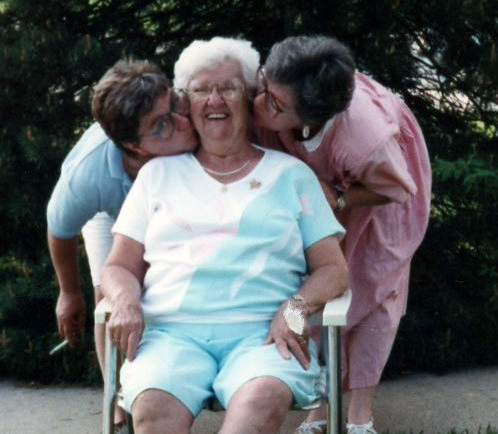
Three namesakes and a virtue. From left:: James, Faith, Ann, and Thomas.

At the time, I didn’t know that I was unplanned, born just a year and three days after my brother (the Third).  Apparently, according to my mom, Grandma felt it was rather unwise having two babies so close together. My parents assured her that my unexpected arrival was clearly a gift from the heavens, and they just took it on Faith (get it?) that the timing was spiritually arranged. Ergo, my name. (Not until I entered high school, however, was this convoluted story was related to me, I assume simply because having babies close together may have involved sex, a thing that was never discussed at our house. God forbid.)

It was when I started religion class in grade school that my name became a liability. Whereas my lucky sibs were named after beloved family members, I was named for a virtue.  And not just any virtue, one that could be endlessly chanted and joked about.  “Faith, Hope and Charity!’  Ha Ha.  Granted, kid humor is not sophisticated, but I didn’t like being teased. I got enough of that at home!

As if that weren’t enough holiness, my middle name is Mary.  I can still feel myself cringing when someone in the family called out in public: “Faith Meeh-ry!”  UUUGHH.

My parents assuring me Faith was a beautiful name didn’t help, especially as I got older and “Faithful” and “Faithless” became more frequent.

How I wanted to be “Maureen” instead.  Lucky Maureen Duffy, a girl in my third-grade class, was pretty, tall and got to wear patent leather shoes to school. She was the teacher’s pet and no one teased her about her name or anything else. I envied everything about her, and even suggested a name change, but my parents showed no inclination to call me Maureen and persisted in calling me Faith or Faithie. Eventually I just pretty much shut up about the whole thing. I figured they loved me in spite of their unfortunate choice of name.  On the rare occasions I complained about the teasing, which, though generally benign, was ongoing, and never not irritating, they would just say,


“Oh they just kid you because they like you.”

 How did that make sense to an eight-year-old?

In High School, as my social anxiety became more acute, I tried to divert attention away from myself, including my name, which was an easy target.  I learned If you didn’t raise your hand, you were rarely called on, and could keep your name pretty much off the radar. Of course that tactic didn’t enhance my scholastic achievements which were desultory at best.

 I switched high schools three times, and at each one, trod the “Faith, Hope and Charity” gauntlet for a month or two.  The hilarity never got old, apparently.

 “Just Faith”, I would sometimes respond, after which one or two especially clever classmates would refer to me as “Just Faith” until they belatedly sensed my frustration. But I survived, eventually even finding a bit of humor in the situation.

Once I was old enough to frequent the “Beer Bars” in Kenosha I often hung out at Dicks, out in the county with my fellow 18-year-old friends.  Dick’s was smoky, grubby, plastered with irreverent posters, and usually packed with swarms of kids drinking 3.2 beer out of large flimsy plastic cups, laughing and sloshing warm foam on each other, generally indulging in enthusiastic, fun, overserved festivity.

On one such occasion (and here I admit there were more than was probably wise), one of my friends noticed and loudly pointed out a black-and white poster of a wide-eyed kitten hanging by its claws from a clothes line.  The caption underneath proclaimed “Keep the Faith, Baby”.

Well, of course, my friends, in their current states of inebriation, were seized with paroxysms of glee.

“Keep the Faith, Baby”. “Yeah, Keep the Faith” Howls of laughter.  “Yeah, Keep the baby, Faith”!  All eyes on me!  I was a thing, for a few moments.  I actually enjoyed the brief notoriety. Fortunately, it’s harder to blush when you’re drinking. Later in the summer, my brother found a copy of that poster and gave it to me.  I kept on the bulletin board in my dorm room for a year.

I was coming to terms with my name, at least, even if my feelings about it remained unresolved.

A few years later, I got married and shortly after the wedding, my husband and I were laughing about the part of the ceremony where we exchanged vows.  Since our rehearsal had been cut short by the illness of the priest in charge, we hadn’t been able to practice, and were unprepared when the celebrant handed the groom-to-be a card containing the vows to be read. with a capital N indicating a name to be filled in.

Taken completely by surprise, the groom started reading off the card. “I, N er Peter, take you Faith…,” etc. Reminiscing about this incident triggered me to tell him about my name issues and childhood desire to be Maureen instead of Faith.

“Yeah, I know what you mean” he agreed.  “In grade school, I wanted to change my name to Bruce”

“Bruce?”  He didn’t conjure up a Bruce-like image in my mind.  “Why did you want to be Bruce”.

He looked at me like I was dense.

“Peter, Peter, Pumpkin Eater.  You know?”

Of course, I knew. I was instantly, and still am, sympathetic. Parents, you just can’t be too careful.

Suffice it to say when choosing names for our kids, we were beyond thoughtful.  Neither is named after anyone, no initials spell anything suggestive, and their names don’t lend themselves to nicknames.  Still, at school, there was some rhyming and associating, but fortunately nothing upsetting. Or at least they never said so.

As time as passed, and more people have said to me, “Faith, what a pretty name,” I have grown to like my name, even embrace it.  Once I had a really annoying boss who at a job interview asked me,

“Do you mind if I call you Faye?” 

“ My name is Faith”, I explained, in case he hadn’t heard it correctly.

“I know,” he said, but Faith is hard to say.  Can I call you Faye?”

“No,” I said, I go by “Faith”.  He hired me anyway and just referred to me as

 “my receptionist”, which seemed harder to say than Faith. Whatever. We endured each other for a year.

Even after evolving in the acceptance and appreciation of my name, I still found the rather pious reasoning behind it to be kind of cringy, not something you could explain as easily as, “Oh, I was named after my Great Aunt, or oh she was my Dad’s favorite teacher.  Truth be told, I felt Mom and Dad didn’t choose the correct child to name Faith.  I was the one for whom religion didn’t work out very well I always felt a tinge of guilt over their disappointment with my spiritual choices.  Even so, Mom and I discussed the story of my name many times over the years.

One day, a few months before she died, she and I were talking about her college experiences.

“You know,” she said, “I was very young when I started college” (she was 15) “and I had some wonderful friends taking care of me. I’ll show you.” We got out her college yearbook, which I didn’t know even existed, and she turned to her sorority photo page, full of signatures.  She pointed out the girl standing directly behind her.

“That was my best friend.  She watched out for me and I just loved her.  Her name was Faith, I named you after her.”

Wow! Speechless. Mic drop.

How I wish I had known that as a kid.  I’m glad I know now, though. I was special just like the others! The mystery of my name is solved. Mom, however, remains an enigma.

© 2025 Faith Ellestad

Faith has been writing to amuse her family since she was old enough to print letters to her grandparents. Now retired, she has the opportunity to share some personal stories, and in the process, discover more about herself. Faith and her husband live in Madison, Wisconsin. They are the parents of two great sons and a loving daughter-in-law.

Posted in Uncategorized | 3 Comments

Stories Welcome Here!

There was a time when I thought of myself as an artist, not yet a writer… it was during that time that I painted this watercolor, which I gave to my boyfriend circa 1975. A couple of years ago he revealed that he had saved it, and offered to send it to me. I said it made me happier to think of him having it.

What have you kept in your life from a time long ago? What have you left behind? What might you invite back in? And what does that reveal about who you are today, or where you might be headed?

I offer this prompt in hopes you’ll write a true story, well told, and send it my way. Find True Stories Well Told submission guidelines at this link.

Thank you, everyone who allowed me to share your stories in 2024, and…

Happy 2025!

Posted in Call for action | Leave a comment

Being a Family Historian

By Margaret Ann Gethers Scott, Ph.D.

Margaret is her family’s historian, and author of two books on family history. This post is the second of a two-part series; last week, Margaret memorialized her deceased brother.

Bits and pieces of knowledge about our ancestors can combine to create a family history worthy of sharing and preserving. My maternal family has little knowledge of its ancestral history. My family can trace its lineage only as far back as the last-generation slaves, Charles and Rebecca Ford. I refer to Charles and Rebecca as “last-generation” because they were among those freed at the end of the Civil War.

Charles and Rebecca had seven children whose names, in the order of their birth, were LUCY, ROBERT, FORTUNE, DIANNA, ADAM, BINA, and TOM. In 1996 when I became the first Ford Family Historian, I decided to capitalize the names of Charles and Rebecca’s children. I did so for two reasons: 1) To distinguish them from others who would later bear some of the same names and 2) To underscore their importance in the genesis of the Ford Family. I also dubbed the children, “The Big Seven.”

The Big Seven gifted Charles and Rebecca with 63 grandchildren. My mother, Nettie Mariah Ford Gethers, was one of only two remaining grandchildren when she died in 2015 at age 90. The last and youngest of the 63 grandchildren, her brother Lawrence Alexander Ford, died five years later at age 92. Whenever I write about members of the seven descendant families, those individuals are referenced by their relationship to one of the Big Seven ancestors: “Daughter of ____” or “Great-Grandson of ____”, etc. As for me, one of the lines in my email signature reads “Granddaughter of TOM” because TOM, youngest of the Big Seven, was my grandfather.

As a family historian my focus is stories. For the most part, I have avoided genealogy research. Instead, I have trusted the oral history my grandfather TOM (Papa) shared with Mama, Frances Rebecca Grimkey Ford, his second wife who, like his first wife, bore him seven children. TOM thus fathered fourteen of Charles and Rebecca’s 63 grandchildren. Along with a litany of names — those of his formerly enslaved parents, his six siblings, and his siblings’ children — Papa’s oral history also included stories both real and imagined. Mama, my orphaned grandmother, embraced Papa’s legacy with griot-like tenacity and after his death in 1940, often told the stories and recited the names. Sadly, Papa never mentioned grandparents or aunts and uncles. Reaching back into his ancestral past, TOM (Papa) was able to glean and bequeath only one fact: His father Charles had been a slave driver.

In my role as Ford Family Historian, I have used information-gathering tools such as interviews, essays, questionnaires, and family news solicitation letters to update our origin story.  Between 1997 and 2019, the ongoing family narrative was captured and inexpensively preserved in eight photocopied and spiral-bound volumes titled, “From Whence We Came: The Ford Family of Walterboro (Colleton County), South Carolina.”  The books are not pretty, but they are beautiful in content and can be easily and endlessly reproduced for future generations.

Family history work is profoundly rewarding, but it can also be frustrating. For one thing, family members do not always observe deadlines. One night, in the early days of the “From Whence We Came…” family history book project, my sister Jell (Priester) was typing what we thought was the final copy. But more family news kept spewing forth from the fax machine. Every time we thought the typing was back on track, the machine started up again. We were happy to receive the information, we just wished it had come in a timelier fashion. We laugh about it now, but it was not funny that night.

Another frustration is not getting as much information as you know exists. In 2021 while working on my first book, I sent a letter inviting family members to submit stories about the impact of the coronavirus pandemic on their lives. When only one COVID story had been received by the deadline, I took a more creative and “in your face” approach. In a follow-up letter I wrote:  

Poor Charles & Rebecca (and The Big Seven)! They are rolling around and turning over in their graves in disbelief. They cannot believe it. They refuse to believe it.

A global pandemic has been going on for more than a year. All over the world people are talking and writing about how the coronavirus pandemic has affected them and their loved ones. But the descendants of Charles and Rebecca Ford remain silent.

Your silence is what has shaken Charles & Rebecca (and The Big Seven) from their eternal rest. Future generations of the Ford Family will have no eyewitness accounts from family members about what our family experienced during this once-in-a-lifetime global historic event. Why not? Because you did not tell your COVID-19 story.

But wait! It’s not too late. Email your story to me by July 1st. I promise to include your story and your name in the book I am writing. I look forward to reading your COVID-19 story.

My strong-arm tactic worked! The Ford Family pandemic stories can be found in Appendix 8 of my book, I Come from Bowman Lane: A Family History Memoir.

The success of a family history project ultimately depends upon the person capturing the information — the family historian. While the project may be the family historian’s primary focus, other concerns may command the attention of family members: Illness, pressures at work, carpooling & children’s sports, relationship difficulties, previously planned events or trips, etc. When family members fail to respond, family historians must not take it personally. It is not about them. It is about life issues family members may be facing at the time. Or, as in the case of the late-night faxes, it may simply be procrastination rearing its ugly head.

Whatever the reason, family historians must not allow projects to falter or fade when participation is less than expected. The stories family historians gather, no matter how few, will be a gift to future generations. For both practicing and potential family historians I end with this thought: Keep your eyes on the family history prize. Some stories are better than no stories!

© 2024 Margaret Scott

Margaret Ann Gethers Scott, Ph.D. is a retired school librarian, family historian, and author of two books on family history. Her workshops, classes, and lectures help everyday ordinary people tell their family story. To learn more visit  https://www.familyhistoryplace.com  

Posted in Uncategorized | 1 Comment

My Brother Danny is Dead

By Margaret Ann Gethers Scott, Ph.D.

Margaret is her family’s historian, and author of two books on family history. This post is the first of a two-part series; next week, Margaret will share her thoughts on being a family historian.

Danny in the tan sweater he almost didn’t get for Christmas.

In the fall of 2013, I began compiling and editing the various musings and recollections my then 88-year-old mother (Mother Dear) had jotted down over the years. Mother Dear’s words were photocopied and spiral-bound into a book which was eventually distributed to family and friends. I invited my siblings and first cousins to send an anecdote or reflection about Mother Dear that would be included in an appendix titled, “Our Recollections of Nettie.” My brother Danny sent the following:

“The Firecrackers Christmas”

One year just after Thanksgiving, Muz [derivative of Mother Dear] asked me what I wanted for Christmas. I told her all I wanted was some firecrackers, nothing else! She kept asking was I sure? I kept saying “Yes.” So, Christmas morning I got a lot of firecrackers, nothing else. When my cousins came over to show what they had gotten, it hit me: “All I have is firecrackers!” The day went on. I was feeling bad now; everyone had nice things but me. Muz sent me to her bedroom to get something for her. Behold, there on the bed was a BB rifle and a tan sweater with brown trim and brown suede patches on the elbows! I think that was the biggest hug Muz ever received from me, ever! She really played along and fooled me that year. That’s why I love her so-o-o-o much!

I illustrated Danny’s story with a school days picture of him wearing that tan sweater. On Friday night, January 10,2014, I called Danny to ask if he liked Mother Dear’s book. The first thing he said was: “You found a picture of the sweater!”

We talked about the book for a while and then I asked, “How are you doing these days?” (He was a disabled veteran diagnosed with pulmonary sarcoidosis.) He said, “Lately, I’ve been having to use more oxygen.” I asked, “When was the last time you saw your pulmonologist?” “I have a two o’clock appointment at the VA Hospital on Monday,” he said. “Good,” I said.

Danny shared that it seemed as if he couldn’t eat the foods he liked anymore – beans, peas, greens, and things like that. I said, “It’s probably because of all that fat you put in your food.” “Yeah,” he laughed, “I was thinking the same thing.” He said he hadn’t eaten yet and would be having a bowl of cereal when he got off the phone. Then he said, “But I have some oxtails that Lawrence gave me, and I’m going to cook my oxtails!” We both laughed then and I responded, “Oxtails are a delicacy. If somebody gives you some oxtails, you’d better enjoy them!”

Danny experienced a respiratory event early on the morning of Monday, January 13, 2014, and died just hours before his scheduled doctor’s appointment. He was 62 years old. I don’t know if my brother ever got a chance to cook those oxtails.

© 2024 Margaret Scott

Margaret Ann Gethers Scott, Ph.D. is a retired school librarian, family historian, and author of two books on family history. Her workshops, classes, and lectures help everyday ordinary people tell their family story. To learn more visit  https://www.familyhistoryplace.com  

Posted in Guest writer | 4 Comments

The Cow in the Room: An Author’s Place in the Publishing Industry

By Sarah White

I originally wrote this piece in 2006. I’m dusting it off & publishing it now because I will soon announce big publishing news for yours truly. I am somewhat more sanguine about the book publishing industry today, now that I’ve broken out of the business how-to genre. But there’s still a cow in the room.

I live in Madison, Wisconsin, where the World Dairy Expo dominates the calendar each year. Thousands of vendors and farm managers converge – as well as thousands of cows  –  to showcase and test the latest in dairy equipment.  The World Dairy Expo comes to mind whenever I think of my experience with book publishers at the American Booksellers Association’s annual convention, BookExpo.

In early 1995 my first book was published, a how-to titled Do It Yourself Advertising for Adams Media Corporation. Adams had wrangled a speaker’s slot for me to give the booksellers advertising advice at the Expo that year. I did not work the convention to promote book sales the way a more motivated author might have. Even though I wore the prestigious “AUTHOR” name badge around my neck, which commanded a flattering degree of attention, I was intimidated. I fled for home as soon as my speech was over.

The next year I returned to the BookExpo in Chicago because the first book had led to a second offer. This time from the Complete Idiots Guide series, for a book on marketing. The publisher’s acquisitions editor would be in Chicago for the Expo and we would take a meeting–me represented by the freelance acquisitions editor J.W. who had arranged my first book deal (and given himself a co-author credit, as I discovered when he handed the first copy to me and I saw both our names on the cover.) J. and snakes have a fair amount in common, but he’s the only contact I had in publishing and I relied on him to lead me through the snake pit as only a denizen could.

And so in 1996, I found myself again at BookExpo, waiting for the appointed time for this meeting.  Again I wore the coveted “AUTHOR” name badge, which had an effect something like a halo in this gathering of people who worship books.

I did a circuit of the tradeshow floor, then went to the exhibit of Adams Media. A sales rep read my name badge and reacted with delight – “Oh, you’re one of OUR authors.“ He motioned for me to come deeper into the exhibit booth. “Sit down, rest a while with us. Here, you can sit on the white couch. It’s reserved for our authors.” He shooed a couple of salesmen from the couch into the folding chairs nearby, then introduced me. In regal glory I sat alone on the white couch, enjoying their attention. When the time came, I rose from the white couch and excused myself. “I have to go meet with a publisher about my next book.”  Does it get any better than that?

For several years in the mid 1990s the BookExpo was held in Chicago’s cavernous McCormick Center, the only venue big enough to host this gathering of publishers and booksellers. Entire product lines are decided there, and a number of publishing contracts are signed, as publishers use the occasion to meet with authors.

The BookExpo furnishes a room just for publishers meeting with authors about books – you have to have an invitation from a publisher to get in.

The main feature of this special room is food. There was a long buffet – spiral-cut ham, smoked salmon, fresh fruit and vegetables, warm croissants, muffins, more and more wonderful-looking food. Conventioneers outside this room were spending $8 on Chicago-style hot dogs and $5 for Starbucks coffee. Inside this room authors like me were enjoying much better fare, and for free.

I immediately loaded up a plate, then joined my snake/handler J. at a table. Dick from the Idiots joined us, a little bowling ball of a man with a hard-driving style. J. handed him a copy of my first book. Dick weighed it in his hand, checked the table of contents, flipped quickly through its pages. Then he began to ask J. questions about its development. The questions flew between J. and Dick as I sat between them, munching my salmon and melon wedges, my mini-croissants and muffins. Barely a word was addressed to me. Astounded, I watched and munched.

This was the equivalent of the dairy equipment vendor cutting a deal with the farmer, and I was the cow. Once they had figuratively hefted my teats and judged I could produce, my contribution to this meeting was over.

This was the equivalent of the dairy equipment vendor cutting a deal with the farmer, and I was the cow.

I wanted to be back on the white couch, enjoying the fawning attention of salespeople. This was a little too real. I wanted my fantasy of authorhood back.

My advice to would-be authors is a warning. You will be producing milk for publishers and booksellers to haggle over. Your carefully chosen words are to them a commodity. They have no interest in your beautiful precious mind, only your ability to distill its contents into a marketable fluid they can pour onto pages and sell at 40% discount on Amazon.

Write if you want, pursue publication if it pleases you to do so, and sit on the white couch when it’s offered. But don’t ever think the process is about you.

© 2024 Sarah White

Posted in Sarah's memoir | Leave a comment

Amelia Bedelia Moments

By Janet Manders

Image credit: https://www.icanread.com/characters/amelia-bedelia

Growing up, one of my favorite children’s books was “Amelia Bedelia”. I always smiled broadly at Amelia’s misunderstanding of language. Her silly behaviors that were a result of her literal interpretation of directions often had me laughing out loud. I’ll never forget when she was told to dust the furniture. Instead of grabbing a feather duster, she sprinkled dust all over the chairs, tables and couches. A classic, amusing moment in the life of Amelia Bedelia.

I thought of Amelia Bedelia the other day when someone told me the joke about a woman who texted her husband with the message, “Windows frozen, won’t open.” In his electronic response, he advised her to pour some lukewarm water over it and then gently tap the edges with a hammer. Ten minutes later she texted him back to say, “Computer really messed up now.”

The potential for texting miscommunications, similar to that poor couple’s experience, has been an ongoing topic of conversation between my friends. Several in my circle have reached the conclusion to significantly limit their use of technology to converse with others. Because of the inherent challenges, they especially avoid texting. I understand their desire to avoid the potential misinterpretations that exist. And yet, I have chosen to keep using tools offered on my various electronic devices for chatting with friends and family.  I’m willing to take the risks to stay connected to my children, as well as my young grandchildren who are fascinated by and quickly increasing their use of technology.  I believe my commitment to remaining current with what the younger generation has in their back pocket is the best way to stay a part of their world. On the other hand, I have to admit, it’s also leading to more frequent Amelia Bdelia moments in my life.

The other day I was providing childcare for my seven-year-old granddaughter, Cora and her one-year-old brother, Zay. Zay was napping in his crib, on the second floor, while Cora was in her bedroom coloring. As usual, her tablet was right next to her for further entertainment. Capitalizing on what I hoped would be a few minutes of peace and quiet, I told Cora I would be in the backyard and then added that she should call me if Zay woke up. Shortly after settling into a cushioned patio chair with my book, the sliding glass doors opened. There was Cora with a bright red face, carrying her twenty-five pound brother. Dangling in her quivering arms, his feet were only two inches from the ground. Thoughts of the flight of stairs she had just navigated with her heavy load had me shuddering. I jumped up to grab the wiggling bundle from Cora. Once he was safe in my arms, I gently scolded, “Cora. I told you to call me when Zay woke up.”

She simply replied, “Grandma. I did call you. You didn’t answer.”  Then looking around she asked, “Where is your phone anyway?”  Her call had come via the messenger app on her tablet to my phone which was inside the house on the kitchen table. Clearly, between the two of us,  there were different ideas of what “call” meant.

There’s no doubt in my mind, as my grandchildren become more proficient with technology and the language of a different generation, our Amelia Bdelia moments will only increase. I can resist the misunderstandings by putting my phone away. Or, I can keep it closer to my side to experience the silly little mishaps that will occur. And to enjoy the ensuing grins, that I wouldn’t trade for anything.

© 2024 Janet Manders

Janet is a newly retired Occupational Therapist who enjoyed a career of working with Public School Teachers to support students to be successful academically, socially, and emotionally. She has always enjoyed books and is currently working on a memoir along with picture books for children.

Posted in Uncategorized | 1 Comment

Mom goes to the Boston Store

By Faith Ellestad

Mom called.

“Hello, Faith?”

“Hi, Mom, it’s me. What’s up?”

“Well, your brother called.  Carina is graduating from law school and I am invited to the party.”

“Gee, that sounds like fun,” I suggested, knowing there was more to come.

“Oh, I suppose they thought they had to invite me because I’m her only remaining grandparent.”

“I bet they actually want you there because who wouldn’t want their Grandma at their graduation party?” I responded, aware that her life-long social anxiety often took the form of dour self-deprecation.

“Maybe,” she said grudgingly.  “But I will need an outfit.  I don’t have anything suitable to wear.  I never go anywhere, you know.”

Mom (Charlotte Fowler)–she loved being stylish.

The unspoken ramifications of this conversation were not subtle. 1. My husband and I would also be attending the festivity because Mom was a frail ninety-year-old and couldn’t get there without help. 2. There was an unmistakable implication of guilt implicit in her tone. 3. I, too, would need a new outfit, and 4. God help me, we would be shopping together.

“How about if we plan to go to the Boston Store and find you something to wear?’ I asked in what I hoped was an encouraging and cheerful tone.

“I guess we could do that,” she said, sounding more upbeat than earlier.

We made a plan to go that Sunday, and I could tell she was looking forward to our mother-daughter trip far more than I. Mom was a super-bright and very independent woman who rarely kept her opinions to herself. With the progression of time, her inhibitor cells, if she ever actually had any, had pretty much disappeared. Her outspokenness could be challenging to deal with for people with actual self-esteem who preferred to avoid public humiliation, but lacking that defense, I just employed more of a duck-and-cover strategy when we were out together.

To make this shopping trip successful for her and less stressful for me, since our ideas of fashion were diametrically opposed, I had formulated a crafty plan. I would pretend we were both looking for outfits, but we would really just find things she liked and I would go alone another day. Mom was in high spirits as we set out. I was cautiously optimistic at best, having been down this aisle many times before.

I knew it was going be a tough slog as soon as we got into the Petites section.  Mom steered her walker over to a rack, reached out for a soft pastel print blouse, felt it with two fingers, and proclaimed to anyone within hearing range, “Don’t you just hate those colors?” 

Of course it was just the type of thing I liked, so I muttered quietly,

“Oh, I don’t think they’re so bad,” realizing I would certainly not show up at the event wearing anything remotely resembling that blouse. 

Mom’s fashion dictates at the time included bright solids, stripes, and plaids, but not pastels, paisleys, or prints, especially, what she described as “washy prints.” Well, that narrowed the scope of clothing choices, and her age lowered her endurance, so our default destination became, of necessity, Moderate Sportswear.  I darted around like a guppy in a fish bowl, grabbing anything that looked remotely promising.   From the comfort of a bench in the fitting room, Mom held forth, loudly rejecting various elastic-waist pants, as “old lady clothes,” ditto several shirts as having “slingey” material. Finally, we settled on a crisp cotton blouse striped in cheerful spring colors and a pair of cream slacks that could be worn by ladies of all ages. While Mom rested in a chair, I pretended to try on a skirt, rejected it, and suggested we check out.

As we approached the check-out station, several customers already in line were treated to Mom’s acerbic dissertation on the evils of credit cards, the annoying machines that took them, modern technology in general, and the irritation of having to use coupons when the stores could JUST CHARGE LESS in the first place.

“Time to start back,” I said, probably a bit too eagerly. “We don’t want to fight rush hour traffic.”

“No, but I want to go past the shoe section first.  I might get a pair of Keds if they’re having a reasonable sale,” she declared.

I assumed “reasonable” meant “nearly free” to Mom who was nothing if not frugal, but I was determined to let her set the agenda. She seemed to have more energy than I, by this time.        

 “OK,” I agreed, steering her in that direction.

 After another brief chair rest in the footwear department, which had become quite busy, she decided she didn’t really need more Keds, and we might as well leave.  But she wasn’t done with me yet.

We were about to exit the department, when she stopped to watch a stylish young woman admiring a very pretty pair of steeply wedged silver sandals with ankle straps. Immediately after the woman set them down, Mom trundled over and grabbed one. Quickly completing her examination, she turned to me, and in her most ringing stage voice, proclaimed for all to hear,

“Oh, look.  Slut shoes!” 

Unfortunately, I had forgotten my cloak of invisibility. With no quick escape possible, I just lowered my head and avoiding all eye contact, hustled her out as quickly as she could shuffle.

Mom had goals. She told me on numerous occasions that she didn’t want to be a “sweet old lady,” she wanted to be a “great old gal.”  It took her 98 years, but she reached them both.  Me, I have no goals.  I’m still recovering from hers.

© 2024 Faith Ellestad

Faith has been writing to amuse her family since she was old enough to print letters to her grandparents. Now retired, she has the opportunity to share some personal stories, and in the process, discover more about herself. Faith and her husband live in Madison, Wisconsin. They are the parents of two great sons and a loving daughter-in-law.

Posted in Uncategorized | 1 Comment