Searching for a Story

By Sarah Skalitzky

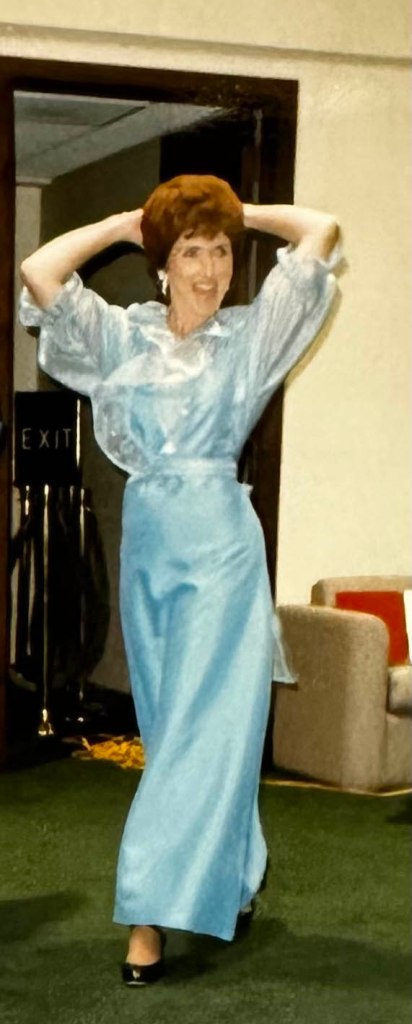
” all of us together – Christmas 1985″

How do I tell a story about my family when I can barely remember a time when we were all together?

Driving home from class, that’s all I can think about. I’m searching a place in my brain where a story should be, but all I can see is a dark empty hole.

Watering the flowers at the greenhouse, I continue to grasp for an idea of what to write. I keep thinking about that photo, the one that hung on the wall at the top of the stairs in my childhood home. The family photo of a father and his three children, a mother of one, and stepmother of two others. A missing child who wasn’t born yet.  I always wanted to take a new picture, one that I could be in, too, but life was more complicated by the time I was thinking those thoughts, and the six of us would never pose for a photo together.

It’s not a story. I have to write a story. As I deadhead the geraniums I’m searching through my childhood memories. Memories of Meghan making pancakes after Karen and I woke her up by jumping up and down and throwing Legos on the kitchen floor above her basement bedroom. Memories of finding a dead mouse in Meghan’s bed. Memories that aren’t really memories, but photos that I’ve seen or stories that I’ve been told. Like the time my arm was accidentally removed from the socket when Meghan pulled me up onto the bed to play with her and Karen.

David isn’t in these memories.

Sweet Surrender by Sarah McLachlan starts to play in my ear bud and I immediately think of Karen. Forget the rest of the family, I should just write about Karen. She has always been my best friend. She was the one I looked up to, the one I wanted to be just like. She taught me what music to like, what sports to play, what clothes to wear, what instrument to play. We have millions of memories, millions of stories to tell. What story can I tell that wraps up our relationship in only 800 words? I think of the time I traded her homemade button in gym class, the pit in my stomach the whole way to Illinois that night knowing that I had to tell her what I did. The advice she gave me while we were on vacation when I was 8 and she was 12, advice to be myself and not worry about what others think of it. The advice that she should have taken for herself, instead of living most of her life trying to be and do what she was supposed to be and do, and finally figuring out in her 30s who she really was. I think of the time that I accidentally told my mom she was dating a woman, essentially outing her to my parents, a few weeks before she was planning to tell them herself.

My mom. I can’t write a story about family without talking about my mom. Or my Dad. Where do I start? I feel stunted by thinking of who they are now, unable to really remember who they were when I was young. When they were young.

I keep coming back to that picture. I keep thinking about the family that wasn’t there more than the family that was. I keep thinking about David. I think about the years that he didn’t speak to my dad, and how he didn’t want to be part of our family. I think about the life that he has lived, so different from mine. I wonder how things would be different if he was raised by my dad instead of his mom. Would he have made different choices in life? Would he have rebelled against our dad’s strict conservative values? Would we have a relationship if we had ever lived together? Would he have left the house for good as soon as he turned 18, when I was only 4, or would he have returned for holidays and summer breaks to see his little sisters?

I sit down to write, scribbling drafts of essays about my family. Feeling defeated. I’m still searching for a story.

© 2024 Sarah Skalitzky

Sarah Skalitzky – Madison, WI
Architect | Writer | Musician | Quilter/Crafter | Gardener
Daughter | Sister | Wife | Friend | Dog Mom

Posted in Guest writer | 1 Comment

Renting a Car in Buenos Aires

by Donald A. Ranard

Photo credit: almendron.com

            I’m a member of Triple A, I told the woman behind the counter. Do you give discounts to Triple A members?
            The color drained from her face. Triple A?
            Yes. I took my Triple A card out of my wallet and showed it to her.
            She looked at the card. American Automobile Association, she read slowly.
            Yes. Do you know it?
            She shook her head.
            Later I told an Argentine acquaintance about the strange exchange. That was how I learned that during the right-wing dictatorship, Triple A—Alianza Anticommunista Argentina—was a death squad that had murdered thousands of suspected leftists.

© Donald A. Ranard


Donald A. Ranard’s writing has appeared in The Atlantic, The Washington Post, The Boston Globe, The Los Angeles Times, New World Writing Quarterly, The Best Travel Writing, and many other publications. His flash fiction story “5/25/22” was chosen by Wigleaf as one of 2022’s top 50 Very Short Fictions, and his prize-winning play, ELBOW. APPLE. CARPET. SADDLE. BUBBLE., was recently performed by Veterans Repertory Theater in Cornwall, New York. Before settling in Arlington, VA, he lived and worked for many years in Asia, Europe, and Latin America.

Posted in Guest writer | Leave a comment

GAB Theme 3: The Role of Money

This week we conclude our exploration of themes from Guided Autobiography, or “GAB” for short, the reminiscence writing method developed by Dr. James Birren to help individuals explore and document their life stories. The process involves small-group workshops where participants do structured, thematic writing assignments on significant life experiences. Each session focuses on a different theme.

Throughout August, I’ve been sharing mini-lessons from the GAB curriculum and thematic prompts that Dr. Birren called “Sensitizing Questions.” These prompts are designed to spark reflection and memory recall. They are not meant to all be answered like questions in a survey, but rather, to get you thinking. After reflection, choose just one prompt to write on.

When I began teaching Guided Autobiography in 2004, I wrote on each of the themes myself, along with my students. Here’s how my essay on The Role of Money began.

“I’m having trouble with this week’s assignment,” I said to Jim. “We’re supposed to write about Money.”

“Then why don’t you write about the Vespa?” he said. He is still angry about the Vespa.

He is angry because the Vespa Situation brings up a mismatch in our values. I have just spent money he thinks I should have saved, and for the life of him, he can’t figure out why.

The essay went on to examine my occasionally reckless attitude about money. I find it fascinating to look back on now, twenty years later, realizing how that attitude has evolved in the intervening years.

Sarah on her Vespa, 2008. Photo by Steven J. Agard

Role of Money: Sensitizing Questions

Money and how we feel about it can influence our lives in both obvious and subtle ways. Family life, health, relationships, self-esteem and where we live, learn, work or play can reflect our relationship with money. Our attitudes toward money can be shaped both positively and negatively by our histories, peers and the commercial and natural world.

Probing Questions: These questions are designed to help reflect on your life and forgotten memories. They will help get you thinking and are not meant to all be answered. Some questions will bring more thoughts or memories to your mind than others. Write what comes to mind. Choose two pages to share.

  1. What role did money play in your family? Was it scarce or plentiful? How did your family’s financial situation compare to other people you knew? Did your family think of itself as wealthy, middle-class or poor? What were the challenges and implications of being in a particular economic bracket?
  2. Who earned the money in your childhood family? Who was in charge of the money flow? Who paid the bills, balanced the checkbook, decided how to spend the money?
  3. Did anyone make sacrifices to help you financially? How has this influenced your decisions about money as an adult?
  4. How did you learn about money? Who gave you your ideas about it? Were you given an allowance? How were you taught to save, spend and share? Regardless of whether or not you were paid, how were you expected to contribute to your family? How did that change over time?
  5. Has a financial windfall or major loss changed your life? Have you ever inherited money? What were the circumstances? How did it impact your life? What was your best financial decision? Your worst mistake? Did you ever experience a win or loss from a gamble you took?
  6. Was money tied to affection and love in your family? Did money help your family bond or did it cause conflict?
  7. Describe the first time you earned money. How did it influence your ideas or choices? How have your ideas about spending changed over time?
  8. Have you ever felt embarrassed or lied about your financial situation? If so, why? What was the result? Have you ever stolen money? What was the situation? How did this make you feel?
  9. What is the history of wealth in your family? How have government policies and programs influenced your family’s wealth acquisition? What roles have social preferences or prejudices, such as gender, race or ethnicity, played in your ability or inability to earn, spend and acquire money?
  10. How do you spend money? What are your main expenses? Your “guilty pleasures”? Do you budget and plan carefully or spend freely and spontaneously? Describe an uncharacteristic splurge or a time you worked hard to pay for something you really wanted. How did that feel?
  11. What are your thoughts and feelings about debt? Do you use credit cards? Have you ever had to borrow money? What were the circumstances?
  12. How important has money been to you in life? Has it come to mean power, position, comfort, security or something else?

Note, these probing questions were updated from Dr. Birren’s original set in 2021 by a curriculum development group of certified Guided Autobiography instructors.

© 2021 The Birren Center

Posted in Writing prompt | Leave a comment

GAB Theme 2: History of Your Family

This week we continue our exploration of themes from Guided Autobiography, or “GAB” for short. GAB is a reminiscence writing method where you reflect on prompts and write two to three pages on a specific theme. In a GAB workshop, participants share their stories in small, supportive groups led by a trained instructor.

Throughout August, I’m sharing mini-lessons from the GAB curriculum and thematic prompts that Dr. Birren called “Sensitizing Questions.” These prompts are designed to spark reflection and memory recall. They are not meant to all be answered like questions in a survey, but rather, to get you thinking. After reflection, choose just one prompt to write on.

Memorabilia from my beloved Aunt Flash

Thanks to the Guided Autobiography world’s generous culture of sharing these writing prompts, I offer this set, originally published by Dr. James Birren in 2001. It was revised in 2021 by the Navigating Differences working group of the Birren Center.

Family: Sensitizing Questions

We have many families: our family of origin, our chosen family of friends and loved ones, plus the people we feel close to through a church, a workplace, or team. Family simply means a group of people who are connected. In this theme, we explore whom you consider as family and their influence on you.

Probing Questions: These questions are designed to help reflect on your life and forgotten memories. They will help get you thinking and are not meant to all be answered. Some questions will bring more thoughts or memories to your mind than others. Write what comes to mind. Choose two pages to share.

  1. Who do you consider to be your family?
  2. Were you an only child? If not, what was your place in the birth order? How did your birth order or your gender influence expectations on you as a child, and later as an adult?
  3. How do the people in your family communicate? How do you handle differences? Did your family have secrets? How did you show or express love? How has this changed over time? How have relationships with family members evolved?
  4. Describe a family member who was important in shaping your life; positively, negatively, or both. How and why has this person had an impact on you? Has your perspective changed with time?
  5. What is the impact of your cultural heritage on your family life? Has your family moved from one place to another? Have you ever visited your homeland? What connection did you feel there? What stories were you told about places and your ancestors who lived there?
  6. What family rituals or traditions have you continued or passed on to the next generation? What have you dropped or changed? Why?
  7. How would you describe your family’s values, expectations, and spiritual practices? What were the “shoulds” in your family? How did rewards, punishment, or unspoken rules guide your behavior around eating, cleaning up, and other life functions? Where did these rules come from and who enforced them?
  8. Describe a specific event or conflict that made your family stronger or tore it apart.
  9. Did you ever compare your family with another? Or perhaps with a family on the screen, in books, magazines, or other media? What do you feel is unusual or different about your family? What is typical?
  10. Has your concept of family changed as you aged? If so, how? What elements do you consider when you refer to someone as “family”? How have you created a family in your life today? How does this compare to the family you grew up with?

© 2021 The Birren Center

Posted in Writing prompt | Leave a comment

GAB Theme 1: Major Branching Points

Welcome to our focus on themes from Guided Autobiography, or “GAB” as we call it, for short! Guided Autobiography is a reminiscence writing method in which you reflect on prompting questions on a theme, then write two or three pages. Participants in GAB workshops share these narratives in a small, supportive group, led by a trained instructor. Students and Instructors who become members of the Birren Center* join a worldwide movement dedicated to enriching lives through life story writing and sharing.

For the rest of August, I’ll be posting mini-lessons from the GAB curriculum, accompanied by thematic prompts that Dr. Birren called “Sensitizing Questions.” These prompts stimulate thinking and trigger memory recall on specific themes.

“The themes and sensitizing questions act as a guide, just like a guide for a fisherman. They lead you to good fishing holes where the plump fish of memory are hiding,” Dr. Birren wrote in his 2001 book, Telling the Stories of Life through Guided Autobiography Groups.

Thanks to the Guided Autobiography world’s generous culture of sharing these writing prompts, I offer this set, originally published by Dr. James Birren in 2001. It was revised in 2021 by the Navigating Differences working group of the Birren Center.

Note, these questions are designed to help reflect on your life and forgotten memories. They are not meant to all be answered like questions in a survey, but rather, to get you thinking. Some questions will bring more thoughts or memories to your mind than others. After reflection, choose one to write on.

Branching Points: Sensitizing Questions

The directions our lives take are shaped by people, places, circumstances and choices. Our life journey takes many turns, influenced by big events such as relationships, illness, or war; or small events that had big outcomes like reading a book or going on a hike. The circumstances of our birth, race, ethnicity, and community, even events that took place before we were born, determine our life’s journey. Our reactions to these circumstances and the choices we make ultimately form the course of our lives.


What have been the branching points in your life? Do you know what events or circumstances caused them? Some branching points affect us positively and others negatively. Think of your life as a river winding its way to the sea. Where did it begin? Did it widen or narrow, add branches or merge with other streams as it flowed? What choices did you make to direct its course?

  1. How was your life’s direction shaped by events before you were born?
  2. What events after you were born then shaped your life? Why were they important? How did gender, race or ethnicity affect the course of your life?
  3. Who were the significant people who influenced or changed the direction of your life?
  4. What local, national, or global events impacted your life, such as war,economic downturn or public health disasters? How were you affected by these events? Sometimes unrest, protests, race riots, marches, boycotts, campaigns, civil or political responses are a direct result of these events. How did any of these affect your life?
  5. Natural and environmental disasters can wreak havoc in our lives. Were you ever impacted by tornadoes, hurricanes, earthquakes, floods, fires or other natural disasters?
  6. In your life, some things build you up and others tear you down. Which life events have built you up? Which have torn you down? Did any of the positive events become negative or vice-versa?
  7. Moving from one part of the country to another, changing neighborhoods or schools or living abroad can lead to encounters with differences; economic, cultural, racial. How did these changes influence your life path? How did you adapt to or navigate these new circumstances?
  8. What lasting effects have you experienced from a job change?
  9. What branching points in your life were you responsible for? Were you able to choose the paths your life took, or were there outside circumstances you had no control over? What surprised you the most and least? What is a fond or funny memory you have from that time?
  10. Looking back on your life, what helps you cope with the uncertainties of life? Do you welcome change, or try to hold onto the past?

© 2021 The Birren Center

*The Birren Center is launching its membership program later this summer–we’re in the final steps of preparing the website’s members area. Perks of membership include access to an online community, a searchable forum, courses, and other exclusive content.

Posted in Writing prompt | Leave a comment

Let’s just grab a cup of coffee & gab awhile

It’s summer. Time slows down. What doesn’t get done today can get moved to tomorrow’s list. Let’s just sit down and catch up, shall we?

What’s new with me? Well, I’m looking for new stories for this blog, as always. I’ve slowed down my teaching schedule a bit, so I have fewer opportunities to catch stories as they’re born. I rely on you regular readers–and you who serendipitously stumble across this story-space–to keep writing and sending stories my way. Find my guidelines for guest writers here.

Upcoming this fall: in-person Guided Autobiography

What else is new? This fall, I’m focusing on teaching Guided Autobiography workshops. Madison College has kindly offered to host me again. We’re trying evening sessions, with “Intro to Guided Autobiography” offered on five Thursday evenings 6:30-8:30, September 5 through October 3, at the Truax campus. Then we’ll follow that with “Going Deeper with Guided Autobiography,” Thursday evenings 6:30-8:30, October 17 through November 14.

What is Guided Autobiography, you ask?

Guided Autobiography (GAB) is an expressive writing workshop methodology developed by Dr. James Birren, designed to help individuals explore and document their life stories. The process involves structured, thematic writing assignments that guide participants in reflecting on significant life experiences.

Each session typically focuses on a different theme, such as family, career, or health, prompting writers to compose short autobiographical stories. These narratives are then shared in small, supportive groups, fostering a sense of community and mutual understanding. The GAB methodology not only encourages self-reflection and personal growth but also enhances social connections through the shared storytelling experience.

And hey, when you’re done you have some essays that could add up to your own life story, if you keep writing.

I’ve written about GAB off and on here on True Stories Well Told. This link will take you to those posts.

If you’d like to try a GAB workshop, but you’re not in Madison, email me at sarah.white@firstpersonprod.com. I’m part of a global network of over 700 GAB Instructors. There’s probably one near where you live, and some offer online workshops that could work for anyone, anywhere. I’ll do my best to hook you up.

For a free taste, check back here over the next three weeks.

I’ll be posting mini-lessons from the GAB curriculum, accompanied by the sheets of prompts that Dr. Birren called “Sensitizing Questions.” These sets of questions are designed to stimulate thinking and trigger memory recall on specific themes. Try them out, see if this method is “juicy” for you!

In other news…

A few weeks ago I posted that my Fall writing retreat, “Responding to Experience: Writing the Personal Essay” was open for applications. I received enough that the retreat would have been a go–except the lodging option fell through. I felt strongly that the lodging had to be a memorable part of the experience, and I just wasn’t ready to downgrade to a motel in Sauk County. So, with regret, I cancelled the retreat. But I’m sure new ideas and opportunities will emerge, and I’ll bring them to you, my fellow writers. “Watch this space,” as they say.

Thanks for reading! Keep writing–and send me your “true stories, well told”!

  • Sarah White
Posted in Call for action | Leave a comment

Hung Up on Souvenirs

By Sue Oakes

I am a souvenir connoisseur.  A sentimental soul such as myself requires tangible mementos from every occasion.  I’ve been this way since I was a little kid.  I always thought it was a very romantic notion to have a hope chest at the end of my bed to store all my treasures.  Notes, class pictures, objects both bought and found, or anything I just couldn’t throw away was in my hope chest.  As I grew up, my adventures outgrew my hope chest.  But what do you do with all that precious stuff?  There is only so much space on bookshelves and walls. 

In 1993 I took my first really big adventure when I was a Junior in college.   It was Semester At Sea and I boarded an old cruise ship full of college students and sailed around the world taking classes on the ship and learning even more from the places we traveled to.  We left from Vancouver and returned to Florida 3 months later. 

My roommate’s name was Tiffany.  All I had was a name.  This was before Facebook and texting so we never talked before that day.   She was already a seasoned traveler and had that cool girl vibe.  Tiffany brought very few things with her.  Just a duffle bag and a boyfriend. 

I would get locked out from time to time so they could be alone, but our paths would cross on occasion.  As the semester went on, I noticed a growing collection of cardboard drink coasters and small trinkets on her nightstand.  She explained that since she didn’t have much room in her small duffle bag for souvenirs that those would have to do.  She would turn them into Christmas ornaments when she got home.   

Genius!  The only thing I love even more than souvenirs is Christmas.  It takes some time for a souvenir addict to downshift to thinking a small trinket would ever suffice.  I certainly packed my bags with souvenirs both great and small on that trip.  I donated a bunch of clothes to Goodwill (they were waiting for us all at the dock when we returned) so I could pack it all home.  I had small statues of Terracotta Warriors from China, Matryoshka nesting dolls from Russia, and tea cups from Turkey.  But I also had a few small items to hang on my tree.  A bounty of souvenirs as well as new friends, new confidence, and a new love of travel. 

The adventures weren’t quite as grand for a while, but I still collected a few baubles.  Then after Grad school, I moved to Denver on my own and soon after got engaged.  The champagne cork that popped when he popped the question was now a precious object.  I had some jewelry wire and beads and made a Christmas ornament.  And then it REALLY began.  Marriage, 2.5 years of amazing travels, kids, milestones, and vacations.  A collection of coasters, ticket stubs, money, subway passes and shells quickly became my favorite Christmas accessories. The story of my life can be traced along the branches of my tree.  Some are actual Christmas ornaments, I have lots of keychains that suffice, but most are just things fashioned into ornaments.  I would say the ones that are actual Christmas ornaments aren’t quite as interesting as the things.  I smile when I see the horseshoe that has San Antonio printed across it from a family trip, but I sit back and close my eyes to remember when I pull out my favorite cheap metal fork.  It’s from the night market in Taiwan and always earns the top spot front and center on my tree.  I can still taste the food, remember what I was wearing, and hear the K-pop music videos playing above the bowling alley that was randomly in the middle of the bustling market. 

I have to admit that there are a lot of alcohol-related items hanging on my Christmas tree.  Wine corks and beer bottle caps are abundant.  But that is because they are usually involved in many memorable moments.  A wine cork from the first time I saw my friend outside after COVID began.  Beer caps glued in the shape of a Christmas tree from our sunset trip down the Mekong River in Laos when we paid a man on the end of the pier to take us out.  And corks from my 50th birthday party in wine country with friends.  And yes, I made each one of them a souvenir cork ornament and sent it to them.  In fact most of my friends and family have at least one signature box from our times together. 

A collection like this must be cared for.  I have to confess that each one is in its own box with a wallet-sized picture on it and the date that this memory took place.  They are in 3 glorious tubs of memories and absolutely the only part of my life that is organized.  If the house was on fire I would grab those first.  I would make sure my family was coming, but I would have them grab one on their way because I probably couldn’t carry all 3 by myself. 

Somehow seeing them only once a year makes the memories even sweeter.  Nothing has been collecting dust on the bookshelf or taken for granted.  Each memory is unveiled and remembered in its own cameo appearance.  When it is time to hang them up every year, I am thrilled that my kids like to hang them with me now.  Especially my son.  He is also a sentimental soul and remembers many of the stories and has his favorites that he requests to hang on the tree.  Many of the memories now include them.  I do it for me, but always hope someone else will appreciate them after I am gone.  I spend hours sitting next to my Christmas tree recounting tales and reminiscing with each ornament.  A record of a life well lived.  And a glimpse into what made their mother tic. 

I proudly watched my son help me sneak a set of plastic chopsticks into our backpack on a recent trip to New York to remember our lunch in Chinatown.  That will be a new addition to our Christmas tree this year.  As a parent, I like to think I am showing them how to cherish memories and not teaching my children how to steal.  I hope I will be forgiven for my misdemeanors.

But for the rest of the year, they are all stuck in plastic tubs next to the toilet paper waiting for their moment.  I’m sure the fork had no idea it would become a souvenir.  But I do hope it knows it is not just a souvenir, it is a Christmas ornament.  And in my book, there is no higher honor than that. 

©  2024 Sue Oakes

Sue Oakes likes to write about her adventures, both far away and close to home, with her husband and two kids.  She loves hearing a good tale almost as much as she enjoys telling one. Currently, she is completely engrossed in watching the Olympics and, of course, hearing the stories about all the athletes!

Posted in Guest writer | Leave a comment

Cheers! Madison, or Preaching to the Choir

By Sarah White

First rehearsal

A friend and I have been talking about our mutual interest in getting singing back into our lives. She’s tried one local community choir and heard about another just launching into its summer cycle. It would meet for three rehearsals, then a performance. It met at the Garver Feed Mill, a renovated historic building a short walk from my house.

I have history with the mill, having been part of the citizen group that agitated for its restoration over a decade ago. The opportunity to be part of making music in that vast honey-colored brick hall, that was a graffiti-splotched cavern when I first saw it on a hard-hat tour, cinched the deal. I had the next four Wednesday evenings free. I would celebrate the old feed mill in song.

Garver Feed Mill hard hat tour, December 2011

Cheers! Madison is the project of a doctoral music student, Liz, our choir director. I describe it as a drinking club with a singing problem, since she opened every rehearsal with an encouragement to have a beverage from the bar in hand and lift it whenever she randomly cried “Cheers!”

Too rusty at sight-reading to trust myself on alcohol, I brought a water bottle instead. Arriving for the first rehearsal, I was amazed to discover that 160 people had signed up for this! We were directed to our rehearsal room and the quadrant for our voices—Soprano, Alto, Tenor, Bass. I sat with the altos and quickly discovered my vocal range has collapsed by an octave since I sang in the high school choir.

We sight-read our way through seemingly random sections of the six songs we would perform. This was the pattern for each of the three rehearsals. Week by week, we built toward singing all the way through each piece.

It took me about two minutes to figure out that if I didn’t work on the songs outside of rehearsal, I didn’t stand a chance. Turns out choir is like signing up for dog obedience training—the work doesn’t happen in the class, the class just teaches you the work you need to do on your own.

I decided to take “Cheers!” seriously; I searched YouTube and found vocal warm-up videos, plus recordings of choirs performing the four songs I didn’t know—one African anthem, two gospel songs, and a Christian hymn. I did a lot of singing in the car on my short drives to the gym.

The day of the performance quickly arrived. “Are you nervous?” spouse and friends asked. “No, why would I be? This is pretty low stakes,” I replied. My voice among 160 would never be heard. There’s safety, as well as fun, in a crowd.

But that question sent me spiraling back to my high school choir days and the time Jesus saved me from performance anxiety.

The Jesus movement came to Carmel, Indiana in the spring of 1972. I was a sophomore. I followed a friend to a youth revival meeting at the Methodist church (just like I followed a friend to Cheers! Madison). At altar call, I came down. Parishioners circled me and held me on the ground as they prayed for the Spirit to enter me.

“Feel Jesus enter your heart!” There was moaning and chanting and singing all around. Other teens were in similar positions on the ground. One by one the Spirit came and they got up, reborn in the name of Jesus. Only my call wasn’t coming. It was like waiting for an orgasm that just isn’t coming. (Not yet familiar with orgasms, I wouldn’t have made that comparison then.)

I finally faked it just to get on with it. That led to personal confusion; I began reading the Bible, a small bit every night before bed, and praying for some sign of salvation.

Meanwhile, I was singing in the high school’s show choir. We did songs like “Tea for Two”. We had matching dresses of navy-blue polka dot voile, high-waisted, cinched under the bust, supposedly flattering to all figures.  We were given patterns and fabric and sent home to sew. I hated how I looked in mine—egg-shaped.

I was very shy. I found performing, even in the navy-blue polka dot anonymity of a thirty-person choir, very unsettling. I never even had a solo—just standing up in group was too hard for me.

That spring, our choir was booked to sing at the Masonic Temple for the Ladies of the Eastern Star, and I was nervous. That evening, I prayed to Jesus for salvation, again. And something finally happened. My nervousness was replaced by a great sensation of peace. This must be “the peace of the Lord that passeth all understanding”! If so, then I must have finally felt Jesus enter my heart!

I felt a lot better about the show choir after that moment. That feeling of extreme calm was accessible to me for several months before it faded.

Sound check

Now, at the performance in the Garver Feed Mill’s atrium, surrounded by my 160 singing peers, I felt nothing but joy—a light heart engaged in play. There was nothing at stake whatsoever. The thing I’d hoped to achieve by getting singing back into my life had already happened.

At the last rehearsal before our performance, after our usual vocal warm-ups, Liz the choir director threw in a new one. “Play a chord—C Major,” she told our accompanist. “Okay, everybody sing your note—a nice open ‘Oooh’. When I signal you, move down one whole step.” We did—and the atrium filled with a joyful sound.

“Sopranos: Down one!” The harmony grew a bit discordant. “Altos, down one!” The discord grew more dramatic as voices matched and melded, two harmonies competing. “Tenors, down!” The tension became a question groping for an answer. “Basses, down!” The question found its answer and beauty filled the room again. We held that note, following her gesturing arms, many voices but one instrument. Our sound sustained and swelled until she released it. Our “oooh” soared into the vast atrium like a holy dove.

©  2024 Sarah White

Posted in Sarah's memoir | 1 Comment

The Lucky Ones

By Sarah Skalitzky

In the spring of 2009, I didn’t truly understand what was going on in the world. I’d heard the names Bernie Madoff and Fannie Mae in the news but didn’t know who they were. They said the economy was bad, whatever that meant. I knew that people were losing their retirement savings, their houses, and their jobs, but none of that really mattered to me.

I was almost two years out of college, working in my first architecture job, living in a one-bedroom apartment on the East side of Madison, and dating Jeremy. I didn’t have retirement savings or a house to lose, and I was already planning to leave my job and return to graduate school in the fall.

Nonetheless, I was still shocked when I got an email from HR one morning asking to talk to me later that day about my position in the firm. I turned to my cube-mate and said, a little too loudly, “I think I’m getting fired today!”

When my lease was up on my apartment, I moved across town into Jeremy’s house, where I would live for the summer until moving back to Milwaukee for school. My summer of unemployment was lonely – my friends were all still working, and I spent my days broke, in my PJ’s, watching TV on the couch.

The graduate program was only two years, and when I graduated, I moved back to Madison. I wanted to stay in Milwaukee, but it wasn’t a good time for Jeremy to sell his house, and the job market in Milwaukee was still non-existent. I landed a job at a small firm in Madison, a job that, for various reasons, I thought would be my dream job. I was one of the few in my graduating class to get hired before graduation and start working right away. I thought I was one of the lucky ones.

I didn’t know then about the long-term impact the Great Recession would have on the architecture industry, and the effect on my career and my life. As an industry, we lost knowledge when older employees were forced into early retirement; we lost managers and mentors when mid-level architects were let go, often to find work in other fields in order to support their families, and never to return to architecture; young professionals and jobless graduates who also found their way on alternate paths, leaving an enormous hole in the workforce.

I didn’t know that the competitive nature of both my education and the job market at the time would lead me to years of personal scrutiny, perfectionism, internal pressure, and constant stress.

I didn’t know that being one of the few at my level with a job in 2011 meant that I would become highly valuable in a few years, hitting that sweet spot of 3-5 years of experience that every firm was looking for, and there weren’t enough of us to fill. I didn’t know that being that valuable wasn’t actually a good thing, that it meant that you had to do more work because you didn’t have a team to support you. It meant that you would be given more and more responsibility. It meant that you had to advance quickly, and soon enough you’d have your own mountain of work to complete and a new workforce of young professionals that you would be expected to mentor, having little experience of being mentored yourself, and now having to figure out what it meant to be a mentor.

I didn’t know that I would be miserable, that my health would suffer, and that I would decide to leave before I turned 40.

No, I didn’t know any of these things. I just thought I was one of the lucky ones.

On my first day of work at my new job, I wore gray dress pants, a white short-sleeve top, and a cute cardigan. I walked into the office excited to start my life and reboot my career. I was welcomed by my boss, who seemed happy to have me there. After a brief tour, I sat at my desk made of plywood, a computer on one side and a drafting table on the other, and started to settle in. Today was the first day of the rest of my life. Today was going to be great.

© 2024 Sarah Skalitzky

Sarah Skalitzky – Madison, WI
Architect | Writer | Musician | Quilter/Crafter | Gardener
Daughter | Sister | Wife | Friend | Dog Mom

Posted in Guest writer | 1 Comment

Christmas Dishes

By Carrie Callahan

It is mid-December 2023. I have just returned home from a trip to Minneapolis. My son Ryan had just completed a two-year construction management program at Dunwoody Technical College. School had never been a strong suit for him and completing this program with honors was a magnificent accomplishment that deserved a celebration! What started out as a nice dinner out turned into a party for 30 hosted by his dad and wife Sue.

Arthur and I had split amiably many years prior and we had co-parented with respect. However, to have a big party with the extended family of my ex wasn’t exactly what I had in mind. This was crossing a new bridge with him. Of course, this what Ryan wanted, so off Colin (my new husband) and I went to celebrate and support Ryan in the way that he wished.

In a much-appreciated text, Arthur let me know that as this was a special party, they would not be using paper dishes. They would be using china — specifically the Villeroy and Boch Sienna pattern that we both shared and the Block Poinsettia Christmas dishes that I surrendered at the time of our divorce.

These Christmas dishes were the one thing around which I still held some regret. At the time, I was so sad that I couldn’t imagine enjoying Christmas without Arthur’s enthusiasm and joy. The dishes were part of that. Arthur wanted them so, I let them go. Now, I was grateful to have some advance warning so I could prepare myself to see them again.

It is November 1990 and I am six months pregnant. Arthur and I moved into the house on Colfax Ave. that September as we prepared to start our family. The house was receiving some remodeling and, as I anticipated leaving my job at the time of the birth, we were being financially conservative.

Cruising through TJ Maxx with the intent of getting my Christmas shopping completed early, I came across the Block Poinsettia Christmas dishes that I had fallen in love with multiple years earlier at an upscale boutique. Part of my Christmas ritual was to go to that boutique to visit them and dream of the time when I could afford to have them for my own. And now, here they were being clearanced. OMG! I wanted those dishes so badly — but buying these dishes now really was a luxury — and yet they were being clearanced! I might never get another chance to have them.

I brought home a place setting for Arthur to see and without much shame asked if he thought there was any way. We figured out a way and purchased what we needed for Christmas dinners. He loved Christmas and had dreams of his own about how he wanted to celebrate with good food, family, and friends. He agreed we should do it and I spent the next few days pushing myself hard after work going to every TJ Maxx in the Twin Cities collecting the pieces we needed to put together a set of eight place settings plus the extras like matching glasses and serving dishes. I was so happy!

So now, here I am at Arthur and Sue’s home, with the table set with those very same Christmas dishes. I’d like to say I had a cringe of regret, but the truth is, surprisingly, I just didn’t.

The house was beautifully decorated for Christmas. The house was full of people with Arthur in their large open kitchen wearing his apron, putting on the last touches to a wonderful dinner, pouring wine and offering charcuterie and cheese. He was in his glory. I could see how Arthur and Sue were putting these dishes to use in the way Arthur and I had originally intended. They were used and appreciated. They had landed in the right place.

I left that night at peace, with a warm heart. The party couldn’t have gone better. Friends and teachers were invited, so it wasn’t strictly a Stickley family affair. Sue and Arthur and the extended family greeted Colin and me with friendly generosity. I felt a deep appreciation for the time and experiences I shared with Arthur, that he gave me Ryan and supported us as agreed with integrity, and continues that support with Ryan now. I left knowing that Ryan is loved by so many and will be celebrated in the years to come by both his families, separately and perhaps occasionally together now, with ease. The intention for my Christmas dishes lives on — just differently than I originally imagined.

© 2024 Carrie Callahan

Carrie Callahan is a creative life-long learner. When she’s not writing, she’s reading, working in the garden, whipping something up in the kitchen for her hubby or making a mess in her studio.

Posted in Guest writer | 2 Comments