
Back in July 2011 I posted here crowing about winning a writing contest. The story, titled “Make Love Not War”, is about my brief love affair during a summer-study abroad program in 1978.
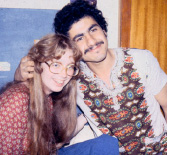
Sarah and Halim, 1978, Dijon, France
Now that story has been published in Seasons of Our Lives, a new ebook series available on Amazon’s Kindle Store from Matilda Butler and Kendra Bonnett of Women’s Memoirs. And they asked me to read my story for the book trailer!
(2025 update: Unfortunately that video is no longer available. I’ve posted the text of the story at the end of this post.)
They’d like me to tell you that “These are award-winning life stories that will charm, intrigue, captivate, and inspire. There is a second treat in these volumes. After each story, there is a takeaway to help readers think about their lives and consider effective ways to write their own life stories.”
- SEASONS OF OUR LIVES: SPRING
- SEASONS OF OUR LIVES: SUMMER
- SEASONS OF OUR LIVES: AUTUMN
- SEASONS OF OUR LIVES: WINTER
I was delighted with the “takeaway” Matilda and Kendra wrote to accompany “Make Love Not War.” They called out aspects of my essay that I had not yet seen–such as the way the details of time and place are essential to this story. And they liked the way the repeated phrase about the telephone “brings change and creates hinges in the plot.” It’s nice to know that something I worked hard on actually worked for my readers! (And please, let’s talk more about my writing. This feels good!)
I believe this was the most revised piece of writing in my memoir repertoire. I boiled away episodes and even characters until some would read this and say, “That’s not the way it happened at all,” in order to make it work in the Women’s Memoirs short essay format. This is the craft aspect of writing memoir. I killed a lot of darlings to create that contest entry. (For my actual memoir, I’ll go back to the 30-page version and see if I’ve learned enough to make it work.)
So here’s my request–my message in a bottle. IF YOU know someone who was part of the Group Indiana, 1978, Dijon France–If YOU know the whereabouts of a boy from Lebanon who passed through Dijon before moving to Moscow to study medicine in 1978–whose family was from Morocco and may have returned there–if YOU are, or knew, the boy we called “Miko” who loved Halim as much as I did–please get in touch. What are the Internets for, if not unlikely reunions?
“Make Love, Not War”
It’s July 4, 1978. I’m sitting in a dorm room in Dijon, France, with the girls of “Group Indiana.” We are throwing an Independence Day party. A classmate has brought a new friend, a Lebanese boy named Halim.
We’re homesick for our hometown festivities. “Just two years ago we were celebrating the Bicentennial–two hundred years since the American Revolution.”
Halim interjects softly, “Two years ago, I was fighting in a revolution, myself.” Action trumps nostalgia and we all turn to listen. “I’ve come to Dijon to make up classes because the civil war interrupted my studies. I fought with the Palestinian guerrilla forces.”
Sometimes a moment changes everything. Sometimes the trigger is a phone call, or as the French say, un coup de telephone. My coup came when my father called to say, “How would you like to study in France this summer?” And now a few weeks later here I am, listening to this exotic boy speak in his halting English.
We press him for details. Halim describes fighting in the streets.
“But barricades? Barricades of what?” I ask.
“Broken pavement. The bombs had torn up the pavement, and we tipped up slabs.”
“Where were you?” I continue.
“In front of the Holy Den. Then inside it.”
My mind summons a picture of a Holy Den, something religious, maybe a cave in a desert scene out of Lawrence of Arabia. “Halim, describe a Holy Den.”
“It’s a big building in downtown Beirut. It was a hotel before the war.”
“Stone? Like a mosque?” I’m stuck in my desert scene.
“No, you know, with the green and orange sign.”
It bursts like a bomb in my head—the Holiday Inn. War not in a desert but in a place of clean sheets and room service.
A few nights later I see Halim at a folk dance, and the next night we run into each other at the cafeteria. We walk the campus and talk. He tells me about how he had lived with other students taking part in street actions, making revolution with Soviet guns and home-made bombs.
We go to his room and talk more. He describes how his dreams morphed into visions telling him to find a way to help people that didn’t kill them. “I decided to leave Lebanon, to become a doctor, to study how to live in peace again.”
I wonder if he will try to seduce me, or if I will need to make the first pass. But it comes surprisingly fast—he gets up, locks the door, and simply approaches me. His hands tilt my head back for a kiss. “You are my ideal woman,” he whispers. Back in Indiana my plump form is far from a boy’s ideal. In Halim’s world my fair skin and full rump are a man’s dream.
And Halim is a man with dreams. He has applied to medical schools in the US and the Soviet Union. He will attend whichever accepts first. He is as serious about his studies as I am frivolous.
Three weeks pass. Halim talks of me staying on with him. The idea is intoxicating. I’m a banquet to this starving man, and he is an exotic drug to me. Why not surrender?
But a moment can change everything. Halim receives his coup de telephone: A university in Moscow has accepted his application. He has to appear in 48 hours. My romantic indecision departs with his train.
When I got home from France I found a letter from Halim. More letters followed. He was as fascinating on paper as he had been in person. We continued to correspond.
In late 1982 he wrote that he was going back to Beirut for the Christmas holidays. That was the last letter I received. There was fighting again that Christmas, and I worried he’d been killed. After a time I gave up writing, but not waiting for one more coup de telephone.
Just in case, I’ve kept a telephone listed in my name ever since—even after I married. If Halim should need me, I want to be able to take the coup.
© 2014 Sarah White

 True Stories Well Told
Great story, and Halim is so handsome! I shall put ‘searching for Halim’ on my ‘Moroccan To Do List!’ If he isn’t located before then! 🙂 I pray that he is alive and well – inshallah!
LikeLike
Do you have a last name? I am asking my father-in-law, who befriended a Lebanese man about your age, if the description of Halim rings a bell. I believe Sammy was still living in Lebanon during the 70’s. At times the world is so small!!
LikeLike
Sarah! Great story! I don’t know what you had to sacrifice but the essay is tight, fascinating and well written. I liked hearing you read it and congratulations about being included in an anthology! Where did they put you? Spring? : ) Dhyan
LikeLike
Pingback: Mopeds in Burgundy | True Stories Well Told