
By Marlene Samuels
I grew up in a community almost entirely devoid of old people — those who might be considered “grandparent” age. My understanding of “grandparent” was so totally confused and distorted that the concept and title resulted in endless disappointments during my young life. Oddly, most stemmed from my best friend Ruthie and Ruthie’s Zaidie (grandfather).
In all fairness, my sheltered life and limited exposure to the world beyond our “shtetl-like” St. Urbane neighborhood of Montreal had informed my convoluted beliefs. My brother and I had no grandparents. Well, actually that statement is somewhat ridiculous because, of course, we did have them but never knew any of them. They’d all been murdered in the Nazi death camps during World War II.
Two distinct populations made their homes in our old neighborhood: Québécois French laborers and Jewish Holocaust survivors. And just like my family, the survivors who’d emigrated to Canada after being liberated from the camps had been denied visas into the U.S.A.
Ruthie Whitefish was my “bestie” from the time we were old enough to walk and talk. We had more than our girlfriend interests in common. Her family was a mirror image of mine: her dad was from Poland as was mine and Ruthie’s mom was Romanian just like mine. And Issey, her brother, the same age as mine, had also been born in a D.P. Camp (Displaced Persons’ Camp) in Germany exactly like mine. Only one feature of her family was dramatically different: Ruthie had her Zaidie.
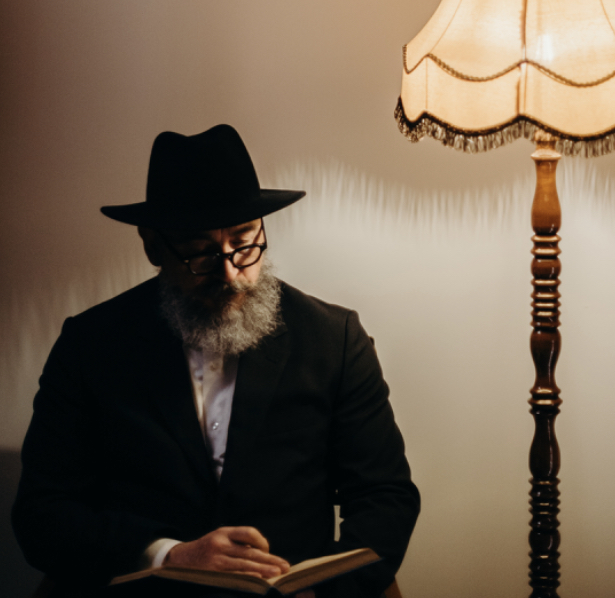
This bearded, highly pious, old Jewish man was the epitome of what I believed was a Zaidie. To us children, he appeared beyond ancient — Moses incarnate. In view of my current advanced age, I’m fairly certain the man couldn’t have been older than sixty-five at most.
Ruthie adored Zaidie and Sylvia, her mother, catered to him constantly. In fact, all members of the Whitefish family felt honored that the old man was a boarder in their flat. Just as wonderful: he was thrilled to be living with the family. He adored the children and treated them as though they were his biological grandchildren. On weekdays, when Ruthie arrived home from school and her mom was still at work, Zaidie eagerly waited my best friend.
As soon as she walked into their flat, she headed into the kitchen. There, at the kitchen table, Zaidie could be found studying his Hebrew texts. And there, on the table across from him, centered on the bottle-green glass plate, sat a butter and raspberry-jam sandwich he’d prepared for my “bestie,” crusts removed! And next to the plate? A half-glass of chocolate milk.
On my lucky days, I was invited to go home with Ruthie and on those lucky days, Zaidie placed two plates, two sandwiches, and two half-glasses of chocolate-milk on the table. “Sailboats or boxes?” He asked Ruthie without variation. He held a long breadknife over one of the sandwiches after he’d removed the crusts.
“Today, I want sailboats! Don’t you remember, Zaidie? Yesterday,” she announced, “was boxes.” Zaidie nodded, rested the blade atop the sandwich, cut it in half on an angle, then in half again. His creation: four triangle-shaped mini-sandwiches. Next, he turned his gaze toward me. Again, his knife hovered above a sandwich. “And you, ziese kleine Maydalah (sweet little girl), sailboats also?”
“No, I like boxes.” But looking back, it really made not a bit of difference to me since I was beyond ecstatic watching him create my butter and jam boxes.
Yet whenever I’d been so lucky to have been included, I’d also been plagued by an indescribably intense jealousy. Besides Zaidie making after-school snacks for Ruthie, the two of them played games together — checkers, tic-tac-toe, hangman—and they worked on her homework. The old man also took Ruthie and Issey to matinee movies on Sundays. Sometimes the three of them took the streetcar to St. Catherine’s Square and even to the top of Mt. Royal Park to feed the ducks.
More than anything, I became desperate for a Zaidie of my very own. No longer did I express interest in a dog or cat. I had evolved! It was a Zaidie for whom I longed in no uncertain terms — an old man who might live in our house and do all the things with me that Ruthie’s Zaidie did with her. It was the one thing I wanted more than anything else in the whole world.
What I could not know was that none of our survivor parents’ parents had made it out of Europe. Consequently, the Jewish Federation of Montreal had established a program similar to foster care but instead of a program for children, it was for those rare elderly survivors who’d lost everyone. Jewish families were given cash stipends for providing room and board in a family environment to those elderly. And that was precisely how Ruthie Whitefish got her Zaidie. He arrived at the Whitefish’s home just about the time Ruthie had begun to walk and talk and he never left.
One particular Sunday, Ruthie and Zaidie were headed to see the newly released movie, Lassie Come Home. I’d not been invited to join them. And it was on that exact day I knew the time had come. I burst into my mother’s workroom, shouting above the noise of her sewing machine. “Mom, Mom, I have to talk to you! It’s important!”
“What is it? What’s happened?” She shouted back, her feet still working the machine’s heavy pedal.
“Mom, you know that Ruthie has a Zaidie, right?”
“Of course I do.”
“Why does she have one but we don’t?”
“Have one of what?” Mom asked. She didn’t understand what I was asking. “A Zaidie, that’s what! Why can’t we get one of them? He could live with us and do the same kinds of things with me that Zaidie Whitefish does with Ruthie? He could live in the extra room next to our kitchen!”
Mom was rendered speechless. I truly believed that Zaidies (Bubbies, too) were religious old Jews who came to live with Jewish families in extra rooms, did fun things with the resident children, and possessed quantities of books all in Hebrew.“Mom, Mom, did you even hear what I said?” I was shouting at her.
“Let me talk to Daddy about this. We’ll see.” She whispered, staring through her workroom window onto the street.
I waited for my mother’s response. But I never did see. During the last decade or two of my life, a period when so many close contemporary male friends have morphed into grandfathers, I’ve finally realized that for most of my younger life, I actually suffered from a serious case of “Zaidie Envy”.
© 2023 Marlene Samuels
Marlene holds a Ph.D., from University of Chicago. A research sociologist by training, she writes creative non-fiction by preference. Currently, she is completing her book entitled, Ask Mr. Hitler: A Memoir Told In Short Story. She is coauthor of The Seamstress: A Memoir of Survival, and author of When Digital Isn’t Real: Fact-Finding Off-Line for Serious Writers. Her essays and stories have been published widely in anthologies, journals, and online. (www.marlenesamuels.com)

 True Stories Well Told
Marlene,
You convey so well, the innocence of a child, and a child’s expectations that things will be just as she imagines. I remember the dreaded “we’ll see” non-answer from my mother. Makes me shudder to think of it.
Congratulations on a captivating story! I’m going to have a raspberry jam sandwich and a glass of chocolate milk now.
Virginia
LikeLike