
By Gloria Sinibaldi
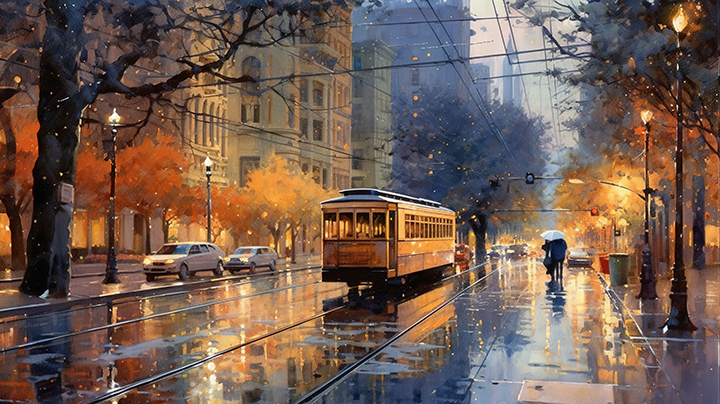
I called him Charlie although I didn’t know his real name. He had poor posture and an unruly beard, an older gentlemen, with tangled hair that grew over his ears and down the back of his neck. The bulky coat he wore, protected him against the cold morning mist, and it also bogged down his frail body as did the backpack he had slung over his shoulders. Charlie boarded the Sacramento Street bus each morning at 6:30am sharp, along with the rest of us commuters. He was never late or absent. Charlie was reliable that way. He didn’t speak to us, nor did we speak to him. But we knew he was a talker for sure. He carried on spirited conversations with his invisible friend who never left his side. As we headed up hill, he would be shouting at her. “I told you not to go there!” “Why didn’t you give it back?” His conversations were disjointed, each morning a new argument, more angst and frustration. Not many of his words made sense, especially since we heard only his side of the exchange, but on occasion we could make something out. “Next time you should listen to me! “Don’t interrupt me!” On and on the disputes went, Charlie’s voice reaching high volumes in the quiet hours of the morning as the bus rattled along. The louder Charlie got, the more subdued we became, shrinking into our seats, pretending Charlie was invisible too.
The damp streets were dark during winter months and the bus was dimly lit with only flashing neon signs from shops and businesses illuminating the sky in spurts. The sun had not yet crested the San Francisco hills and thick fog blanketed the city creating a surreal feeling. We were a captive audience and as the bus jostled and jerked its way up the hill we listened to Charlie and learned about his life. He was from Chicago and didn’t like San Francisco much. He came here because of her and was angry. “It’s crazy here, not home” he’d say. The blank spaces of the conversations were filled in by our imaginations. I tried to piece together clues as I listened. Charlie’s mood swings would take him from angry to woeful in a quick minute. He never laughed but sometimes Charlie would cry. It was sad to see him so broken. Occasionally, he would sleep using his backpack for a pillow. Those were the good days, when his invisible friend would let him rest. We knew Charlie was homeless but indifference kept us at a distance. He never asked for anything. Not once. He just went about his business, trying to settle the score in this challenging, invisible relationship. Every morning, a new argument erupted. It was exhausting for Charlie and for us too.
Polk Street was Charlie’s stop. He’d drag his body out of his seat, step down to the sidewalk and disappear into the day with his invisible friend tagging along. With the two of them gone, quiet settled in the space around us. You could hear a collective sigh of relief as the doors slammed shut, rambling further up the hill to where I got off, at Van Ness. During the short jaunt, from Polk to Van Ness and on the walk to my office, I’d think about Charlie. What was he like when he lived in Chicago? I pictured him wearing a suit, sitting in a tall office building, shuffling papers. No, maybe he was a fry cook, working in a busy restaurant, in a steamy hot kitchen. Then I’d picture him with a family and kids, maybe a dog? Why did he leave Chicago? Who was his friend? And how did Charlie end up on the Sacramento Street bus? Maybe the next day would provide more clues. I knew I’d see him again. There he would be, waiting to take the trek up Sacramento Street in the drafty, dimly lit bus, at 6:30 am sharp. Charlie was reliable that way.
Since leaving my job in the city I never saw Charlie again. But after years of riding with him on the bus he still comes to my mind on occasion. “Is there a little bit of Charlie in all of us?” I wonder. Charlie was a man fighting a battle. Trying to resolve the trials and tribulations of his life and to manage the voices in his head that told him he wasn’t enough. Like us, he was doing the best he could in a world that could be complicated and cruel. I hope Charlie found peace with his invisible friend.
© 2023 Gloria Sinibaldi
Gloria Sinibaldi lives in South Lake Tahoe with her husband Ralph and Goldendoodle, Sissy. She is a retired employment program manager who writes as a form of expression and therapy. Her story, “A Means to Survive” was published in the short story collection, “Tahoe Blues, Short Lit on Life at the Lake”. “Lone Wolf”, a poem, appeared in Perspectives Magazine. She’s contributed to Writing it Real Anthologies and Story Circle. As a columnist for the Tahoe Daily Tribune, Gloria has written numerous business-related articles and book reviews. Walking in nature, landscape photography, and time spent with her eight grandchildren brings her much joy.

 True Stories Well Told
This is a finely- crafted story that transported me into those early- morning commutes we all take for granted. It is made rich by the author’s musings about Charlie and his imaginary companion, and sweet by the other commuters’ acceptance of his short interruption in their daily lives. We’ll done.
LikeLike
I am a personal friend of Gloria, we started Kindergarten together and have been friends ever since. I think this story is amazing and I am so proud of her! Sharon Hermann
LikeLike