
By Loriann Knapton
This is an example of a “braided essay,” one that weaves two or more distinct “threads” into a single essay, that Loriann wrote in my Creative Writing class through Madison College in May 2023. Loriann’s essays have appeared occasionally on True Stories Well Told.
I’m weary of having unsolicited self-help guides turning up in my phone’s newsfeed telling me I need to declutter my life. The algorithms of my search history tag me, correctly, as a Senior Citizen, which I really hesitate to admit unless there is a discount involved. Still, I don’t quite understand why other people, well-meaning people, perfectly nice people, I’m certain, have the need to advise me about what I must purge from my life, or to tell me how much better off my family will be if only I declutter the pieces of me sooner rather than later. The articles instruct readers that getting rid of “the stuff” will not only liberate me, but more importantly, liberate my family, by making it easier when I am gone. They advise that children and grandchildren have no interest and really don’t want “the stuff” unless they can spend it, drive it, or at the very least put it in the dishwasher. I find this interesting because until now I was clueless that my things were holding my children hostage. The writers of these pieces of wisdom further instruct that getting rid of “the stuff” is really a most positive thing and while I may feel sad at first about donating my mother’s outdated, faded, flowered sofa, that if I take a picture of it before the thrift store folks pick it up, the memory of the many happy hours of my youth spent snuggled into its cushions will be enough. What exactly is the article telling me? That at my advanced age of 65 years my life is no longer significant?
Declutter from Oxford Dictionary: Verb, Remove unnecessary items from (an untidy or overcrowded place.)
Looking around my house, I’ll concede that there are items that would be better off in the trash or the donation box at Hope Gospel Misson. Old receipts and shopping lists, the menu from a favorite restaurant long closed, the plastic box of hair ribbons and bows that my granddaughters have outgrown, and canning jars that will never preserve another peach, all come to mind. But I am sorely offended when people that do not know my story blithely advise me to discard the very things that tell the story. Well, you know what? The story isn’t over yet and despite my advanced age I think for now I will keep the evidence.
Purge: Verb: 1) Rid (someone or something) of an unwanted quality, condition, or feeling.
2) remove (a group of people considered undesirable) from an organization or place in an abrupt or violent way.
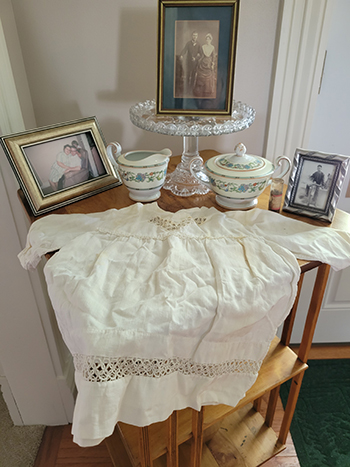
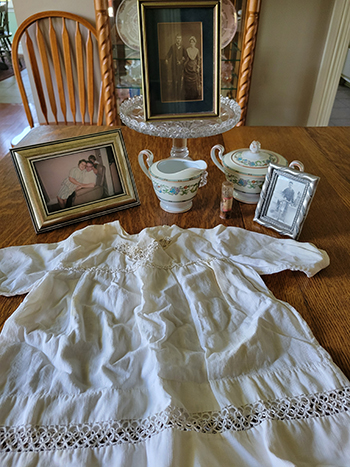
Books, magazines, and internet articles, written by self-proclaimed gurus in how to declutter your life (is this a college degree – Decluttering– a study on what people must dispose of?) advise me that “no one wants; my great grandmother’s 1887 crystal wedding cake plate, which has sat on every child and grandchild’s reception table for over 130 years, the Noritake China with their beautiful yellow and blue flowers, shipped from Japan by my father-in-law to his mother in 1951 just before he flew to Korea to fight on the front, or my father’s baptismal dress from 1926, handmade by my grandmother from linen handkerchiefs and held together with hand tatted lace because they were so poor she was unable to afford satin. Maybe not – maybe it is true. Maybe my children, their children, or even their children’s children will have no interest in these things. If so they can dispose of them when I’m gone. But for now, I think I will keep them as a testament to my history and as a memorial to those whose lives shaped mine.
Junk: Noun: Old or discarded articles that are considered useless or of little value
Don’t get me wrong. I’m not against getting rid of actual junk. If it’s truly so. I still have, for example, preserved in a glass jar in our granary, my father-in-law’s tonsils from an operation in 1946 when he was fourteen years old. I can’t say why his mother thought to keep them and admittedly they could be classified as junk. I probably should get rid of them. But oh, the stories and speculation that comes forth whenever the tonsil box turns up. The laughter, about why great grandma thought to keep them, the banter, from each kid on who will have to inherit them, and the discussions of the dynamics of our family history truly makes the tonsils, for now, worth their keep.
History: Noun: 1) the study of past events, particularly in human affairs
2) The whole series of past events connected with someone or something.
The history of a life is connected to things. Tangible items that tell our story. In 1949 at age 17, my mother trained as a nurse. The white starched cap that was pinned on her head, when she earned her degree in 1951, was unique to the nursing school she attended. Most nursing schools of that time had their own cap design which served as a proud beacon of success when a student earned their degree as a professional caregiver. Many times, during my growing up years, I remember mom before her shift at the hospital standing at the ironing board, sprinkling her freshly laundered cap with liquid starch. If I think about it can still smell the distinct tingling clean scent of the starch as it met the hot iron and the hissing noise and puff of steam it made as she pressed the cap. When my mother retired in the late 1990’s, her cap went into the trash. I am still heartbroken at the loss. While disposing of it was her choice (the article writers would have approved), finding it among her belongings once she is gone, would have been mine.
Love: Verb: 1) an intense feeling of deep affection
2) a great interest and pleasure in something
Oh, I’m realistic enough to know that my family will toss much of the evidence of me when I have departed this earth and that’s OK. The antique shops and thrift stores will be richer for it. But for right now, I don’t feel the need, nor will I be told, when to purge my life. Because the physical evidence of living, the items I can touch, see, and feel, surround me with comfort, connect me to my past, and will someday validate that I have lived. My family will just have to figure it out. Decide what to toss or keep. But they won’t be doing it alone. I will be there too, in each dish, handmade quilt and porcelain vase they touch, helping them to say goodbye.
© 2024 Loriann Knapton
Loriann Knapton has been writing since childhood. Having crafted countless rhymes, short stories, and personal essays over her sixty-odd years she has a keen interest in ensuring her family memories are recorded for the next generations. Her writing reflects the humorous and poignant experiences of growing up in 1960’s small-town America with her mom and disabled dad.

 True Stories Well Told
Lorianne,
I loved your piece. It speaks to me and even though I’ve de-cluttered my life to an extent
at age 78, I still choose to keep certain things that speak to my family history. Your stories, too,
will help connect your family to their past even if they choose not to keep those momentos.
Keep writing,
Suzy Beal
LikeLike