
By Marlene Samuels
This is the first post of a two-part series. Read the second post here.
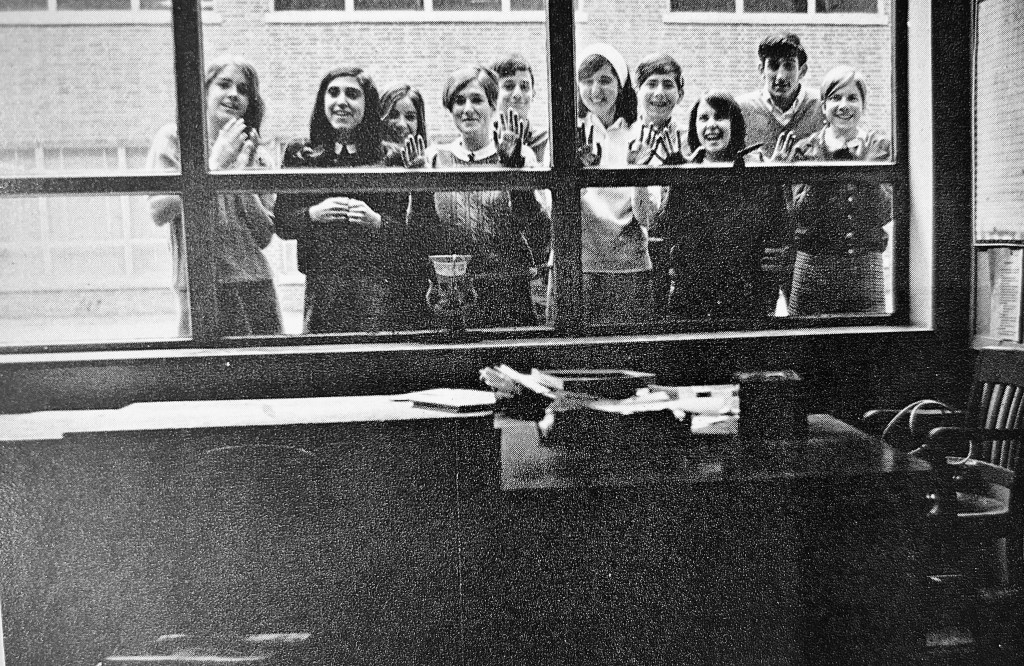
During my senior year of high school in 1968, Home Economics was a mandatory, one-semester sewing and cooking class all girls were supposed to complete in order to graduate. It met for one-and-a-half hours three times a week.
I was the newcomer to school, the community and the United States. Although I was from Canada — a country with more in common to the U.S.A., than not— and despite my English proficiency, the mean girls had one mission, to convey that we were worlds apart. I didn’t belong.
In Canada, I’d been accustomed to wearing a school uniform so, consequently, I was utterly clueless about how American teenage girls, particularly those from affluent communities, dressed despite my hours spent studying teen-magazines. To admit that I didn’t exactly blend in with my classmates is, at best, an understatement. Most days I was mocked. On occasion, leader of the “mean girls” harassed me in performance for her friends.”
Freckle-faced cheerleader and “Queen of Mean” Peggy spent summers touring Europe with her parents. Consequently, she’d acquired an extensive French and Italian vocabulary of expletives she hurled around the classroom to express frustration with her projects. She also directed them at me whenever I neared her periphery.
Side-kick MaryAnne returned to our school senior year having completed junior year at a Swiss boarding school. Daily, she found ways to demonstrate her acquired sophistication. Her mission: remind me I was lower class. Regularly, she’d announce, “Your parents have European accents but Eastern European ones, hardly as elegant as Italian or French. Any wonder your dad’s got that tailoring shop and your mom’s a dressmaker?”
On the first day of the semester, every girl in Home Economics was given the choice of two projects they’d complete; an A-line skirt with a back zipper and a sleeveless, straight shift-dress or a household domestic project consisting of an apron and well-padded oven mitts.
I’d been around sewing in my mom’s dressmaking business all my life and the memory of sewing my fingers up in her heavy-duty Singer sewing machine when I was three still evoked my horror. The girls in my class, all from wealthy homes— staffed with maids and gardeners and even cooks—toiled on their projects well past the deadline. Most had chosen what they’d assumed was simpler, an apron and oven mitts.
I’d chosen clothes reasoning that two additions to my pathetic wardrobe would be a welcome side benefit. I completed my shift-dress during two class sessions followed by the skirt during the third. Unlike the other girls who’d selected the clothes project, I hadn’t found it necessary to consult the pattern’s diagrams continuously nor to correct crooked stitching. On grading-day of our two-week project, Mrs. Putznick awarded me an A-plus. She’d evaluated the dress and skirt for “seam neatness”, matching the fabric pattern plus evenness and invisibility of blind-stitched hems.
“Excellent job, Marlene!” Chortled our home economics teacher. “Not only was your punctuality in completing this project excellent but you did an amazing job! Without a doubt, very impressive. Class, let’s all give Marlene some well-deserved applause for her achievements? I don’t think I’ve ever had such a capable student. Such a pleasure!”
The nasty girls— almost every one of whom tormented me— glared at one another, then at me. I could hear loud, rapid and hostile sounding whispers that struck me as contrary to Mrs. Putznick’s positive remarks. At the moment I should have been basking in glory of recognition, anxiety overwhelmed me. Was I having a premonition of impending doom?
My Holocaust survivor parents had drilled into the core of my being never to speak up, never to behave in any way that might call attention to myself lest it endanger my survival. “Thank you so much, Mrs. Putznick.” I mumbled, barely above a whisper. All eyes were riveted upon me.
“Marlene, would you like to choose another project for extra credit or maybe you want to be my assistant? You could help the other girls with their projects and be something like my teacher’s aide.”
“I’d much rather be your assistant!” I replied too quickly and with far too enthusiasm. “I want to be a teacher if I get to go to college so this would be a good opportunity and good practice.” I felt invisible lightning bolts directed at my four-foot ten, eight-six pound anatomy as my armpits grew damp. I felt my face flush. I was over-heating. For the first time in the three years since I’d moved to the U.S.A., I was enjoying small bits of high school, albeit without friends. But as far as the mean girls were concerned, everything had proceeded way too much in my favor.
The following week, the proverbial “merde” hit the fan. Ninth-period bell had just rung and class busied itself putting works-in-progress into their assigned cubbies. The second the clanging bell stopped, Peggy’s shrieking began. My lead nemesis of all the mean-girls shouted again and again, “My purse, my purse! It’s gone! Oh god, has anyone seen my purse?”
“Where and when did you last have it, Peggy dear?” asked the ingratiating Mrs. Putznick.
“It was right under my chair when we started to clean up, but now it’s gone! Oh god, Mom’s going to kill! It’s hers but I borrowed it without asking her!” Peggy’s shrieks escalated to all-out howls as mascara-tears streaked down her acne spotted cheeks. The rest of the girls enveloped her in a show of support. I stared at the unfamiliar spectacle.
“Surely, it must be somewhere in this room?” Offered Mrs. Putznick. “It didn’t just grow legs and run away! Girls, let’s all help Peggy search but we must be systematic. First, we’ll start with the cubby-hole baskets, one by one.”
Each girl took one from its cubby-hole, emptied the contents onto the table, sorted through everything then returned it to its place. I’d literally just walked into class yet joined in the search. Abruptly, new shrieks pierced our ear-drums, now from MaryAnne, partners with Queen-of-Mean”.
“I found it! I found it!” She shouted, waving the purse over-head like a golf trophy. Before Mrs. Putznick took a breath, MaryAnne announced, “Want to guess where I found it?” The room grew silent while she maximized the drama. “Inside Marlene’s basket under her A-plus projects, that’s where!”
All eyes turned toward me. “Nice cooperating, girls and MaryAnne, you really saved the day! Marlene, you’ll need to stay after everyone leaves.”
This is the first post of a two-part series. Read the second post here.
©2025 Marlene Samuels
Marlene holds a Ph.D., from University of Chicago. A research sociologist by training, she writes creative non-fiction by preference. Currently, she is completing her book entitled, Ask Mr. Hitler: A Memoir Told In Short Story. She is coauthor of The Seamstress: A Memoir of Survival, and author of When Digital Isn’t Real: Fact-Finding Off-Line for Serious Writers. Her essays and stories have been published widely in anthologies, journals, and online. (www.marlenesamuels.com)

 True Stories Well Told
Loved the story. Amazed at your resilience and survival! I remember bullying so well, in my case, in JrHS, and I had a penchant for walking into their (mean girls) traps.
Hugs, Shalom, in friendship Carol J Blatter
LikeLike