
By Kurt McGinnis Brown
“My Islands” originally appeared in Wisconsin Writers Association Creative Wisconsin magazine, October 2025.
I’m in love with islands. Their siren call streams through me like those neutrinos constantly passing through all of us. Thinking of an island of any type makes me happy, and when I’m on one I find special freedom in its circumscribed space. On an island our limit is proved, death certain, and so there is no escaping the knowledge that every one of our actions is consequential.
The first island I landed on was Monhegan, off the coast of Maine. One square mile, no cars, no paved roads, reached only by ferry. I was eight. My sister and I spent the first day on the wild eastern side, Atlantic breakers crashing over us and pinning us to black rocks. That night over dinner in the lodge we were chastised by the owner. It impressed me that he spoke to us, not my parents. He’d seen us playing on the rocks, dodging waves and hanging on through the streaming foam when hit. Perhaps it was made up to terrify us but he claimed that the week before two kids had been swept from those rocks and out to sea.
Islands that followed are Ibiza, San Juan (in Washington), St. Lucia, Barbados, Big Pine Key, the big island of Hawaii, Ko Samet, Sicily, and Lesbos, which is so large it contains two mountain ranges. Sappho and her exquisite sensibility came from there. Aristotle, the observer of phainomena, exiled himself there to do biology experiments in the skinny lagoon that makes Lesbos look like an amoeba undergoing mitosis.
Its now ten years since the great migrant crisis of 2015. My partner Susana and I were on Lesbos that October when ten thousand people every week landed on the north coast after crossing in small boats from Turkey. We were aware of the refugee crises but didn’t know that Lesbos was a prime destination until we arrived and found the shuttle from the airport crammed with reporters and camerapeople. Driving to our lodging near Molyvos on the north coast we passed hundreds of refugees walking toward the capital Mytilene.
We were tourists. Our first full day on the island we visited a small building covering pools fed by hot springs. The women who owned the building instructed us to first immerse ourselves in the near-scalding water for two minutes then race outside to stand in the cold sea before returning for another immersion. Susana couldn’t force herself into the hot water and instead relaxed on a bathchair in the humid air. Counting off the seconds while trying to not panic I finally stood up and ran outside to cool off in the sea.
And there I am, hip deep in the Aegean, fingers swirling the water, staring into the distance, oblivious, relaxed, and psyching myself up to go back inside for the painful-then-pleasurable-then-panicked spell in the hottest water I’ve ever been in when, bouncing over the waves toward me, there appeared a dingy full of people. There must have been forty adults in a craft built to hold twenty. I ran inside to dress and then back outside to meet people clambering up the rocky shore to the dirt road where I stood.
A jeep with aid workers zoomed up behind me, the woman driving yelling at me in French. I understood by her gestures that she wanted me to urge the people to come to the jeep. “Qu’est-ce que c’est?” I blurted out, a melodious phrase remembered from French films. Or possibly I said “Quelle heure est-il?” because that too rolls off the tongue. Whatever nonsense came out of my mouth, my astonished point was, “Aren’t you the aid workers?” But the woman got out and shooed me toward the new arrivals, again telling me to get them to come to her.
I had only English to use. “Excuse me, that lady over there might be able to help you.” One of the travelers who spoke some English explained that they had no intention of talking with aid workers. Next to me another man unwrapped what he’d used to waterproof his phone and made a call. I was told that the boat his brother and family were on was still out there in the waves, and this first group was going to wait to see if that boat made it across. I went back to report this to the French in the jeep and received scowls. They zoomed off. To do what I have no idea, as they seemed reluctant to engage directly with the cold, wet people who had just arrived.
The travelers’ greatest fear was to be separated forever from family members still trying to make it over the sea. Once they got on one of the many tour buses pressed into driving people to the camp near the capital, there was no telling what would happen to them. Most chose instead to walk over the island’s mountains to reach the harbor at Mytilene, hoping to avoid the camp and somehow find a way to continue on to the mainland and then central or northern Europe. They chose to stay together and govern themselves rather than turn their lives over to the well-intentioned but chaotic (and sometimes literally imprisoning) aid process. Many of the people who made the crossing remain trapped in the giant migrant camp. Today a second camp is being built.
To be on vacation and to find myself unexpectedly among heartbreak and chaos and suffering was to also witness a tenuous hope as expressed by the majority of Greeks, who though struggling themselves, were sacrificing to help strangers. A common sight in the little shops along the coast was locals mingling with aid workers and tourists, speaking many languages, all of us buying up whatever we could carry down to the thousands of people arriving every day. One shop owner near the hot springs simply said “take, take” when we came back and no longer charged for the items. At one point, I stood side by side with a local watching the latest group to set off over the mountains on the walk to Mytilene. As if he needed to explain why he provided help, he said in accented English, “Some people know what time it is, some remain asleep.”
The women who ran the hot springs had a method of helping that was heartbreaking and beautiful in its practicality. When a boat landed they coaxed people with children to come to their building. Of that first group I saw land, the women managed to direct a few women and several children to their building. All were soaking wet. The Greek women stripped the shivering children of their wet clothes, threw these in a pile to be washed and dried and then, because the families had to keep moving, dressed the children in the clean, dry clothes of previous arrivals.
Susana helped strip, dry, and dress two little Iraqi girls. Then, wearing the clothes of Afghani girls who landed on Lesbos the day before, these girls continued with their family on their frightening journey of hope—to find a safe, welcoming country in which to start a new life. Soon their clothes would wind up on children from another country.
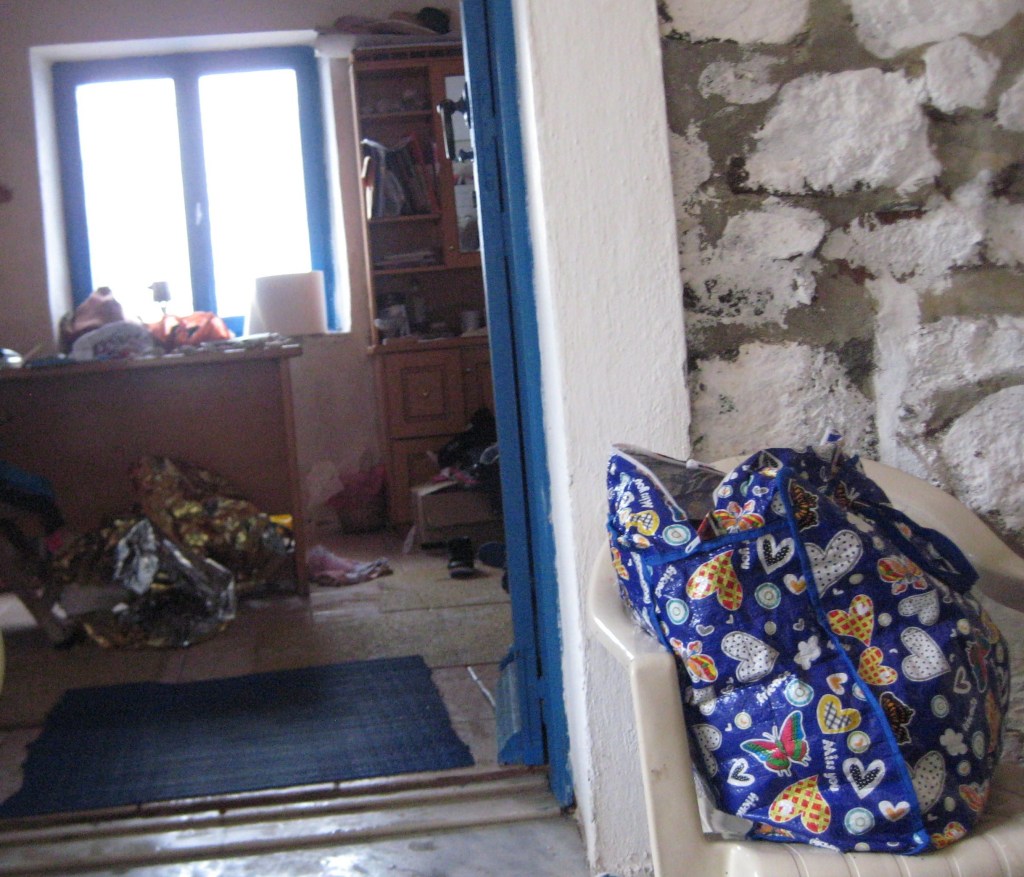
As they were being dried and dressed, I sat next to the large colorful bag covered with a multitude of hearts the girls carried on their journey. Their only belongings. Imagine what’s inside: the well-worn, the well-loved, the things they judged most valuable moments before they left their home forever.
After landing back in the U.S. and entering our comfortable house we saw a news story from that same coast. One of the dinghies sank and babies, children, fathers and mothers died. That year 100,000 people made that crossing. I feel helpless to hope for happy endings for all those desperate people. Yet sometimes late at night, in my yellow armchair by a window where the moon often peeks in, I find myself trying to picture where those Iraqi girls are now. Here on this yellow cozy island where imagination is free, I’m able to construct stories in my head of the girls happy, safe, and laughing.
© 2026 Kurt McGinnis Brown
Kurt’s plays have been performed across the country, and his fiction has appeared in national journals. He’s finishing a book tracing his transformation from criminal to creative writer. His work on land and poverty took him to countries he’d otherwise never have experienced. http://kurtmcginnisbrown.com/

 True Stories Well Told
Great story! Rich with detail and meaning. I was jut scrolling my emails, but couldn’t close this until I got to the end!
LikeLike
Beautiful, especially the ending. And so relevant today with many of us trying to protect our own migrants.
LikeLike
Beautiful, especially the ending. And so relevant today with many of us trying to protect our own migrants.
LikeLike