This is an example of object writing — start “zoomed in” on an object and let it make your writing powerful through its concrete specificity.
Three years ago my keychain was full to bursting, each key a connection and a responsibility.
My friend’s house key, so I could walk her dog if she was working late, and water her plants if she was away.
My mother’s key to her apartment at the assisted living facility, even though her door was rarely locked. Usually I’d find her in her recliner, her back to the open door.
The key to the building where I was the office manager, responsible for a cabinet full of keys to all the tenants’ suites, the mechanicals room, the front and back entries. I took refuge in the simplicity of my to-do list there.
And of course, my own house key and car key.
The friend’s key went first, removed in May, 2020. The office keys went next, closed by Covid, removed in August that year. The mother’s key, removed in October. My keychain grew lighter, less clumsy, with each loss.
Now, my keychain holds only house key, car key, and YMCA ID card.
All that responsibility, replaced with only taking care of myself.
Our last day in Sicily, we four tourists were lounging on Cefalu’s crowded beach. The Mediterranean beckoned. I fell for it big time. Its turquoise clarity colliding with other shades of blue, matching the sky. Gazing at the sea, its gently rolling waves were supposed to relax us before boarding the long flight across the big pond, back to Boston and our daily lives filled with errands, writing, walking, coffee, and adorable grandchildren.
The young entrepreneur with curly dark hair walked by. Patterned Indian beach blankets, or tablecloths, piled high in his backpack propelled him forward. Bogging him down with financial responsibility. His dark eyes sparkled.
“Look,” he pointed to one of his blankets, shaking the sand off. He proved his case. Always smiling.
I wondered about his background. Was he Sicilian, or had he relocated as an immigrant from some ravaged country? And, how did he procure his wares? As a former journalist, I’m permanently curious.
“Bellissimo!” we four travelers announced. Somehow the entrepreneur heard us. Or he intuited how undecided we were about buying one of his blankets. Four times he returned to egg us on, until my partner, Marc, encouraged us to support him. Marc bought two blankets, at $10 each.
Our friend Claire chose the second blanket, covered with blue sea creatures. She imagined it bringing a smile to her grandchildren’s faces, back in Maine.
“Where are you from?” I asked the entrepreneur.
“Morocco,” he replied. I figured he was happy to be gone from his country, following the recent devastating earthquake.
Could he make more money than at home? What was his story?
I would never know. But I wanted to. I enjoy making up stories about people, and I’m not shy about talking to strangers. On this trip to Sicily, one of my fondest memories was splashing around in the Mediterranean with fifty or so strangers, after jumping off a boat anchored near the lovely Egadi Islands.
I felt like a happy-go-lucky kid in an international camp – where I heard Australian, German, French, and other accents I couldn’t identify. Bobbing in the salty sea, I spoke with a young Argentinian woman who had moved to Sicily two years before. Looking for a better life. Without having to sell coconuts or beach blankets. Yeah, I wondered, what was her story? I didn’t have enough time to get it all.
Back at the Cefalu beach, I was happy when we initiated more sales for the young entrepreneur, perhaps in his twenties. Others waved him down to purchase his blankets. We got into the act, trying to convince a blond British woman lying on the beach beside us. She didn’t buy a blanket but we had a lovely conversation about our parallel visits to Sicily.
We agreed that Sicily was gorgeous and so diverse for travelers who could afford to make the trip.
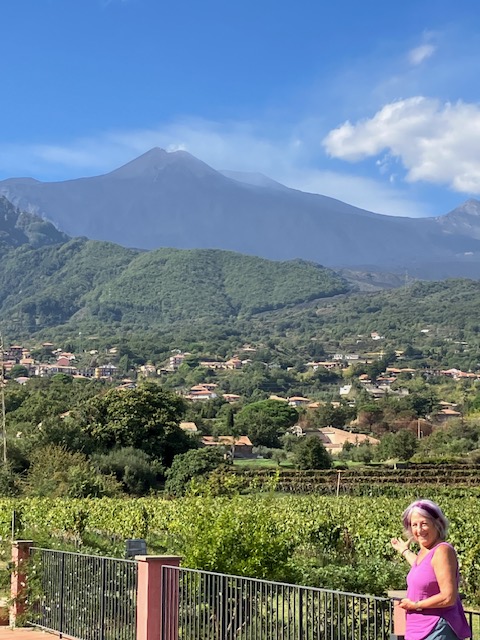
Driving from busy, wild Palermo; to a golden thousand-year-old Greek temple on a Segesta hilltop; to Trapani, where a last-minute booking to the Egadi Islands turned out to be a trip highlight; to the Italian TV show’s Montalbano beach house in Punta Secca; to Ragusa, where a political conversation with a local young council member infuriated me; to Modica, where we spent an hour choosing “the world’s best chocolate;” to walking the island of Ortigia’s perimeter umpteen times; to the alluring Santa Venerina resort with the Mediterranean below us and Mount Etna above us. All this prior to reaching Cefalu, Sicily’s small beach town, where we connected with the unique entrepreneur.
I’ll never guess his entire story. He blew kisses our way as he strode away, down the beach, bent over with his wares. Still smiling.
“Optum, optum!” I sent kisses back to him in Turkish, the only words I knew in a language possibly close to his. I’m not sure why, but I won’t forget him.
Sheila Wilensky is a freelance writer/editor living in Minneapolis to be close to her adorable grandchildren. She has written for Publishers Weekly, American Bookseller, Desert Leaf, the Tucson Weekly, Poets & Writers online, and other publications.
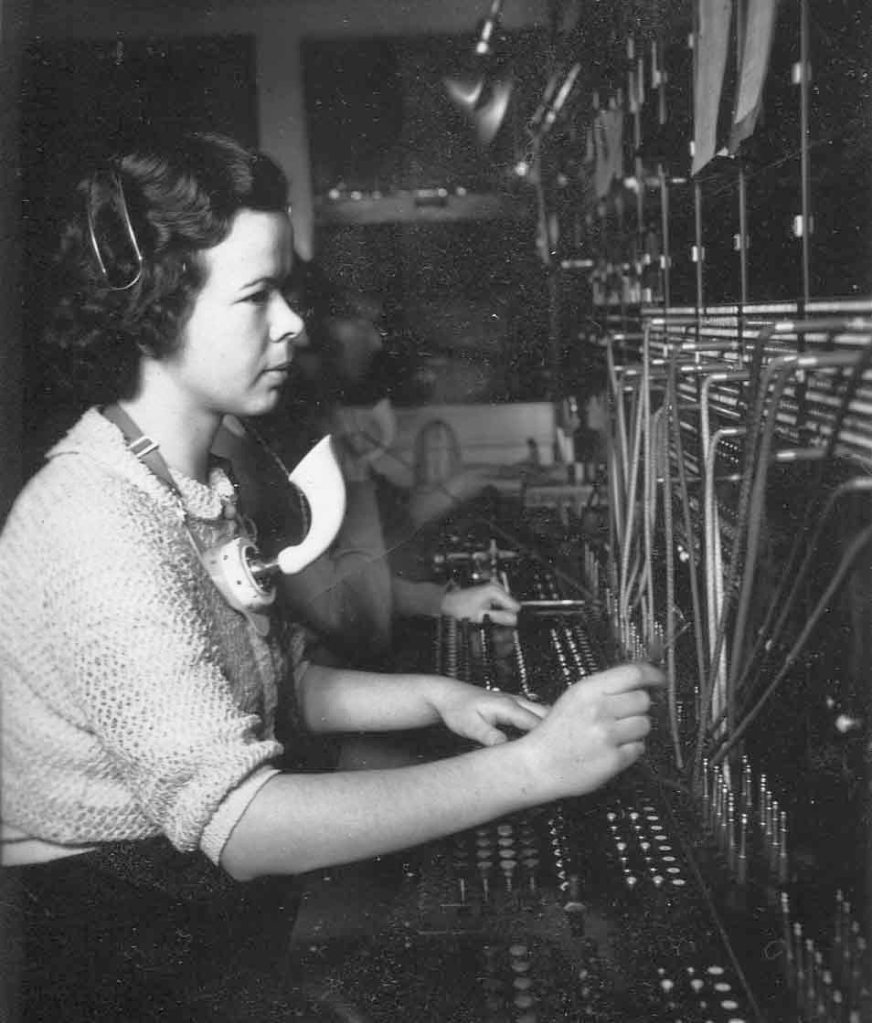
My mother at her first job on a switchboard. (circa 1940)
I’ve worked hard to stay current and relevant with the times, but each year it becomes more challenging.
Yesterday our oldest daughter set up our cell phones with “WhatsApp” so she could text us from Ireland, where she will be traveling. “It’s easy. Mom, you use it the same as the other text app. you use.” “OK, but the app isn’t on the same screen as my other apps, so where is it?” “Mom, you swipe the page that has your other apps and it will show up.” “But I would like to have everything on one page. “OK, I’ll come back and fix that for you before I leave.”
Our youngest daughter was over with our granddaughter the other day and they wanted to show me how to use a feature on my cell phone that lets you send a voice message instead of a text. I watched her show me, knowing I would never use it. She talks so fast the whole time, I’m left in a fog. I tell her to please show me again but to please slow down so I can write the instructions down. She does.
I purchased a cell phone when our granddaughter got her first one six years ago, so I could text with her when calling wouldn’t work. She has moved on to voice messaging with multiple addresses and phone numbers. I can’t keep track. I’m lucky she lives close by and I can rely on face-to-face visits.
We recently moved, and I visited the big box stationery story to have a new address stamp made. They told me I had to order it online, they no longer did it in the store. I left. Our bank opened a new branch near to our new home. We were excited because it meant not having to drive across town to do our banking. We went to the open house and immediately inside the front door were three large machines to handle all “your banking needs.” A woman stood there showing us how to use the machines. My husband and I glanced at each other and left. The drive to the other side of town to have a real person teller to talk to and do our banking needs was well worth the few more minutes in the car.
We recently met with our financial planner to discuss the proceeds of our house sale. In the past, in our once a year meeting in her office, she would print out our projected financial numbers based on a series of suggestions we gave her. This time, we walked into her new office and sat at a conference table. She opened up her computer. Two large screens on the wall came to life. One had her assistant, who lives in another town and a third consultant in still a different state. Both women smiled and introduced themselves. Our discussion took place with all three. We looked back and forth, listened to each, and tried to make sense of all the terms, numbers on the screen. We are not stupid. We owned a thriving business for many years, have set on boards, done volunteer work, and stayed current. With our heads in a fog, we came out of this meeting not sure about anything, which wasn’t a good feeling. Our financial future is in the hands of these three women.
What about MyChart? It is supposed to make life easier, I guess, but I wonder for whom. Yes, I can make appointments and get messages to my doctor without having to get in the car, but I used to do that on the telephone. Now, we get all our test results (most of which we can’t read) on MyChart. We still have to make an appointment with our doctor to find out if we really are sick.
This morning my husband was looking up something for me on the computer. The item on the model in the picture showed a dark purple fleece jacket. Just what I wanted, but the description said it was navy, not the color I wanted. We tried every possible “click” to find the right description and finally gave up.
Life goes on as I’m getting used to new routines in my new home. Dinners are coming out of my kitchen and my husband is back to playing his piano. We are not complaining, just trying to keep up, as our world around us goes faster and faster. Don’t get me wrong, technology has its benefits. I love my Word writing program, and email.
Without e-mail, I’d be lost to my friends. I’ve taken many writing classes over the years and have friends in all parts of the globe. We share our lives and our writing world. E-mail allows us to stay in touch and improve our writing skills.
My Word writing program is magic. I started writing before computers were in every household. I spent hours with my old typewriter typing and retyping all my stories. Once I understood how computers worked for writers, my life changed. I looked forward to sitting down and working on a story. No need to erase, rewrite, or start over, it all happened with the flick of the wrist.
Then, along came writing programs like Pro Writing Aid that could catch misspelled words, grammar mistakes, (not that I made any) and overused words. These added tools made writing a new experience. I still have to come up with the ideas and make my own choices, but…
No worries, AI will soon make our decisions and we will all live happily ever after!
Writer and budding poet Suzy Beal spent twenty-five years helping seniors put their stories to paper and this year just finished her own memoir. Suzy’s work has appeared on truestorieswelltold.com, including a serialized portion of her travel memoir. She writes personal essays and is currently studying poetry. Her work has appeared on Story Circle Network, 101words, Central Oregon Writer’s Guild, and recently an essay in Placed: An Encyclopedia of Central Oregon. She lives and writes from Bend, Oregon.
We’re nearing the end of this special series featuring essays shared by writers at First Monday, First Person, my “salon” for memoir writers held at the Pinney Branch Library in Madison.
By LoriannKnapton
Flom Minnesota, Population 183 (according to the 2020 census), located in Northwest Minnesota, was settled in 1880 and named after early settler Hans Erik Flom. Today this little town with proud Scandinavian roots boasts several businesses lined up across from one another between Minnesota Highway 38, including the Flom Pub, the Flom Café, Johnson’s Market, Max’s barbershop, the Flom Insurance Agency which competes with the Flom Region Mutual Insurance Company, Lunde Blade and Gravel, and the Flom Post Office.
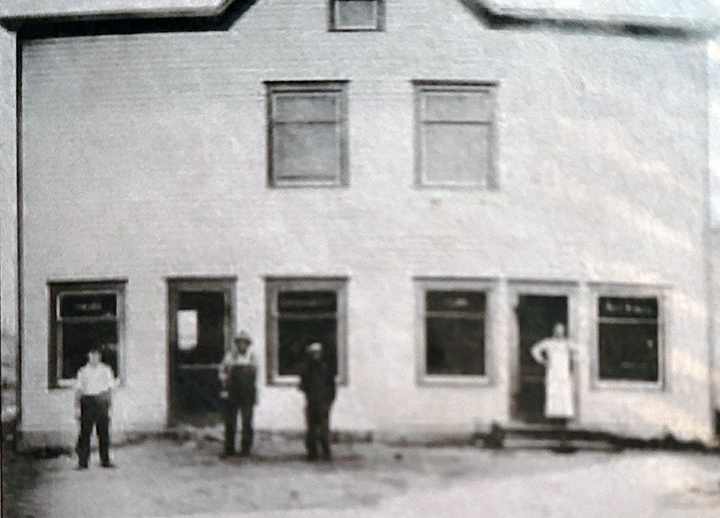
My Mother grew up three miles north of Flom on the east side of the gravel road leading into the center of town. When she was a girl in the 1930s and ’40s Flom was the center of her family life. In Flom, groceries were purchased at the general store, the family’s beef and pigs were butchered, processed, and stored at the Flom meat locker, gas for the car and the farm tractor were purchased from the Flom CO-OP, and Grandpa enjoyed a beer (always Grain Belt) or two from the Flom Pub. Most Saturday nights there was a dance and sometimes a movie in the summer shown on the whitewashed side of the general store. Folks would bring their chairs and blankets to sit out below the stars and watch the free show munching on snacks purchased beforehand from the store. The locals, mostly farm families, all knew each other well and Flom was their gathering place to catch up, jaw up, and get full up when they needed supplies.
As a child, I remember spending many happy days during summer vacations eating freshly made pie at the Flom café with big scoops of fresh ice cream churned at the Flom creamery just across the street. I also remember going to the community center dances where polka or “old time” music, as it was always referred to by my grandparents, was king. The dancers didn’t have to be good to whirl around the floor and it didn’t matter if you had a partner or not because unpartnered ladies danced with each other and unattached men weren’t afraid to jig about the perimeter of the floor solo if all of the ladies had partners. Open-faced sandwiches of ground-up wieners or chicken mixed with mayonnaise were served by the Flom ladies’ aid society along with gallons of lemonade and coffee. The lunch was supported by donations from the crowd with the profits going to the women of the church. A farmer in the crowd would volunteer his Massey Ferguson baseball hat to pass round several times during the evening for donations to sponsor the band.
As a child I loved to go to Flom when we visited my grandparents, and I would often beg to ride my aunt’s rickety two wheeled bike the three miles to buy a treat from the general store. Three miles didn’t seem so far to a bored eight-year-old, but that gravel road served as a very bumpy ride on a decrepit two wheeler with a rusty chain, and the adults were concerned that the dust churned up from the tires of an oncoming car or tractor might render me invisible to the driver, so unless Grandpa or Mom had an errand in “town” I didn’t get there. Nonetheless, a trip to Flom was always a great adventure and I eagerly waited for my chance to go whenever we visited.
Several years ago, on a trip back to visit my Minnesota family I was trying to explain the allure of Flom Minnesota to my husband during a day trip with my mom, her brother, and sister-in-law to see the old homestead. The property had long since been sold for farmland, but the house was still standing, abandoned when my grandparents moved to Pelican Rapids in 1978. Many years of abuse by harsh Minnesota winters had left the little house sad and forlorn, stripped of its paint, standing stark and alone except for an equally dilapidated outhouse. I was glad we had come that day but I was also saddened by the now broken-down house where so much of my childhood was centered. Staring at the scene I closed my eyes and could hear voices in the wind; the laughter of my grandpa after being dealt a good hand of cards, the sounds of my grandmother pouring water from the dipper to make nectar (her word for Kool-Aid) for our meals, the voice of my mom saying don’t waste the water Loriann or you’ll be making the next trip to the spring.” I could hear it all.
On our way back to Pelican we decided lunch would be the perfect ending to our day, so we turned out of the driveway and traveled the three miles down the dusty gravel road leading south until we pulled up in front of The Flom Café. Through the large windows on either side of the screen door we could see the place was empty except for two old timers sitting at the counter stools. The modest counter had space for four more people on the stools next to those occupied by the older men and along the outer wall four small Formica-topped tables were set with placemats. The walls and counter were plain, painted white and well-scrubbed. Various foodservice equipment stood on a prep counter behind the service counter including a shake machine, toaster, a small glassed-in fridge holding a variety of sodas, and stainless-steel bowls of various sizes. The year’s Co-op calendar was hanging on the wall next to the coffee station, a glossy photo of the newest Farm-All tractor gracing its top.
A burly chested man, probably in his mid 50s, white apron covering an ample stomach and a soda jerk cap on his head, stood in the kitchen doorway, pancake spatula in his right hand which he waved cordially in our direction as the seven of us, my husband, myself, my mother, and my mother’s aunt, and uncle who had met us in town, all crowded into the place. “Have a seat anywhere, just put a couple of tables together. I’ll be right with you,” he said, before going back to the grill. We did as we were instructed, pushing three of the tables together and organizing the chairs to make seating for all of us.
Once seated, it wasn’t long before the man came out of the back, refilling the coffee cups of the men sitting at the counter on his way, and approached our table. “Nice to see you folks,” then speaking directly to my Great Aunt Nolda and Uncle Bill, longtime Flom residents, he said “Hello Bill — I see you brought company – Are you here for lunch or just coffee and pie?” In his mid 80s at the time, Uncle Bill, known for his dry Minnesota wit, told the man he was sorry for the big crowd on a Tuesday afternoon, but we were hoping that there weren’t too many for lunch. The cook smiled and said “we weren’t expecting a party, but we’ll take care of you. What can I get everybody to drink?” We gave our drink order, sodas and coffees, each in our turn, and then every one of us ordered hamburgers, three with cheese, five orders of French Fries, and two Potato Salads (homemade of course).
As soon as we ordered he headed behind the counter to get the drinks, coming back quickly to deposit Cokes and coffee, silverware and napkins, and squeeze bottles of ketchup and mustard on our table with a smile before heading back into the kitchen, where he removed his apron and the soda jerk hat and exchanged them for a light jacket and baseball cap with Flom Café printed on it, from a hook near the back wall. Sticking his sleeve through the jacket he came out front, put the hat on, opened the cash register, removed some cash, and strode out the front door. My husband just looked at me and started to say something when my Uncle Bill said in his quiet Minnesota drawl, “It’s alright, he’ll be back.”
And soon enough we saw him strolling back to the café from across the street, a large package wrapped in freezer paper under his arm. He entered the café without a word and headed to the kitchen, stopping only long enough to hang his jacket and cap back on the hook, replacing it with the chef’s apron and paper hat before sliding through the kitchen door. We could hear running water as he washed his hands and the rustle of the freezer paper as he opened the package to start forming the beef patties from the ground meat he had just purchased from the general store, to make seven hamburgers. He called over his shoulder as he worked. “Sorry about the wait – I wasn’t prepared for a big crowd today, but the food will be up shortly.” Hearing this, my husband turned and looked at me sideways in disbelief. “It’s Flom,” I told him with a grin.
Loriann Knapton recently retired from the Wisconsin Department of Public Instruction where she served as a child nutrition consultant and trainer. Although unpublished, she has been none the less a writer all of her life, starting with silly rhymes and short stories in grade school and moving on to countless poems, personal essays and eulogies for family members and friends. In retirement she is delighted to finally have the time to work on completing a memoir of growing up on the “wrong side of the tracks” in the 1960s with a disabled dad.
For the next month or so, True Stories Well Told is featuring essays shared by writers at First Monday, First Person, my “salon” for memoir writers held at the Pinney Branch Library in Madison.
Do you believe in angels? I know that my wife, Denise, is a firm believer in them. She even collects angels. And she is an accomplished ceramicist, with one of her favorite subjects being angels. But in what form can an angel touch your life? Is it only in the conventional image of someone with wings and a halo? Or perhaps a chubby, elderly, bumbling man trying to earn his angel wings as in the movie classic “It’s a Wonderful Life”?
Well, I believe that my family was touched by an angel on a bitterly cold January day. Only this angel was one foot high, with big yellow eyes, long curly whiskers and a scrawny tail. It was a feral cat. I don’t think the timing of its arrival could have been any better. The winters can be brutal in Wisconsin, but last winter was one of the worst I have ever experienced. Along with most of the northern states, we were cursed that winter with alternating cycles of fierce winter storms and bone-chilling cold. The difficulty of that winter was complicated by a very traumatic holiday season for us. My wife’s sister died the previous summer from cervical cancer at the tender age of only 35 after valiantly fighting the disease for a year and a half. She left behind three beautiful young children and the ordeal adversely affected us all. Christmas is an important tradition in my wife’s family and this was the first holiday season without her. It was a strain on everyone, but my wife had the most difficulty coping. In fact, I could tell that she had been severely depressed for most of the year.
I live in the country near Madison, Wisconsin, encompassed by farmer’s fields and lush woods with a 180-acre nature preserve across the road. I can always tell when winter conditions are the worst by the activity at the bird feeders in our backyard. The opossums come out at night to gorge on the cracked corn scattered on the ground feeder. And bevies of quail and ruffed grouse march across the road from the nature preserve o dine on seeds that the birds cast haphazardly on the ground.
I remember that it was bone-chilling cold one January morning when my daughter, Danelle, dashed for the school bus from the comfort of our garage, trying to minimize her exposure to the frigid arctic air. However, in her haste, Danelle forgot to close the side garage door. Late that afternoon my wife came home from work and eased her minivan into the security of our garage. As she stepped out of the van, she noticed something move along the back wall of the garage.
We have an old chest of dilapidated drawers stacked against the back wall in our garage that is used for storage. The lower right-hand drawer was missing, leaving a gaping hole. From the recesses of this hole, a pair of large yellow eyes glowered at my wife. She approached the chest of drawers cautiously to get a better look at the owner of these large eyes. Bending over and peering into the recess, she saw a scrawny, dirty, burr-infested tabby cat curled up in the corner of the drawer. It was very cold in the garage. My wife ran into the house, grabbed a couple of old towels and stuffed them in the hole so the bedraggled feline could have some warmth.
I remember that for the next few weeks she religiously fed the cat and spent time talking to it and trying to pet it every day. I kept telling my wife that once the weather improved, the feral cat would scamper back into the woods. Any port in a storm, you know. But the weather did not get better. In fact, it got much worse. And one night toward the end of January an arctic blast swooped down from Canada and the temperature plunged to 30 degrees below zero without the wind chill, Consequently, even in the a shelter of the garage, it was so cold that my wife became concerned about the cat’s health. So, she grabbed one of the large towels used for his bed, trapped the cat in the corner of the drawer and wrapped the towel around him so she wouldn’t get scratched. Folks, this cat was not a happy camper. The cat kicked, squirmed and struggled valiantly to extricate itself from its terry cloth cocoon. But my wife held on to him firmly.
Quickly my wife transported the cat to the office at the back of our house. She unraveled his cocoon and slammed the office door shut. Then she set the cat up with his own little apartment, including a food dish, water bowl, litter box and a cat carrier with a towel in the bottom for a bed. For the next month, our office was this cat’s castle. I thought he would be ecstatic to have his own comfortable abode out of the arctic elements. But, whenever someone had to use the office, he would retreat to the security of his cat carrier or hide under the computer table and glower at the intruder.
Every day I saw my wife in the office continuing her ritual of trying to socialize with the forlorn feline by cooing at him and attempting to pet him. He wanted no part of this attempt to convert him into a member of society. I thought it was a lost cause, because it is very difficult to domesticate a feral cat. Then, one day while I was working on the computer, I noticed this layer of dust all over the office. I realized that the cat was creating this dust bowl by his daily ritual of using the litter box. He acted like a bird taking a bath, strewing litter everywhere as he tried to cover up the evidence of his dirty deeds. After all, no one ever taught this poor feline proper etiquette.
Since the office contained a lot of expensive electronic equipment, I demanded that my wife remove the cat from the office. I didn’t want to jeopardize the proper functioning of all these fancy gadgets. I told my wife I wanted the cat back in the garage by the time I got home from work that evening. It was the end of February or early March by then and the weather had improved considerably. Oh yeah, she took care of it all right. When I got home from work that night, the cat was smugly staring at me from the comfort of his cat carrier in our bedroom. And my wife had given him a name, Lucky. Because he was lucky to be alive. I knew then that this “lucky” tabby cat was a permanent addition to our family.
The complete socialization of Lucky into our family and menagerie of five other pets took about another four months. For the first two months, he spent most of his time in the comfort of his cat carrier, occasionally venturing out when he thought no one was looking. As Lucky became comfortable with our bedroom and the constant attention of my wife and our daughter, he became bolder. He began to spend very little time in his cat carrier and we eventually removed his security blanket. Lucky then began to venture bravely into the living room and other uncharted territories, investigating the stomping grounds of our three other cats and two dogs. By now I knew Lucky had decided that maybe this wasn’t such a bad place to be. Then, finally feeling safe and secure, one night he curled up on our bed, purring like a runaway motorboat. He has been there ever since. Except, of course, when our daughter steals Lucky for herself. This is one popular kitty.
After a year, I could hardly believe that Lucky was once a scrawny, confused and antisocial feral cat without a friend in the world. He became a sleek, handsome tabby cat who was playful and very affectionate. In fact, Lucky is the most affectionate cat I have ever known. Our daughter’s best friend, Amy, wanted to steal Lucky and take him to college with her. At night he curls up on the pillow next to my wife’s head, purring in her ear. Lucky knows who was his savior.
One of Lucky’s playful antics is his ritual while I get dressed in the morning. First, he looks up at me from our bed with his bright, inquisitive eyes and offers me his right paw. I shake it. Then he offers me his left paw. I shake that one too. Then Lucky extends himself on his hind haunches and offers me both paws. I vigorously shake them simultaneously. The morning ritual is usually completed by Lucky playing with the shoestrings on each of my shoes as I attempt to tie them.
Yes, I know my wife is right. There are angels. They come when you are very much in need, as we were that winter. And we were touched by an angel in the form of a playful, affectionate tabby cat who has blessed our home and charmed my family with his angelic personality.
Rich is retired from working for over 25 years in the biotechnology industry. He started spending more time on his writing this year with a particular emphasis on creative nonfiction.
For the next month or so, True Stories Well Told is featuring writers who have shared their work at First Monday, First Person, my “salon” for memoir writers held at the Pinney Branch Library in Madison.
By Karen Milstein
I felt my feet firm on the ground, my junior year abroad friends surrounding me, gathered in the Rathausplatz (city hall square) in front of the brightly painted off-orange Rathaus. We were young, still growing, all of us barely twenty years old. The uneven cobblestones, probably several hundred years old, but having been damaged in the Second World War, were solid beneath my black Reeboks. As much as my cohort was close by, the depths within me were suddenly touched and felt more akin to the dancing spinning noise blue canary yellow bright red deep green colors that floated about me. They pulled on a part of me that had only been sent to my room before as a child in conflict with my father. A part of me that had run and cried in torrents when friends or relatives had left, and I felt abandoned. A place of deep solitude, but also of revelry, because there was joy in this place. Only no one had ever stayed there very long; I cried when others left it. Sadness spouted from the same deep font of passion and delight.
Fasnet starts at 11:11 on the eleventh month, November on the eleventh day. The end of Fasnet marks the beginning of Lent in southern Germany, where Catholicism and poorer folks started the ritual to chase out demons and drive out winter. This festival is called Karnival or Fasching in the more northern parts but is not celebrated in all of Germany. The cool breeze touched my cheeks as I pulled my scarf tighter around me. I watched Fasnet. Various Vereine (clubs) of fools or characters represented leagues within mostly southern parts of Germany.
The fools were the first to celebrate: I found company in this promenade. I watched, but I was also somehow part of the scene. I didn’t even mind that it was cold; I dug my fingers deeper in my pockets and breathed in the warmth of feeling akin to the individuals walking by. The old green, orange, blue buildings, white, curl trim, no doubt that I was in Germany, foreign, yet here I was, found, a part within.
I was surrounded by costumed people who somehow knew what was inside of me. Their faces were wooden and angular: large eyes, deep, dark black pupils, reddened lips and cheeks, large eyebrows etched across their foreheads. Figures danced by, dressed in bright red, yellow, green feathered bodies, some masked faces with slits for eyes—mystery—broad cheeks prominent atop their smile, wearing a purple foolscap over their forest green shirt and pants. Then, the truly whimsical: mythical beasts with goldenrod faces, elongated noses, antlers sprouting from the creature’s forehead. Madness captured in the whole parade, dancing past me. Their huge eyes looking about, sometimes even looking over at me.
Jesters, women, lions, dogs, roosters, all danced to the tune of whistles, drums, cacophony, pipes, all hopping, skipping, running in circles. I could understand this. I could understand freedom: no rules, laughter, smiles, delight, and whimsical beat. I stood still, unable to believe this existed somewhere, that I stood amid this festivity, something I had never experienced before outside my rigid obsessive-compulsive existence. This was abandon. This was happiness. Yes, this was freedom.
I was pulled in whether I wished or not; via something, possibly love, possibly recklessness. I avoided eye contact so I wouldn’t be swept up by this wave I had never felt so publicly before—only in private—so powerful; it connected my heart, the veins pumping within. I didn’t want them to see me and how shy I was, how distant I was from their frolicking, how scared, but also desperately drawn in. I was something to which even the people within the costumes might aspire; something animal. I wondered what this energy under the masks and gaiety was. I felt a longing to connect to this unknown, but also distant and scared of it. Long ago, I had constructed an intricate cage within, so good at fending off such powerful, surging energy. I stood on the cobblestones, permitting the creatures to tap into my cage with their colorful costumed energy. Little did they know the effect they had on this youth in the cold: they celebrated Fasnet; I contemplated within.
Karen is writing a memoir entitled Local Journey: A Memoir of Learning to Love. Karen has been a writer since she was eight years old and tried transcribing the Narnia series into a screenplay and wrote stories in her own red notebook. For Karen, writing is breathing.
For the next month or so, True Stories Well Told is featuring writers who have shared their work at First Monday, First Person, my “salon” for memoir writers held at the Pinney Branch Library in Madison.
By LoriannKnapton
Dad and me in July of 1968, on his birthday, the year before he died.
Something had gone terribly wrong. Life was never meant to be like this. It did not look, I’m sure, like anything my mother envisioned when she signed on as Mrs. Lauris Ring in 1954. But the evidence was all around us, beginning with the very large Hoyer lift, standing menacingly in the living room next to my dad’s reclining chair. The Hoyer was made up of steel tubes and looked a bit like a torture device. The bottom of the hoist was U shaped and on wheels. The attached support pole from which jutted a longer horizontal steel beam about 4 inches in diameter, was fitted with a steel ring to support separate S hooks attached to 4-inch-wide packing straps. Designed in early 1950s by Ted Hoyer of Oshkosh Wisconsin after a car accident paralyzed him at age 16, the Hoyer lift allowed my mom to move my dad by placing the wide webbed straps underneath his bottom and back and then hooking the straps to the steel ring on the top bar of the lift before the pumping the manual hydraulic handle to transfer dad from the wheelchair to a bed or recliner. A separate lift was mounted on the roof of our Nash Rambler to move dad from the wheelchair to the front passenger’s seat if we needed to go somewhere. These lifts, along with a hospital bed, with a hand crank at the end to lower and raise the head or foot, and a portable commode, remodeled and repurposed from an oak captain’s chair, were standard furniture at 320 Oneida Street. Each piece standing as a testament of the circumstances of our life.
My dad suffered from multiple sclerosis. As a very young child I didn’t have any idea what this meant. I wasn’t aware that our one child household was a rarity, especially in the post war baby boom of the 1960s, or that our family was any different from anyone else’s. The fact that my dad sat in a wheelchair during the day and slept alone in a hospital bed in the back bedroom at night didn’t seem strange or unusual to me at all. Apart from the assorted medical supplies and the occasional wish for a sibling or two to take my side in neighborhood squabbles, my perception was that this was a perfectly normal way to grow up. I began to realize our family life was different than most when at six years old I was taught how to operate the Hoyer lift we had in our house (although not the one on the top of the car.), so I could transfer my dad from bed to chair or chair to bed if my mom was at work. Using my new skills to my best advantage, I remember giving “Hoyer” rides to the neighborhood kids when they came over to play, which I think my parents tolerated in efforts to make our house, with all the strange and mysterious stuff my dad needed for his daily cares, less frightening for my friends.
With Dad unable to work, my mother had to work full time to support our family. This meant I was often called into service as a nursing assistant, helping Mom with Dad’s daily cares as much as my age could manage. My duties were varied, starting from around age six. One task I remember well even as a young child, four to five years old maybe, was when I was called into service to empty Dad’s portable catheter bag which was attached by straps just above his right knee. Normally a larger bag hung from a hook on the side of his bed or chair, but we use the smaller leg bag when we had visitors, or needed to be away from the house, to provide him with mobility and some sense of dignity. The leg bag held about a quart of urine and a short flexible hose was attached at the bottom of the bag with a small metal clamp which was tightened around the tube to prevent the contents from spilling out. To empty it, I would remove the clamp and let the contents empty into a white plastic urinal then replace the clamp before emptying the urinal into in the nearest toilet (or sometimes on the ground depending on where we were). The process needed to be repeated every 4 hours or so and was up to me to check it if Mom were busy or at happened to be at work. I became quite expert at managing this, but woe was me on the few occasions when I forgot to reattach that clamp!
After my dad was diagnosed with MS my mother worked full-time nights at our local hospital as a pediatric nurse. She would go to work at 11 pm, work until 7am, and then come home to make breakfast, get Dad up and ready for the day and send me off to kindergarten before heading to bed for two or three hours of sleep, setting her alarm to go off every hour or so to check on him and to make sure she was up when I came home from school at noon. Sometimes she would lie down after supper for an hour or two before heading off to work again. Even at my young age I realized life at our house was extremely difficult for my mom. I know now it was probably very frustrating for my dad, especially during a time when the man of the house was the expected breadwinner. But despite the indominable enemy called MS, my parents were optimistic. Instead of focusing on the “what if’s”, “how’s”, and “Why’s” of their situation they did their best to live their lives without complaint, laughed more than they cried, and found joy in the smallest victories.
Long before “The Americans with Disabilities Act” required accommodations for disabled people, there were many places and many things that Dad’s wheelchair prevented us from doing. But during the summer of 1966, when I was eight years old, my dad announced we were taking a family trip 16 miles down the road to “Storybook Gardens”. The gardens were a grand place for a young child. A theme park where storybook characters came alive, where fiberglass roosters, dogs, and kittens from popular children’s books lined garden paths, and costumed college students dressed as story characters engaged visitors with impromptu dance routines among bright and colorful plywood backdrops. Pristine gardens of yellow marigolds, red geraniums, and purple petunias led the way to the house of the little kittens without their mittens, Humpty Dumpty’s wall, and Chicken Little’s farmyard, where one could watch her industriously gathering grain to make her family’s bread. Another section of the park was devoted to Little Red Riding Hood and the wolf, the Three little Pig’s houses, and Jack in the Beanstalk’s mother’s garden. Even though at eight years old I was a couple of years older than most children visiting for the first time, Storybook Gardens was an exciting place for any child, and my dad was insistent that I get to see it. Looking back, I realize that he realized that our time together was limited. But back then the why’s didn’t matter. I was just excited to go.
Grandma Ring and me with the fiberglass Rooster, summer 1966
To save money, on the day of the trip, Mom packed a lunch of bologna sandwiches, apples and cookies, along with a thermos of milk. My Grandma Ring drove in from Pardeeville to join us, the Hoyer lifted Dad into our tan Nash Rambler and the wheelchair was finagled carefully into the trunk. With Mom behind the wheel, Dad with his elbow out the window, and Grandma and me in the back seat, we chattered happily as we made the 35-mile drive to the Dells. Turning into the parking lot of the gardens I remember being mesmerized by the outside of the entrance decorated with colorful plywood silhouettes of storybook friends I knew and I could hardly contain my excitement as Mom parked the car. “Loriann, stop bouncing around and pipe down” she admonished me as she swung into a space near the back. “She’s OK Betty,” Dad interjected, “She’s just excited.” then to me, “Now honey girl, just hold on till we get inside, Little Red Riding Hood isn’t going anywhere.”
As excited as I was, it seemed like the rest of us waited forever while Mom got out of the car and headed to the front gate to purchase tickets, but she was only gone a few minutes before her head poked through the open window on the passenger’s side of the car and she announced to my dad that there was no way to get his wheelchair into the entrance tunnel leading into the park. I stopped jumping and sat in the back seat staring out the window while my parents discussed what to do. Mom wanted to turn around and go home thinking there was really no other option, but my father simply told her that we were there and we would stay, and that he didn’t mind at all sitting in the car in the parking lot with the windows open, watching the people come and go while the rest of us went inside. My mother was not one bit happy with this suggestion and started to protest, but my father stopped her. He would not be swayed. He had promised Storybook Gardens and I was going to Storybook Gardens and that was that!
So, my reluctant mother moved the car to a shady area of the parking before Mom and Grandma and I went through the gates to spend the day in Storybook Gardens without my dad, who was sitting in the car, elbow resting on the open window, chatting with any passerby that came his way. My mom frequently went out to the car to check on him throughout the day and at lunchtime we all went back to the car to eat our sandwiches together. I sat on the hood of the rambler on the passenger’s side, swinging my legs and chattering happily telling my father all about the morning’s adventures in storyland. He listened to me talk, never interrupting, elbow resting on the frame of the Rambler’s open window, slowly chewing an apple and smiling the entire time. Thank you, Dad.
Loriann Knapton recently retired from the Wisconsin Department of Public Instruction where she served as a child nutrition consultant and trainer. Although unpublished, she has been none the less a writer all of her life, starting with silly rhymes and short stories in grade school and moving on to countless poems, personal essays and eulogies for family members and friends. In retirement she is delighted to finally have the time to work on completing a memoir of growing up on the “wrong side of the tracks” in the 1960s with a disabled dad.
For the next month or so, True Stories Well Told is featuring writers I have met through First Monday, First Person, my “salon” for memoir writers held at the Pinney Branch Library in Madison.
I think I was bewitched by the recent spate of beautiful warm weather, greening willows, and burgeoning clumps of daffodils, into bucolic thoughts of gardening. Actually, more likely, I felt guilty watching my husband mowing what grass is left in our front yard after a year no lawn service and two very hard winters. Prior to mowing, he had spent some time diligently poking holes in the straw-like lawn covering with a manual aerating tool while I stood in the garage, helpfully encouraging him to hydrate.
This was definitely not sharing the work-load, I realized as I looked over the landscaping and saw dead ornamental grass needing to be removed, creeping charley gaining steam under the front hedge and virtually every surviving shrub in need of fierce pruning.
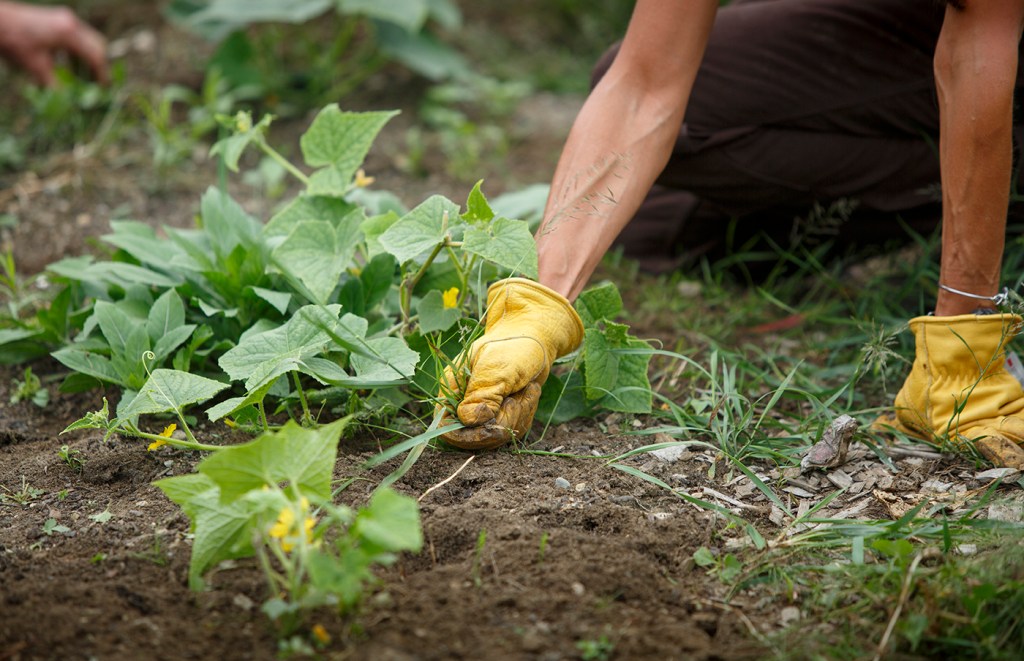
Suddenly, like fists punching the heavy bag, a burst of energy shattered my comfortable ennui. I was pumped, now, and strode determinedly into the front yard armed with, well, nothing but good intentions and a giant black lawn n leaf bag. First, I decided to tackle the remaining stems from last year’s little bluestem die-off. I wrapped some of the tall crispy brown stalks around my hands and began to pull. After about ten minutes, I had a large pile of dead grass blades which would have been much larger had I taken the wind into consideration. But no. Instead, I spent several unnecessary minutes and considerable energy gathering the leavings which were now strewn across the entire front yard, and wrestling the whole harvest into the huge, unwieldy bag. My hands had begun to hurt, par for the arthritis course, I thought, as I moved on to weeds. Becoming impatient, I commenced tugging at them without benefit of any tool, and in my haste, grabbed a large thistle that had hidden itself under a particularly expansive dandelion. That pain I couldn’t ignore and quickly let go to examine my damaged appendage. Tiny nettles were sticking out of several fingers. While plucking them gingerly out, I noticed numerous small bleeding cuts on my palms, courtesy of the razor-like blades of grass I had decapitated earlier.
Then it dawned on me. I’d forgotten about gardening gloves. I have three pairs. Well, one actual pair really, and a collection of unmatched, mostly left-handed, mystery gloves. But anything would have been better than bare-handing dangerous flora. Too late now, though. I was determined to uproot a quickly expanding bed of creeping charley from under the evergreens, wisely deciding to use a tool since I couldn’t locate any of those elusive gloves.
Onto my knees in the dirt I went, with a little claw-thingy which I thought might be good to scrape out the charley. It wasn’t. I only managed to dislodge a tiny bit before it became clear that 1) the tool I had selected was a cultivator, not a weed remover, and 2.) the amount which had grown up was overwhelming, and would require chemical treatment to control it, so I just gathered up my tiny harvest to deposit in the trash bag. It was then I noticed numerous cuts on my forearms and an alarming rash on the backs of my hands.
I forgot, I’m sensitive to evergreen sap, and really sensitive to sharp yew stems trying to hack the skin off of my body. The wet knees of my jeans reminded me that I hadn’t changed into old clothes for this task, so now my best pants had dirt and plant detritus ground into them which I could only hope would come out in the wash.
By this time, my back had begun to twinge and I was super sweaty. I decided to sweep up the sidewalk and head indoors to take my own advice and hydrate.
As I entered the bathroom to scrub up and splash some cold water on my cheeks before indulging in my lemon Le Croix, I caught an unfortunate glimpse of myself in the mirror. One more thing I’d forgotten. I’m allergic to early spring sun. Watching giant hives develop on my face, I really, really wished I’d remembered my hat.
Well that does it. The yard looks better (thanks mostly to my husband, and a little bit to me), but at what cost. In less than an hour and a half I have marred and disfigured my body, possibly ruined my pants, strained my back, and reminded myself once again, of my truly unfortunate habit -plunging into a project with no planning or equipment, always to my own detriment.
The thing is, I love gardens. I applaud people who grow beautiful plants and create appealing spaces. I admire them just because they enjoy gardening, and look forward to it.
They are lucky to be so gifted, and I‘ll drive around and enjoy the fruits of their labors every chance I get. But I‘m going to stick to houseplants, inside. They like me and I like them. As for working out of doors, no thank you. In the contest of gardener versus yard, the yard won. I am throwing in the trowel.
Faith has been writing to amuse her family since she was old enough to print letters to her grandparents. Now retired, she has the opportunity to share some personal stories, and in the process, discover more about herself. Faith and her husband live with an elderly cat in Madison, Wisconsin. They are the parents of two great sons and a loving daughter-in-law.
For the next month or so, True Stories Well Told is featuring writers I have met through First Monday, First Person, my “salon” for memoir writers held at the Pinney Branch Library in Madison.
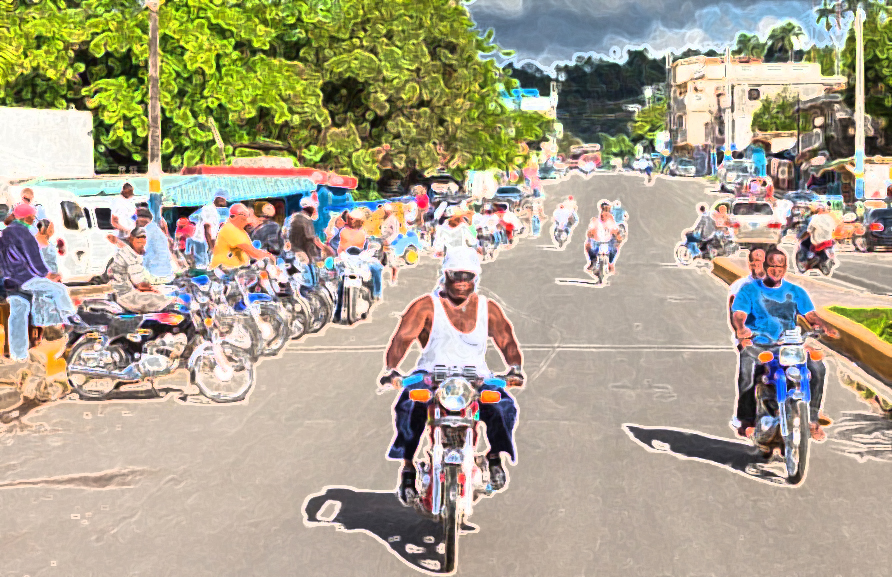
The most vivid memory I have of my trip to the Dominican Republic a few years ago was the constant whir of Los Muchachas (motorbikes) weaving in and out of traffic like swarms of angry wasps.
The Dominican Republic is a large island (the combined size of Vermont and New Hampshire), so we decided to rent a car so we could see as much of the island as possible. Driving in the Dominican Republic turned out to be quite the adventure as the roads are quire problematic and because of the ubiquitous presence of Los Muchachas (motorbikes). In fact, while we were careening along the island’s roads, I composed in the back seat of the car this little rhyme that depicted the experience.
Muchachas to the right Muchachas to the left Muchachas straight ahead Like harbingers of death Muchachas everywhere we looked If we don’t keep our eyes glued to the road Soon our gooses will be cooked
There were 4 to 5 motorbikes for every car. Our daughter, Danelle, did all the driving. I figured that her naturally aggressive driving style would be a good fit for the driving challenges. She said that driving in the Dominican Republic reminded her of driving in New Jersey. I thought of it differently. Driving in the Dominican Republic reminded me of one of those video games where you have to steer a car through a series of obstacles without crashing.
But let’s back up a bit. Danelle was already starting to express reservations about driving on the island a month before we left. She called me about the trip and, in a very concerned voice, she said, “My husband doesn’t want me to drive in the mountains in the Dominican Republic.”
“Oh, why is that?” I queried.
Danelle said, “Ryan knows a couple of guys who live in the Dominican Republic and they told him that bandits throw flaming tires on the mountain roads so they can stop you and rob you.”
“Oh,” I said again, taking her comments with a grain of salt because I knew her husband was a bit paranoid. “Then we’ll be careful not to go through the mountains,” I reassured her.
In actuality, we traveled through the mountains several times and never had a problem. But that was about the only thing that went right driving on the island. I’m glad we didn’t see an article on the “10 Countries with the Most Dangerous Roads” before we left on our trip. I saw this article on the internet about six months after we returned home. I was shocked. The Dominican Republic was listed as the most dangerous country in the world to drive in, based on the number of highway deaths per 100,000 population. After our experiences driving on the island, I wouldn’t question the veracity of this article.
The primary reason for this high death rate is the ubiquitous muchachas. There are a number of reasons for the prevalence of motorbikes on the island. First, the cost of gasoline was about $8 a gallon, so muchachas are a lot more economical. Secondly, the annual income is very low for most Dominicans and they cannot afford a car. Thirdly, the narrow, ill-maintained roads with no shoulders make muchachas a much more practical form of transportation.
Finally, as the trip progressed, we began to understand perhaps the most important reason for the prevalence of Los Muchachas. The motorbikes were only modest in size, larger than a motor scooter but smaller than a true motorcycle like a Harley. Yet most of them had multiple passengers. I even saw one motorbike with five people on it. Our second or third day on the island, we were walking on the streets of Cabrete when two muchachas stopped and asked if we needed a lift. It was then that we realized that muchachas were the primary taxi service, transporting people inexpensively all over the island.
Besides Los Muchachas whizzing past you in every direction, there were other hazards that interfered with safe driving. There were almost no road signs on the island. You almost never knew what the speed limit was or what hazards lay ahead. There were no center lines in the roads. In many areas, there were no shoulders on the roads. This made it difficult to swerve to avoid Los Muchachas and other obstacles because there could be a drop-off of several inches at the edge of the road.
The island also had road dips and speed bumps all over the place. But there were no warning signs. One day we were speeding along on their best highway, the only one equivalent to roads in the U.S. We came upon a bridge and Danelle did not see the speed bump. We hit the speed bump at 65 mile per hour. The vehicle was airborne like the General roadster in the Dukes of Hazard. Our heads hit the roof of the car. We were not injured, but we sure were surprised.
The travel literature was right. Driving in the Dominican Republic is a challenge. The question is, would we do it again? We would because we are now aware of the driving challenges. The Dominican Republic is a beautiful island with warm, friendly people. Many of the wonderful experiences we had would not have been possible without a rental car. But driving in the Dominican Republic is not for everyone. You need to have a spirit of adventure. But definitely visit the Dominican Republic, as it is the most popular destination in the Caribbean. Oh, by the way, if you go watch out for Los Muchachas!
Rich is retired from working for over 25 years in the biotechnology industry. He started spending more time on his writing this year with a particular emphasis on creative nonfiction.
For the next month or so, True Stories Well Told is featuring writers I have met through First Monday, First Person, my “salon” for memoir writers held at the Pinney Branch Library in Madison.
By Kaye Morgan
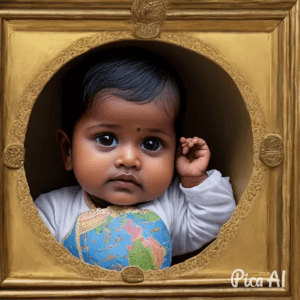
Illustration generated by AI
I have two adult children. My son, Ben, is the oldest and married to a beautiful and wise woman Julia, and they have two active and healthy girls, Elena and Eloisa. Ben is my biological child or a “homemade” child as they referred to it in adoption groups. Ben and his family live in Madison about 20 minutes from my home. My daughter, Sally, was born in India and came to our family through adoption. She is single and Trevor is her significant other. Sally lives in Washington, DC, but I visit her at least once a year and she comes to Madison several times a year. I also had a husband, Paul, who died last September. Of all the accomplishments Paul & I would talk about, our adult children were at the top of our list.
This is a very personal story. It’s a letter to my children. It’s filled with hope and happiness. I knew Father’s Day would be different this year for my children, so I did what Paul did for years: I told them the story of how Sally came to live with us.
Dear Ben & Sally,
Father’s Dad was never a big deal to Dad or me, yet I know this year will be different. Dad’s best work was being a dad and of course a husband! Every year he revisited the Father’s Day in 1980 when, at just nine months old, Sally, you came all the way from India and joined our family where we lived in Mosinee, WI.
Sally, we were so ready for you to join our family. When you were just two days old, our adoption agency gave us your picture and told us you were ours. We were so excited and made final preparations for your arrival. We had your room ready, clothes laid out, and the diaper bag all packed for driving to Chicago to fetch you!
However, given red tape and canceled flights, you didn’t make it to Wisconsin as quickly as we’d hoped. I remember being told there were two flights out of Trivandrum (the capital of Kerala) and we would hear by mid-week if you were on one, and that you would arrive in Chicago on a Sunday. After many setbacks and hopes rising and then falling, we were told you were on a flight out of Trivandrum to Madras. Yay! We didn’t think it would be long now. Unfortunately, you didn’t make the flight out of Madras. We were told you were in an orphanage and getting good care, but we felt so helpless and so very far away from you.
Father’s Day 1980 began as usual, but with a sadness permeating our souls. Ben, you were an active two-year-old, so after church we went to Mcdonald’s in Wausau where there was an indoor playland. We stayed there for a while, then went home to find something to keep us occupied. Once home, Ben, you decided to play outside with a zillion balls scattered all over the front yard. Dad was doing some work in the garage, and I heard the phone ring and went inside to answer it. I was shocked and beyond excitement! Our social worker was calling to say Sally was on her way and would arrive in Chicago about 9:00pm. I remember my first thought was that I hadn’t washed my hair that morning and I sure wish I had!
We quickly picked up the balls and must have been a bit loud with our excitement because our neighbor, Connie Schanowski, came out of her house and we told her and she clapped and said, “Hurray!” We grabbed the diaper bag and our packed bags of clothes as we knew we’d have to stay overnight in Chicago. Off we went in our big Ford van with Ben fastened in his car seat in the middle seat, Dad driving, and me in the passenger seat up front. I don’t remember what time it was when we received the call, but I do remember thinking, we don’t have much time to drive to Chicago!
Dad did all the driving to Chicago and I don’t remember much about the drive, but we made it on time. When we got close to O’Hare, we started talking about you and what you would be like. Ben chimed in with, “I can’t kiss her lips because they’ll be too small!” Somehow, when he met you, he kissed you on your head and immediately got out diapers and things for you from the diaper bag!
You went into my arms first and I remember feeling so thankful that you had made it and grateful for the many adults who cared for you and made it possible for you to be in our family. Dad held you too and when we got to the hotel, we changed you into one-piece pajamas, but I don’t think you closed your big brown eyes for very long during the night.
We had conversations with our pediatrician about your coming and he had recommended a brand of formula which you had no problem with. At breakfast, our first morning as a family, you watched with big envious eyes as I ate my scrambled eggs. I gave you a small bite and you loved them. I didn’t give you much as I didn’t know what you would tolerate.
I don’t have many memories of the trip back home to Mosinee, but the days and weeks that followed you showed us your beautiful personality, and Ben, you adjusted quite quickly to having a younger sibling.
After waiting nine months for you, Sally, your arrival and adjustment seemed easy, and it was! Our family was complete. We have loved you since the day we were given your picture and were told you were ours.
Kaye Morgan lives in Monona, Wisconsin, and writes about her life and family and other issues worth venting about! Her two adult children are the best thing she has added to this world!





 True Stories Well Told