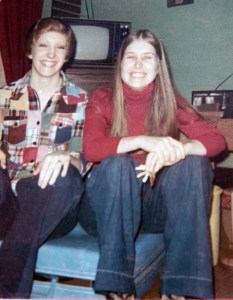
Friend and Virginia, just before this story takes place.
Like most kids, I had grown up eating peanut butter. Smooth or crunchy, alone or with strawberry jam, I did not care. My veins ran with the legume. At the time it was cheap and there were many lunches to pack. My mother tried to make it interesting, vary our peanut butter sandwiches using with different combinations: peanut butter and apple butter; peanut butter and chocolate bars, broken into pieces. Peanut butter and bacon. Peanut butter and marshmallow fluff. Every day a new peanut butter sandwich surprise. I loved them all. I was not ready to fall out of love with peanut butter in 1977.
It was June. Wedged into my moss green subcompact were my mother, my sister, and me as we set off on a journey from Pittsburgh to Oklahoma City. I was leaving home to join my new husband who was already there setting up our first residence in his home state. Not wanting me to make the drive alone, my mother and sister joined me, each planning to fly home after the car trip.
My petite mother was wedged into the back seat with items I had chosen to move myself piled high on the seat next to her. I completely disregarded that three adults and their essential luggage also had to fit in the limited space. My sister and I took up the front seat, alternating up to six hours apiece behind the wheel. A few times I spelled my mother and let her sit in the front passenger seat while I leaned my head on my red wool coat and took a nap.
By day three, we had grown weary with the long hours spent together in cramped quarters. Our conversations about interesting road side attraction signs, the weather in Oklahoma and would I acquire a twang in my speech had run their course. I did not mind quiet time, but my sister and I were not alike in that regard.
We were traveling on a particularly boring stretch in Kansas, the highest elevation an overpass, when my sister began telling us the plots of all the books she had read in the last year.
To be fair, I should have done more to contribute to the conversation. That might have put her off a bit, made her know that she did not have to fill in every empty moment with the sound of her own voice. After several hours of her “story time,” I was glad for the pit stop urged by the fuel tank dial showing close to “E.” As I pulled into the station, I remember thinking if I could stretch the stop, I would not have to hear about another book for ten minutes.
Fifteen minutes later, somewhat refreshed, we resumed our travels, this time my sister behind the wheel. From my purse I pulled out several packages of peanut butter crackers wrapped in cellophane and offered them all around. At least, if my sister were eating, she would not be talking. My mother peeled hers open and began to munch. But my sister waved away the offering.
“You know,” she said as she pulled back on to the interstate, “In the Book of Lists I read where there is a governmental quota for how many flies are considered acceptable in peanut butter as it is being packaged by the manufacturer.”
“What?”
My mother stopped chewing.
“It’s true! They can’t keep them out so the government tells them how many are allowed in a batch.”
I looked down at the unopened package of peanut butter crackers sitting in my lap. We broke up that day, peanut butter and me. The world has never been the same. As for my relationship with my sister, I have found silence to be the best approach.
Virginia Amis has published stories in Perspectives Magazine, Reminisce Extra, 2019, 2020, 2021, and 2022 Scribes Valley Publishing Anthologies, Beyond the Norm, Where Tales Grip, and Story Harvest, Linden Avenue Literary Journal, For Women Who Roar, several Writing It Real Anthologies and in 101words.com. Her characters are inspired by family, the extraordinary people she has had the pleasure to meet, and by the beauty of natural surroundings near her Pacific Northwest home.
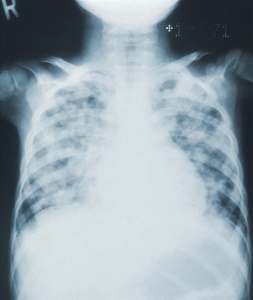
In 1955, Polio raged through the densely populated Montreal neighborhood in which I was growing up. The vaccine hadn’t yet become available in our Canadian province even though it was already being administered in the United States. No surprise, then, that this horrible disease was sweeping through every congested city in Canada like floodwaters into sewer-drains.
For two months every summer during my childhood, my parents rented a shack of a cottage one-hundred and fifty miles north of Montreal in the Laurentian Mountains. Our family joined other Jewish immigrant families for the summer exodus out of the city into Quebec’s rural villages that were distant enough to accomplish one goal: get children out of the city during the season parents believed was peak for contracting every life-threatening disease known to humanity.
These villages were close enough for husbands to leave Montreal on Friday afternoons, arriving in time for Shabbat dinners and an abbreviated three-day weekend with their families. It was the middle of July. Dad had just driven back to Montreal the morning before. Mom, Jake and I sat at the kitchen’s formica table ready for dinner.
“I can’t eat, Mom,” my brother groaned. “I can’t turn my head and it hurts too much to swallow. I’m going to cry!” His eyes filled.
“Maybe you’re just over-tired?” My mother suggested. “You know, you’ve been pretty wild since we got up here, much more than you are in the city.” Jake nodded, unconvinced. “How about I’ll make you some warm milk with honey and you’ll get into bed early?” He nodded. Two huge tears rolled down his cheeks.
Morning arrived and with it, Jake’s intensified symptoms. “Mom, I can’t swallow at all! I can’t even turn my head and it hurts much worse than it did last night. And my back is also killing me now!” His sobs increased. “My neck and back feel like someone’s ramming a rod into them.” He howled trying to describe his symptoms. “Could it be tonsillitis?” He asked, hopefully.
“Stay here, both of you!” Ordered Mom. “Don’t you dare leave this house. I’m going to the pay-phone at Rechard’s Grocery to call Dr. Ostrovich in the city.” She grabbed her purse and took off jogging down the gravel driveway for the one-mile trip to Rechard’s pay-phone. When she returned, Mom was flushed, breathless and sweat-drenched. But ger voice was surprisingly calm as she relayed everything Dr. Ostrovich had told her.
“Dr. O said it sounds like symptoms of that Polio virus. He wants you back into the city immediately so he can see you. He also said that treating you right away,” she continued, “means decreasing the chance you develop any problems.” Those “problems,” we learned later on, were serious risks of paralysis.
Because Dad wouldn’t be back out for three more days, we had no car. But Mom wasted not one second at Rechard’s. She didn’t call Dad. Instead, after she’d spoken with Dr. Ostrovich, she called the village’s only taxi and it arrived at our cottage seconds after she did. “Children, put anything you’ll want at home into my bag now! I’ve checked the train schedule from Shawbridge to Montreal but the next one isn’t until six-o’clock tonight. We’re taking a taxi!”
Only when we’d settled into the taxi’s back seat did Jake and I comprehend that we weren’t heading home. “Children’s Memorial Hospital, please!” Commanded Mom to the French taxi-driver. Worried he couldn’t understood her Romanian accented English, she repeated herself loudly.
“Oui, oui Madam!” He snapped, as though insulted. Rolling hills and lush green fields blurred past. The driver, sensing Mom’s anxiety, drove like a lunatic.
Upon our arrival, Jake was admitted to the hospital and taken, immediately, to the pediatric isolation wing. During our pre-cell phone days, Dad was stunned when his boss appeared in front of him at 2:00 pm and told him to leave. The hospital’s director had called the factory where Dad worked and insisted they give the rest of the day off.
One wall of Jake’s room was glass beginning three feet above the floor all the way to the ceiling—the front of a fish-tank. We could see each other but were forbidden any in-person contact. Mom, Dad and I visited daily through a glass wall. The mandatory barrier upset my parents but provided endless amusements for Jake and me. We pantomimed, mashed our faces against the glass and conducted games of charades.
Three days after he’d been placed into isolation, my brother developed breathing problems. His doctor raced into our part of the room and led us into the hallway.
In a near-whisper, he said, “I’m glad you were already here. Your son is experiencing serious breathing issues so the Polio team wants him to go into an iron lung for a few days. It should minimize stress on his chest and that can help his recovery.” He explained, then added, “He’s a lucky boy! His Polio is a milder strain than what we’ve seen so far!”
By the end of the second week we were back in the city, Jake was still at Children’s Memorial. His three best friends noticed our lights were on and rang the door-bell. “Hey, so what’s with Jake?” Asked Itsick Barsher.
“Is he really in the hospital?” Asked Franklin Feldman.
“Yeah, and why’s he there for so long, anyway?” Asked Melvin Mishkin.
“Yea he’s in the hospital. He’s supposed to stay for three weeks, maybe longer. Nobody knows.” I explained, feeling official.
“Why’s that?’ Itsick asked. “What are they doing to him?”
“He has to stay because he’s getting iron lungs.” I said.
“Yikes, iron lungs!” They exclaimed, simultaneously.
“What happens to his old ones? I mean, can he keep them if he gets iron ones?” Asked Franklin.
“Bet those iron ones are plenty heavy, huh!” Added Melvin.
“I didn’t even think about that when the doctor said Jake was getting iron ones. I’ll go ask my mother. For sure she’ll know!”
Afterword
Jake was released from the hospital at the end of his third week. Deemed non-contagious, his recovery was nothing short of miraculous although he did experience some slight paralysis of several toes. Considered temporary, he was prescribed physical therapy three times a week to expedite his recovery. This part of Jake’s polio proved entertaining for the two of us as well. Physical therapy consisted of lifting marbles with his toes. I was beyond excited to be included as a participant and upon arriving home after these sessions, we’d practice drawing with crayons held between our toes.
I received my Polio vaccine as soon as Jake was admitted to the hospital and he received his before being discharged. It wasn’t clear whether having Polio developed immunity to the disease. My brother recovered fully and has led a productive and extremely successful life except for one glitch in his story.
During the past two years — some sixty-plus years after the great epidemic, a significant number of those who’d recovered from juvenile Polio have begun to experience a range of very specific, painful symptoms.
Extensive testing has revealed a condition termed “post-Polio Syndrome.” All said, the long-term effects of viruses that lay dormant for most, if not all, of our lives, can and do reemerge unexpectedly— such as Chicken-pox and Shingles, Polio and post-Polio syndrome.
In an era when we possess the means to prevent so many horrible diseases, it’s beyond distressing that too many populations continue to question the value of inoculations.
Marlene holds a Ph.D., from University of Chicago. A research sociologist by training, she writes creative non-fiction by preference. Currently, she is completing her book entitled, Ask Mr. Hitler: A Memoir Told In Short Story. She is coauthor of The Seamstress: A Memoir of Survival, and author of When Digital Isn’t Real: Fact-Finding Off-Line for Serious Writers. Her essays and stories have been published widely in anthologies, journals, and online. (www.marlenesamuels.com)
It’s been awhile since I surfaced on the virtual page here at True Stories Well Told, so I thought I’d take a break from publishing others’ stories and show up myself.
I have Guided Autobiography workshops going on this summer. These workshops are organized around a sequence of themes that are common threads in the fabric of just about anyone’s life. The themes start in fairly neutral territory–things you might discuss with someone sitting next to you on an airplane–and progress to more personal topics as the group members build trust in each other and comfort with the writing process.
My groups are at the midway “pivot” where the more personal themes emerge. The stuff we’re writing can get dark. I share some tips on how to keep ourselves safe as we do what can be difficult work, digging in the dirt, hoping to find gold.
What’s the point? Why is this important work to do? Dr. James Birren, founder of Guided Autobiography, would frequently say, “Autobiography can be therapeutic, but it is not therapy.” Its primary purpose is not to cure or improve anyone’s psychological, social, or emotional problems. Even so, its principal product, in addition to written stories, is INSIGHT. And that’s why writing about the dark as well as the light is important work.
Writing about your difficult experiences can be good for yourself and good for others.
It’s good for you to get your story down on paper. It’s a way to familiarize yourself with your “narrative identity” — the story you create about yourself, peopled with heroes and villains, made up of major branching points that form the plot. You tell yourself a story of challenges overcome and suffering endured. With insight, you can find a resilient arc in that narrative. Like Shirley MacLaine singing “I’m Still Here” in Postcards from the Edge. you can glory in a battle won against a past that tormented you, that wanted you dead.
It’s good for others to hear your story. There’s more than one way to view life. Hearing how you look at your life stimulates others to see their own lives in new ways. It feels amazing to have others validate your view of an experience, and powerful to bear witness to others’ experiences.
So how do you go into the dark cave of memory and come back safe?
I recently found Tommie Ann Bower’s post “Conditions of Artistic Safety” on the Brevity Blog. It’s funny and wise–which reminds me that those are great characteristics to bring to your writing about your “dark stuff.”
Both posts are worth a look before you go into that dark cave. Come back safe–and bearing the “boon” of a gift for yourself and others!
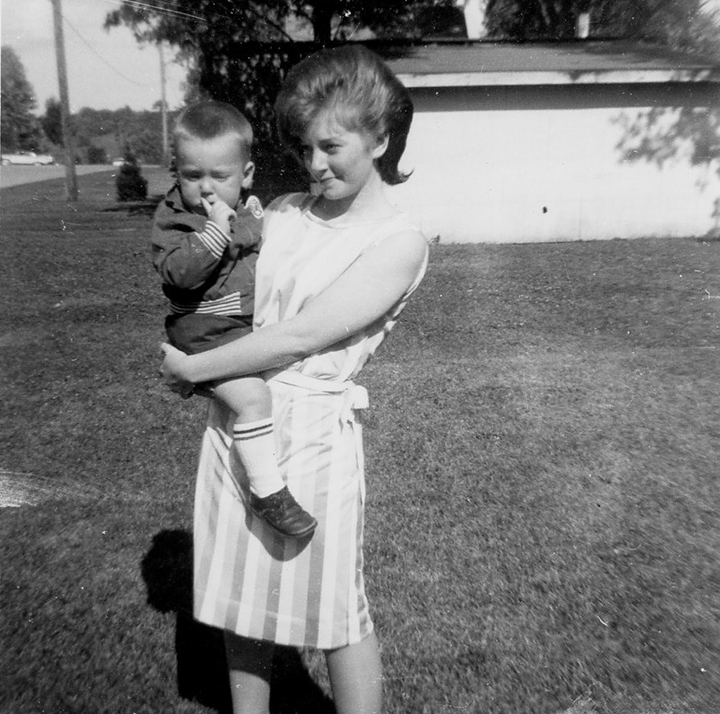
Bobbie with son Noel, 1963–about the time this episode took place.
Jack was a really nice guy. I don’t remember where or how we met. In addition to my regular job as a clerical worker at General Electric, I was working one night a week as a cocktail waitress on Rush Street. I probably met him there. We dated for about a year.
Jack was the day bartender at a popular restaurant in the Chicago Loop. His customers mainly consisted of high-flying businessmen working in the area. They would come in for lunch and seemed to appreciate his quiet, unassuming nature, and rewarded him well with tips. He would leave at the end of his shift with a pocket full of money that, in those days, he did not have to account for with the IRS. Hence, we could go out on the town in style.
Our favorite spot was the London House. One night we were there for dinner when the Ramsey Lewis Trio was playing. After dinner, we went to the bar to have another drink and listen to the music. And of course, one drink led to another. Now, as nice a guy as Jack was, he had one major flaw. He spent the day serving drinks, but when the drinks were being served to him, that nice guy turned into a sloppy drunk. I don’t remember what he did or what he said that night, but I remember being quite embarrassed by his behavior. When I noticed that we were getting a lot attention from other customers, I asked him for a dollar to tip the attendant and sought a brief respite in the restroom.
I spent a short time there visiting with the attendant. I was curious about her job and how she dealt with spending so much time in a little windowless room. She was quite friendly and interesting, but in time, the confined space became uncomfortable for me. I knew I would eventually have to go back to the bar, if for nothing else, to get cab fare from Jack to go home.
When I got back to the bar, Jack was gone. I panicked for a moment. I didn’t have enough money with me for cab fare, but the bartender told me Jack had just gone to the restroom. As I was sitting there waiting for him to return and hoping he was sobering up a bit, two men who had been sitting next to us approached me.
Now I was about 21 at the time and had recently moved to Chicago from a little redneck village in Wisconsin with a population of 540. Until my recent move to Chicago, I recall having had only very brief contact with just 3 or 4 people of color in my entire life.
I felt no racial prejudice or fear, but rather a fascination with a culture I had never been exposed to. But still being rather naïve, I was a bit uncomfortable when these two big, burly black men approached me. I soon learned that they were a part of Ramsey Lewis’s entourage. If I recall correctly, they were his bodyguards. They were very pleasant and expressed displeasure over the behavior I was being subject to by Jack. They indicated there was going to be an after-hours party at a private home and invited me to attend. I was quite hesitant of course, but they assured me it would be a safe and pleasant time. After all Ramsey Lewis would be there and he had a reputation and career to protect. He wouldn’t allow anything to occur that would jeopardize my safety or his career.
By the time Jack stumbled back to the bar, they had given me the address. The set was over, Lewis had come off the stage and was speaking to the men. It was obvious they were telling the truth about their relationship with him. I turned to Jack, told him I wanted to go home and to give me cab fare. He reached into his pocket and pulled out a wad of bills. I took the money, left him at the bar and went outside and hailed a cab. But I didn’t go home. I decided I wasn’t going to pass up the chance to party with a big celebrity like Ramsey Lewis, so I gave the driver the address the men had given me.
The cab took me to a house somewhere on the south side. I don’t recall where. When we got there, the cab driver said he was going to wait to make sure I got into the house safely as it was about midnight. I went to the door and knocked. A very attractive young woman, about my age, answered the door. She wasn’t terribly friendly, but I felt comfortable enough to wave to the cab driver signaling to him I was okay.
I walked into the house and was directed to the kitchen. I was quite surprised and taken aback when there at the kitchen table sat the London House restroom attendant. I don’t think I ever learned her name, so I will just call her Sadie. Sadie explained that this was her house. She introduced me to four young and very attractive women that lived with her. We sat and chatted for a while and soon Lewis and his entourage arrived. I sat there in awe, but also uncomfortable. I was so naïve, so unsophisticated, I simply did not know how to behave. Once Jack had referred to me as a “diamond in the rough.” Now isn’t that a left-handed compliment! Of course, it didn’t help that I was the only white person there. I didn’t know how accepting they were of my joining the party.
I soon noticed that the young women were getting very friendly with the men. Nothing terribly inappropriate, but a bit too intimate too quickly for my comfort. They had essentially paired off into couples. I must say that Mr. Lewis was not engaging in the intimate behavior. I sat there and just observed and followed the lead of others in smiling and laughing. I remained at the table with Sadie where she began to tell me how nice it was living in her home. How everyone got along well and had fun together. She offered an invitation for me to move in with them. And then it hit me. Another even bigger surprise. This was a brothel, and she was a madam trying to recruit me into her stable.
I held my cool and didn’t disclose that I had caught on to her plan. I don’t recall feeling unsafe, but I certainly was extremely uncomfortable. I thanked her for the invitation but explained I had a three-year-old son at home, which I did. And that I needed to stay where I was living as I had excellent childcare available there, which I did. I politely indicated it was getting very late and my babysitter would be worried. I really needed to get home to my son. I asked Sadie to call me a cab, and thankfully it arrived quite quickly. I said goodbye, thanked everyone for a nice time and got the heck out of there as fast as I could. But darn, I didn’t get Ramsey Lewis’s autograph.
(The song “Hit the Road, Jack” was written by singer Percy Mayfield and recorded by Ray Charles.)
Roberta (better known as Bobbie) Johnson had a difficult childhood lasting through her teens. Each month she would take some of her lunch money, buy a True Story magazine and devour every story. While not the best reading material for a teenager, it gave her comfort knowing her experiences were not unique and life would get better. Through her working years, she discovered she had a bit of a knack for writing. Now Bobbie writes her own true stories. Not about the pain but about the people in her life that gave her cherished memories. Memories to remind her that through it all, life was and still is good.
Joe A halada, Holly Halada Schmidt, Beth Halada DeMeuse, Dorothy Halada, Andrew Halada, Mark Halada
My dad died in 1983. My mom, after living on the farm by herself for six years with the support of all my siblings, decided it was time to sell the homestead along with the 40 acres it was located on and move to town (Algoma, Wisconsin).
The struggles of living alone in what was becoming a sparsely populated area along with grieving the loss of her husband made the decision easier. Most of the old neighbors have also passed on or moved to begin new lives. With the farm being about 5 miles from Algoma and now becoming more isolated, especially in winter, also hastened the move.
As I look back, I think us kids felt more sentimental than she did, as she was ready to move on. The fond (and maybe some not so fond) memories were not a practical reason to stay.
Cleaning out and sorting through things in preparation for the auction was tough, as again so many memories.
The day of the auction was very sad even though many relatives, friends and the remaining neighbors came to support us.
My dear friends Dennis and Debbie Anderson drove up from Port Washington and without me knowing, bought two wooden spoked grain drill wheels. Much to my surprise they gave them to me as a gift. The wheels are still prominently displayed on the side of our garage here in Madison. I think of the farm every time I walk by them.
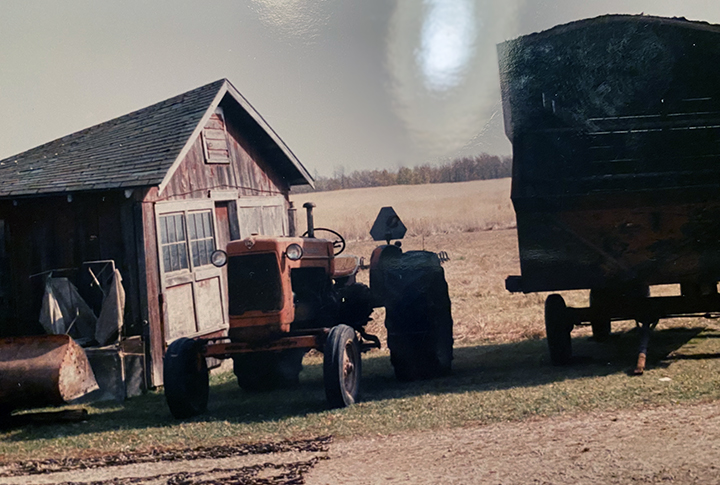
The hardest thing to see sold was our Allis Chalmers D-17 Tractor which our parents bought new in 1960. It was our workhouse tractor, which was our main tractor until the very last day. The purchase of this tractor meant the end of the line for our draft horses King & Nellie.
On the day of the real estate closing, I got up early and walked through the buildings for most likely the final time. I took pictures of the milkhouse wall where we, as well as friends and family, wrote or carved things, mainly initials and dates. I then etched into the wall for the last time my initials AAH and 11/30/1989.
It was a melancholy time and I moped around for a few months feeling sad about selling what was a big part of our life. The sadness passed after seeing how happy my mother was, living in town in a house she loved and was proud of.
One can only imagine the heartache those farmers and families felt who lost their farms due to the agricultural downturn of the 198’s.
As a side note, my wife and I bought my mother’s house in town to preserve these memories with the idea of keeping our Algoma roots together and having the family gather with ease. So far, the goal has been met.
A farm boy at heart, Andrew Halada grew up in rural Algoma, Wisconsin on a 120-acre dairy farm that also had pigs, chickens, and a small apple orchard. He attended UW River Falls with a Major in Agribusiness and a Minor in Animal Science. Andrew retired from the USDA Farm Service Agency in 2019 after a 40-year career. Writing short stories has always been an interest and he has taken a few writing classes the last few years.
I have known Marty since the early 1970s; he’s a key member of my chosen family. When he shared this reflection with Facebook friends earlier this summer, I asked if I could publish it here. Thank you, old friend!
May 2023 — Hi all, I have been pretty quiet on social media for a while and haven’t said anything about my diagnosis, not because I didn’t want people to know, but more because I didn’t really know what to write. Many people around me know (there is a good gossip network here), but I guess it is time to tell people who don’t know, and as importantly, let people who do know from the gossip network that it is OK that they know and can talk with me about it if they want.
I finished a 6 week radiation therapy last week and finally wrote this reflection. I have been told that it isn’t overindulgent and is actually a decent read, so here is my reflection on being diagnosed with prostate cancer:
Marty Laubach in one of his Happy Places
I have found in the last few years of meditation that when I am experiencing pain I go into a meditative state and “embrace the pain as a part of the ‘human experience.’” My thought is that when I am on my death bed facing corporeal oblivion, would I trade 5 more minutes of life if it meant re-experiencing that pain? That thought first helped me through a root canal in 2018, and more recently through the last 6 weeks of radiation treatment for prostate cancer. It follows a narrative that I have been developing while reflecting on the twists and turns of my life, which is that I am here to experience (verb) the “human experience (noun).”
This essential human experience reflects the body/mind duality, but my recent life exposes the blur between them. The cancer and treatments are certainly an embodied experience, except that I have never actually felt the effects of the cancer. This whole incident has been mental – and in this case specifically social. I have been told by socially credentialed authorities (doctors) that a part of my body is … well, rotting … because of a set of numbers. My PSA was 8. The first biopsy gave me a Gleason score of 7 and a “stage II,” the second biopsy gave me a Gleason score 8 and found that the rot had moved from the prostate to the seminal vesicle, raising me to “stage III.” On the basis of these numbers I have been taking these pills for the last 8 weeks and for the last 6 weeks have been laying on a platform while a machine revolves around me twice making a screaming sound of a 1960s sci-fi ray gun as it burns my internal organ into scar tissue. But again, all of this is mental – I haven’t “felt” a thing from the cancer.
My embodied experience has been all about the treatment. The “hot flashes” that have estranged me from trusting my interoceptive sense of body temperature, and the “bladder full, bowels empty” imperative that scrambled my body’s intake and elimination cycles and estranged me from trusting my interoceptive sense of my elimination needs. And then, there is the loss of stamina that has come from the elimination of testosterone that is the point of the pills.
All of these numbers have mediated between the “me” of everyday experience and the underlying, unsensible state of my body.
This is the same numerical mediation that our technological culture has created between humanity and nature. It is the principle we discuss in the sociology of science that when a credentialed authority pours a test tube of goo into a beaker of glop and it fizzes and turns green, then it is assigned some kind of meaning about the underlying nature of the universe. Or worse, when the European Union spends millions of euros to build a machine that spins nuclear particles around a miles wide loop, crashing them together to get some photographic streaks in a bubble chamber and readings on instruments, and then declare that they have “discovered” the “God particle” – which really just means that their instruments gave the reading that their esoteric math predicted – math derived from their theories about the underlying nature of the universe.
As above – the God particle – so below – the scarification of a cancer infested organ in my body.
All of these numbers, narratives, and moments from my part of the “human experience.” Would I trade it all for 5 more minutes of life on my death bed? Well … I certainly traded these last 8 weeks for the hope of another few years.
At least the number reinforced theories of the underlying nature of the universe produces nice computer toys for me to play with.
Marty Laubach is closing in on retirement as a Professor of Sociology at Marshall University, his third career after Computer Programmer and Data Processing Manager. His research focuses on spiritual experiences, in particular by members of minority religious communities in the US like American Neopaganism and Buddhism. Marty has waffled between being health conscious and not, sedentary and active, carnivore and vegetarian (settling on flexitarian).
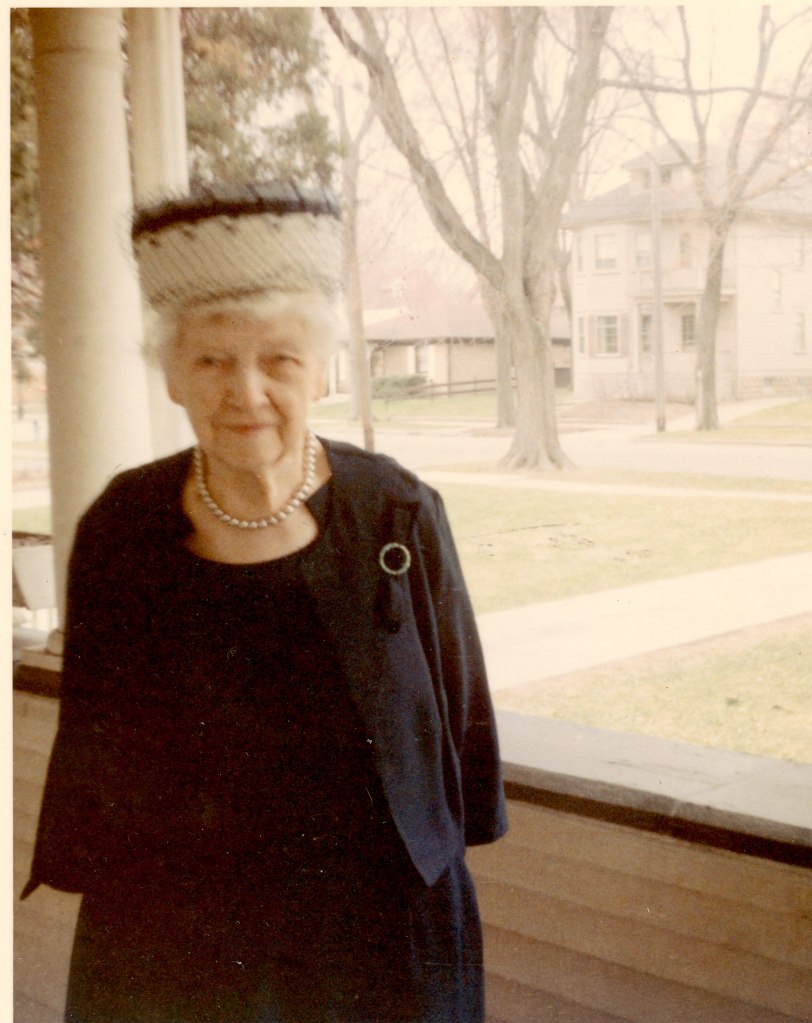
Grandma was standing on the front screen porch of our house at 5th Avenue in Kenosha. She was so cute. Mike’s Deli was across the street to the right, sadly just out of the frame.
Late Spring of 1966. My brother and I had just returned home from college, Jim from Ithaca, New York after a wildly successful second year at Cornell University and I from UW Whitewater where my first year of higher education had been slightly less triumphant, in that I was unlikely to be invited back. But no matter our wildly divergent academic styles, Jim and I, barely a year apart, were great friends. We really enjoyed each other’s company, and now, 19 and 18 respectively, were able to go out together and revel in what I considered the only redeeming aspect of our family’s abrupt move from Illinois to Wisconsin-TEEN BEER BARS!
What an awesome concept! Although you had to be twenty-one to purchase beer in town, it was perfectly legal for any 18 year old to drive miles out into the countryside, where beer bars were located, spend several hours at Dick’s or Rasmussen’s, or the Brat Stop drinking quarts of what was purported to be 3.2 beer, then get into a car and drive home at breakneck speed in order to make curfew. Crazy. But it was accepted, lawful, and everyone did it. It went almost without discussion that Jim and I would be part of this weekend’s great migration of teens to the outskirts of town.
Jim found me on the porch smoking a cigarette.
“Want to go to Dick’s tomorrow?” It was more of a statement, than a question.
“Of course, if you can get yourself ready before bar time!”
Jim was notorious for his late starts.
“I knew that was coming.” He did not sound remotely repentant.
Just then, the porch door squeaked and Dad appeared.
“Oh, there you are. I wanted to ask you something. Your sister invited us to visit her in Urbana this weekend, and your mother promised her we’d come, so would you stick around home and wrangle Thomas and Grandma for us?”
Serious bummer! We were so looking forward to our inaugural summer outing, but really, what could we say. Our parents had just paid for a year of college for each of us, our 15-year-old brother required someone to ride herd on him and Grandma, at 90, was losing her sight and needed our help. Also, my grades hadn’t arrived yet and I felt It would be better for me in the long run if I showcased my earnest, helpful side prior to the big reveal. Of course, we agreed.
“I know you were thinking about going out, but I’ll provide you with some beer here, so maybe your weekend won’t be a total loss.”
Dad, who himself, enjoyed a frosty pilsner from time to time, was trying hard to sweeten the deal, bless his heart. Of COURSE, we agreed.
Early Saturday morning, Jim and I waved our parents out of the driveway, fixed Grandma some oatmeal and a cup of Nescafe for breakfast, warned Thomas not to leave without letting us know, and went back to bed. I rallied at around 11 to a strange clanking sound,
“What’s that noise?” I yelled to no one in particular as I stumbled into the kitchen.
Grandma was standing at the sink looking distressed.
“I think a hairpin might have fallen into the disposal. I was trying to get it out.”
Oh lordy. Mom had pretty much forbidden Grandma to do the dishes now that her vision had become so poor. But Grandma was a bit of a rebel. She liked to help, and if Mom wasn’t there to stop her, she’d do what she wanted, even if it meant grinding a finger off in the disposal.
“Here, let me try. I’ll use a pliers.”
A few wiggles and the hairpin was extracted.
“Please don’t tell your mother, she’s always worrying that I’ll hurt myself.”
Obviously, I would never rat out my beloved Grandma.
“I won’t. No harm done. Let’s get some lunch.”
Jim, never a morning person, must have heard the word “lunch” and appeared in the kitchen just in time to intercept Thomas on his way out the door.
“Going to Joes’, Tom announced. “OK?”
Jim nodded from behind the refrigerator door, where he was eyeing several Tupperware containers.
“Hey, is there any leftover spaghetti?” he asked hopefully.
“I don’t know. Grandma and I had fried egg sandwiches. You’re on your own.”
Soon I heard, “Yumm-o, I love this stuff,” accompanied by the sounds of slurping and a fork scraping glass.
“Didn’t you heat that up?”
“No. I like it cold. Is there any French bread left?” There wasn’t.
Grandma decided to go play the piano. She had once been a music teacher and could still play by ear. “My eyes aren’t so good, but I have nimble fingers,” she would explain virtually every time we complimented her skill.
After she left the kitchen, I told Jim I needed to talk to him.
“Got a minute? I need your advice.”
“Is it about school?” He knew me all too well.
“I’m afraid so.”
“Oh. OK. Let’s talk about it after supper. Everything’s better with beer and popcorn, right?”
“True.” I sighed. “It’s probably just as well we’re not going to Dick’s tonight”.
I spent most of the afternoon reading “The Screwtape Letters” and anxiously checking the mail, while Jim called a couple of old friends and practiced Kingston Trio songs on his guitar. By supper time, I had determined that my grades would not be coming until at least Monday, a brief reprieve, anyway.
At 6:00 PM, we prepared a meal of Kraft Dinner, hot dogs and sliced tomatoes, which Grandma sprinkled liberally with sugar. No one knew why, that was just her thing. We skipped dessert.
Dinner complete, Jim helped Grandma up to her room to catch a rerun of “My Three Sons” and Thomas retired to the basement to work on a ship model.
I loaded the dishwasher and suggested to Jim that he check to see if the beer was cold.
“Where is it?” he queried, after not finding it in the refrigerator.
“I don’t know. Where he usually keeps it, I guess.”
“Oh yeah.” He checked the broom closet where Dad often stored an extra six-pack or two for his poker nights.”
“It’s not in there.”
“Try under the workbench in the basement.”
“Don’t see anything there either.”
We knew he wouldn’t lock beer in the liquor cabinet, but we combed the rest of the house. Nothing. Not so much as a bottle cap. Then it dawned on me.
“Mom was in such a hurry to get going, he probably forgot to buy any.”
“I bet you’re right. I guess we’re just screwed.”
“Yeah, so much for our great evening.”
It couldn’t have been more frustrating. Mike’s Neighborhood Deli was directly across the street, liberally stocked with cases of beer we were just barely too young to buy.
I flopped down on the couch in despair, and frowned at Jim who was suddenly and inexplicably smiling.
“What’s so funny?” I snapped.
“Hey, Grandma loves Bun Bars, doesn’t she?”
“You know she does. It’s about her favorite thing ever. What does that have to do with anything?”
“Well, GRANDMA’S old enough to buy beer. What if we asked her to go over to the store and get us some. We could treat her to a Bun Bar!” Jim had not been valedictorian for nothing.
“Bribe her, you mean. Well, I suppose we could try. I don’t know if she’ll go for it, though. It’s awfully late. You better ask her.”
Necessity – the mother of invention. Or possibly – the Grandmother of invention.
Jim’s eyes twinkled. He knew Grandma would do anything for him. And she loved the chance to be a little naughty. She was ready in five minutes.
So at 8:55 on Saturday night, our “innovative” solution to the dreadful prospect of a beer-free weekend was playing out under a street light for all the neighbors to see, and believe me, they were always tuned in to the high school principal’s kids.
Tonight’s special episode featured Jim and me each supporting an elbow of our fragile 90-year-old white-haired Grandma, as she stepped spryly out the door of Mike’s Deli in her pale blue coat and matching pill box hat, cradling a six-pack of Pabst Blue Ribbon in her arms, sad sporting a little Mona Lisa smile.
Faith has been writing to amuse her family since she was old enough to print letters to her grandparents. Now retired, she has the opportunity to share some personal stories, and in the process, discover more about herself. Faith and her husband live with an elderly cat in Madison, Wisconsin. They are the parents of two great sons and a loving daughter-in-law.
We were about as far away from home as you could get. The other side of the world to be exact. It was 2008 and we were moving to Hong Kong! I was trying to get into the spirit, but at that moment I was exhausted and I really wished the airline hadn’t lost our luggage.
I spent the last 13 hours on a plane trying to figure out how I was feeling about our next move to Asia. It was pretty much a done deal and this trip was meant to woo us and find housing. The business class tickets and endless supply of champagne certainly helped the trip along, but I was unsettled and John was starting to look a little pale.
Just 10 months earlier we arrived back from our first experience living abroad in Amsterdam. It was a total surprise and only lasted for six months. I had just been downsized from my job and my dad had passed away. It was if the Universe was telling me I should go away and eat pastry. So, I listened. Being in Amsterdam, and Europe in general, was like living in a snow globe. Everything was so cute and cobblestoned. All I needed was a scarf to transform me from an American to a Dutch local sitting up straight on my rusty bike, dinging my bell. Knowing we only had a few precious months, we wasted no time jumping between bakeries, museums and bars. We traveled almost every weekend to see everything we could and soak up beer and the culture. My mind, and my waistline, were expanding beautifully.
This, however, was not Amsterdam. As we realized the baggage carousel was not going to produce our luggage we went through the necessary steps in the hopes it was somewhere nearby. I only had the clothes I was wearing, magazines and sleeping pills in my carryon, none of which was going to be of any use that night. A rookie mistake! It was late, I think, or at least it was dark when we stepped out to get a cab to our hotel. The air was steamy and you could still feel the heat coming off the walkway and building. The airport is far off on Lantau Island so there was not a lot to see at first. I stared out the window to get my first glance of the city. As we drove closer to the city, the lights became brighter, the buildings soared taller, and the streets were buzzing. It seemed quite like most big cities I had been in except many of the signs were written in Cantonese reminding me I was somewhere else. It was late but the city was still awake and I could feel it. My eyes were too tired to take it all in and I fell asleep as soon as my head hit the pillow. I didn’t even mind that I had nothing clean to sleep in.
The next morning, our company appointed tour guide and driver whisked us away at 9:00am. Since our luggage still hadn’t arrived, I was wearing the same tired travel clothes with the same tired underwear from the day before and no makeup. Not exactly how I wanted to be introduced on my big first date with Hong Kong. I felt like a teenager being dragged against her will on a family vacation. I rolled my eyes and faked a smile.
We took off in the van and the city flew by. Skyscrapers everywhere, concrete, steel, billboards, octopusing highway intersections with cars above us, below us and all around. Our guide kept talking and asking us questions and pointing out different parts of the city, “How was your flight?” “Are you excited to be in Hong Kong?” Our driver, on the other hand, didn’t speak any English, but he would point out the window and say, “famous tree.” I didn’t know how to respond to any of it.
First stop was a beginner’s orientation of Hong Kong at their office. It was a Cliffs Note presentation highlighting the history of their city and holding up maps outlining all the different areas where we might like to live. My favorite souvenir was a red Welcome tote bag with brochures and a handbook outlining the different weather warning signals. We were told what to do if there was a typhoon and to get home as soon as possible when the rain warnings started. You had to get through 3 levels of rain warnings before the typhoon even started. There was the amber, red and black rain warnings. Even though I still wasn’t totally sure what a typhoon was, I knew I better get moving before they shut down the trains and people started going crazy. I had no idea what was going on. And now I was very worried about typhoons, something that wasn’t even on my radar until that very moment. I dug through my big red Welcome tote bag looking for assistance and a cup of coffee, but alas I was on my own.
We spent the morning whipping around town looking at apartments and “famous trees.” It was rush hour all day on the roads and on the sidewalks. Right before I was about to have a tantrum, we headed to a hotel for our driver’s mandatory lunch break. Finally, we sat still. Our lunch arrived on plates full of fluffy, steamy dim sum buns with salty sauces and mystery ingredients. We washed it all down with jasmine tea. Sustenance for what would lay ahead. The tea kept flowing and so did the questions.
The afternoon was a repeat of the morning, except now we were on the Kowloon side across the harbor from Hong Kong Island. It was even busier and had even more people to weave through. Everything was piled on top of each other, the buildings and the people. There was no oasis. John was starting to turn green and I knew I felt like he looked. Finally, we were back at our hotel. Our luggage still had not arrived, and I would not get any comfort from a fresh pair of underwear.
I can count on one hand the times that John has been really sick, but even he had succumbed to the weight of the day. But he also knew he had an overwhelmed wife on his hands and tried to rally. His courageous offer to go out on the town was shot down much to his relief. I tucked him in bed and went up to the rooftop restaurant by the pool for dinner. I wanted to be alone.
I quickly found a place at the bar and ordered a glass of cold white wine. That went down quickly and I ordered another one. As the wine started moving through my veins I looked out at the skyline. I sat back in my chair and allowed my body to finally relax. The city was still for the first time. From my rooftop perch at the JW Marriott, I was not distracted by the chaos below. The city smelled like exhaust, humidity, ocean and chlorine. I could just see the tops of towering building begin to light up in the dark. The sun was setting over the ocean and the solitude of being on a little island looking out over the vast world helped put things in perspective. This was going to be my new home. It was time to let that sink in.
When we awoke the next morning, our luggage had arrived.
Sue loves to write about her adventures living abroad, traveling, and the challenges of making it all happen from one day to the next. Currently, her exploits keep her closer to home with her husband and twin children living in Madison, WI.
I’ve never felt more excited about going out. Nineteen months inside.
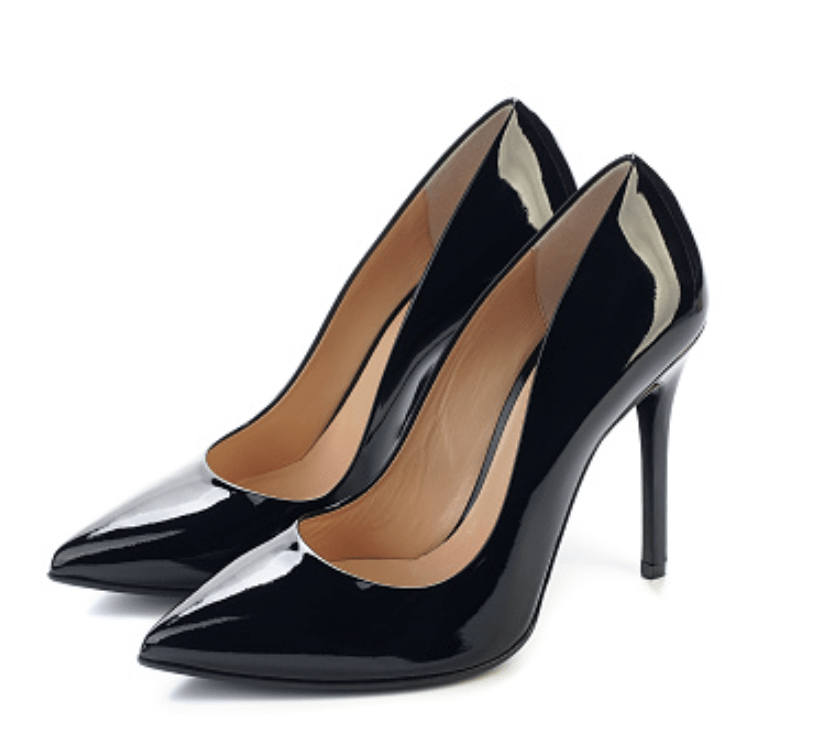
“OOH, my black stilettos. I can hardly wait to wear them again.”
Shoe: “I shouldn’t care. If you want to break your neck, it’s your choice”.
Me: “Well, you don’t need to be rude.” Why am I talking to a shoe?
Shoe: “Not rude. Realistic. You chose those “stilts” over my comfy, memory foam, rubber-heeled, particularly chic and beautiful tan flats once before. Really. Think about the last time you made that choice.”
Me: “You are always bringing that up.”
Shoe: “Duh. Remember? Memory foam?”
Me: “I thought that was just to help me walk more comfortably.”
Shoe: “You can be so clueless sometimes. Are you forgetting the snapping sound your right ankle made when you fell? The painful ride to the emergency room? The nasty-smelling cast that was put had to wear? Or how your leg began to itch so bad you were using a hanger to get under it and scratch? How about how you had to go up and down the stairs on your butt?”
Me: “Must you remind me of every detail?”
Shoe: “Memory foam.”
Me: “Yea, right.”
Shoe: “So, put those shoes on.”
I put them on.
Shoe: “Now, walk across the room.”
Me: “I don’t know what’s your point, but I’ll do it anyway.”
I wobble across the room, trip on a rug, and hear my left ankle snap
Shoe: “Told you so. Remember to bring only my right one when you leave for the emergency room.”
“Wake up, Pat. We are going to be late.” Shouts my husband. How long have you been asleep in the closet?”
I grew up in a community almost entirely devoid of old people — those who might be considered “grandparent” age. My understanding of “grandparent” was so totally confused and distorted that the concept and title resulted in endless disappointments during my young life. Oddly, most stemmed from my best friend Ruthie and Ruthie’s Zaidie (grandfather).
In all fairness, my sheltered life and limited exposure to the world beyond our “shtetl-like” St. Urbane neighborhood of Montreal had informed my convoluted beliefs. My brother and I had no grandparents. Well, actually that statement is somewhat ridiculous because, of course, we did have them but never knew any of them. They’d all been murdered in the Nazi death camps during World War II.
Two distinct populations made their homes in our old neighborhood: Québécois French laborers and Jewish Holocaust survivors. And just like my family, the survivors who’d emigrated to Canada after being liberated from the camps had been denied visas into the U.S.A.
Ruthie Whitefish was my “bestie” from the time we were old enough to walk and talk. We had more than our girlfriend interests in common. Her family was a mirror image of mine: her dad was from Poland as was mine and Ruthie’s mom was Romanian just like mine. And Issey, her brother, the same age as mine, had also been born in a D.P. Camp (Displaced Persons’ Camp) in Germany exactly like mine. Only one feature of her family was dramatically different: Ruthie had her Zaidie.
This bearded, highly pious, old Jewish man was the epitome of what I believed was a Zaidie. To us children, he appeared beyond ancient — Moses incarnate. In view of my current advanced age, I’m fairly certain the man couldn’t have been older than sixty-five at most.
Ruthie adored Zaidie and Sylvia, her mother, catered to him constantly. In fact, all members of the Whitefish family felt honored that the old man was a boarder in their flat. Just as wonderful: he was thrilled to be living with the family. He adored the children and treated them as though they were his biological grandchildren. On weekdays, when Ruthie arrived home from school and her mom was still at work, Zaidie eagerly waited my best friend.
As soon as she walked into their flat, she headed into the kitchen. There, at the kitchen table, Zaidie could be found studying his Hebrew texts. And there, on the table across from him, centered on the bottle-green glass plate, sat a butter and raspberry-jam sandwich he’d prepared for my “bestie,” crusts removed! And next to the plate? A half-glass of chocolate milk.
On my lucky days, I was invited to go home with Ruthie and on those lucky days, Zaidie placed two plates, two sandwiches, and two half-glasses of chocolate-milk on the table. “Sailboats or boxes?” He asked Ruthie without variation. He held a long breadknife over one of the sandwiches after he’d removed the crusts.
“Today, I want sailboats! Don’t you remember, Zaidie? Yesterday,” she announced, “was boxes.” Zaidie nodded, rested the blade atop the sandwich, cut it in half on an angle, then in half again. His creation: four triangle-shaped mini-sandwiches. Next, he turned his gaze toward me. Again, his knife hovered above a sandwich. “And you, ziesekleine Maydalah (sweet little girl), sailboats also?”
“No, I like boxes.” But looking back, it really made not a bit of difference to me since I was beyond ecstatic watching him create my butter and jam boxes.
Yet whenever I’d been so lucky to have been included, I’d also been plagued by an indescribably intense jealousy. Besides Zaidie making after-school snacks for Ruthie, the two of them played games together — checkers, tic-tac-toe, hangman—and they worked on her homework. The old man also took Ruthie and Issey to matinee movies on Sundays. Sometimes the three of them took the streetcar to St. Catherine’s Square and even to the top of Mt. Royal Park to feed the ducks.
More than anything, I became desperate for a Zaidie of my very own. No longer did I express interest in a dog or cat. I had evolved! It was a Zaidie for whom I longed in no uncertain terms — an old man who might live in our house and do all the things with me that Ruthie’s Zaidie did with her. It was the one thing I wanted more than anything else in the whole world.
What I could not know was that none of our survivor parents’ parents had made it out of Europe. Consequently, the Jewish Federation of Montreal had established a program similar to foster care but instead of a program for children, it was for those rare elderly survivors who’d lost everyone. Jewish families were given cash stipends for providing room and board in a family environment to those elderly. And that was precisely how Ruthie Whitefish got her Zaidie. He arrived at the Whitefish’s home just about the time Ruthie had begun to walk and talk and he never left.
One particular Sunday, Ruthie and Zaidie were headed to see the newly released movie, Lassie Come Home. I’d not been invited to join them. And it was on that exact day I knew the time had come. I burst into my mother’s workroom, shouting above the noise of her sewing machine. “Mom, Mom, I have to talk to you! It’s important!”
“What is it? What’s happened?” She shouted back, her feet still working the machine’s heavy pedal.
“Mom, you know that Ruthie has a Zaidie, right?”
“Of course I do.”
“Why does she have one but we don’t?”
“Have one of what?” Mom asked. She didn’t understand what I was asking. “A Zaidie, that’s what! Why can’t we get one of them? He could live with us and do the same kinds of things with me that Zaidie Whitefish does with Ruthie? He could live in the extra room next to our kitchen!”
Mom was rendered speechless. I truly believed that Zaidies (Bubbies, too) were religious old Jews who came to live with Jewish families in extra rooms, did fun things with the resident children, and possessed quantities of books all in Hebrew.“Mom, Mom, did you even hear what I said?” I was shouting at her.
“Let me talk to Daddy about this. We’ll see.” She whispered, staring through her workroom window onto the street.
I waited for my mother’s response. But I never did see. During the last decade or two of my life, a period when so many close contemporary male friends have morphed into grandfathers, I’ve finally realized that for most of my younger life, I actually suffered from a serious case of “Zaidie Envy”.
Marlene holds a Ph.D., from University of Chicago. A research sociologist by training, she writes creative non-fiction by preference. Currently, she is completing her book entitled, Ask Mr. Hitler: A Memoir Told In Short Story. She is coauthor of The Seamstress: A Memoir of Survival, and author of When Digital Isn’t Real: Fact-Finding Off-Line for Serious Writers. Her essays and stories have been published widely in anthologies, journals, and online. (www.marlenesamuels.com)






 True Stories Well Told
Musing on Why We Write “the Dark Stuff”
By Sarah White
It’s been awhile since I surfaced on the virtual page here at True Stories Well Told, so I thought I’d take a break from publishing others’ stories and show up myself.
I have Guided Autobiography workshops going on this summer. These workshops are organized around a sequence of themes that are common threads in the fabric of just about anyone’s life. The themes start in fairly neutral territory–things you might discuss with someone sitting next to you on an airplane–and progress to more personal topics as the group members build trust in each other and comfort with the writing process.
My groups are at the midway “pivot” where the more personal themes emerge. The stuff we’re writing can get dark. I share some tips on how to keep ourselves safe as we do what can be difficult work, digging in the dirt, hoping to find gold.
What’s the point? Why is this important work to do? Dr. James Birren, founder of Guided Autobiography, would frequently say, “Autobiography can be therapeutic, but it is not therapy.” Its primary purpose is not to cure or improve anyone’s psychological, social, or emotional problems. Even so, its principal product, in addition to written stories, is INSIGHT. And that’s why writing about the dark as well as the light is important work.
It’s good for you to get your story down on paper. It’s a way to familiarize yourself with your “narrative identity” — the story you create about yourself, peopled with heroes and villains, made up of major branching points that form the plot. You tell yourself a story of challenges overcome and suffering endured. With insight, you can find a resilient arc in that narrative. Like Shirley MacLaine singing “I’m Still Here” in Postcards from the Edge. you can glory in a battle won against a past that tormented you, that wanted you dead.
It’s good for others to hear your story. There’s more than one way to view life. Hearing how you look at your life stimulates others to see their own lives in new ways. It feels amazing to have others validate your view of an experience, and powerful to bear witness to others’ experiences.
So how do you go into the dark cave of memory and come back safe?
I have posted about this some time ago on this blog. Have a look at “Two tips on “dealing with the dark”.
I recently found Tommie Ann Bower’s post “Conditions of Artistic Safety” on the Brevity Blog. It’s funny and wise–which reminds me that those are great characteristics to bring to your writing about your “dark stuff.”
Both posts are worth a look before you go into that dark cave. Come back safe–and bearing the “boon” of a gift for yourself and others!
If it feels like something you’d like to publish, feel free to submit it to me for this blog. You’ll find guidelines for submissions here.
© 2023 Sarah White
Share this: