November 1, 2011

By Jay Akin

It’s 9 AM on a Tuesday. I’ve never been in so much pain in my life! I’ve never broken a bone or birthed a child so I don’t have those as reference points. The next level of agony that I have experienced was probably my wisdom teeth at nineteen or tonsil removal at seven. I had some rather strong drugs to help me those times. So far I’ve been alternating between ibuprofen and acetaminophen every four hours and it’s doing nothing for me. I guess the pain would be even worse without them. Dr. Weaver will fix me!

This all started on Saturday night. Well, that’s when the pain started. The concept that led to the pain started about a week earlier when I was dead set on winning the costume contest at work. I went to Joannes Fabrics for the material and the foam for the headpiece. Do you know how difficult it is to find a hula hoop around Halloween? I found some thick tubing and duct tape at Menards. It’s going to work!

I recruited my ten-year-old to help me with gluing the headpiece and cutting the arm portions while I iron the adhesive tape to the main garment. I probably could’ve borrowed a sewing machine from someone but this worked.

“This is going to be crazy!” my daughter, says as she uses the hot glue to get the headpiece just right.

“Crazy awesome! Am I right?” I put my hand up for a high five but she’s focused on her gluing. I don’t want her to have a core memory involving a hot glue gun and being distracted so I slowly put my hand down. “Are you excited for your party tomorrow?” I ask.

She shrugged her shoulders. “Mom says I don’t have to stay the whole night if I don’t want to.”

“That’s right. Just give her a call and she’ll pick you up.”  I plan on drinking heavily tomorrow so her mom has rescue duties. Alexis has still not forgiven me for rescuing her last time. I didn’t realize nine-year-olds hold such a grudge!

We finish up the costume and try it on. “You. Look. Ridiculous!” She exclaims. I did the special “dance” and she busted out laughing. “You’re going to win first place for sure!” I got to make her proud!

I dropped her off the next morning for her sleepover. She has her 90s punk rockstar costume and enough hairspray to open a hole in the ozone. I called Jeremy to see when he wants to meet up to go downtown. He recently moved out of my basement at the beginning of the month and into his home, a couple blocks away. I wonder if helping him move last week caused some of this pain. Then I remember the “dance”. It was all me!

We head downtown. He is dressed as Walter White from “Breaking Bad” and me as “name redacted for dramatic climax in storytelling.”

“Are you lava?” Green army man asks. I do the dance. “That’s awesome!”

“Are you a devil?” Indiana Jones asks. I do the dance.”That’s worthy of a coin.” He takes out a chocolate coin from his bag for me. I assume it’s drugs and give it to Jeremy.

“Oh you’re definitely a flamer!” Fred from Scooby Doo, says. Daphne slugs them in the shoulder. I do the dance. “From the ‘Family Guy’ episode! Nice!”

The next day at work is a bit of a blur. The throbbing head pain was calmed by the ibuprofen and the back started to hurt a little, but no neck pain yet. That’s still to come…

Monday at work I get the same questions from most of the customers about what I am until the dance, then they get it. My favorite guess was a red sock. If I could go back in time and agree that he was right, I think my life could have taken a different turn. I do the little dance and instantly there is shooting pain in my neck. I’m a professional in my costume at this point. A little neck pain ain’t going to stop me! A little neck pain turned into a lot of neck pain real quick! It wasn’t a decapitating amount of neck pain at this point so I just add acetaminophen into the rotation. By the time I leave work, I feel better and call Jeremy when I get home to see if he still wants to go out to the gay bar for their Halloween show. Everyone knows Halloween is the number one gay holiday. “For sure!” he says. “I’ll change and head over.”

He opens the door without knocking like he still lives here. I, of course, will be in the same costume, despite the dance getting more and more difficult to perform. He walks in wearing nothing but his 3-inch inseam shorts, running shoes, and the number from the last marathon he ran taped to his back. We head to the bar and have to park a bit away. On the walk over to the bar, someone yells out their truck as we are walking, “Fag!”

“Are you OK?” he asks. I look at him puzzled.

“Why would you think that he was yelling at me?” as I wave my hands over my outfit. “While you are dressed like this?” as I waive my hands over his shorty shorts.

By the time the drag show is over I’ve done enough “dancing” for the night showing off my costume. Jeremy has found a sexy female nurse so we stick around for a bit. As much as he enjoys the attention from us gays he’s glad to know that our hot single lady friends will be around also. I get home alone around 2 AM, he will get a ride back to his house in the morning from Mindy or was it Mandy? I don’t remember. I instantly fall asleep only to wake up a few hours later in the most excruciating pain of my life.

I called Dr. Weaver and he can see me at 9 AM. Ever since my primary care doctor ordered a $2300 CAT scan of my brain before entertaining alternatives medicines I’ve decided to go to the chiropractor first and primary care second. In reality, I meet my deductible with my allergy shots anyway so bring on all the specialists!

Dr. Weaver does some adjustments and I’m feeling better in no time. Still not great but much better. I stopped by my store to get the recommended Biofreeze for continued care. I also need to see who won the costume contest.

We have all the non-winners on a yearbook-style poster board on the wall. I don’t see my picture. I’m a winner! Next board, third place winner Taco Cat. She was cool. Second place winner, Family Friendly Joker. He was pretty funny. First place winner… drum roll…Washer and Dryer combo. Don’t get me wrong, they did have an awesome costume. But my costume was by far the best!

Last poster board. Honorable mention. Very large photo of me at the gas station next to my inspiration. Wacky Waving Arm Flailing Inflatable Tube Man. All of this pain for honorable mention?!?! I was robbed!

© 2024 Jay Akin


Jay Akin is a retail professional in his mid-40s. His hobbies include hiking, science fiction, underwater basket weaving, and writing his mostly true autobiography that he intends to sell to Netflix.
Posted in Guest writer | 1 Comment

I want your true stories, well told.

Writing prompts are everywhere if you open your eyes… simply a splash of color can be a point of departure for a reminiscence, a musing, a call to action. We live in a beautiful world and now is a good time to celebrate what we have.

We have our truth.

I want to hear about yours. To fill the digital pages of this blog, I publish writing prompts, book reviews, and stories from my own life, but my favorite content is YOUR stories. Here are the guidelines. 

Send your true life stories to sarah.white@firstpersonprod.com and I’ll consider them for publication here.

Posted in Call for action | Leave a comment

Diane and Me

By Loriann Knapton

Diane was my best friend Sue’s mother. I met her during my first playdate at Sue’s house on Wisconsin Street around 1968. Because 1960s etiquette required that all children call their elders by Mr., Mrs., or Miss until they were told that a first name was OK, she was Mrs. Sarbacker to me until a few years later when a change in husbands made her a Balzer, at which point she told me I should just call her Diane, which I did. It was less complicated.

 Over the next 20 years, we had an interesting relationship, Diane and me. One of the “cool” moms in my circle of friends, she was so unlike my own conservative, plain “churchy” mother. Young and pretty with sassy red hair, a larger-than-life smile, and a deep-throated laugh that seemed to start in her toes, she wasn’t afraid to speak her mind on any subject which she did often and unapologetically. Like me, she relished a debate, and like me if she had something to say she said it and damn the consequences. As a result, we sometimes found ourselves doing battle: she and I, usually in disagreement over what was best for her daughter, me, or our respective families. Despite our sometimes-fiery discussions, Diane was a positive force in my life and one of the few people I’ve ever met who could teach life’s lessons by simply allowing one to learn them.

It was Diane who took me to my first professional live performance at a local college: An “arty” modern play, which my 12-year-old self didn’t really understand. But I remember being mesmerized by what was happening on the stage. Until then the only live performance I had seen was the local high school production of The Music Man. It was Diane who initiated me to the wonders of the natural world beyond my own backyard, by taking me on my first visit to Devil’s Lake State Park where we swam and hiked and grilled hamburgers from dawn to dusk. It was Diane, 4-H Foods project leader, who introduced me to my first taste of ripe fresh pineapple. It was so delicious and exotic. I begged my own mother for weeks to please buy this very expensive whole fruit, so excited was I by the revelation that there was an option other than the syrup-packed rings, chunks, and tidbits out of a can labeled Dole that I was familiar with.

It was also Diane who one scorching July afternoon at a private pond on her property sat quietly near the edge of the bank reading a book while I, Sue, and a couple of 13-year-old girlfriends shed suits and went skinny dipping. How scandalously daring we felt, mud squishing between our toes, tadpoles nipping at our feet as we splashed around in the cool shallow water. My own mother would have stopped us and scolded us properly with a lecture on propriety, but not Diane; she just smiled, understanding our need to be safely fearless and kept careful watch to ensure that no one else was around to see.

As I became a young adult our relationship changed from being my best friend’s mom to simply being a friend. As my friend, Diane offered support even when she didn’t agree, and expressive approval when she did. When I was married at 18, the summer after high school graduation, she wished me well but didn’t hesitate to let me know she thought I was a bit young for such a big step. Then she promptly invited me, three weeks before my wedding, to go with their family when Sue moved into her dorm at college.  It was her way, I believe, of showing me there might be other paths to take besides walking down a church aisle in a white dress. A couple of years later when I was nine months pregnant with my first baby, she loudly chided me in front of shower guests not to sit in an antique chair lest “I break it by my excessive weight.” But when ten-pound four-ounce Jacob was born a few weeks later she came to the hospital to see me with big smiles and arms full of infant sleepers. All sizes extra-large. When she directed The Fantasticks for our local community theatre, Diane asked me to be the costume director, supporting and defending me throughout the play’s run to everyone despite my obvious lack of experience. Her confidence in me made me confident in my abilities and was the major reason I succeeded in the task. That was Diane. Throughout her life I don’t think she realized the many positive ways my life was shaped by being in her aura and at the time, neither did I.

The last time I saw Diane was a few weeks before she died. My husband and I (the one she thought I was too young to marry), had just moved from a very small starter home to a larger three-bedroom Cape Cod on the Wisconsin River. She stopped by one evening with Sue to see the house. As I gushed about how wonderful everything was, she listened quietly and then in typical Diane fashion proceeded to point out every flaw as well as how each cupboard, closet, shelving unit, and room could benefit from an update. I smiled and for once didn’t argue because I realized as she spoke that her comments were made not as a criticism but from a place of love. I was certain of this truth as she stood on the sidewalk outside of the house before leaving and said to me, “You know, the important thing, the most important thing, is that you are here. That’s all that matters. I’m just so happy that you are home.”

Sometimes people pass through your life circle during a time when daily living gets in the way of understanding their importance. Diane was one of those people. Her presence in my life throughout the many years we knew each other shaped mine in so many ways. I only regret that I never took the time to let her know.

© 2024 Loriann Knapton

Loriann Knapton has been writing since childhood.  Having crafted countless rhymes, short stories, and personal essays over her sixty-odd years she has a keen interest in ensuring her family memories are recorded for the next generations. Her writing reflects the humorous and poignant experiences of growing up in 1960’s small-town America with her mom and disabled dad.

Posted in Guest writer | Leave a comment

Pine Time

by Casem AbuLughod

Casey wrote this essay in the “Summer Fun & Games” workshop I led at Pinney Library last summer. In it he captured just how I feel about “pine time.”

…from a trip out to the Smoky Mountain NP earlier this year…

They walked through the woods, watching their steps on uneven ground. Roots and rocks ready to make one unsteady. Holding hands when the path was wide enough. Looking up through branches to a bright blue sky, the occasional cloud peeking past the leaves filtering the sunlight into cooler air. Rounding a bend, the two find themselves walking on the soft ground created by orange needles. She looks expectantly at him, a small smirk quirking her lips. 

“Do you know what time it is?”

“Pine time.”

They laugh lightly at the familiar wordplay that has entertained them as a couple for years. Standing beneath the sappy spires, they enjoy the sappiness of their own little laughs together as they’ve made a life. Feeling a breeze waft through, carrying the sharp fresh scent of the needles. A sharp word for something so soft to stand upon. 

A memory of campfire and sitting with close humans sharing stories as the light crackles around faces in the darkness, the warmth of the fire, and the friendships, floats through his mind like the ash that puzzled small children who’d never been outside. 

Memory gives way to the present like a scent is overwhelmed by another. Focus shifts and it’s time to continue moving along the trail. Pine time is at an end until the next copse is approached. 

Moving through the forest, more trees are admired and creatures are looked for and occasionally spotted. Here we find them, two humans, creatures of the woods as well, at least briefly. Making their way through makes them part of the space for this time and this space starts to become part of them. Locking in their memories of each other and who they are in the other’s perception of themselves. 

Where do they go in their minds when needing a respite? Do they find pine time on their own or is it only within the reality of the space that we can truly escape? Does the memory act as a safe harbor or add to the misery we try to escape by showing how happiness was once possible? Do we forget the frustrations and pains that led us there?

Maybe it’s time for another walk through the pines. 

©2024 Casem AbuLughod

Casem is a Madison, WI-based performer, stay at home father, and occasional putter of words together. He can be found at www.rhymeswithawesome.com 

Posted in Guest writer | Leave a comment

Tupperware Party

By Renee Lajcak

Food container firm Tupperware files for bankruptcy in the US, 18 September 2024

It’s the 1970s in conservative Oshkosh, Wisconsin.  My older brother Bob and older sister Michelle are out of the house in their own apartments, having exciting lives with interesting friends, while I’m still stuck at home going to high school.  One of their more intriguing friends is Roger Beregszazi, someone we all agree is a really nice guy to be around.  Roger is a nurse who lives only a block from our family’s house with a group of other guys.   Michelle is invited to Roger’s house for a Halloween party and I tag along.  I don’t remember my own costume, but I do remember one costume I saw.  It was a young man with delicate features and golden blond curls who dressed in a white nightgown as “Wee Willie Winkie” from the childhood poem:

Wee Willie Winkie runs through the town,

Upstairs and downstairs, in his nightgown;

Rapping at the window, crying through the lock,

“Are the children in their beds?

Now it’s eight o’clock.”

The other thing I remember is the distinctive decorations.  There were groups of two round balloons and one long balloon, attached up and down the stairway banister.  I could easily spot the phallic innuendo, but only saw it as a finger flick in the face of the moralistic adult world I was still subject to.  It took me a while to realize that the group of men, Wee Willie Winkie, and the balloons were a glimpse into the tiny island of gay culture in my hometown in the 70s.

A few months later, Michelle and I are invited to another party at Roger’s more and more intriguing house.  A Tupperware Party of all things.  The mom of one of the roommates is just starting out selling Tupperware, and her son told her that he could get together a group of friends for her to practice on.  The mom, a heavy-set woman in a dress, is sitting on a chair, knees demurely together, with all her Tupperware items displayed around her, hoping to sell some.  But first, at Tupperware parties, goofy games are required.  And this is where the party turned raucous and raunchy. One game was a series of advertising slogans, and we had to name the product.  I still remember two.  Tupperware Mom read from a card, “Breakfast of Champions” to which someone from the back shouted out “Oral sex!” An outburst of laughter from all.  Except Tupperware Mom.  A few cards later, she read, “The taste you hate, twice a day.” to which someone else shouted out, “Now THAT is oral sex!”  These audacious comments were meant to harmlessly entertain the other guys, not to offend Tupperware Mom, but by the time the game was over, she was so flustered that she was trembling.  Despite the bawdy, in-your-face humor of the group (and maybe due to a bit of guilt), the guys then seriously examined all her wares and everybody bought at least one piece of Tupperware.

I read in the 1980s that Roger had died of AIDS.  His mother had written an article in our local paper about Roger and how he died.  I remember being impressed because AIDS was still something that was only whispered about in those early days in towns like ours.  I’m grateful I had an introduction to the joy and laughter of the gay community before this tragedy unfolded.

©2024 Renee Lajcak

Renee is a newly retired English language teacher who has taught in several Asian countries but now enjoys her woodsy backyard the best.  She loves the connections made through storytelling and teaching conversational English, but writing about memories allows her to go inward to contemplate the good, the bad and the ugly.  But mostly the good. 

Posted in Guest writer | 1 Comment

Something Had to Give, Part 2

In recognition of World Mental Health Day October 10, an international day for global mental health education, awareness, and advocacy against social stigma, I invited Max Blaska, writer, filmmaker, and mental health warrior, to write about his journey. This is the second of a two-part essay.

Max Blaska had to die. Not completely mind you.  The Max Blaska who gave in to the doubt. The Max Blaska who was not just wallowing in the waters of self-pity but drowning in them. He had to die and from his wake will come his true self, the Mental Health Warrior.

After I got out of Miramont Behavioral facility, I went off of Clonopin, an anti-anxiety drug that was doing me more damage than good.  I clawed my way out of the pit of despair. The film that I thought was dead came back to life. We found a new producer who was quite literally an answer to a prayer. Kurt Krauss came on board around Thanksgiving and we started to film in January.

Watching something I wrote come together like the filming of “Last Rung On The Ladder” was magical. Our first shoot, up in Land O’Lakes, was a little traumatic. In the story and the original script, Kitty died by leaping to her death from her sky-rise apartment. The motel that we stayed in up in Land O’Lakes, the Bel Aire, was a great location and had great hospitality but did not have a high enough railing to shoot the suicide dive. So, we had to rewrite on the spot. We changed the suicide to a drug overdose. This was the way my aunt committed suicide.

I locked myself in my motel room. I was beginning to spiral. My deepest fear was that I would end up like her. The Carnival Barker loves to remind me of that. Our script supervisor Cola Engel knocked on my door and we talked. This shoot and that conversation helped me resolve issues surrounding her death I never knew I was still clinging to.

We shot over three months. Director Jeff Blankenship suggested that we should change the order a bit. Instead of Kitty being dead on the outset of the film, she would kill herself at the same time as the award banquet.

I was dead set against this. In my original version, Larry was aware of Kitty’s death and the  Carnival Barker was trying to goad Larry to join her in death. I thought this would be a betrayal of King’s trust in me. On the last weekend of February 2023, we were filming the large banquet scene. Larry was accepting his award and coming clean about how he failed his sister and he talked about wanting to connect with the one person who always had his back. I realized that Jeff was doing it. I was furious but I didn’t want to create conflict so I just accepted it.

However, I am glad I did because about a month later it dawned on me that this was the perfect ending. Larry was about to make up with his estranged sister but was just too late. It added a heartbreaking ending that the original didn’t have. I texted him saying that he was right.

I was in communication with Anthony Northrup, the author who wrote the definitive book on Dollar Babies. One question that he kept asking was, “King fans are very particular when you alter the original material.”  My Carnival Barker was screaming in my head that altering the story in the way we had was a mistake. “Stephen King will hate this.” “You are betraying the man you respect so much.” “You are a sellout.” Etc.

Of course, that voice was a liar, Anthony and the rest of the Stephen King fan community loved our adaptation. The film will be screened at the first annual Stephen King Convention in October 2024.

Stephen King discontinued the Dollar Baby Program on December 31, 2023. Our film is one of the last. We finished shooting in June but the editing was a long and arduous process and I started to get depressed and obsessed, thinking we wouldn’t get it done in time for the December 31 deadline. That was also the deadline to get into the Wisconsin Film Festival.

“Last Rung” premiered in Oshkosh on January 28th, 2024, in the same venue that we had filmed in. We made it a celebration of mental health.

The contract stated that I could not use the film for commercial use but I wanted to use the screenings to showcase mental health charities and to tell my story of suicide to filmmaker.

We could not advertise it as a fundraiser but if people wanted to give a goodwill offering, they were more than welcome. The two non-profits were the Franki Jo Foundation and Damascus Road Project. The Franki Jo Foundation is a suicide prevention organization started by Franki Jo Moscato. She was an “American Idol” runner-up as well as an actress in our film. She won a fictional award from a fictional non-profit for her real organization. She also provided the song “Tightrope” that became our theme song and my go-to song to keep the Barker at bay. I also wanted someone from Oshkosh-based Damascus Road Project to speak. I thought it was important because they help sex workers escape from sex trafficking and our female character was one.

I emailed Franki Jo and didn’t hear back from her and I was obsessed with the thought that I pissed her off by having two non-profits there. Instead of enjoying the lead up to the premier, I was in mental agony.

But she was not angry at me in the slightest. Her mom put her arm around my shoulder and said, “You did this.” I did do this. My anxiety and depression lie to me. And this experience has shown me that clear as day.

In May in Madison, we had the “Mental Health Warrior Film Festival”, which I started. Twenty-three short films were shown and filmmakers came from Chicago, Toronto and Los Angeles. I did this. All the worrying and fretting was for naught. The voice of despair and failure screaming into my head was wrong. I knew that he would rear his ugly head sometime in the future, but  for now, I enjoyed this accomplishment.

Being invited to my first mental health summit in Salt Lake City was great. Of course the voice was telling me that I was unworthy, that I would just embarrass myself, that all my dreams are for naught. I networked. I never thought I was able to do this. I impressed myself. I met several people there. We exchanged business cards. I was particularly fascinated by the Mental Health Storyteller’s Coalition. They are a group of entertainers, writers, producers, etc. who are using their talents to shape the way we talk about mental health. I am under consideration as a possible new member.

I have flown to a Mental health festival in Denver. I will fly to Las Vegas where “Last Rung” is going to be screened at the first annual StephenKingCon. And next month the film will be screened in Santa Monica at the Ethos Film Awards.

The voice of despair and anxiety is still there. But unlike two years ago, I am able to push through. I look back at all that I have done in the last two years and I know that I am  just getting started. I know that endurance and faith will get me there.

Those thoughts are always there. The thoughts plagued me writing this essay. “Who are you to write this?” “Nobody will care about your story.” “You are fooling yourself that you are a writer.”

I beat those thoughts before and I will beat them again. I hope my story might inspire others who are plagued by paralyzing self-doubt, anxiety, and depression that if I can do it, so can you.

Creativity is our best weapon against the darkness. All we have to do is wield it.

© 2024 Max Blaska

Max Blaska is a 47-year-old writer and filmmaker who has been fighting against mental illness and the stigma that comes with it for most of his adult life. He believes that creativity is one of the most important weapons in this fight. His latest short film “Last Rung On The Ladder” is getting awards and playing the film festival circuit.

Posted in Guest writer | 1 Comment

Something Had to Give

In recognition of World Mental Health Day October 10, an international day for global mental health education, awareness, and advocacy against social stigma, I invited Max Blaska, writer, filmmaker, and mental health warrior, to write about his journey. This is the first of a two-part essay.

By Max Blaska

“You are not actually going to write that are you?” “You can’t ask him that, he is just going to say no and you will embarrass yourself.” “This is as good as it gets. You are going to be stuck in your dead end job forever.”

We all have these thoughts. They come and go and usually they are able to be pushed aside like those little tiny insects that congregate around light posts. But that is for normal people. For people with moderate to severe anxiety or depressive disorders, that voice is around almost 24/7.

In 2022 these thoughts almost killed me. But I decided not to let them destroy me.

That is what these essays are about. As I said, everybody has this voice but not everybody is able to show that voice on screen. My name is Max Blaska. I am a writer, filmmaker, and mental health advocate. This is a story of drive fighting entropy, happiness fighting sadness, and hope fighting despair.

Writing is hard when you have an inner critic. Every writer has one. But when you have a mental illness, that inner critic can be paralyzing. He edits everything. It makes you dread taking pen to paper or fingers to keyboard. But I can write. I have done it before.  I will do it again. I am doing it right now.

I have always been a storyteller. I directed half-written/half-improvised murder mysteries with the neighborhood kids when I was in elementary school. I can’t call myself an author. An author has discipline. My anxiety and depression make discipline very hard to come by. But I am becoming better every time I write. One of my favorite quotes is from Stephen King. “You can learn to be a writer. But you can’t learn to be a storyteller.”

It is amazing that you can live years of coasting, going to a job, watching TV, eating, and sleeping.  Each day bleeds into the next. But then something happens that changes everything.

For me it was a trip to Bangor, Maine in the summer of 2021 after the Covid restrictions were lifted.  I went with my cousin Olivia. Acadia National Park was beautiful but what really stood out was the tour of King Country with SKTours. We saw the manhole where Stephen King was inspired to write Pennywise, the human cemetery that was the location for “Pet Semetery,” and more. I told James Tinker, the tour guide, that I co-wrote four short films. He told me about the “Dollar Baby Program” in which King contracts with students and very, very independent filmmakers to adapt one of his short stories into a film for the cost of one dollar.

I knew what story I wanted to adapt immediately. “Last Rung on The Ladder” was a short story about suicide. I knew I wanted to make a film that touched on mental illness and suicide. August 2022 was going to be the 25th anniversary of my Aunt Betty’s suicide, I loved my Aunt Betty. She was the one who introduced me to Stephen King in the first place. When she babysat me, we would watch movies that 11-year-old me maybe shouldn’t have seen. She also was a mental health advocate. She struggled with bipolar disorder and was one of the pivotal figures of the mental health consumers’ movement in the ’70s through early ’90s.  She struggled with bi-polar disorder. We lost her to it in 1997.

King’s story in the “Night Shift” collection is about a high-powered attorney who gets a letter from his estranged sister. She reflects on a time when they both were kids playing a dangerous game in the barn; when the ladder she was climbing broke and she almost died. Quick thinking on her brother’s part saved her. Her last words in the letter say that it would have better if he hadn’t saved her. He received the letter after her suicide.

I wanted to show the turmoil of the brother. First I changed the brother from a lawyer to a pop psychologist, making the backdrop of the film a NAMI-like organization’s awards banquet. Larry Gatling, the brother, was receiving an award for fighting stigma of mental Illness but his own stigma against his own sister’s sex work killed her.

The previous year I was working with the Super Better therapy system. The key is to make fighting your personal demons into a game. You have secret identities, power-ups, quests, allies, and bad guys. This is when I took on the mantle of Max the Mental Health Warrior and created the Carnival Barker of Despair as a bad guy. That was the name I gave this unrelenting voice, and I made him a character in the film.

I have been battling this depression and anxiety for most of my life, I had my first anxiety attack when I was ten and had my first depressive episode when I was fourteen. I have been through many therapists and even more medications. I would get better and I would get worse. Never had serious suicide attempts. Got really close only two times. The last time in 2022.

It didn’t take long to write the script. But something was missing. The character of Kitty, the sister, just wasn’t jelling. So I asked a friend and established screenwriter Karla S. Bryant to help me. She made Kitty come alive.  Once the screenplay was finished, I found a producer and a director.

I first met the director, Jeff Blankenship, in 2015. I was at a screening of my first short film. A friend and cast member, Tim Towne, suggested that I go to lunch with a few of his friends. The Barker was screaming, “Don’t go. You will embarrass yourself.” I forced myself to go and I am glad I did. It was a meeting for the 48 Hour Film Festival where a team has to write, direct, act, edit, and score a five-to-seven-minute film in 48 hours. I joined their team and a had great time. If I had listened to that voice, I might not have ever met him. 

We cast “Last Rung” in late spring of 2022, looking forward to beginning shooting in the fall. That summer was very bad for me. A longtime friend got really sick and almost died. To help him and his wife out, I was house-sitting for them and their four dogs in a small house. They drove me crazy with their constant barking and whining.

But by the end of that summer, it looked like the project was dead. Our producer wasn’t really doing his job of getting locations, having meetings, and the other details needed to make a production.  I also realized on the anniversary of my aunt’s suicide in late August, that I was the same age she was when she ended her life. My Carnival Barker of Despair was having a field day. “You know this film will never be made, right?” “You would be better off dead.” “So, you can’t kill yourself because you don’t want to leave your parents behind. Why don’t you kill them and then kill yourself?”

This last thought scared the living daylights out of me. I committed myself to Miramont Behavioral  Health Facility. It was the worst 48 hours of my life. The screaming, the indifferent staff, the BBQ sandwiches that tasted like they went through the digestive tract already. This place was not helping me. I had to get out. Thankfully, with a lawyer’s help, I got free of the place.

I knew that I could not kill myself. That was not an option. But the film was falling apart. My decades-long friendship was falling apart. I was falling apart. I was a 45 year old single male without a job or a future who knew he couldn’t survive like this.  Something had to give. But sometimes when you are at your lowest ebb, that is when things really start to change.

To be continued…

© 2024 Max Blaska

Max Blaska is a 47-year-old writer and filmmaker who has been fighting against mental illness and the stigma that comes with it for most of his adult life. He believes that creativity is one of the most important weapons in this fight. His latest short film “Last Rung On The Ladder” is getting awards and playing the film festival circuit.

Posted in Guest writer | 1 Comment

A Powerful Thirst

By Faith Ellestad

The summer I turned nine, my parents seized the opportunity to buy a great big old house at an amazing bargain price.  The catch was it had to be moved to a different lot, a process that was likely to take several weeks.  Realizing four kids running around in a construction site all summer would make for some frayed nerves, Mom and Dad decided to take us on a month long trip from our home in the Chicago suburbs to San Diego, to visit Mom’s relatives and introduce us to the Pacific Ocean.

Our house on wheels, getting ready to move down the street.

One warm humid day in late June, all six of us piled in to the old green Ford station wagon (no seat belts, no air conditioning), dropped our dog off with some friends, and with Dad at the wheel, set off briskly on our journey west. Brisk was Dad’s middle name.  We kids were well acquainted with his favorite phrases including “time’s a wasting”, “Hit the deck” and the dreaded “The Clock is Ticking!” Apparently so was the speedometer as we whizzed past cornfield after cornfields with an occasional soybean field breaking the monotony.  Sooner than you might think, we reached the Black Hills, where we paused for at least 20 minutes, to take in the grandeur of the natural formations and snap a few commemorative pictures, then set briskly off for Yellowstone National Park.

Unfortunately, between the two landmarks, my 5-year-old brother Thomas had spied a giant statue of a brontosaurus on a hill above the highway and he really, really wanted Dad to stop the car so he could examine it, but my already frazzled parents decided we needed to press on. Request denied. This did not sit well with my little brother, who began to sob, “But I wanted to see the diii-no- sooooar” and continued howling non-stop all the way to Yellowstone.

Luckily for the rest of us, just moments after we entered the park, grizzly bears appeared on the road, diverting Tom’s attention, and the brontosaurus tragedy evaporated along with his tears. He wasn’t the only one transfixed by the bears, though. My mother, ignoring the prominent warning signs, rolled her window down several inches and began waving a Kleenex at the bears, hoping to get a close-up snapshot. Fumbling for the camera, she dropped her Kleenex onto the road, and reflexively started opening her door to retrieve it.  Perhaps it was the last Kleenex we owned, but after a loud, startled “Charlotte! Don’t!” from Dad, Mom decided it was best to let the bears have it.

We may have spent an hour at Yellowstone inciting the bears, viewing Old Faithful, which in my 9 year-old opinion, took an awfully long time between shows, admiring Morning Glory pool, and stopping at the visitor center for a quick bathroom break. Tour complete, we exited the park. Next on the agenda was a brief field trip to Obsidian Cliff.  Mom and Dad wanted us to experience this giant black-glass-like rock formation up close, so we all scrambled out of the car to view it and gather a few obsidian samples, taking perhaps as long as ten full minutes.  Then we were back on our way.

Our family taking in a brisk view of the Badlands.

 As a treat for our relatively benign behavior, we were promised a sit-down dinner in a hamburger place. Having long since devoured the bananas, pretzels and after-dinner mints we had packed at the start of the trip, we were hungry and excited.  Arriving at the restaurant, Dad parked the car and got out to change into his good loafers. He scuffled around under the seat for a minute.

 “Has anyone seen my other shoe?” he asked, and when no one answered, he repeated his question more sharply.

“Has anyone seen my other shoe?”

The small nervous voice of my older brother floated up from the back seat.

“Daddy, um, I think it fell out at Obsidian Rock”. The rest of us nodded in solemn agreement.

“What? Why didn’t you tell me?’ he actually shouted. 

“ Now Jim…” my mother tried to calm him.

 “Why didn’t anyone say anything?” he asked with some irritation.

“Well, Dad,” my older sister ventured, being brave, “you were in a hurry and we thought you might get mad.” 

Dad was a pretty mellow guy, generally, but this was clearly his last straw. He got back into the car without a word, cranked the steering wheel around, and drove the thirty miles back to Obsidian Cliff in total silence.  There was his shoe, right where it had landed. Mom got out, retrieved it, handed it wordlessly to Dad, and we returned, in uneasy silence, to the restaurant.

 I, the child who despised long car trips, had rashly assumed the worst was over, but then we reached Death Valley.  Since Dad was renown for his marathon drives, stopping only for the most urgent bathroom breaks, brisk viewings of natural wonders, and quick take-out meals, the trip through Death Valley would likely be non-stop.

 It was hot, hot, hot that day. The four of us kids were sticky and cranky. We began to whine about the heat, then to fight with each other, and finally to beg Dad to stop. We were so thirsty. We were dying. We couldn’t swallow. There wasn’t much he could do about it on that desolate stretch of desert highway, until miraculously, well into Death Valley, Mom spotted a sign advertising gas and cold drinks ahead.  Dad promised to stop there and get us each a soda, a rare treat indeed.

 At long last, we arrived at the advertised oasis.  In the desert heat, Mom’s skirt had become one with the seat cover, and she had to literally peel it off the backs of her legs. Dad’s shirt was soaked with sweat from collar to waist. We kids unstuck ourselves from the back seats, leaped out of the car and raced into the gas station, desperate for our sodas.

While Mom paid the attendant, Dad selected six glass bottles from the cooler.

 “Well, we were lucky to get here when we did,” he announced,” they were almost out!”

 He handed each of us a dripping cold bottle of grape NEHI. Whoops of delight surrounded me. The other kids immediately began slurping their beverages and trying to out-burp each other.  But I suddenly wasn’t feeling well. I handed mine back.

 This had to be a joke. Everyone knew I hated grape. Grape juice, grape jelly, grape jellybeans, grape gum, I couldn’t stand them. Even the smell made me queasy.

This perceived flaw delighted my siblings, who loved to torture me by ramming grape gum into their mouths, chewing furiously, and breathing grape fumes at me to make me cry or tattle. I usually did both. Had Dad forgotten? Maybe he was teasing.

“Is that all they have? Grape?”  I asked hesitantly,

“Yes, that’s all they have. It’s nice and cold. Try it.”  No, he wasn’t kidding.

I could smell the grapeness effervescing from the open bottles. My stomach lurched and I shook my head. There was no way I could drink it, and I was so thirsty, tears began to roll down my cheeks. Finally, Dad recognized my real distress, and left to consult with the attendant. A few minutes later, he returned with a paper cup containing water of unknown purity and some rust-flecked ice that they had chipped off the inside of the beverage cooler. He handed me the cup with an apologetic little squeeze of my shoulder.  One sip of that water was better than any soda. Cold, tasteless, except for a slight, delicious tang of rust, and best of all, no awful grape smell.  Good to the last drop.

Happily refreshed, we returned to the car and Mom forbade the other kids to breathe on me. Dad, now attired in a fresh, dry shirt, completed the drive through Death Valley and reached San Diego in record time. At long last, settled into our cottage on Mission Beach, we could relax and enjoy our time playing on the beach and splashing in the ocean while our new house was readied for our return. 

The trauma of the Death Valley Incident has diminished over time, but my dislike of things grape remains strong. I still can’t stand that grape-y flavor or smell, with one exception. Wine. Don’t ask. I don’t know. Cheers, though.

© 2024 Faith Ellestad

Faith has been writing to amuse her family since she was old enough to print letters to her grandparents. Now retired, she has the opportunity to share some personal stories, and in the process, discover more about herself. Faith and her husband live in Madison, Wisconsin. They are the parents of two great sons and a loving daughter-in-law.

Posted in Guest writer | Leave a comment

Exploring Memoir Writing with Jerry Waxler: A Conversation

In 2013, I interviewed Jerry Waxler, about his first book,  Memoir Revolution. Recently we talked about his path since then, which has led to Jerry publishing his latest book. Read on to learn more!

SW: Jerry, let’s start with the basics. How did you get interested in memoir writing?

Jerry: When I was young, I had no idea memoirs even existed. In the ’90s, Mother began to read them and ask if I’d heard of any good ones, but I wasn’t reading them at the time. After I graduated with a master’s in counseling psychology in 1999, I was still trying to understand people beyond academic learning. I initially joined a writing group intending to write self-help content, hoping to communicate the insights I’d gained in my therapy training. But my writing felt abstract and detached. A mentor advised me to include more of myself, which was a challenge because I was shy and reluctant to talk about my personal life. He seemed to think it was a natural thing; I didn’t know how to do it.

Then, in 2002, another mentor introduced me to memoir writing through a class, and that’s when it all clicked. Fortunately, I love writing and having that as a challenge was awesome for me. So, in addition to learning about memoirs, I had to learn about storytelling. As I continued to learn about memoirs and read them, it became clear that memoirs could offer self-development, psychological introspection, and a way to share deeply personal insights. The whole thing’s just been a blast ever since.

SW: So you really enjoy it and you want to share that pleasure with other people, show them “here’s a place to play.”

Jerry: That’s a great way to put it. Sarah. Play is not something that comes naturally to me in other areas of life, but through writing, especially memoirs, I find joy and creativity. For somebody with my kind of overactive mind and intellectual tendencies, writing is a form of play. It allows me to express emotions and stories that have shaped who I am. Sharing this pleasure with others, and helping them discover their own stories, is incredibly rewarding.

SW: How would you characterize your work life right now?

Jerry: I do counseling, I do memoir coaching, and I write articles and essays, and I facilitate memoir groups. I think memoir groups are awesome because they let people get a feeling for what it’s like to be together in a room, sharing. Someone tells you their story and this lovely, compassionate, empathetic room full of people are listening. There’s this circle of life, circle of love, that happens. Embracing all these modalities, teaching, coaching, counseling, group work, individual writing – has been a real journey in its own right, as I’ve been struggling to understand how they all connect. They’re all amazing opportunities to be helpful.

SW: You have a new book out—tell us about that.

Jerry: My latest book is called How I Learned to Love the World: My Epic Journey from Solving Equations to Healing Hearts with Therapy, Writing and Memoirs.(Published March 2024.) It’s a culmination of my experiences, reflecting on my journey from emotional immaturity, how I learned to using writing, memoirs and therapy to grow and mature.

SW: I’m seeing how intertwined writing and therapeutic goals are for you. How do you see the intersection of therapy and memoir writing?

Jerry: Therapy and memoir writing have a lot in common, particularly in the way they involve sharing and reflecting on deep personal experiences. But they’re also very different. When someone enters therapy, they usually have an immediate need—they’re in turmoil and seeking help right now. Memoir writing, however, allows for a retrospective look, which helps build emotional intelligence and self-understanding over time.

In memoir groups, people share their stories in a compassionate space, which can be therapeutic without being formal therapy. Writing allows you to piece together your past, making sense of your experiences in a coherent way. This process is incredibly valuable, whether or not you call it “therapy.” They’re not that dissimilar, because in both instances, it’s healing to be able to share your deepest experiences and feelings.

SW: How does memoir writing enhance emotional intelligence?

Jerry: Memoir writing forces you to engage deeply with your emotions and the emotions of others. When you write, you bring your whole self to the page—your thoughts, your physical reactions, your feelings. This builds emotional intelligence by increasing your awareness of your own emotions and enhancing your empathy towards others. As you write, you start seeing your past experiences from a new perspective, making you more comfortable with who you are.

SW: Grief is a significant topic in memoir writing. How do you see storytelling as part of the grieving process?

Jerry: Grieving is complex, but storytelling can play a crucial role in processing loss. Writing about someone you’ve lost helps you appreciate their place in your life and keeps their memory alive. Memoir writing builds resilience by allowing you to explore your grief and gradually find strength in those memories.

SW: Can writing about trauma or grief be too much, too soon?

Jerry: Absolutely. If someone is still in the intense throes of grief or trauma, it might be overwhelming to write about it in an organized way. Memoir writing is most powerful when there’s some emotional distance from the events being described. It’s often better to wait until you’re ready to reflect on those experiences rather than diving in too soon. Sometimes, writing about happier moments or focusing on lighter memories can help balance the process.

SW: Are there any memoirs you recommend?

Jerry: That’s always a tough question because there are so many! I look for memoirs with an upward slope—stories that move toward hope or resolution. Memoirs are hope machines, and they can expand our empathy and understanding of people whose lives are completely different from our own.

SW: Thanks, Jerry. This has been an insightful conversation. For readers who want to learn more about Jerry Waxler’s work, you can explore his blog and other writings at jerrywaxler.com.

Posted in Book review, Commentary | Leave a comment

What I Did Last Summer: Teach “Summer Fun & Games for Writers”

I proposed this workshop to my favorite local library branch, the one that hosts my “First Monday, First Person” salons, because I wanted a break from teaching reminiscence writing. I believe in its mandate to write the truth, but I just wanted some summer fun, in community with other writers. I wanted to mess about with the clay of words.

The sessions would consist of timed, prompted writing, trying out different kinds of prompts, different lengths of scribble-time. There would be a “teachable moment” with a craft tip of some kind. I would read aloud some short piece that exemplified what I was teaching. Everyone loves to be read to, I think. There would be pauses to share what we’d written with each other—if we felt like it. No pressure. I would ask students to do a different creativity-priming activity–a “Field Trip”–between each session.

What would you have witnessed if you’d been among us?

Each session started with an ice-breaker—the first time it was “Two truths and a lie.” That will teach you not to jump to conclusions about others solely on appearance. Others: “Something on you has meaning for you—tell us about it.” “If you could live in a sitcom, which one would it be? What character would you be? If you were to get a tattoo, what would it say or what would the graphic be? And where would you put it on your body?” We were getting to know each other through these ice-breakers, and it was delightful.

Then out would come the prompts. A basket of ordinary objects one time, another time an assortment of things with aromas or smells or scents—what would be the right word? We’d choose one and write for 15 minutes, then share. I played music in the background, mixing it up between genres. A Pandora “French Café” soundtrack took one writer deep into her favorite double crème brie. An Arabic dance track took another into her past as a belly dancer.

After the teaching/reading, the next prompt was what Augusten Burroughs, author of Running with Scissors, calls “Bible Dips”: “It was like asking a Magic Eight Ball a question, only you were asking God. The way it worked was, one person held the Bible while another person thought of a question to ask God, like, ‘Should I get my hair cut short?’” Each week I had the librarian pull a dozen books on a different theme—travel guides, how-to books, biographies. Open to a page, plant a finger, read a short bit, write. Participants said this was one of their favorite parts of the class.

What were the “Field Trips”? The first was to visit a new location and, while there, write a detailed description, drawing on all the senses. Another was to go somewhere public, observe, and eavesdrop on people. Come back with a snippet of dialogue. (This turned out to be harder than it sounds—if you don’t want to attract attention.)

Playing along—I was doing this for fun, after all–I wrote during the free-writes along with my participants. I did the Field Trips.

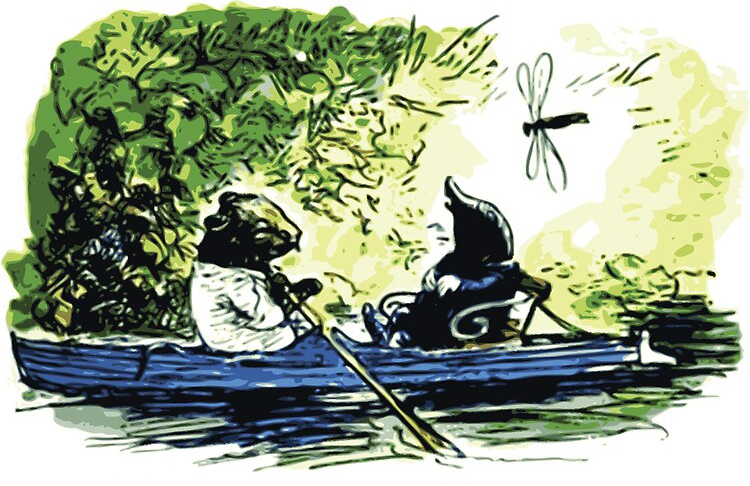
And what do I have to say for myself? I didn’t produce great gems—and that’s precisely the point. I had fun. “Believe me my young friend, there is nothing – absolutely nothing – half so much worth doing as simply messing about in boats.” So says Ratty to Mole in Kenneth Grahame’s classic novel The Wind in the Willows. For this writer, there is nothing more fun that simply messing about with words.

Don’t forget to have fun with your writing!

© 2024 Sarah White

Posted in writing workshop | 1 Comment