Puerto Andraitx, Our New Home

By Suzy Beal

This is the fifth episode of a memoir that is unfolding, one chapter each month, here on True Stories Well Told. Stay tuned for more of the adventure as teenage Suzy’s family moves to Europe, builds a sailboat, and takes up life on the high seas circa 1961. Click here to read the earlier episodes.


Not another boat ride!  We took the night boat to Palma, Mallorca the next evening.  Upon boarding, we discovered Mom, with the little ones, had a cabin, but the rest of us had to sleep in hard wooden chairs on deck.  We accepted being uncomfortable for a few hours because to object to anything Dad said was useless.  We learned later Dad hadn’t realized he needed to make reservations for cabins, so was lucky to get a cabin for Mom, Conrad, and Frank.

After a long uncomfortable night, morning brought us to our new home.  As dawn approached, Dad pointed out the island of Mallorca just coming into view. I looked on the horizon.  The sun was shining on the island.  The buildings shown white in the morning sunlight just like the buildings we’d seen in Casablanca.  A castle came into view on the hill above the city of Palma and a huge cathedral on a smaller hill in the city.  When we tied up at the dock, I searched for something familiar.  I spotted my brother Tommy with “La Cucaracha” and a sense of relief came over me.  The van, a part of the family now, meant security and home, in its own familiar way.
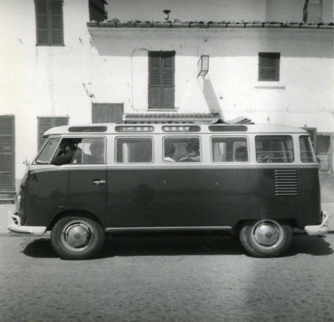
We headed for the town of Puerto De Andraitx where a villa waited for us.  On the narrow, busy corners drivers honked at each other.  La Cucarachafilled the entire road.  When the van slowed on the corners, we opened the top.  The warm air rushed in, I closed my eyes and listened to the crickets.   The blue sky against the pine trees was a shade of a blue I’d never seen in Oregon, here a limitless sky with no clouds. Things didn’t seem real.  The houses made of stone and tile had terraces and archways.  Windmills dotted the landscape.   I remembered from the National Geographic the farmers used them for irrigation.

We approached Puerto de Andraitx after passing through Andraitx.  Dad explained that “Puerto de”meant the “Port of” and we headed for the port.  As we passed through town, I noticed that the older women wore black.  I learned later they wore black because they’d lost a loved one and dressed in mourning and since the older women always had someone in their families dying, they wore black most of the time.

My senses heightened by the vivid contrasts of light and dark, bright and dim, warm sun, and cool sea breezes, I’d never imagined these bright, distinct images.  Dad drove us to our villa on the opposite side of the bay from the town and we saw that the harbor lay between hills on either side of the bay.  He’d arranged on his prior trip to have an English woman named Pat rent a villa for us and arrange for a cook and maid.  Pat rented, in addition, a room in a neighboring villa for Tom and Hank because our house didn’t have enough rooms for everyone.

“You boys will eat your meals here with the whole family, because the kitchen and the other rooms in your house are off limits to you. Do you understand?”

“Yes, Mom.”   Excited to be living independent from the rest of the family, they agreed immediately.

Notes to Harbor Light

(The editor of our high school newspaper had asked me to write to him about our travel experiences.)

 I’m so glad to be on solid ground after the boat trips.  It makes me wonder what life aboard a sailboat might be like and if I will be seasick.

 The house we are living in has a name “Villa Coleta.  It sounds so European.  It’s made entirely of rock and the interior walls are stucco and whitewashed.  Two stairways made of rock lead up to the main floors.  The terrace that runs the entire length of the house faces the harbor and the village of Puerto Andraitx.  We are walking distance from the harbor and quay where we can swim in the warm, blue Mediterranean.
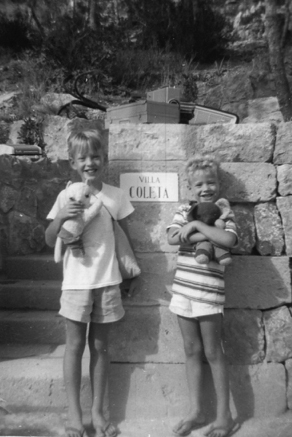
Conrad and Frank with their stuffed animals – photo by Jan Chamberlin

 I can’t understand anyone yet and don’t know how long it will take to speak Spanish.  I will keep you updated with my progress.


On our first day, we discovered we didn’t have a washing machine or dryer, but we had a cook and washerwoman.  Carmen, the cook was a young woman in her early 20s.  Manuella, a small lady, sixty years old, dressed in black who walked six miles each day to our house was to be our washerwoman.  I wanted Dad to offer to pick her up and bring her to our house in the mornings because I remembered six miles was the same distance from our home on the river to Newport.  She had to walk this distance twice each day after doing laundry for nine people.

When Pat explained to Mom how the maid’s salaries worked, Mom didn’t think it was fair that Carmen, the cook, made more money than Manuela, who did the laundry for nine people. So, Mom decided (without telling Pat) to raise the pay for Manuellato match that of Carmen.

Carmen arrived each day on the back of her boyfriend’s Vespa. She sat with both legs on the same side as if she were riding a horse sidesaddle.  I watched the romantic scene each time they drove up in the mornings. They visited, teased and kissed goodbye. They went through the same ceremony when Carmen finished her work.  Although the thought of having my own Vespa thrilled me, I missed and yearned to be with my friends back in Oregon.  I wanted to be having a romantic moment, too.  Even though I was mad at John for being with Sandy, I still missed him.

One morning, we heard screeching and yelling coming from the kitchen.  We rushed in and found Carmen and Manuella fighting and hitting each other.  Mom stepped in and separated them and sent me to bring Pat to help us.  She wasn’t home, but I convinced her little girl to come translate for us.  Her daughter was only five, but could speak Spanish and English.  She told us that Carmen was mad because Manuella had bragged to her that Mom had given her a raise and now Manuella made as much money as Carmen.  To solve the dilemma, Mom gave Carmen a raise; not knowing if she’d done the right thing.  Dad offered to drive Manuella sometimes to help compensate.

One day Dad took me out of town into the countryside with his camera and spent the afternoon trying to teach me how to use it.  Tired of my lack of enthusiasm and my long face, Dad tried to engage me in learning something new, but I wanted no distraction. I was in mourning for my friends back home.  I wasn’t ready to forgive my parents for bringing me to this place, so I showed little interest in learning how to take pictures.

. . .

“Why are you crying?”  my sister asks.

“Because I can’t find any tunes on the radio I can understand, these songs are in a foreign language. I wish I could hear the top -10 songs from the States again.”

 Everything is so different here in Spain. Our parents impose the Spanish custom of the afternoon “Siesta.”  They send us to our rooms for the afternoon “rest.”  I share a bedroom with, Jan.  She doesn’t understand my need for hearing songs that connect me to my life in Newport. I hate these new customs they expect us to accept without arguing. Villa Coleta is where we live now.  It irritates me that our house has a name.   I want nothing to be personal, here.  I’m fifteen and I’ve left everything personal and important behind, without knowing if I will ever return.


© 2018 Suzy Beal

Suzy Beal, an occasional contributor to True Stories Well Told, has been writing her life story and personal essays for years. In 2016 Suzy began studying with Sheila Bender at writingitreal.com.  Watch for new chapters of her travel memoir to be posted! Please leave comments for Suzy on this post.

Posted in Guest writer | Tagged , | 2 Comments

A Test of Mettle

By Robert E. Martin


The Texas plant hired several young men at the beginning of the summer. After that first week, they fired all of them and kept me. The lesson I learned from this experience was: It always pays to exceed expectations when working for a new employer—it is the quickest way to job security. Indeed, it is a good idea to make a habit of exceeding expectations. There is a downside, however. This practice will not endear you to your coworkers and you will experience some pushback from them.

A classic problem in the labor market is sorting workers for qualifications and capabilities. This is a problem all companies have, for an application and interview does not always show how the new worker will perform. You don’t want to retain unsatisfactory employees. The steel plant used a clever method to screen labor, immediately giving new employees difficult jobs and observing performance. I saw different varieties of this technique in my career, and learned more about it through readings in economics. I passed the test of mettle.

Bob Martin, college man

The next week, they moved me around to several different stations in the plant process where I worked under journeyman supervisors. After that, I worked with the foreman. He took me under his wing and taught me various jobs. Then, he assigned me to driving a forklift. I spent the rest of the summer on the forklift. I enjoyed working at this plant. Hard work never bothered me. What I would run afoul of was the union shop.

It was a union plant. Being just a summer worker, there was no attempt to recruit me. I did not know the union culture. One day, I heard a lunch conversation about a union meeting to take place the following night. Working with the foreman that afternoon, I mentioned the meeting and asked what it was about. I assumed the foreman was in the union, but he was not. The union was organizing a strike. I had no idea! The foreman immediately went to speak to the union stewards. Naïve, young Bob had stepped into it—now I was a snitch and there was no way to explain what had happened. My life became a living hell.

The union steward especially despised me, razzing me about being a “college boy” in front of others and isolating me. Then it became more than a psychological war, it got dangerous. One of my co-workers was a big fellow but known to be a slacker, shirking his share of the work. He and I were assigned to use a crane to unload coils of steel rod from a freight car. I worked in the car, placing the hook from the crane into these steel coils that weighed a couple of thousand pounds and were about five feet in diameter. The other fellow ran the crane, lowering the hook for me to attach, which would then lift the roll and move it out onto the floor for the fork lift to deliver. But the hook would come crashing down into that car. The job of hooking up these coils was not random; they could come rolling on top of you if not removed in order.

On another occasion I was running the fork lift, which could carry two of the coils of rod back to the bull block loading area where they were kept. It should have been a smooth operation, but the crane operator did his best to make it more difficult since he dumped the coils on the ground. I didn’t comment, just did my best.

The foreman came into view and saw what was happening. He got Pissed Off!He chewed the guy out, and I learned that my coworker should “…know this works best by lowering those coils right onto the fork lift!” The crane operator said that I took too long to get the coils hooked up, and he was wasting time waiting for me. He tried to make me look bad. But I learned that normally it was a three-person job.

There was another incident at the rail head. I was in the car, working, which meant a lot of bending over. The safety procedure was to holler, “Ready to pull that!” when you were standing up, ready to observe and catch the big steel hook as it descended from overhead, swinging, guided by another worker. But several times as I stood up the hook was swinging into the car, and I could have been severely hurt. It was a deliberate attempt by the man to put me in jeopardy. I realized I was in danger and stood up and leaned over the edge of the car. There was a worker bragging to the crane operator about what he had done to me! I just looked at him. The men stopped laughing and then they became uncomfortable. I had no more trouble from that kid.

The summer was a living hell, not from the hard work, which I enjoyed, but because my co-workers would put me in harm’s way if they could. I had learned that in addition to the job itself, it was important to learn the workplace culture as fast as possible.

When I left at the end of the summer, the plant manager made a point of telling me I could work for them “anytime you want to!” I thanked him and said I was off to graduate school.


© Robert E. Marin, PhD 2018, all rights reserved. Used by permission.

Robert E. Martin, PhD, is the author of several books about economics, including The College Cost Disease: Higher Cost and Lower Quality. The story “Test of Mettle” is excerpted from his forthcoming memoir, My American Life: Minimizing Regrets, privately published by Perfect Memoirs. Bob is Emeritus Boles Professor of Economics, Centre College, Danville, Kentucky.


Posted in Guest writer | Leave a comment

Flash Memoir: Obey the pull of “concrete” or “object” writing

Last month I began a series of “writing workshop” posts here on Flash Memoir. Today that series continues with a look at “concrete” or “object” writing.

Most of the stories presented as examples of Flash Memoir in that post were based on an image. That’s a particular style of writing. Some people term it “concrete writing.” Others call it “object writing.” (Neither label is more correct than the other.)

The idea is that this style of writing is about concrete, specific, observable, things, as opposed to abstractions and concepts. Object or Concrete writing avoids subjects that are more “think-y”—more in the brain, less in the heart and gut.

When I teach this, I invoke the “Ladder of Abstraction,” explained in this 2015 post on True Stories Well Told. In a nutshell, stay down that ladder at the level of specifics, not high on the rungs of abstraction. If you’re reminiscing about a sweet potato pie, don’t say “I loved Momma’s desserts.” Name it. Claim it. Expound on it in specific detail.  “I loved Momma’s sticky, sweet, orange-fleshed, rimmed-with-caramelized-juice SWEET POTATO PIE.”

Here are two examples of Object Writing in Flash Memoir essays: Notice how your mind’s eye can see specific, tangible objects that keep you oriented to what is happening in these stories.

In writing, the concrete will always have more power than the abstract. Our brains are wired to hear words in our head as we read; with those words come images. “Desserts” leaves you with an imaginary buffet but can you zoom in  to see which tasty treat I loved most? No. SWEET POTATO PIE puts an image in focus. You can zoom in and see that the blisters of yam juice bubbling on its dark orange surface. From there you can begin to engage your senses–smell, taste, texture. When you obey the pull of concrete writing, you get your ideas across to your reader most powerfully.


Got thoughts on object writing? Post to the comments section! And stay tuned for Part 3 of this four-part series on Flash Memoir.

© Sarah White 2018

Posted in writing workshop | Tagged | Leave a comment

Aboard Ship, continued

By Suzy Beal

This is the fourth episode of a memoir that is unfolding, one chapter each month, here on True Stories Well Told. Stay tuned for more of the adventure as teenage Suzy’s family moves to Europe, builds a sailboat, and takes up life on the high seas circa 1961. Click here to read the earlier episodes.


Our first landfall was in North Africa: Casablanca, Morocco.  We descended here to take a tour of the city with an African we’d met onboard ship. The white buildings with ornate shapes and tile decor stood out in stark contrast to anything we’d ever seen.  We learned that “Casablanca” meant “white house.” I’d never see the skin color of these people, not white or black, but a dark brown, as if they’d been sunbathing every day.  Their clothing was of dark colors, too.  The women wore veils that covered their faces, except the eyes. Small children flocked to us begging for coins, their faces scarred from disease.  Their language sounded confusing and frantic, but the tone reminded me of fast music.  Dirt, filth, and pungent odors permeated everything.  I thought of the missionary family and wondered if their town had this squalor.  It appeared impossible that rising out of this grime stood the most gorgeous buildings I’d ever seen.  The ornate mosques reminded me of “Scheherazade and the 1001 Nights,” a story my fifth grade teacher had read to us.  Monkeys on leashes dancing to organ grinders sashayed up to us for coins.  We even saw a monkey smoking a cigarette.


Photos by Jan Chamberlin  (my eleven-year-old sister) with her new Brownie Camera


We re-boarded the ship and sailed on to Gibraltar where it slowed to a stop and dozens of small boats came out to sell things to the passengers.  Long ropes thrown up and baskets of colorful trinkets, bracelets, and scarfs came on board.  We leaned over the edge of the ship to see these strange boats filled with merchandise.  The Augustus sailed on past Gibraltar into the blue Mediterranean.

Augustus at Gibraltar – photos by Jan Chamberlin

We arrived at our destination of Barcelona, Spain after five days at sea.  Our suitcases in hand, we headed down the gangplank to foreign soil, a foreign language, and foreign customs officers.  Our trunks sat on the docks.  They’d been brought up from the depths of the ship. The customs officer told us to open our suitcases and the trunks.  Worrying they might arrest him; Dad tried to explain that he’d packed a revolver in one trunk, but couldn’t remember which one.  He’d brought it as a security measure to have on our sailboat. He’d heard stories of pirates commandeering private boats or just trying to steal from them, so the revolver was for our protection.   Dad pointed to the Guardia’s pistol and then to the trunks.  At that point, the Guardia dumped our trunks onto the docks and the customs officers rummaged through them until they found the pistol and confiscated it.   I stared at the police in fear.  The Guardiawore triangular-shaped, hard plastic hats that made them appear sinister. They wore guns and screamed at my Dad.   Angry and embarrassed, Mom cried watching our belongings being scattered on the docks. Once they found the pistol, they left us to repack everything.  The Augustus, our home for the past five days, lay empty beside the dock.  Everyone else had disembarked and gone on with their lives while we faced an uncertain future.

Dad located two taxis, and he explained we needed a hotel for the night.  He went in one cab with several of us and Mom in another with the others.  Our cabs circled around the strange city until we stopped at a small hotel where we got rooms.  Upon investigation of the bathroom, I discovered the pull chain flush toilets and “bidets.”   I decided they must be for washing feet. The room I shared with my sister had two beds and flimsy bed covers.  The room was sparse with only a large cabinet against one wall.   I’d never seen an armoire before and at first didn’t understand what it was for, but upon further inspection found hangers in it. We put our coats in it.  Mom told us not to bother with unpacking because we would be on the night boat to Mallorca the next evening.  The elevator was old and rickety, so I used the stairs.

After getting settled we headed out for a walk on the Ramblas, the main avenue of the city.  The sights and sounds excited me.   We discovered that just crossing the street was dangerous. Motorbikes, Vespas, and bicycles dodged the car traffic without adhering to the traffic laws.   The diesel odor of the cars and buses permeated the air.  People shouted at us.  The looks and gestures soon became too much for Mom and she sought a bench. An old man came up to her waving his hands and making wild gestures.  Mom tried to just ignore him.  She had Frank and Conrad sitting beside her when he motioned to the boys she tried to understand.  “What is he saying?  Why is he yelling at us?”  Mom’s face turned red with anger and frustration.  We couldn’t help her.  She motioned to us to follow her, and we headed back to the hotel.  We found out later that it cost money to sit on the benches. Our first meeting with a Spaniard hadn’t gone well.

Later in the evening we descended from the upper floor to the dining room for dinner. We sat at a long table put together just to accommodate us.  The menus in Spanish left us wondering how to order.  “We want hamburgers and French fries.” called out Frank and Conrad. When told they weren’t available they both cried.  Dad chose everything for us.  They served a salad first, but none of us trusted what we might find in it.  The main course was chicken with mushrooms and fried potatoes.  I’d never eaten mushrooms before, so I picked at the chicken, but ate the potatoes with relish.   Dad ordered ice cream for dessert.  Even though it tasted different, at least it was familiar. With our first day in Spain over, my sister and I rushed into our pajamas and fell asleep as soon as our heads hit the bed.  My last thoughts were of this strange country that didn’t have any traffic laws, but had little baths for our feet.

© 2018 Suzy Beal

Suzy Beal, an occasional contributor to True Stories Well Told, has been writing her life story and personal essays for years. In 2016 Suzy began studying with Sheila Bender at writingitreal.com.  Watch for new chapters of her travel memoir to be posted! Please leave comments for Suzy on this post.

Posted in Guest writer | 3 Comments

It’s Thanksgiving: Listen Up!

Tomorrow is StoryCorps’ #TheGreatListen. Here’s what they have to say about it:

The Great Thanksgiving Listen is a national movement that empowers young people—and people of all ages—to create an oral history of the contemporary United States by recording an interview with an elder using the free StoryCorps App. Interviews become part of the StoryCorps Archive at the American Folklife Center at the Library of Congress. Since 2015, The Great Thanksgiving Listen has grown from an experimental challenge issued by our founder, Dave Isay, into a vital intergenerational movement.

Consider conducting an interview and recording it for StoryCorps, using their free app. Or just start a conversation using the prompts on their downloadable, printable placemat!

If you’d rather just bask in memories of Thanksgivings gone by, read this post by Linda Lenzke on The Orphan Holidays, posted here Thanksgiving 2012. Linda blogs at Mixed Metaphors, Oh My!

Eat, drink, be merry–and pass the gratitude along with the dinner rolls!

–Sarah White


Posted in Call for action | Leave a comment

Flash Memoir: my definition

In my work as a personal historian, I often coach people on how to write, via workshops  and 1:1 coaching. This keeps me interested in new techniques and ways to approach writing. In the past few years I’ve become aware of the “Flash Fiction” movement, and I’ve wondered, don’t those techniques work as well for creative nonfiction—i.e. the memoir genre? I often bring fiction writing techniques into my workshops. Bringing “flash” techniques into writing memoir just made sense to me.

Over the next few months, I’ll publish four mini-lessons from the curriculum I’ve developed around Flash Memoir. In this first post, we explore what characterizes this genre, in my humble opinion.

Flash Memoir essays tend to be:

  • Free of preambles—They start at the flashpoint—the moment when conflict ignites tangible action that drives the story forward.
  • Scene-based—They frequently take place in one run of time, without jumping around.
  • Observant—They tend to feature not the “I” but the “eye.”
  • Insightful—Like a flashlight illuminating a dark corner, they explore something that provoked an insight.
  • Specific—They stick with concrete, observable events and actions rather than abstract concepts.
  • True—As a subgenre of creative nonfiction, Flash Memoir must uphold the nonfiction contract that what is reported actually happened.

Now, let’s play a game. Which of the following is NOT a Flash Memoir essay? Here are four examples: The links will take you to essays published on this blog.

Post your answer to the comments section! And stay tuned for Part 2 of this four-part series on Flash Memoir.

© Sarah White 2018

Posted in writing workshop | Tagged | 3 Comments

Genetic Engineering is Child’s Play

By Faith Ellestad


To my beloved sons,

I was thinking back to my childhood, and thinking forward to my children, when it came to me.  Guys, its not my fault.  It’s the fault of summer in the ’50s. Let me explain.

The modest neighborhood of my early childhood was newish, and the street, when we first moved there was partially occupied by new construction in a pattern reminiscent of a jack-o-lantern’s smile, missing every third or fourth tooth. The smile rapidly filled in, each new house bringing more kids to play with.  We all had friends our own age, but sometimes, in the summer evenings, age lost its importance and we all played together, games like king of the hill, tag, red light green light, hide and seek in the scary forest (one double lot) or sneak to the creek, which was probably specific to our neighborhood, and extra exciting because it was totally forbidden.

Porches were for the adults to gather on, smoke a pipe or cigarette and discuss parent concerns while they kept an ear open for the occasional fight or hysterical screech that usually indicated blood was involved.  As a rule, the injured child was ushered home by a cadre of concerned friends, all proclaiming their innocence.  While the escorts milled about anxiously, the victim would be blotted off, sprayed with Bactine, bandaged and sent back outdoors, the hero of the evening.

It was during these summer nights we taught each other valuable child survival skills such as, if you hold your eyes really wide open, and make your mouth very round when you say, “It wasn’t me”, you look much more believable. No one will ever blame you for accidentally letting the dog out if you look like that, either. And, if you punch a hole in two paper cups and connect them with a long string, you might possibly create a primitive telephone, handy for talking to your friend next door. (I never personally had much luck with this method of communication, but some of my friends swore by it.)  Also, if you jump off the slide holding an umbrella, the umbrella does not work like a parachute. You will probably end up with a sprained ankle and be unable to participate in certain activities. Just ask your uncle. This may have been why he became a lawyer and not an aeronautical engineer.

In any case, daylight savings time was a miracle to us.  We stayed out playing until we could barely see each other through the falling darkness, and moms started calling us home. Woe betide the naughty child who was sent to bed early as a punishment.  It was torture sitting in your room listening to all the other kids shouting and laughing while perfectly good daylight mocked you through the open window. It was rare for a child to endure that punishment more than once a summer. No one wanted to miss playing out after supper.

Of course there were rainy nights when you couldn’t play outside. Those were the nights you might entertain yourself counting fireflies through the screen, or watching TV if your family happened to have one.  But rainy nights were ok because they brought mosquitoes, and mosquitoes led to the most magical nights of all: the arrival of the DDT truck.

Oh, how we loved that DDT truck. It only came around once or twice a summer and you could hear it grind and hiss for blocks.  As it inched ever closer, the excitement was palpable.  Doors swung open and entire families flooded out on to their lawns.  Parents pulled out folding chairs and children danced around in anticipation.  The moment the truck lumbered onto our street, kids raced out to be first in line behind it.

Back then no one knew much about DDT other than it had miraculous mosquito-killing properties, so we were allowed unfettered access to the clouds of toxic chemicals that sprayed out in a wide arc from a big nozzle at the back of the truck.  We were inexorably lured by this giant, poison-belching mechanical Pied Piper, with its unmistakable chemical-sweet smell, starting our magical journey at one end of the block, and keeping up with the possibly gene-altering cloud all the way to the other. The game was to make ourselves invisible in the thick vapor. A horde of little illusionists, disappearing and re-appearing at will, and not a mosquito in sight!   Consequences? No way.

By the late 50’s, the trucks no longer came, and a few years later, reports of DDT dangers began to surface in the news. I have always worried about this, and recently after a health scare, with some chagrin I asked my very young, earnest doctor whether all those trips behind the DDT truck could have had adverse consequences.  She thought I was kidding, and as I told my tale, I knew she must have been thinking, “Who would be that dumb?” But she did consider my story with admirable gravity, reassured me, and even made a note in my medical record.

So far, so good for my overexposed siblings and me, and I can only hope you kids were unaffected by the folly of those happy summer evenings so long ago, because I will need you to take care of me some day.  So I apologize now for all your future troubles, just in case.

Love,

Mom


© 2018 Faith Ellestad

Faith describes herself as a serial under-achiever, now retired after many years as a hospital scheduling specialist.  When her plan to cultivate a gardening hobby resulted only in hives, she decided to get real and explore her long-time interest in creative writing. She’s so happy she did. Faith and her husband live in Madison, WI with Ivy, their beloved old Belgian Tervuren. They have two grown sons, (also beloved), and a wonderful daughter-in-law.

Posted in Guest writer | Leave a comment

Aboard Ship, Part 1

By Suzy Beal

This is the third episode of a memoir that is unfolding, one chapter each month, here on True Stories Well Told. Stay tuned for more of the adventure as teenage Suzy’s family moves to Europe, builds a sailboat, and takes up life on the high seas. Click here to read the earlier episodes.

The Augustus

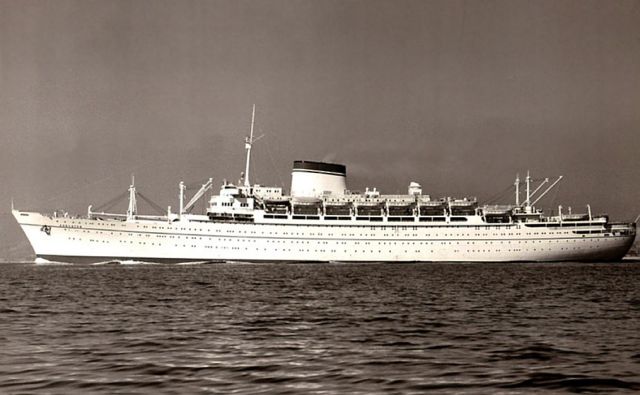
We boarded our ship the next day.  Once aboard the Italian Line “Augustus,” a trans-Atlantic liner, we found our cabins below decks in the depths of the ship.

Notes to Harbor Light

(The editor of our high school newspaper had asked me to write to him about our travel experiences.)

As we sailed out of the New York Harbor passing the Statue of Liberty, I wanted to wave at her, but I didn’t want to appear foolish. When our ship sailed past her, she looked smaller than I imagined her to be.  I remembered stories and pictures I’d seen of the immigrants coming to this country and seeing her for the first time.  My heart swelled with a sense of pride that my country had been a haven for so many.  I felt as though I was going the wrong direction.

By sheer coincidence I’d chosen to read “Exodus” by Leon Uris during this voyage across the U.S. and the Atlantic Ocean. I spent hours reading and living the life of the Jews leaving their homelands. My voyage didn’t compare, but I understood what it meant to leave home. Everything for me now was about leaving, leaving friends, my horse, our home, our town, our country, and now the Statue of Liberty.  My thoughts are with you all back in Newport.

Our first day and night out, we encountered rough seas and four of us got seasick.

“Mom, is this seasickness? I think I have to throw-up.”

“Yes, honey.  Throw-up if you can, it always makes me feel better.”

“Will I be sick for the whole five days crossing the Atlantic?”

“Probably not, you will get your sea legs and then it isn’t as bad.  Maybe the ocean will calm down, too.”

I was nauseous with the rolling of the ship and seeing Mom sick added to my fear of this huge ocean.  Mom kept Frank and Conrad with her in the cabin.  Jan and I stayed below decks helping to entertain them while Dad and the older boys spent their time on deck.

Carl came rushing in “You guys should come on deck and see the huge waves crashing over the bow, it’s so wild up there.”  He was trying to keep us informed of the happenings on deck, not that we cared.  I couldn’t imagine wanting to watch the ocean and I feared we might just roll over and never come up again.

Suddenly, loud buzzers sounded filling our stateroom with noise.  Mom, Jan and I stared at each other. Dad appeared at the door saying, “It’s just a drill, it’s just a drill, but you need to come on deck.  The ship’s crew need tell us what to do in a real emergency.” Mom moaned, but we drug ourselves on deck to the main lobby.  They showed us how to put on life preservers.  They directed us to where the life boats hung off the side of the ship. My mind swirled with the possibilities. I’d read of the Titanic, but I never thought we faced the possibility of sinking.  I didn’t want to know we were vulnerable.

Once our seasickness subsided, we joined the others at mealtimes.  Since the ship was of Italian registry, most of the waiters and ship’s personnel were Italian.  They assigned us a specific table we shared with other passengers.  We couldn’t make our likes and dislikes known in a foreign language, so we had to accept whatever they served to us.  A salad served for lunch one day proved to be the first of many culture shocks.  “Mom, what are these things with legs?”  I lifted the lettuce leaves and found my plate loaded with these creatures sliding around in the oily dressing.

“I think they are pickled baby squid,” Mom explained.

“What’s a squid?” we asked in unison.

“You don’t have to eat them, just push them off to one side.”

Not eat them! I wasn’t going to eat the lettuce they touched!  My stomach lurched again.  The waiter shook his head at all the baby squid left on our plates.

It was our youngest brother, Frank, who broke the class barrier first.  We learned upon boarding we had tourist class tickets, which entitled us to certain liberties and not others such as First Class luxuries. There were whole decks off limits to us.  This became a challenge for my brothers. One day little Frank went missing.  Mom panicked, although she never said it out loud, we understood what she was thinking.  Dad tried to reassure her.

“Check out the enclosure around the entire ship, he couldn’t have fallen overboard.”  Mom didn’t look convinced.  We spread out over the decks calling his name, but we kept coming to the doors we couldn’t open.  Dad explained our distress to a crew member, and he ushered Dad onto the First Class decks. There Dad discovered Frank swinging on the knee of a gentleman seated at the bar.  At six years of age, blond hair, blue eyes, and a smile that came from his heat, he charmed everyone.  The older gentleman, delighted with Frank, didn’t know to whom he belonged. He didn’t speak much English and Frank didn’t speak Italian, so they only exchange smiles.

Mom became friendly with the wife of a missionary.  They were returning to Africa with their young daughters.  She told us stories of living in Africa that worried me.   Would we have to use out-houses? Would there be doctors to cure our illnesses?  The missionaries told us bananas were the only safe fruit to eat without becoming sick as other fruits needed washing, but the water carried dysentery.  “What is dysentery, Mom?”  Mom frowned and her eyes squinted as she listened to these stories. I tried to remember Dad and Tom’s visit to Mallorca a few months earlier to pick out a place for us to live.  They didn’t talk of these hardships.  Their pictures and reports showed civilized towns.  Our only other source had been that National Geographic magazine article on Mallorca.  I kept remembering those pictures while the missionaries talked of the awful conditions in Africa.  I wondered why they returned year after year with their little girls if it wasn’t safe.

© 2018 Suzy Beal

Suzy Beal, an occasional contributor to True Stories Well Told, has been writing her life story and personal essays for years. In 2016 Suzy began studying with Sheila Bender at writingitreal.com.  Watch for new chapters of her travel memoir to be posted on the last Wednesday of each month! Please leave comments for Suzy on this post.


Posted in Guest writer | 1 Comment

The End

This short essay is an experiment in “The Rolling Now,” a structural technique I’m learning to use, taught by my mentor Ken McGoogan at the U-Kings MFA residency in August 2018. We were asked to shape an in-class free-write with three “now” moments and two flashbacks. “Like rocking back and forth, between past and present,” Ken said. Imagine a “W” with the present at the top and the past at the bottom points. The success of this technique depends on choosing the right moment for the “now”–a moment that represents a turning point, about which you have enough detail to write a vivid scene. 

“The End”

By Sarah White

It was late May 1991. I took a seat–near, finally not at–the head table in the banquet hall outside Campobasso, Italy. The Governator’s Cena was the capstone of the Rotary District Conference that was itself the capstone of our five-week tour as “Outstanding Young Professionals” in a Rotary International Group Study Exchange.

To my left sat my husband Jim, just arrived to join me. To my right sat Ron, bane of my existence for most of the last five weeks. Rockstar-handsome with his mane of golden hair, he was flirting with me outrageously. If only the past five weeks had been like that! I’d have had a lot more fun.


At first, he did flirt with me. Or was it flirting? He seemed so sincere that night at the end of the first week, when our team had just come together again at a hotel in Spoleto after being separated to lodge in various Rotarians’ homes in Terni and Todi.

After that night’s banquet concluded, Ron invited me to walk up to the aqueduct we’d toured as a group that morning. The moon was full. After I stumbled on a cobblestone, he held my elbow solicitously.

“I feel like we understand each other—more than the others,” I had said.

“Let me say this—I’m not out here with them. I asked you.”

After he whipped out his cock to pee off the aqueduct, piss arcing and glinting in the moonlight, what moved between us felt like intimacy.


Now, at the Governor’s Cena, it felt like that intimacy was back as he reached out to touch my hand, touch my hair–my husband just a seat away. It felt delicious, after the way he’d ignored me since that night on the bridge.

I’d been sucker-punched by his rejection. It wasn’t even an active verb, that rejection—he just steadfastly directed his attention away from me.

That day at the art museum in Urbino, a week or so after the Spoleto incident, I tested it as we followed a guide through the museum. Every time I moved near Ron, he edged away. I moved closer again. He moved away again.

Annoyed, I gave up thinking about him then. Even so, he managed to sabotage the next weeks—flirting with every translator, abducting her, leaving us with the old Rotarians while he rode in her daddy’s Lamborgini up the coast, or whatever.


Now I turned toward Jim on my left, giving him my attentive smiles, making in-jokes that cut out Ron to my right. Take that, you asshole, I thought. You’re all getting up at 3 a.m. to drive to the airport.

I’m taking my husband in our rented car to the Adriatic coast, where I know the best hotel, the best gelato, the best fish restaurant—all thanks to these Rotarians.

Take that, you damn rockstar asshole hunk.

(c) 2018 Sarah White

p.s. I know you want to see a photo of the rockstar hunk but I’m not including one because  I purposely took none that included him after Urbino, and don’t feel inclined to seek his permission to post his image if I had one. Here’s a link to a photo of the rest of our team.


Posted in Sarah's memoir | 1 Comment

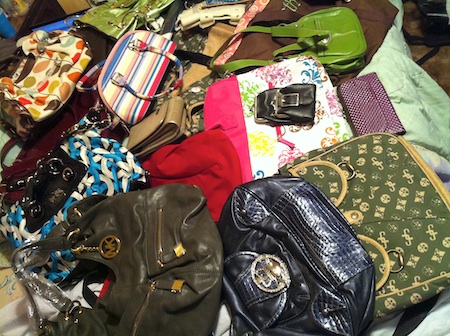
What meaning does a purse carry?

Writing prompt:

I started a 4-week “Flash Memoir Write-In” workshop in Madison recently. One woman wrote about her dad’s anger when she wouldn’t start carrying a purse. (Every woman knows that’s the cusp of womanhood, like that other thing).

I thought–what a great writing prompt!

On the topic, of purses, blogger Lisa Monica wrote:

A woman’s pocketbook is  synonymous with a child’s security blanket, they see it as a constant, it is a familiar item that has become part of their existence and when they hold onto that strap or feel it over their arm they are complete and can face one more day…

Let’s give it a shot–when did YOU start carrying a purse, why, and how did your self-identity change? Men, you’re welcome to play along–tell us about your sporrans, your man-bags, your fanny-packs! Let’s hear YOUR purse stories!

Posted in Writing prompt | 2 Comments